
Issue Brief by Senior Policy Analyst, Matt McCabe
DOWNLOADIntroduction
Governments at all levels face complex challenges to meet the demand for new and increased power generation. With the rapid growth and development of artificial intelligence (AI), state governments are grappling with how to procure, supply, and distribute the resources necessary for data center construction and operation.1 An emerging question is how and where to acquire land and property vital for building out the infrastructure of the future.2 Of the tools at their disposal, eminent domain has emerged at the front of the conversation.3,4
Eminent domain (also known as compulsory taking or expropriation) is the legal power through which a government can acquire all or a portion of privately owned property, so long as the property owner receives just compensation and the taking satisfies current public use standards. Though the concept of eminent domain can be traced back to the colonial era, its use throughout American history has evolved, as have the justifications for its authorization. As the nation grew, governments began to use eminent domain to delegate condemnation authority to qualifying entities under applicable law, including private entities. Governments have used it to build public roads and waterways, raze blighted buildings to create space for economic development projects, and, critically, provide land for energy and utility companies to meet public and industrial demand for power and resources.
However, the use of eminent domain today is as debated as it was when incorporated into the Constitution, with the passage of the Fifth Amendment that constrained an existing sovereign power through its Takings Clause. Recent high-profile examples of eminent domain resistance include several interstate oil and gas pipelines, such as the Dakota Access and Mountain Valley pipelines, respectively.5,6,7,8,9 Nevertheless, there are thousands of data center, pipeline, and transmission line projects already underway or soon to be underway, and with them comes mounting public scrutiny from citizens, legislators, and regulators alike.10,11,12,13,14,15,16 With the rapid rise and spread of hyperscale data centers and the need for energy modernization, communities across the country are revisiting eminent domain for these massive projects. This publication will explore the history of eminent domain and its use in energy infrastructure projects, as well as an overview of the current legal and regulatory landscape.
History
Throughout U.S. history, governments have used eminent domain to acquire private property for public use. As the country expanded from the 13 colonies to the West, so too did the various economic and logistical needs of the growing nation. Originally used primarily for building roads in developing territory and for generating hydropower for mills, eminent domain and the public use doctrine were relatively uncontroversial until the middle of the 19th century. According to Errol E. Meidinger in 1980, with the advent of new technologies, industry, and economic organization, the spirit of the public use doctrine had “been replaced by a distinct aura of economic favoritism“.17
The first records of eminent domain use in the U.S. date back to the 17th century. While a vague notion of what public use meant existed, there remained disagreement about what constituted the justifiable and legal purposes for which eminent domain might be used, and critically, the narrow versus broad public benefit test. Even by 1776, only two state constitutions included the words “public use“.18 Ratified in 1791, The U.S. Constitution’s Fifth Amendment prohibits the taking of private property for public use without just compensation.19
The definitional and practical scope of public use would evolve during the next two centuries as industry, technology, and the country’s growth rapidly accelerated. From governments taking land for roads in rural areas or mills for local commerce, eminent domain would eventually include public service corporations, such as railroads and power companies, and even private enterprises, provided they meet certain public-use criteria.20 Throughout this history, the definition and interpretations of public use were shaped through court cases at all levels, especially as eminent domain authority was increasingly delegated to private enterprises. The prevailing sentiment and legal doctrine would come to clearly favor the broad public benefit argument, granting a wider range of eminent domain power for a broader range of uses. With the development and expansion of the railroads, states were increasingly incentivized to delegate eminent domain powers to semi-public and private enterprises to build the infrastructure needed to connect the centers of finance and industry with the country’s emerging markets in the new Western states.
With the emergence of electrification, energy producers went from local providers to full-scale intrastate public utilities. Much like the railroads before them, these utilities grew into regional and nationwide enterprises with sprawling distribution networks, raising the public-use question yet again, as users were often not citizens of the state authorizing the taking. Eminent domain became an essential tool for large-scale, regional projects.21 The scale of some of these projects became so large that they required congressional authorization. In United States ex rel. TVA v. Welch (1946), the Supreme Court upheld Tennessee Valley Authority’s acquisition of property as part of its congressionally authorized project.22,23
As a result, landowners throughout much of the 20th century found it difficult to challenge eminent domain orders taking their property. The Supreme Court addressed the constitutional meaning of public use in several decisions before revisiting economic-development takings in Kelo v. City of New London (2005).24 The case involved the City of New London, Connecticut’s plans for an economic development project to revitalize its waterfront and generate new revenue, including the construction of a new research facility for the pharmaceutical company as a key component of the plan. Some local property owners rejected the city’s offer to purchase their land, and the city exercised eminent domain to acquire those properties, ultimately leading to the landmark Supreme Court case. Ultimately, the court decided that the City’s use of eminent domain met the public use requirement of the Fifth Amendment’s Takings Clause.25
he decision proved widely controversial, provoking critical reactions across the country. “Quoted in a 2019 journal article by Coleman and Klass, legal scholar Ilya Somin states that the “Kelo backlash led to more new state legislation than that generated by any other Supreme Court decision in history.”26 In response to public outrage about the court’s decision, 45 states enacted reforms directly addressing Kelo. State legislatures restricted the ability of state and local governments to use eminent domain for economic redevelopment, while state supreme courts interpreted public-use provisions in state constitutions to rein in such takings, and state voters put the issue directly on the ballot.27,28 However, many of the Kelo-related state reforms focused exclusively on government-initiated takings and did not restrict to address, or in some cases explicitly left in place, the power of private parties to exercise eminent domain to build pipelines, transmission lines, and other industrial activities in state statutes and constitutions, insofar as they met public use criteria.29
Eminent Domain & Energy Infrastructure
Historically, energy infrastructure often satisfied broadly interpreted public-use standards, although individual projects have generated property-rights disputes. Not long after the Kelo decision, the fracking industry turned the United States from the world’s biggest oil importer to the world’s biggest producer. The boom in oil and gas production required the construction of thousands of miles of new pipelines that inevitably traversed private property, leading to a new wave of resistance to eminent domain.30,31
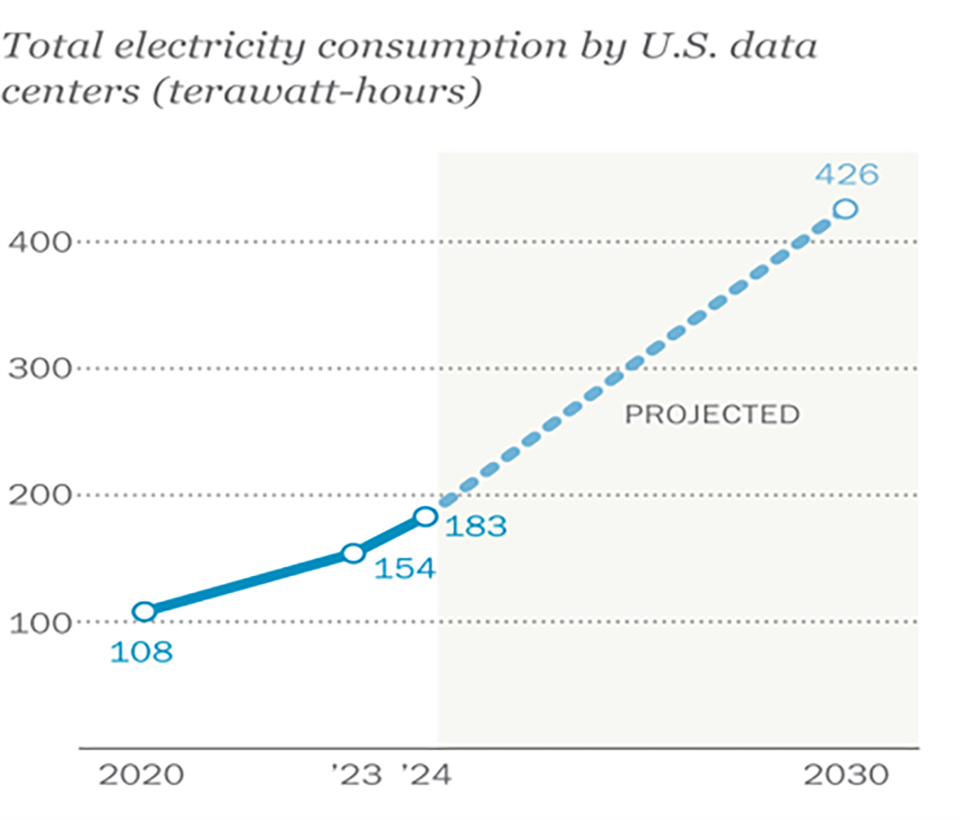
As electricity demand grows across the country, the U.S. electric grid remains due for much-needed upgrades and modernization to meet demand for new technologies, especially AI hyperscale data centers, and to reduce strain on the grid.32,33,34,35 The rapid expansion of data centers is forcing grid operators and state regulators to plan for new contingencies, like unannounced disconnections by data centers, while balancing the country’s electricity supply and demand.36 In the past decade, data center power use has tripled and could triple again by 2028.37
FIGURE 1. Electricity consumption by U.S. data centers (terawatt-hours)
Source: Pew Research Center38
States, power producers, utilities, and technology companies may seek additional land for hyperscale data center sites and the infrastructure needed to serve them. However, a technology company or data center developer does not automatically have the authority to condemn property to acquire a data center site. For utility easements, transmission corridors, pipelines, and generation facilities, the use of eminent domain depends on approval from the appropriate federal, state, or local entity granted condemnation authority, subject to the appropriate permitting process and approvals.
Proposed takings have generated resistance and renewed debate about public use and just compensation. These disputes form part of a broader debate about where and how to build data centers, alongside construction, permitting, and interconnection pauses, which do not themselves address the potential use of eminent domain for such projects in the future.39,40
Data Centers
Data centers support a wide range of digital services for modern-day life. They are large buildings or warehouses hosting computer servers, data storage systems, and networking equipment that enable email, digital banking and finance, streaming, cloud-based photo storage on smartphones, and querying AI chatbots.41,42 Though there are different kinds of data centers, hyperscale data centers are under increasing public scrutiny, as they require vast amounts of land and resources to handle the processing loads that support AI and cloud computing. Hyperscale centers contain at least 5,000 servers and span thousands of square feet, whereas the typical data center usually hosts between 2,000 and 5,000 servers.43
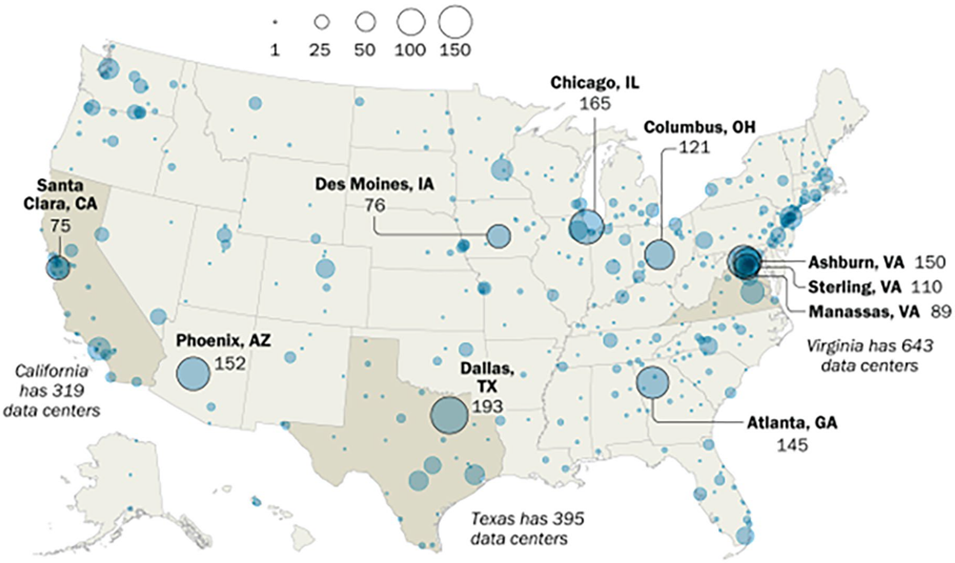
FIGURE 2. Number of Data Centers, by Market
SOURCE: Pew Research Center.44
As of 2026, there was an estimated total of more than 4,000 operational or planned data centers, with demand for services expected to grow through 2030.45 However, as there is no federal registration requirement for data centers, the exact number is not known. As of 2026, more than 1,500 new data centers are in various stages of development nationwide.46 While 87 percent of existing data centers are in urban areas, 67 percent of planned centers are sited in rural areas.47 The surge in rural center locations is driven by the need for vast tracts of land required to build hyperscale data centers.48 Furthermore, initiatives to grow the industry have been anchored in federal directives that designate data center development as a national priority.49,50,51
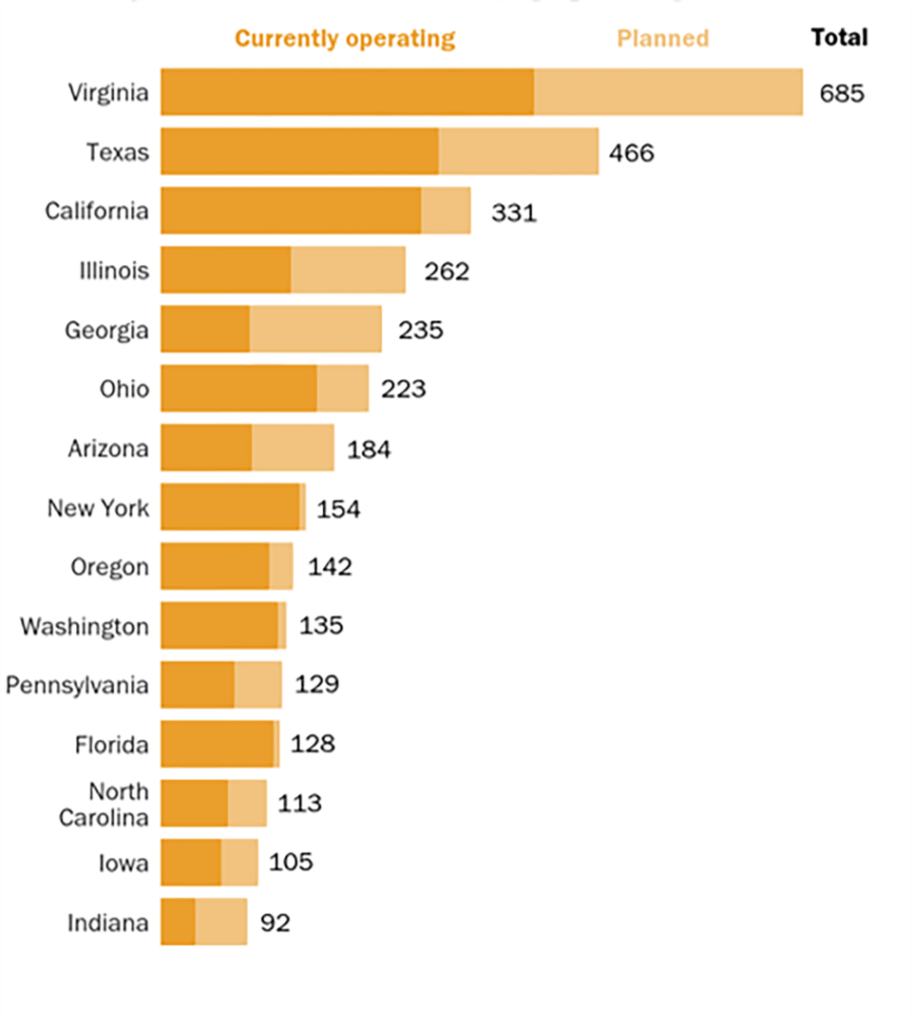
The Southern United States alone accounts for 48 percent of all planned future data centers, representing a projected 62 percent increase from current totals.52 Virginia and Texas, already home to the highest numbers of data centers in the country, have the most planned data centers of all the states, with Georgia not far behind.53
FIGURE 3. Top 15 states with the highest number of operating or planned data centers
Source: Pew Research Center.54
Data centers accounted for more than four percent of the country’s total electricity consumption in 2024, nearly equal to the annual electricity demand of the entire nation of Pakistan.55. By 2030, this number is projected to grow by 133 percent, from 183 TWh in 2024 to 426 TWh. Roughly 60 percent of the electricity used by data centers powers their server fleets with hyperscale servers consuming even higher rates as their computational capacity processes trillions of calculations per second. The cooling systems that prevent servers from overheating require large amounts of water; in 2023, the country’s data centers directly consumed about 17 billion gallons of water.56 By 2028, hyperscale centers alone are projected to use between 16 billion and 33 billion gallons of water annually.57 As utilities across the country look to build more power generation and transmission to meet data center needs, there is growing concern about the use of eminent domain to power these projects.
Current Landscape
While power and utility companies often pledge that eminent domain is a last resort used only in minimal expropriations, property rights disputes could increase with the rush to expand the grid. Georgia’s 10-year transmission plan calls for building 1,000 miles of new power lines, impacting hundreds of private property owners along the way.58,59,60 A similar transmission project underway in rural Northern Virginia has led several counties to adopt resolutions opposing the project.61 With more plans being unveiled, a growing number of states are seeing public resistance to data centers.
The debate has only intensified as the public’s stance toward data centers has shifted since the start of 2026.62,63
State Action
As of July 2026, 15 states have introduced a pause on data center development. Though most bills have failed to pass thus far, according to current policy trends monitored by CSG South, the number of bills is expected to increase in 2027, especially as local governments write their own standards and regulations.
FIGURE 4. Share of American Adults Who Support or Oppose Building a Data Center Within Three Miles of Where They Live

SOURCE: Politico.64
TABLE 1. Proposed Data Center Restrictions by state, as of October 2026
| STATE | BILL | DETAILS | STATUS |
| Delaware | SB 353 | Moratorium on permits for data centers of more than 100 MW until January 2027. | Introduced |
| Georgia | HB 1059 | Forbids local governments from permitting data centers until December 2028. | Introduced |
| Maine | LD 307 | Moratorium on data centers of more than 20 MW until November 2027. | Vetoed |
| Maryland | HB 120 | No data centers may be constructed or permitted. | Failed |
| Michigan | HB 5594/ HB 5595 | Local governments and the public service commission may not permit or approve new data centers until April 2027. | Introduced |
| Minnesota | SB 4298 | Prohibits state or local government from issuing data center permits until one year after the Public Utility Commission submits a report assessing data center development in the state. The report is due no later than July 1, 2027; if not completed, the commission may extend the submission date to no later than January 1, 2028. | Failed |
| New Hampshire | HB 1265 | One-year moratorium on data center construction. | Failed |
| New York | SB 9144 | Prohibits state and local agencies from issuing new permits for the siting, construction, or operation of data centers until at least 90 days after new regulations are promulgated. The moratorium does not apply to modifications or renewals of existing permits. | Passed Legislature |
| Oklahoma | SB 1488 | Moratorium on data center construction until November 2029. | Failed |
| Pennsylvania | SB 1359/ | Prohibits any Commonwealth agency, political subdivision, or public benefit corporation from accepting or approving applications for new or expanded hyperscale data centers for three years from the act’s effective date, regardless of when applications were or are submitted. | Introduced |
| South Carolina | H 5526 | Forbids local approval of data centers until the Legislature adopts a “comprehensive oversight” framework. | Introduced |
| South Dakota | SB 232 | One-year moratorium on the construction or expansion of data centers. | Failed |
| Vermont | S 205 | Moratorium on data centers until 2030; requires an impact study. | Introduced |
| Virginia | HB 1515 | Prohibits final approval of new data centers until all interconnection requests are fulfilled, or until July 2028. | Continued |
| Wisconsin | SB 1061/ AB 1099 | Prohibits data center operation until 14 conditions are satisfied. | Failed |
Source: Author’s Visualization of Legislation Using State Legislative databases and website. 65,66,67,68,69,70,71,72,73,74,75,76,77,78,79,80,81,82,83
In July 2026, New York Governor Kathy Hochul issued an executive order directing the Department of Environmental Conservation to halt applications for any discretionary permit, approval, license, or similar permission for a data center pending or filed after July 14, 2026.
The order applies to data centers that can or do consume 50 megawatts or more and does not apply to permits, approvals, licenses, or other forms of approval from local governments.84 In August 2026, Texas Governor Greg Abbot issued a moratorium on data center permit approvals until the Electric Reliability Council of Texas (ERCOT) can audit an existing waitlist of data centers seeking to connect to the state’s grid. Abbot passed a second order in September 2026, expanding the August moratorium to include halting environmental approvals through the Texas Commission on Environmental Quality (TCEQ) until ERCOT completes their audit.85 The potential public benefits in jobs, tax revenue, and enhancements to the grid provided by data center development present complex challenges for state leaders trying to balance economic priorities and constituent demands.86
Questions for State Policymakers
Data center development and energy projects in general present complicated legal questions for state lawmakers. Each project is unique and subject to different regulatory and statutory frameworks, depending on its location and the purpose of the work. For data centers, utility easements, transmission corridors, pipelines, and generation facilities, the use of eminent domain depends on approval from the appropriate federal, state, or local entity granted condemnation authority, subject to the appropriate permitting process and approvals. As the 2027 legislative session approaches, several important questions remain for state leaders and policymakers to address, such as:
- Who has condemnation authority?
- Does the construction of transmission infrastructure for data centers satisfy the public-use standard
for eminent domain? - Who pays for transmission and generation upgrades?
- What protections apply to affected landowners?
- How are transmission routes selected?
- Do states or municipalities have siting authority?
- What transparency and notice requirements apply, and should they change?
- What policies will state and local governments use to protect agricultural land while balancing rural development?
- How do various incentives affect public-use analysis?
- How do states distinguish infrastructure serving the broader grid from infrastructure serving a specific, private load (e.g., a data center)?
Conclusion
Throughout American history, eminent domain has been used to shape the geography of the country, as well as its industries and population centers. Eminent domain has become a sweeping, powerful tool used to spur economic development, facilitate transportation and interstate commerce, and ensure the country’s access to affordable, reliable power. With the arrival of artificial intelligence and cloud computing, states face decisions about infrastructure investment, land use, and the distribution of costs and benefits.
As data center growth accelerates, states will need to consider how to accommodate new development while balancing energy, infrastructure, land-use, and community priorities. The issue has brought eminent domain squarely back into the headlines and the daily discourse, along with questions about who benefits from the growth of data center development. Heading into 2027, Southern states face decisions about whether and how to use eminent domain data centers and related energy infrastructure, weighing potential economic benefits alongside property rights, energy needs, and community impacts.
Citations
- Lauren Bridges, The State of Data Center Policy in the United States, Tech Policy Press, June 2, 2026.
https://www.techpolicy.press/the-state-of-data-center-policy-in-the-united-states/ - U.S. Congress, Data Center Energy Infrastructure: Federal Permit Requirements, Library of Congress, accessed August 10, 2026. https://www.congress.gov/crs-product/R48762
- Aaron Walayat, Power companies are using eminent domain to seize land for data centers as 70% of Americans say not in my backyard, Fortune, July 19, 2026. https://fortune.com/2026/07/19/data-center-eminent-domain-public-use/
- Walayat, When can a power company take your land for data center infrastructure? The Conversation, July 16, 2026.
https://theconversation.com/when-can-a-power-company-take-your-land-for-data-center-infrastructure-284061 - Harvard Law School, The Dakota Access Pipeline (DAPL), Environmental and Energy Law Program, June 23, 2026.
- Gregor Aisch, K.K. Rebecca Lai, The Conflicts Along 1,172 Miles, The New York Times, March 20, 2017.
https://www.nytimes.com/interactive/2016/11/23/us/dakota-access-pipeline-protest-map.html - The Associated Press, A timeline of the Dakota Access oil pipeline, A.P., October 12, 2017.
https://apnews.com/general-news-1a00f95c83594dac931796a332540750 - U.S. Congress, Mountain Valley Pipeline: Past the Finish Line, Library of Congress, accessed August 10, 2026.
https://www.congress.gov/crs-product/IN12032 - Amy Howe, Supreme Court rules in favor of Mountain Valley Pipeline, SCOTUSblog, July 27, 2023.
https://www.scotusblog.com/2023/07/supreme-court-rules-in-favor-of-mountain-valley-pipeline/ - Goldman Sachs, U.S. Data Center Power Demand Projected to Double by 2027, May 20, 2026.
https://www.goldmansachs.com/insights/articles/us-data-center-power-demand-projected-to-double-by-2027 - Sebastian Obando, Construction planning falls again, but data center boom continues, Construction Dive, December 5, 2025. https://www.constructiondive.com/news/construction-planning-november-data-center-boom/807215/
- Jim VandeHei, The data center era that’s reshaping America, Axios, August 25, 2026.
https://www.axios.com/2026/08/25/data-centers-ai-electricity-water-politics - Aaron Mak, Jessie Blaeser, Data centers have a politics problem — and industry knows it, Politico, August 1, 2026.
https://www.politico.com/news/2026/08/01/data-centers-have-a-politics-problem-and-industry-knows-it-01020412 - Shawn Cabbagestalk, Georgia Power to hold public meeting on proposed 75-mile transmission line project, WJBF News, July 11, 2026. https://www.wjbf.com/news/georgia-power-to-hold-public-meeting-on-proposed-75-mile-transmission-line-project/
- U.S. Department of Energy, Transmission Facilitation Program Selections, Office of Energy Dominance Financing, accessed August 20, 2026. https://www.energy.gov/edf/transmission-facilitation-program-selections
- Federal Energy Regulatory Commission, Major Pipeline Projects Pending, FERC, accessed August 10, 2026.
https://www.ferc.gov/industries-data/natural-gas/major-pipeline-projects-pending - Errol E. Meidinger, The “Public Uses” of Eminent Domain: History and Policy, University at Buffalo School of Law, Fall 1980. https://digitalcommons.law.buffalo.edu/cgi/viewcontent.cgi?params=/context/journal_articles/article/1557/&path_info=Meidinger_The_20Public_20Uses_20of_20Eminent_20Domain_Envtl._L._1980.pdf
- Ibid.
- U.S. Constitution, Amdt5.10.1 Overview of Takings Clause, accessed August 10, 2026.
https://constitution.congress.gov/browse/essay/amdt5-10-1/ALDE_00013280/ - U.S. Department of Justice, History of the Federal Use of Eminent Domain, Energy and Natural Resources Division, accessed August 10, 2026. https://www.justice.gov/enrd/history-federal-use-eminent-domain
- Madeline, Hagan, “People of a Sentimental Nature”: The Tennessee Valley Authority, Progress, and Curation of Heritage in the Norris Basin, 1933-1940, Columbia University Libraries, 2024. https://academiccommons.columbia.edu/doi/10.7916/eqmy-tx98
- Charles J. McCarthy, Land Acquisition Policies and Proceedings in TVA-A Study of the Role of Land Acquisition in a Regional Agency, Ohio State University, 1949.
- United States ex rel. TVA v. Welch, 327 U.S. 546 (1946), Justia, accessed August 16, 2026. https://supreme.justia.com/cases/federal/us/327/546/
- Kelo v. City of New London, 545 U.S. 469 (2005), Justia, accessed August 10, 2026. https://supreme.justia.com/cases/federal/us/545/469/
- Kelo v. City of New London, 545 U.S. 469 (2005), Justia.
- James W. Coleman, Alexandra B. Klass, Energy and Eminent Domain, Minnesota Law Review, 2019.
https://scholar.smu.edu/cgi/viewcontent.cgi?article=1652&context=law_faculty - Ilya Somin, Assessing the State Reaction to the Supreme Court’s Undermining of Property Rights, State Court Report,
June 23, 2025. https://statecourtreport.org/our-work/analysis-opinion/assessing-state-reaction-supreme-courts-undermining-property-rights - Scott D. Mikkelson, Eminent Domain after Kelo v. City of New London: Compensating for the Supreme Court’s Refusal to Enforce the Fifth Amendment, Duke Journal of Constitutional Law and Public Policy Sidebar, January 25, 2007.
https://scholarship.law.duke.edu/djclpp_sidebar/7/ - Ilya Somin, Assessing the State Reaction to the Supreme Court’s Undermining of Property Rights, State Court Report,
June 23, 2025. https://statecourtreport.org/our-work/analysis-opinion/assessing-state-reaction-supreme-courts-undermining-property-rights - Rhonda Fanning, Eminent Domain Reform Bill Dies, Despite Negotiations Between Property Owners And Industry, Texas Standard, May 29, 2019. https://texasstandard.org/stories/eminent-domain-reform-bill-dies-despite-negotiations-between-property-owners-and-industry/
- Mark Scialla, Activists occupy the trees to stop a Pennsylvania pipeline, PBS, July 6, 2017.
https://www.pbs.org/newshour/nation/activists-occupy-trees-stop-pennsylvania-pipeline - Scott Steinberg, What Can Be Done to Strengthen the U.S. Power Grid? University of Chicago Booth School of Business Magazine, October 15, 2025. https://www.chicagobooth.edu/magazine/what-can-be-done-to-strengthen-the-us-power-grid
- U.S. Energy Information Agency, After more than a decade of little change, U.S. electricity consumption is rising again, Monthly Energy Review, May 13, 2025. https://www.eia.gov/todayinenergy/detail.php?id=65264
- Jeremy Hsu, Data centers become “killer application” for new power transformer tech, Ars Technica, August 24, 2026.
https://arstechnica.com/gadgets/2026/08/energy-hungry-ai-data-centers-spur-new-power-transformer-technology/ - Rachel Mural, Dipesh Pherwani, Chaitanya Gupta, Yiqi Yu, AI, Data Centers, and the U.S. Electric Grid: A Watershed Moment, Harvard Kennedy School Belfer Center for Science and International Affairs, February 10, 2025.
https://www.belfercenter.org/research-analysis/ai-data-centers-us-electric-grid - Tim McLaughlin, Massive disconnect of power roils largest U.S. electric grid, Reuters, July 22, 2026.
https://www.reuters.com/business/energy/massive-disconnect-power-roiled-largest-us-electric-grid-2026-07-22/ - Tim McLaughlin, Big Tech’s data center boom poses new risk to U.S. grid operators, Reuters, March 19, 2025.
https://www.reuters.com/technology/big-techs-data-center-boom-poses-new-risk-us-grid-operators-2025-03-19/ - Rebecca Leppert, What we know about energy use at U.S. data centers amid the AI boom, Pew Research Center,
October 24, 2025. - Which States Are Banning Data Centers? National Conference of State Legislatures, updated July 01, 2026, accessed August 24, 2026. https://www.ncsl.org/fiscal/which-states-are-banning-data-centers
- U.S. Public Interest Research Group, Where have Americans hit pause on new data centers? PIRG, August 10, 2026.
https://pirg.org/articles/where-have-americans-hit-pause-on-new-data-centers/ - Rachel Mural, Dipesh Pherwani, Chaitanya Gupta, Yiqi Yu, AI, Data Centers, and the U.S. Electric Grid: A Watershed Moment, Harvard Kennedy School Belfer Center for Science and International Affairs, February 10, 2025.
- Rebecca Leppert, What we know about energy use at U.S. data centers amid the AI boom, Pew Research Center,
October 24, 2025. - Ibid.
- Skyler Seets, Kaitlyn Radde, Most new data centers in the U.S. are coming to rural areas, Pew Research Center, April 13, 2026. https://www.pewresearch.org/short-reads/2026/04/13/most-new-data-centers-in-the-us-are-coming-to-rural-areas/
- Rachel Mural, Dipesh Pherwani, Chaitanya Gupta, Yiqi Yu, Ai Takahashi, Dongjoo Kim, Subir Majumder, Henry Lee, Minlan Yu, Le Xie, AI, Data Centers, and the U.S. Electric Grid: A Watershed Moment, Harvard Kennedy School Belfer Center for Science and International Affairs, February 10, 2025.
- Skyler Seets, Kaitlyn Radde, Most new data centers in the U.S. are coming to rural areas, Pew Research Center, April 13, 2026. https://www.pewresearch.org/short-reads/2026/04/13/most-new-data-centers-in-the-us-are-coming-to-rural-areas/
- Ibid.
- Subsidizing Servers: How States Are Competing to Attract Data Centers, National Conference of State Legislatures, updated April 01, 2026, accessed August 24, 2026. https://www.ncsl.org/fiscal/subsidizing-servers-how-states-are-competing-to-attract-data-centers
- FERC Launches Aggressive Targeted Action to Speed Large Load Integration, FERC, June 18, 2026.
https://www.ferc.gov/news-events/news/ferc-launches-aggressive-targeted-action-speed-large-load-integration - Executive Order 14318, ACCELERATING FEDERAL PERMITTING OF DATA CENTER INFRASTRUCTURE, The White House, July 23, 2025.
https://www.whitehouse.gov/presidential-actions/2025/07/accelerating-federal-permitting-of-data-center-infrastructure/ - U.S. Department of Energy, Powering America’s AI Future—Data Center Resource Hub, Powering America’s AI Future – Data Center Resource Hub, accessed August 10, 2026. https://www.energy.gov/powering-americas-ai-future-data-center-resource-hub
- Skyler Seets, Kaitlyn Radde, Most new data centers in the U.S. are coming to rural areas, Pew Research Center, April 13, 2026
- Ibid.
- Ibid.
- Rebecca Leppert, What we know about energy use at U.S. data centers amid the AI boom, Pew Research Center, October 24, 2025.
- Ibid.
- Arman Shehabi, Sarah J. Smith, Alex Hubbard, Alex Newkirk, Nuoa Lei, Md Abu Bakar Siddik, Billie Holecek, Jonathan Koomey, Eric Masanet, Dale Sartor, 2024 United States Data Center Energy Usage Report, Energy Analysis & Environmental Impacts Division of Lawrence Berkeley National Laboratory, December 2024. https://eta-publications.lbl.gov/sites/default/files/2024-12/lbnl-2024-united-states-data-center-energy-usage-report.pdf?utm_source=substack&utm_medium=email
- Georgia Power Transmission Expansion & Upgrades, Georgia Power, accessed August 14, 2026.
https://www.georgiapower.com/about/grid-reliability/grid-improvements/grid-projects/transmission-projects.html - Drew Kann, Georgia Power’s energy road map adds renewables but keeps coal alive, The Atlanta Journal Constitution, January 31, 2025. https://www.ajc.com/news/georgia-powers-plan-for-the-future-add-renewables-keep-burning-coal/CJYINXDOJ5HLFEWMTSNC2WDC4I/
- Mary K. Jacob, Georgia residents stand to lose everything as homes seized by private company in $16B data center plan to power AI, New York Post, May 21, 2026. https://nypost.com/2026/05/21/real-estate/residents-fume-as-georgia-power-seizes-homes-under-eminent-domain/
- Scott Gelman, Why Northern Virginians will help pay for controversial rural transmission line project, WTOP News, July 20, 2026. https://wtop.com/virginia/2026/07/why-northern-virginians-will-help-pay-for-controversial-transmission-line-project-in-rural-neighborhoods/
- Jeffrey M. Jones, Americans Oppose AI Data Centers in Their Area, Gallup, May 13, 2026.
https://news.gallup.com/poll/709772/americans-oppose-data-centers-area.aspx 9 - Katherine Long, Jessie Blaeser, A growing political reckoning is coming for data centers, POLITICO Poll shows, Politico,
July 21, 2026. https://www.politico.com/news/2026/07/21/poll-data-centers-democrats-moratorium-0100179 - Ibid.
- Delaware General Assembly, Senate Bill 353, accessed August 19, 2026. https://legis.delaware.gov/BillDetail/143681
- Georgia General Assembly, Georgia HB 1059, accessed August 19, 2026. https://www.legis.ga.gov/api/legislationdocument/20252026/240599
- Maine Legislature, An Act to Establish the Maine Data Center Coordination Council and Place a Temporary Limitation on Certain Data Centers, accessed August 19, 2026.
- Maryland General Assembly, Moratorium on Construction of New Data Centers – Co-Location and Generation Contingency, accessed August 19, 2026.
- Michigan Legislature, House Bill 5594 of 2026, accessed August 19, 2026. https://www.legislature.mi.gov/Bills/Bill?ObjectName=2026-HB-5594
- Michigan Legislature, House Bill 5595 of 2026, accessed August 19, 2026.
https://www.legislature.mi.gov/Bills/Bill?ObjectName=2026-HB-5595 - Minnesota Legislature, SF 4298, accessed August 19, 2026. https://www.revisor.mn.gov/bills/94/2026/0/SF/4298/
- Minnesota Legislature, HF 4888, accessed August 19, 2026. https://www.revisor.mn.gov/bills/94/2026/0/HF/4888/versions/latest/
- The General Court of New Hampshire, HB1265, accessed August 19, 2026. https://gc.nh.gov/bill_status/billinfo.aspx?id=1685&inflect=2
- New York State Senate, Senate Bill S9144A, accessed August 19, 2026. https://www.nysenate.gov/legislation/bills/2025/S9144
- Oklahoma Legislature, SB 1488, accessed August 19, 2026. https://www.oklegislature.gov/BillInfo.aspx?Bill=SB1488
- Pennsylvania General Assembly, Senate Bill 1359, accessed August 19, 2026. https://www.palegis.us/legislation/bills/2025/sb1359
- Pennsylvania General Assembly, House Bill 2533, accessed August 19, 2026. https://www.palegis.us/legislation/bills/2025/hb2533
- South Carolina General Assembly, H. 5526, accessed August 19, 2026. https://www.scstatehouse.gov/sess126_2025-2026/bills/5526.htm
- South Dakota Legislature, Senate Bill 232, accessed August 19, 2026. https://sdlegislature.gov/Session/Bill/27269/301228
- Vermont General Assembly, S.205, accessed August 19, 2026. https://legislature.vermont.gov/bill/status/2026/S.205
- Virginia General Assembly, HB 1515, accessed August 19, 2026. https://lis.virginia.gov/bill-details/20261/HB1515
- Wisconsin State Legislature, Senate Bill 1061, accessed August 19, 2026. https://docs.legis.wisconsin.gov/2025/proposals/sb1061
- Wisconsin State Legislature, Assembly Bill 1099, accessed August 19, 2026. https://docs.legis.wisconsin.gov/2025/proposals/ab1099
- Governor Kathy Hochul, New York Executive Order 62, accessed August 19, 2026. https://www.governor.ny.gov/sites/default/files/2026-07/EO_62.pdf
- Office of the Texas Governor Greg Abbott, Governor Abbott Directs Comprehensive Data Center Audit, August 03, 2026.
https://gov.texas.gov/news/post/governor-Abbott-directs-comprehensive-data-center-audit - Daniel Goetzel, Mark Muro, Shriya Methkupally, Turning the data center boom into long-term, local prosperity, Brookings, February 05, 2025. https://www.brookings.edu/articles/turning-the-data-center-boom-into-long-term-local-prosperity/