

Issue Brief by Policy Analyst, Judah Lebofsky
DOWNLOADIntroduction
Manufacturing and large-scale industrial projects remain an important component of economic development in the South.1 States compete for large industrial projects and the sites needed to accommodate them.2 For states seeking industrial investment, the availability of land is only one component of site selection.3 A property may be suitable for industrial use but may still require environmental review, infrastructure extensions, transportation improvements, or other work before construction can begin.
These considerations have also expanded the role of state and local governments in industrial site development.4,5 Rather than limiting public investment to infrastructure or incentives associated with an announced project, some states are funding site evaluation, due diligence, land preparation, and infrastructure improvements before a company has selected the property.6 This approach shifts part of the economic development process from responding to individual projects to maintaining an inventory of properties that can accommodate future investment.
This Issue Brief examines industrial site readiness through five interconnected components: land and site preparation, physical infrastructure, workforce capacity, surrounding community resources, and the financing and coordination used to bring those elements together. The publication explains the components that determine site readiness, examines how states fund and coordinate site development, and highlights specific Southern approaches to preparing industrial sites.
Understanding Industrial Site Readiness
What Makes an Industrial Site “Ready”?
Industrial site readiness does not depend on a single characteristic. Instead, state programs commonly evaluate a combination of land control and developable acreage, regulatory and environmental conditions, infrastructure and transportation access, and the availability of documentation describing site conditions, costs, and development timelines.7 A property may have sufficient acreage and be located near utilities or major transportation routes, but still require environmental review, geotechnical analysis, infrastructure upgrades, or additional permitting before construction can begin.8 In this sense, site readiness is both physical and informational: the condition of the property matters, but so does the extent to which potential constraints, costs, and timelines have already been identified and documented for prospective employers.
Tennessee’s Select Tennessee program illustrates how these categories are applied in practice. Its certification criteria include requirements related to developable acreage, property pricing, flood information, boundary and topographic surveys, truck-quality road access, utility service or extension plans, zoning and permitting, Phase I environmental review, and geotechnical and natural-resource conditions.9 Tennessee’s criteria illustrate how a readiness program can move beyond acreage alone by requiring documented information on a property’s physical, regulatory, and infrastructure conditions.
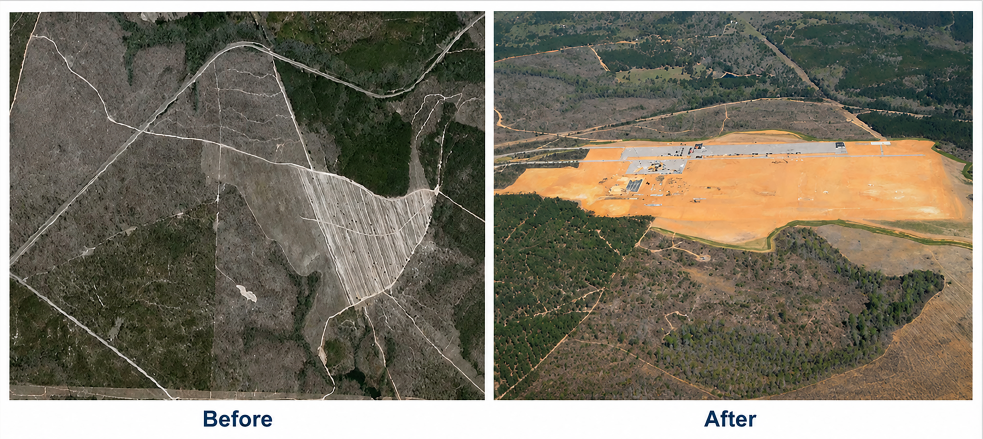
The before-and-after images of the Bridgestone site in Aiken County, South Carolina, illustrate the distinction between land that is simply available for industrial use and land that has undergone site preparation (see Figure 1).10 Pre-development work can include clearing, grading, access improvements, and other activities intended to reduce the amount of work remaining before vertical construction can begin.11
FIGURE 1. Bridgestone Industrial Site Before and After Site Preparation, Aiken County, South Carolina
Source: Site Selection.12
Even if a property appears ready for industrial development, unresolved site conditions can affect whether construction can proceed. Environmental constraints, geotechnical conditions, utility limitations, or inadequate transportation access may not become fully apparent until technical studies are completed.13 Conducting this work before a prospective employer begins active site selection can help communities identify potential constraints, estimate necessary improvements, and determine whether additional infrastructure investment is needed. Site-readiness work, therefore, does not eliminate development risk, but it can reduce uncertainty by identifying known conditions and documenting what work remains.
Preparation can also affect how quickly a prospective employer can evaluate a property. North Carolina defines site certification as a means of reducing development risk by providing verified information on a site’s price and availability, utility service, transportation access, environmental conditions, and potential development costs.14 Rather than beginning with preliminary assumptions, site selectors can use this documentation to determine which questions have already been resolved and which improvements remain necessary. This does not mean a certified property is immediately construction-ready, but it can provide greater certainty about the work, cost, and time required to reach that point.
| Certified Sites vs. Development-Ready Sites The following descriptions are used for this publication. Terminology and requirements vary by state and program, and the categories may overlap:
|
Why Site Readiness Has Become a State Policy Issue
A project’s site-selection and construction schedule may be shorter than the time necessary to acquire land, complete environmental studies, extend utilities, build access roads, and obtain necessary permits.17 Advance site preparation can therefore reduce the amount of work that remains once a prospective employer begins evaluating a property.18 Georgia’s Department of Economic Development has framed this issue in terms of “speed to market,” noting that GRAD-certified sites undergo front-end technical work, including surveys, environmental review, and utility assessments, before a prospect reaches the later stages of site selection.19 By completing portions of this work in advance, states and communities may be able to provide prospective employers with greater certainty about development conditions and timelines.
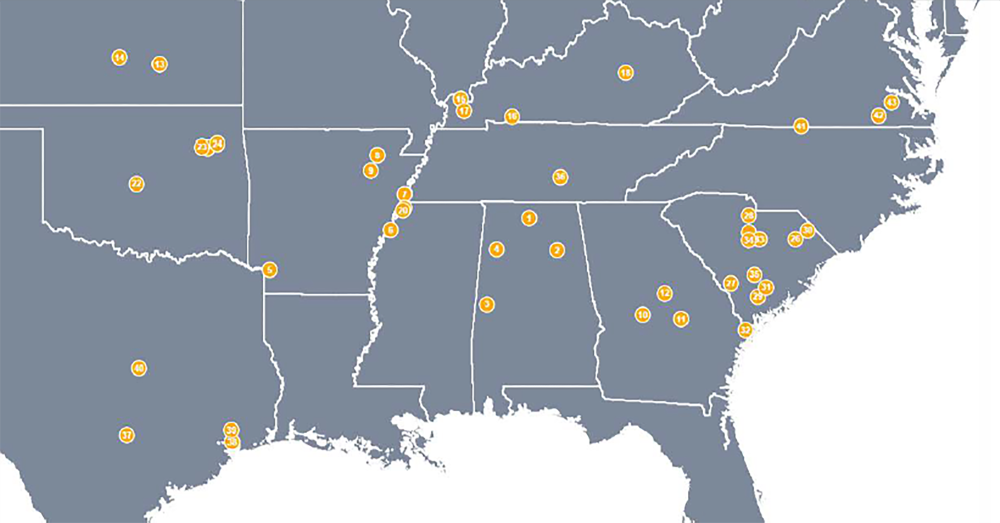
The scale of major industrial projects can also translate into substantial land, utility, and transportation requirements. North Carolina’s Megasite Readiness Program, for example, focuses on sites of at least 1,000 acres that may be capable of supporting large advanced-manufacturing projects in sectors such as automotive, aerospace, clean energy, food processing, life sciences, and semiconductors.20 Megasites in the Southern region are distributed across multiple states, illustrating the regional nature of competition for sites capable of accommodating these projects (see Figure 2).21 Since relatively few properties combine sufficient acreage with the necessary infrastructure, transportation access, and completed due diligence, states may invest in expanding their inventory of prepared sites before a specific company has committed to a location.22
FIGURE 2. Selected Competitive Megasites in Southern and Neighboring States, as of May 2023
Source: Economic Development Partnership of North Carolina.23
Key for Figure 2. Selected Competitive Megasites in Southern and Neighboring States, as of May 2023
| SITE # | SITE NAME | COUNTY | STATE | SITE ACREAGE |
| 1 | Murphy Site | Limestone | AL | 1,300 |
| 2 | NEAR Mega-Site | Etowah | AL | 1,091 |
| 3 | Crossroads of America | Greene | AL | 1,240 |
| 4 | Black Creek | Marion | AL | 1,600 |
| 5 | REDI Arkansas Manufacturing Center | Miller | AR | 1,350 |
| 6 | Helena Harbor Industrial Park | Phillips | AR | 4,000 |
| 7 | West Memphis I-40 Megasite | Crittenden | AR | 1,800 |
| 8 | Lawrence County Mega Site | Lawrence | AR | 2,426 |
| 9 | Newport Mega Site | Jackson | AR | 1,000 |
| 10 | Middle Georgia Megasite | Peach | GA | 1,113 |
| 11 | Heart of Georgia Mega Site | Laurens | GA | 1,999 |
| 12 | Sibley Smith Industrial Park | Baldwin | GA | 1,643 |
| 13 | El Dorado Industrial Area | Butler | KS | 1,600 |
| 14 | K-96 Industrial Complex | Reno | KS | 1,009 |
| 15 | Ohio River Triple Rail Industrial Site | McCracken | KY | 1,001 |
| 16 | Commerce Park II | Christian | KY | 1,001 |
| 17 | West Kentucky Megasite | Graves | KY | 2,112 |
| 18 | Begley Site | Madison | KY | 1,008 |
Key for Figure 2 Cont’d. Selected Competitive Megasites in Southern and Neighboring States, as of May 2023
| SITE # | SITE NAME | COUNTY | STATE | SITE ACREAGE |
| 19 | Northwest Mississippi Mega Site | DeSoto | MS | 1,665 |
| 20 | Tunica Mega Site | Tunica | MS | 2,221 |
| 21 | Tulsa Port of Inola | Rogers | OK | 2,500 |
| 22 | OKC 577 | Oklahoma | OK | 577 |
| 23 | Robson East | Tulsa | OK | 1,000 |
| 24 | MidAmerica Industrial Park | Mayes | OK | 400 |
| 25 | I-77 International Megasite | Fairfield | SC | 1,141 |
| 26 | White Hawk Commerce Park | Florence | SC | 1,779 |
| 27 | South Carolina Adv. Technology Park | Barnwell | SC | 1,606 |
| 28 | Magnolia Industrial Park | Chester | SC | 1,700 |
| 29 | Colleton Mega Site | Colleton | SC | 1,481 |
| 30 | I-95 Megasite | Clarendon | SC | 1,417 |
| 31 | Winding Woods | Dorchester | SC | 1,092 |
| 32 | Sherwood Tract | Jasper | SC | 1,438 |
| 33 | Central SC Megasite | Kershaw | SC | 1,426 |
| 34 | Blythewood Industrial Park | Richland | SC | 1,349 |
| 35 | Orangeburg County Power Site | Orangeburg | SC | 745 |
| 36 | Middle Tennessee I-24 Industrial Site | Coffee | TN | 1,855 |
| 37 | Lockhart Mega Site | Caldwell | TX | 1,800 |
| 38 | TGS Cedar Port Industrial Park | Chambers | TX | 11,000 |
| 39 | Gulf Inland Logistics Park | Liberty | TX | 1,157 |
| 40 | McGregor MegaSite | McLennan | TX | 2,012 |
| 41 | Southern Virginia Megasite | Pittsylvania | VA | 1,015 |
| 42 | Mid-Atlantic Advanced Mfg Center | Greensville | VA | 1,570 |
| 43 | Sussex Megasite | Sussex | VA | 1,130 |
Source: Economic Development Partnership of North Carolina.23
Note: Properties below 1,000 acres are sites included in the source’s competitive comparison, but do not all meet North Carolina’s program threshold.
North Carolina provides an example of how states may invest in site readiness to expand the inventory of properties capable of accommodating major industrial projects. According to the Economic Development Partnership of North Carolina, major industrial development projects have reduced the state’s inventory of available megasites, while demand for large industrial properties has increased nationally. These conditions illustrate the challenges states may face in maintaining an inventory of development-ready properties for prospective industrial projects. Through its Megasite Readiness Program and Selectsite Readiness Program, North Carolina has evaluated and supported properties that could serve large-scale manufacturing and other industrial development.24
The Megasite Readiness Program focuses on especially large sites suited to major advanced-manufacturing projects. At the same time, the Selectsite Readiness Program addresses additional properties that may not meet megasite acreage thresholds but could still support significant investment.
As a result, site readiness can become a subject of public investment before any individual company has committed to the property.25 Rather than responding only after a project is announced, states may spend public funds on due diligence, acquisition, grading, or infrastructure in anticipation of future recruitment opportunities.26 These investments also raise a practical question: what infrastructure must be available for a site to accommodate a prospective project? The answer depends not only on whether utilities and transportation networks are nearby, but also on whether they have sufficient capacity and can be extended or upgraded within the project’s expected timeline.27
For state policymakers, site readiness can involve decisions about when public funding enters the development process, which properties or communities qualify for assistance, and how responsibilities are divided among state agencies, local governments, utilities, and private partners. State programs may also determine whether funding is directed toward maintaining a broader inventory of prepared sites or toward infrastructure associated with specific recruitment opportunities.
Physical Infrastructure
A potential industrial site can be near infrastructure and still not be ready for a major project. Site evaluations consider whether existing infrastructure can support the project. For example, transmission lines, a water main, and an interstate may be present, but whether these features will be useful depends on their capacity, extension requirements, necessary upgrades, permitting, and the project’s construction timeline.28
No single type of infrastructure makes a site universally ready for development. Infrastructure needs vary by industry (see Table 1).29 For example, automotive, semiconductor, battery, and food-processing projects can require very different combinations of acreage, electricity, water, wastewater, and natural gas. These differences make project type an important consideration when evaluating site readiness. The infrastructure required for one industrial user may be insufficient, unnecessary, or differently configured for another.
Utility requirements differ by industry. Site evaluators assess utility readiness by examining existing services and the additional capacity available for the project.
TABLE 1. Selected Industrial Project Characteristics and Utility Demand Ranges, Reported in 2023
| INDUSTRY CATEGORY | ANNOUNCED INVESTMENT ($ BILLION) | ANNOUNCED JOBS | FACILITY SIZE (SF)* | ACREAGE (AC)† | POWER (MW)‡ | WATER (MGD)§ | SEWER (MGD) | NATURAL GAS (MCFH)** |
| RANGE | RANGE | RANGE | RANGE | RANGE | RANGE | RANGE | RANGE | |
| Aerospace | $0.15–$2.2 BIL | 800–5,000 | 115,000– 1,200,000 | 65–400 | 2–50 | 0.1–1.0 | 0.1–1.0 | 100–500 |
| Automotive (OEM, Man. & Incl. E.V.) | $0.3–$8.8 BIL | 650–13,500 | 150,000– 20,000,000 | 180–3,600 | 100–350 | 0.1–20 | 0.1–3.5 | 100–600 |
| Clean Energy | $0.7–$4.0 BIL | 200–2,000 | 160,000– 2,400,000 | 100–2,000 | 2–20 | 0.05–2.8 | 0.01–2.5 | 2–100 |
| EV Battery | $0.1–$5.8 BIL | 1,100–5,000 | 120,000– 4,500,000 | 120–1,825 | 50–250 | 1.0–5.5 | 0.15–2.2 | 100–600 |
| Food Processing | $0.75–$1.1 BIL | 400–1,300 | 300,000– 1,300,000 | 200–600 | 1–50 | 0.25–1.0 | 0.25–1.0 | 2–100 |
| Life Sciences | $0.55–$2.1 BIL | 150–1,000 | 62,000– 1,000,000 | 150–600 | 2–50 | 0.4–1.5 | 0.25–1.0 | Unavailable |
| Semiconductor | $0.55–$100 BIL | 700–14,000 | 350,000– 6,000,000 | 25–1,800 | 200–1,100 | 0.2–45 | 0.5–41 | 50–1,000 |
Source: Economic Development Partnership of North Carolina.30
Utility assessments, therefore, examine both existing conditions and the improvements required to serve a prospective user.31 A property may be located within a utility service territory while still requiring a new substation, line extension, treatment upgrade, or other capital improvement before operations can begin.
*SF = Square Feet.
†AC = Acre.
‡MW = Megawatt.
§MGD = Million Gallons Per Day.
**MCFH = Thousand Cubic Feet Per Hour.
Electricity
For electricity, site evaluations may distinguish between the physical presence of transmission or distribution infrastructure and the amount of power that can be delivered to the property.32 If existing electrical infrastructure cannot meet a project’s needs, required upgrades may delay development and increase project costs. In Georgia, the Department of Economic Development directs companies to industrial site databases maintained by Georgia Power, Georgia EMC, and Electric Cities of Georgia, allowing prospects to consider electrical service alongside other site characteristics.33 For site-readiness purposes, the presence of nearby transmission or distribution infrastructure is only part of the assessment; available capacity, required system upgrades, potential substation needs, and the time required to deliver additional service can also affect whether a property can support a project. Early utility involvement can therefore help clarify both current electrical conditions and the improvements that may be necessary before development proceeds.
Water and Wastewater
The presence of a water line at or near a site does not necessarily mean that the local system can supply the volume required by a large industrial user.34 The existing system may need treatment expansion, increased storage capacity, larger water lines, and improvements to the pumping system. In addition to clean water, wastewater infrastructure is a necessary consideration. The U.S. Economic Development Administration (EDA) includes water and sewer improvements among the types of public infrastructure that may support the establishment or expansion of industrial and commercial activity.35 Water and wastewater readiness extends beyond the presence of existing infrastructure at a site; it depends instead on the systemwide capacity to support the project.
Transportation
Transportation readiness depends on both a site’s connection to regional freight networks and the infrastructure needed to move goods directly to and from the property.36 Interstate and highway proximity, freight rail, ports or inland ports, and airports may influence site suitability. In contrast, last-mile conditions such as truck-quality access roads, intersection improvements, and rail spurs can determine whether those broader networks are practically accessible. North Carolina’s megasite materials reflect this approach by evaluating sites based on combinations of highway, rail, port, and utility access rather than on proximity to a single transportation asset. State transportation agencies may also support these connections through industrial access programs and project-specific improvements. Tennessee’s State Industrial Access Program, for example, provides funding and technical assistance for highway access serving new and expanding industries.37 At the same time, the North Carolina Department of Transportation coordinates with the Department of Commerce to implement transportation improvements that support industrial and commercial growth.38 These programs also illustrate an important distinction in the timing of public investment: some transportation spending may help prepare sites before a specific prospect is known, while other assistance is tied to a company’s commitment to a location.
These infrastructure requirements can place site readiness across several areas of state policy. Legislatures may appropriate funding for utility or transportation improvements, while state transportation and economic development agencies may establish eligibility requirements, prioritize industrial access projects, or coordinate improvements with local governments and prospective employers. The timing of these investments can also vary, with some infrastructure improvements occurring before a specific project is identified and others proceeding after a company has committed to a site.
Workforce Readiness
Workforce Availability
Workforce availability is another component of industrial site readiness, particularly for projects expected to employ large numbers of workers.39 Site selectors may examine the size and participation of the surrounding labor force. Still, those measures alone do not indicate whether a region contains workers with the occupations and skills required by a particular project.40 Assessments may also consider employment in relevant industries, wage levels, educational attainment, and the presence of nearby employers competing for similar workers.41 The significance of each measure varies by industry because the occupational needs of an automotive plant, food-processing facility, or semiconductor operation may differ substantially.
A large labor force does not necessarily indicate that enough workers are available in the occupations required by a particular project.42 Existing manufacturing experience among the available workforce may indicate a strong foundation, but it may also indicate competition among employers for workers with similar skills.43 Wage levels, labor force participation, and unemployment rates may help policymakers understand the current labor market, but they do not by themselves establish whether workers with the required skills are available. Workforce indicators, therefore, are most useful when considered together rather than as independent measures of a region’s ability to support a project.44 These assessments also frequently extend beyond the jurisdiction in which the industrial site is located.45
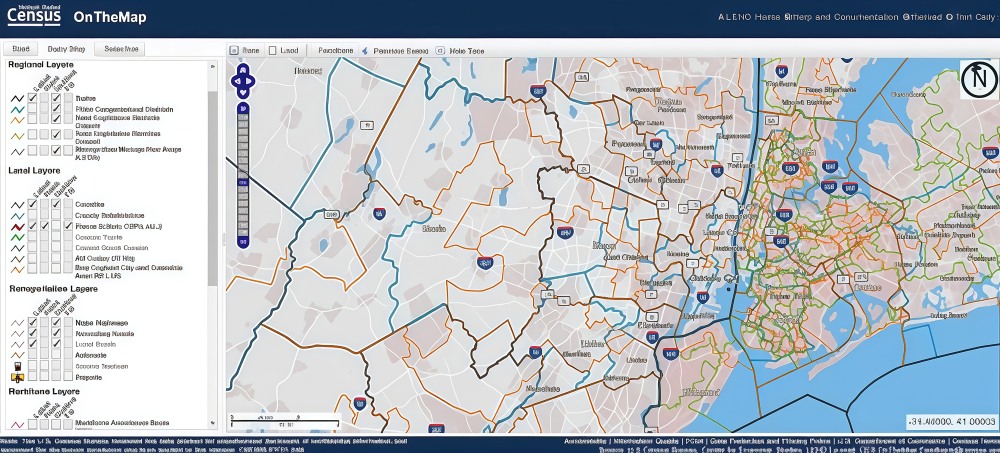
Since workers often commute across county and municipal boundaries, site selectors may evaluate a broader labor shed surrounding a prospective site. A labor shed generally refers to the geographic area from which an employer could reasonably draw workers.46 When evaluating the labor shed, it may be useful to examine where workers live, where they currently work, their commuting distances, and nearby sites competing for the same labor pool.47 The U.S. Census Bureau’s OnTheMap tool can be used to examine workers’ residence and employment patterns, commuting flows, and characteristics within a defined area (see Figure 3).48 Looking at a labor shed may provide a broader picture of workforce availability than relying solely on statistics for the county or municipality that contains the site.
FIGURE 3. Example of the U.S. Census Bureau OnTheMap Tool
Source: U.S. Census Bureau.49
Customized Workforce Training
Existing labor-market conditions are only one component of workforce readiness. States may also use customized training programs to help prepare workers for the occupations, equipment, and production processes associated with a new or expanding facility.50 Customized training assistance may include training assessments, instructional design, instructional costs, and training delivery for workers involved in production and technology support.51 For major industrial projects, the availability of this training capacity can become part of a broader assessment of whether a region is prepared to support the project as it begins operations.
Customized training programs often rely on partnerships between state economic development organizations and technical or community college systems. Employers can identify the occupations, skills, and processes required for a project, while educational institutions provide instructors, facilities, and customized coursework.52 For especially large investments, training may also involve dedicated facilities or equipment tailored to the employer’s production needs.53
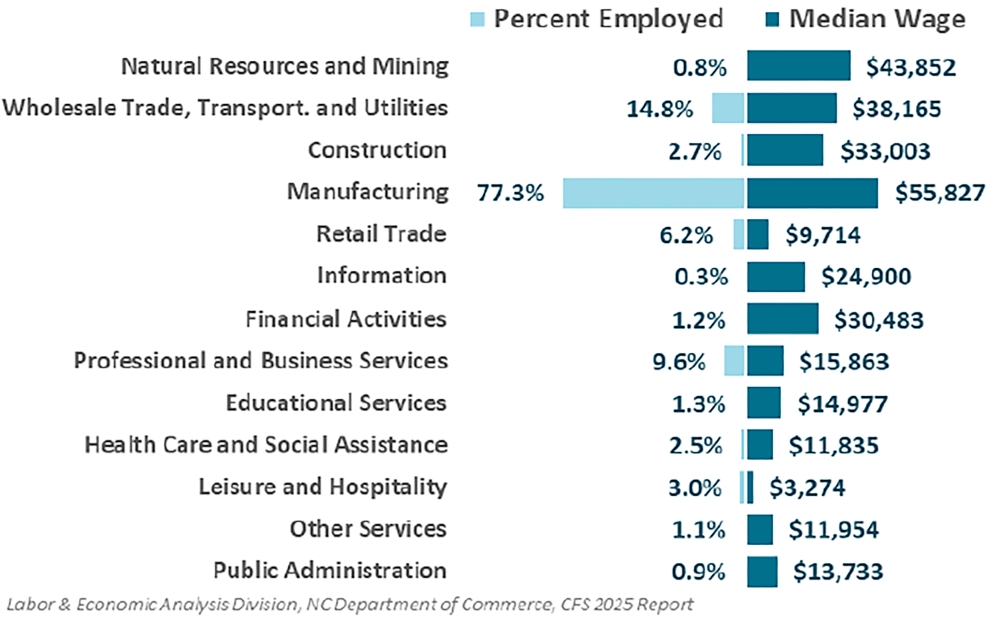
Georgia Quick Start provides customized employer-specific training through the Technical College System of Georgia at no cost to qualifying job-creating companies.54 This statewide approach demonstrates employer-specific job training and the connection between employee recruitment and workforce preparation. Additionally, North Carolina’s Customized Training Program operates through the state’s 58 community colleges, providing statewide coverage across all 100 counties for qualifying new, expanding, and existing businesses (see Figure 4).55 Manufacturing accounted for the largest share of employment among Customized Training Program participants who exited the program in the 2022-2023 cohort.56 Both programs illustrate how states can connect industrial recruitment with existing education and training infrastructure, allowing workforce preparation to occur alongside site development and facility construction.
Figure 4. Employment and Median Annual Earnings of North Carolina Customized Training Program Exiters, 2022–2023, One Year After Exit, by Industry
Source: North Carolina Department of Commerce.57
Note: Individuals may be counted in multiple industries, so employment percentages may total more than 100 percent. Median earnings reflect annual post-exit earnings recorded for participants and do not represent standardized full-time salaries.
For states, workforce readiness can therefore involve more than evaluating the existing labor market. State economic development and postsecondary education systems may also become part of the site-readiness process by determining eligibility for customized training, funding instructional capacity, or coordinating employer-specific training with the development timeline of a new facility.
Beyond the Industrial Park: Community Readiness
Community readiness refers to the capacity of the surrounding area to support the workforce and service demands associated with industrial growth, recognizing that those demands vary considerably by project and location.58 The considerations associated with industrial growth can extend beyond the development site itself. Depending on the scale and location of a project, employment growth may increase demand for housing, child care, transportation, and other community services. Although many of these services are delivered locally or through private providers, state policy can influence their availability through housing programs, transportation funding, workforce initiatives, infrastructure assistance, and other programs that shape community capacity.
Housing
A major industrial project can add jobs more quickly than new housing can be planned, permitted, and constructed, creating a potential mismatch between workforce growth and available housing supply.59 Housing availability can also influence where workers live relative to the employment site and the geographic area from which a project draws its workforce.
Furthermore, housing considerations vary by project location. In a large metropolitan area, there may be a larger housing supply, but the competition for available units and higher housing costs may constrain worker access. Rural communities may have limited housing availability, which can increase commuting distances or constrain recruitment.60 The U.S. Economic Development Administration’s (EDA) current Comprehensive Economic Development Strategy (CEDS) guidance reflects this broader planning approach by identifying housing and workforce development as policy areas that may need to be integrated into regional economic development strategies.61
Child Care
Housing is only one community factor that can shape workforce availability. Child care can also affect whether workers can enter, remain in, or adjust their participation in the labor force, particularly for jobs with nontraditional or rotating schedules.62 For industrial employers operating evening, overnight, or rotating shifts, the availability of child care outside traditional business hours may be especially relevant, directly affecting employee recruitment and retention.63
Federal workforce-development initiatives have treated child care and transportation as practical barriers that can affect workers’ ability to participate in employment and training.64 The Gulf Coast Chambers Network Recompete Plan, covering parts of Alabama, Louisiana, and Mississippi, identifies child care as a barrier to employment in the maritime, manufacturing, and construction industries.65 Part of its proposed solution is providing child care programs for employees to reduce child care barriers to employment.66 Statewide workforce development initiatives may treat child care as part of the infrastructure necessary to connect residents with industrial employment opportunities.
Other Community Infrastructure
Large industrial projects can also influence planning for public services and infrastructure beyond the industrial property itself. Depending on the size and location of the project, communities may evaluate healthcare access, schools, emergency services, fire and law enforcement capacity, local roads, broadband, and other services used by workers and residents.67 These considerations do not mean that every industrial investment requires new public facilities, but substantial employment or population growth may affect existing service capacity and planning needs.
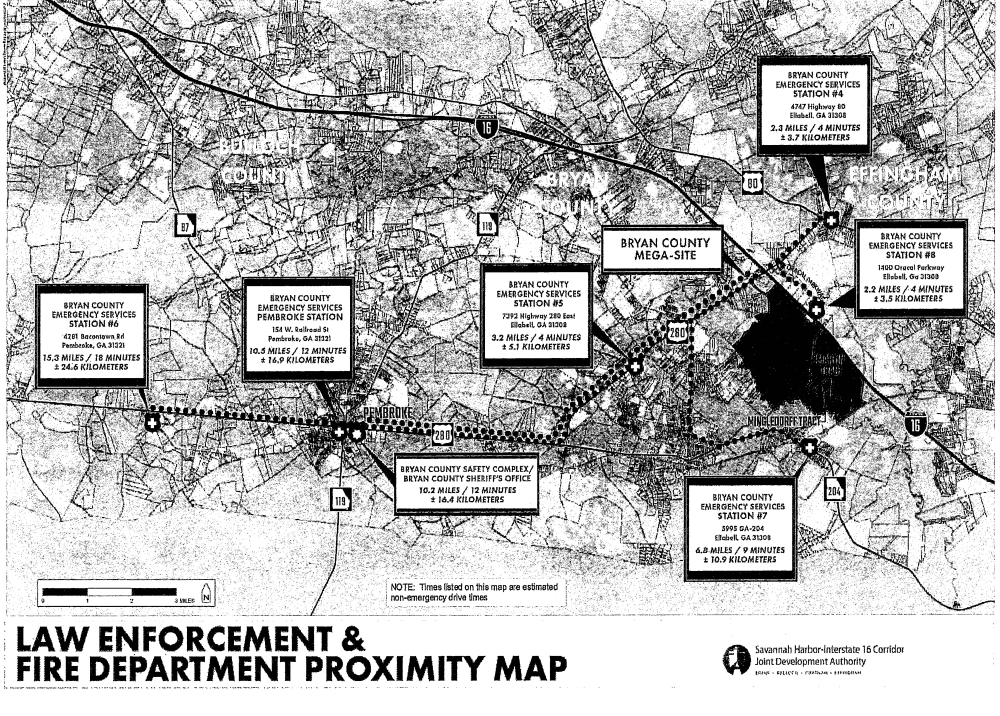
Planning materials for the Bryan County Mega Site in Georgia, for example, included a law enforcement and fire department proximity map identifying nearby emergency-service locations and estimated travel distances and estimated non-emergency driving times to the site (see Figure 5).68 The example illustrates how industrial development planning can extend beyond utilities and transportation to include the surrounding community’s ability to support and respond to growth. For policymakers, these considerations raise questions about the geographic scope of site readiness. A state may prepare the industrial property itself, while housing, transportation, child care, emergency services, or other community needs extend beyond the site boundary and involve different funding streams and levels of government.
Figure 5. Law Enforcement and Fire Department Proximity to the Bryan County Mega Site, Georgia
Source: Savannah Harbor–Interstate 16 Corridor Joint Development Authority.69
Financing and Coordinating Industrial Site Readiness
Timing and Sources of Public Investment
For state policymakers, one distinction in industrial site development is when public investment occurs relative to a prospective project. For purposes of this publication, public investment can be grouped into three stages: pre-development investment, project-linked investment, and post-selection infrastructure. Pre-development occurs before a development company has committed to a project. This investment may include acquisition, due diligence, grading, utility planning, or speculative infrastructure. The purpose of this investment is to improve the site’s readiness for future projects.70 Project-linked investment occurs during the recruitment of a company for development. These investments may include negotiated infrastructure commitments tied to an identified prospective project, although the company has not yet committed to the site and the project may not proceed.71 Post-selection infrastructure investments follow a company’s decision to undertake a project.72 These investments may include road improvements, utility extensions, water upgrades, or transportation connections. Similar types of infrastructure may be funded at each stage, but the timing of investment affects the certainty that a particular project will ultimately use it.
There is no single source of funding for site readiness. Site preparedness may receive funding from sources such as dedicated state site-development programs, water and wastewater grants, utility programs, federal economic development programs, and local funds.73,74 For example, the EDA Public Works program provides funding to communities to invest in their physical infrastructure to attract industry and business expansion.75 As a result, the financing package for a single industrial site may draw from several programs administered by different agencies and designed for different infrastructure purposes.
State Site Development Programs and Cost Sharing
Several Southern states have established dedicated programs that provide funding for industrial site preparation before or apart from a specific project announcement. Tennessee’s Site Development Grant program supports infrastructure and engineering improvements associated with industrial site preparation and operates alongside the Select Tennessee certification process; in June 2026, the state announced more than $13 million in new awards through the program.76,77 Georgia’s Rural Site Development Initiative similarly provides funding for due diligence and site improvements, with the state reporting $21 million in commitments since fiscal year 2025 as of January 2026.78,79 North Carolina uses its Megasite and Selectsite Readiness programs to support acquisition, infrastructure, on-site preparation, and due diligence, awarding $28.3 million to 11 projects in 2025.80,81 Although the programs differ in eligibility and structure, each uses public funding to reduce the remaining work or uncertainty at industrial properties before future recruitment opportunities arise.
These state programs may also require or encourage participation by local governments and development authorities. Georgia’s Rural Site Development Initiative, for example, generally requires a local match of at least 10 percent in eligible counties and 25 percent in conditionally eligible counties.82 Program design may affect not only the amount of state funding available, but also which communities are positioned to participate. Eligibility criteria, local matching requirements, maximum grant amounts, and permissible uses of funds can shape the distribution of state resources among industrial properties. Matching requirements can spread site development costs among state and local partners, while required contributions may vary according to program eligibility criteria. More broadly, site preparation often combines state appropriations with local funds, utility investment, and other infrastructure resources rather than relying on a single source (see Table 2).
TABLE 2. Tennessee Site Development Grant Activity and Funding, 2016–2022
| Year | Investment Category | Grants | TNECD Investment | Leverage* | Total Cost |
|---|---|---|---|---|---|
| 2016 | Site Preparation | 15 | $5,760,585 | $1,946,980 | $7,707,565 |
| 2017 | Site Preparation | 18 | $6,247,383 | $4,020,457 | $10,267,840 |
| 2018 | Site Preparation | 17 | $8,267,583 | $5,585,338 | $13,852,921 |
| Due Diligence/Planning | 7 | $361,057 | $175,989 | $537,046 | |
| 2019 | Site Preparation | 14 | $8,554,007 | $7,173,854 | $15,727,861 |
| Due Diligence/Planning | 15 | $1,136,075 | $421,397 | $1,557,472 | |
| 2020 | Site Preparation | 5 | $2,023,019 | $1,440,472 | $3,463,491 |
| Due Diligence/Planning | 5 | $362,179 | $306,498 | $668,677 | |
| 2021 | Site Preparation | 18 | $12,404,819 | $3,067,816 | $15,472,635 |
| Due Diligence/Planning | 6 | $354,487 | $83,017 | $437,504 | |
| 2022 | Site Preparation | 9 | $7,544,853 | $3,414,120 | $10,958,973 |
| Due Diligence/Planning | 7 | $588,476 | $99,804 | $688,280 | |
| Total | 136 | $53,604,523 | $27,735,742 | $81,340,265 | |
Source: Tennessee Department of Economic and Community Development.83
Project-Specific Funding and Partnerships
Not all public spending on industrial sites occurs through standing readiness programs. Legislatures may also direct funding to a particular site, infrastructure project, or development opportunity. Different types of project-specific funding include direct appropriations by state legislatures, negotiated infrastructure commitments, and funding conditioned on a federal match. Examples of proposed project-specific funding measures that did not advance include Mississippi House Bill 305 (2026), which would have included a direct General Fund appropriation for comprehensive work at a named industrial site; Mississippi House Bill 585 (2026), which would have provided narrower appropriations for access-road improvements serving an industrial park; and North Carolina House Bill 433 (2025), which provides previously appropriated infrastructure funds designated for use as a federal grant match, subject to specified condition.84,85,86
*Leverage includes matching funds that communities are required to put into the project based on program guidelines.
These measures illustrate one area in which legislatures can shape site readiness directly through the appropriations process. Legislative decisions may determine the amount, purpose, recipient, matching conditions, or geographic destination of public funding rather than relying exclusively on administrative grant programs.
Site preparation often requires coordination across several levels of government and with private and infrastructure partners because no single entity typically controls every component of a site’s development.87 State economic development agencies may oversee recruitment, certification, and grant administration, while transportation departments, environmental agencies, and workforce systems address access, permitting, and labor needs. Local governments and development authorities may control the property, provide matching funds, or manage local infrastructure.88,89 Utilities, railroads, ports, and private landowners can contribute capacity information, freight access, or site improvements; community and technical colleges may support workforce training; and federal agencies may provide infrastructure funding.90,91,92 Since the entity that owns a site may not control the road network, utility system, workforce programs, permitting process, or funding needed to prepare it, financing and implementation are often collaborative.
Evaluating Public Investment
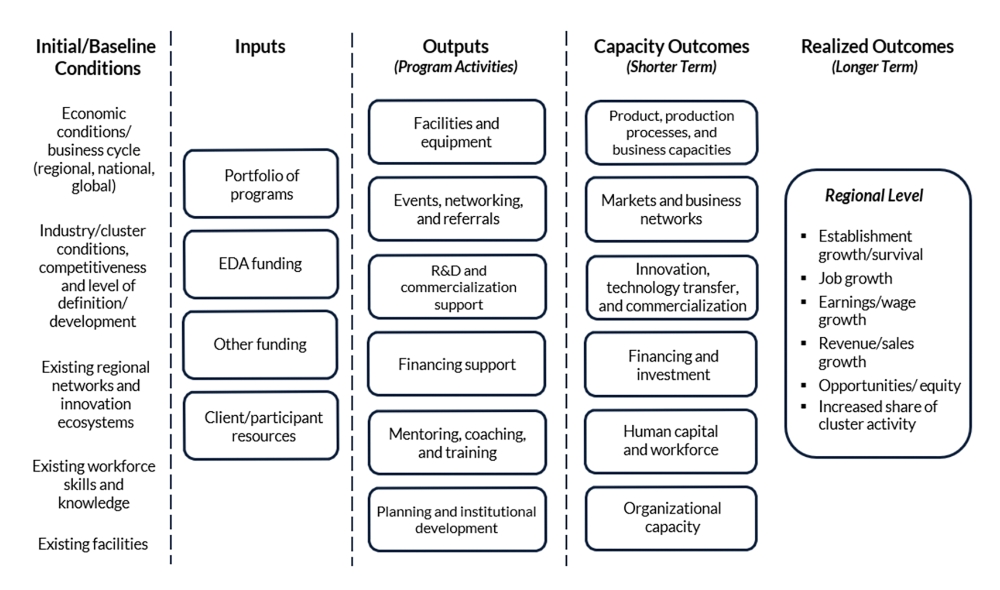
Evaluating site-readiness spending can involve short-term program outputs and longer-term economic outcomes. For site-readiness programs, short-term outputs may include sites evaluated or certified, acres prepared, infrastructure completed, and public funds invested. Longer-term outcomes may include project locations, private investment, employment, and other measures of economic activity.93 Reporting can distinguish announced investment and employment commitments from capital expenditures completed and jobs actually created and retained, with outcomes tracked over time. This distinction is reflected in the EDA logic model (see Figure 6), which connects public investments and programming activities to intermediate outputs and longer-term economic outcomes.94 Using both groups of measures may give policymakers a broader way to assess program activity than relying only on project announcements.
FIGURE 6. U.S. Economic Development Administration Logic Model
Source: Urban Institute.95
There are several challenges to consider when evaluating public investment in site readiness. Site preparation may occur years before a company selects a property, meaning a prepared site may remain unoccupied for some time after public investment. This vacancy does not necessarily indicate that the spending on site readiness provided no value, as some statewide programs seek to retain available inventory of ready-to-go parcels.96 However, evaluations also may consider the opportunity costs of allocating public funds to site development rather than other priorities, ongoing maintenance and carrying costs, and the possibility that infrastructure remains unused if development does not occur. Changes in market demand also may affect a site’s attractiveness over time. Additionally, a project located on a prepared site does not establish that the investment in site readiness caused the location decision. There may be other external factors that drive a developer to select a specific project site.97 An Urban Institute analysis commissioned by EDA found associations between federal construction investments and subsequent changes in employment, business establishments, and income, although estimated effects varied by infrastructure type and geography.98 Evaluation of site-readiness programs can therefore consider both what public investment directly produced and the longer-term economic activity associated with prepared sites, while recognizing the limits of attributing those outcomes to any single investment. Distinguishing announced investment and employment commitments from realized private investment and jobs created can also provide a more complete assessment of program outcomes. For legislatures that establish, appropriate funding for, or oversee site-development programs, these distinctions can also affect what information is requested through program reporting requirements and how results are reviewed over time.
Southern State Approaches
Southern states have structured site-readiness efforts in different ways. The following examples illustrate three approaches: integrating certification, infrastructure, and workforce preparation; investing in large-scale megasite development; and maintaining a statewide pipeline that links site certification to development assistance and industrial access.
Georgia—Integrated Site and Workforce Model
Georgia uses several certification and grant initiatives to support site certification, infrastructure funding, and workforce preparation. The Georgia Ready for Accelerated Development (GRAD) Certification program serves as the baseline for certification, covering environmental, geotechnical, zoning, utility, and related due diligence.99 Furthermore, the Rural Site Development Initiative funds due diligence and physical improvements such as grading, roads, and water/sewer infrastructure.100 Quick Start serves as the workforce component of the Georgia model, providing employer-specific training through the Technical College System of Georgia.101 Taken together, GRAD, RSDI, and Quick Start illustrate a state approach that uses separate certification, infrastructure, and workforce programs as complementary components of industrial recruitment.
North Carolina—Megasite Development
The Megasite Readiness Program serves as North Carolina’s approach to identifying and preparing sites of at least 1,000 acres for major advanced-manufacturing projects.102 Preparing a megasite may involve acquiring the property, preparing the site, and coordinating necessary infrastructure for project use.103 The program’s comparative assessments also illustrate how infrastructure needs can vary substantially across otherwise strategic megasites, with 2023 estimated total development costs ranging from approximately $138.5 million to $737.9 million among the sites reviewed (see Table 3).104 Kingsboro-Edgecombe County had the lowest estimated total in the comparison in part because an existing pad was already in place. At the same time, several other sites required substantial additional investment in transportation, water, wastewater, and pad development. North Carolina’s Selectsite Readiness Program complements this effort by supporting strategic industrial properties at scales below the megasite, creating a tiered approach to expanding the state’s inventory of prepared sites.105 North Carolina’s approach illustrates how a state can use separate programs for megasites and smaller strategic properties while directing funding toward acquisition, due diligence, infrastructure, and site preparation.
TABLE 3. Estimated Development Costs for Selected North Carolina Megasites 2023
| DESCRIPTION | PITT COUNTY SITE | BRUNSWICK COUNTY SITE | CUMBERLAND COUNTY SITE | NASH COUNTY SITE | WILSON COUNTY SITE | ROWAN COUNTY SITE | KINGSBORO-EDGECOMBE COUNTY SITE |
| Due Diligence Costs | $10,000,000 | $2,000,000 | $6,000,000 | $8,900,000 | $7,400,000 | $5,000,000 | $2,000,000 |
| Transportation Costs—NCDOT Vetted Transportation ImprovementsJobs limitations due to transport network | $230,000,000 2,000+ jobs | $130,000,000 2,000+ jobs | $170,000,000 2,000+ jobs | $145,000,000 2,000+ jobs | $130,000,000 2,000+ jobs | $135,000,000 2,000+ jobs | $20,000,000 2,000+ jobs |
| Water Systems Costs | |||||||
| Existing Available Water System Capacity (MGD) | 19 | 12 | 26 | 10 | 4 | 14 | 11 |
| Minimum Water Treatment Plant Expansion Required (MGD) | 0 | 0 | 0 | 5 | 10 | 0 | 0 |
| Water System Improvements | $44,200,000 | $41,800,000 | $44,200,000 | $161,000,000 | $243,500,000 | $101,000,000 | $76,500,000 |
| Wastewater System Costs | |||||||
| Existing Available Wastewater System Capacity (MGD) | 7 | 3 | 3.5 | 11 | 3 | 2.5 | 10 |
| Minimum Wastewater Treatment Plant Expansion Required (MGD) | 0 | 6 | 6 | 0 | 6 | 6 | 0 |
| Wastewater System Improvements | $41,800,000 | $259,000,000 | $235,000,000 | $49,000,000 | $232,000,000 | $302,000,000 | $40,000,000 |
| Total Due Diligence & Order of Magnitude Infrastructure Costs | $326,000,000 | $432,800,000 | $455,200,000 | $363,900,000 | $612,900,000 | $543,000,000 | $138,500,000 |
| “Pad Ready” Site Development Costs (500 Acres Total) | $125,000,000 | $125,000,000 | $125,000,000 | $125,000,000 | $125,000,000 | $125,000,000 | Exists as of May 2023 |
| Total “All In” Order of Magnitude Development Costs | $451,000,000 | $557,800,000 | $580,200,000 | $488,900,000 | $737,900,000 | $668,000,000 | $138,500,000 |
Source: Economic Development Partnership of North Carolina.106
Note: The source states that further engineering, transportation studies, and due diligence are necessary to verify costs and identify potential fatal flaws.
Tennessee—Statewide Site Development Program
Select Tennessee serves as the statewide certification system to establish consistent readiness criteria across potential sites.107 The certification covers land, due diligence, infrastructure, access, and development conditions.108 The Site Development Grant program can support engineering and infrastructure improvements needed to advance prepared sites.109 Similarly, the Tennessee Department of Transportation’s State Industrial Access Program serves as a complementary tool to support highway access to proposed sites.110 Tennessee’s approach illustrates how certification, site-development grants, and state transportation assistance can operate as complementary elements of a statewide site-development pipeline. Together, these programs connect site evaluation and certification with infrastructure investment and industrial access.
Recent Legislative Activity
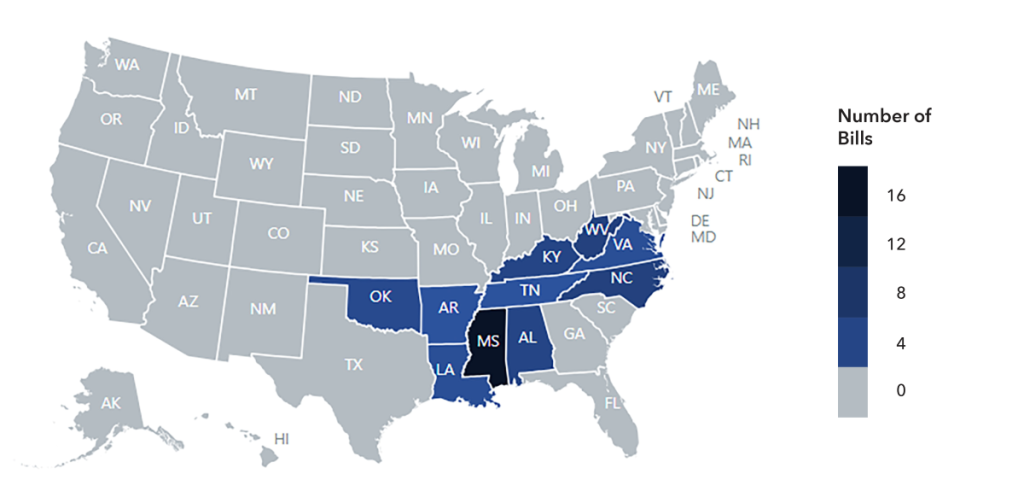
Legislative activity related to industrial site readiness has included a range of measures across Southern states in recent years (see Appendix I for the legislative measures identified for this publication). From 2022 through 2026, at least 43 measures in 10 CSG South states addressed industrial site development, infrastructure, funding, or related readiness programs (see Figure 7).111 The measures demonstrate that state legislative involvement extends beyond direct site-development appropriations and can include the creation or modification of readiness programs, infrastructure funds, eligibility standards, matching requirements, industrial access programs, and authority for large-site development.
Enacted laws and introduced bills reflect a range of approaches to preparing industrial property for future development.
The legislation also reflects differences in the timing of public investment, with some measures supporting site preparation before a company commits and others financing infrastructure associated with a particular site or development project.112
Areas of State Legislative Activity in Industrial Site Readiness, 2022–2026:
|
Figure 7. Industrial Site Readiness Legislation in the South, 2022-2026
Source: Author’s visualization utilizing data from Quorum.113
Note: Gray states mean no measures identified in this review.
Conclusion
Industrial site readiness involves more than the availability of developable land. Utilities, transportation access, completed due diligence, workforce availability, and surrounding community capacity can all influence whether a property can accommodate a prospective project within its expected development timeline.114 Southern states have responded to these considerations at different stages of the development process, with some programs supporting site preparation in advance of a specific prospect and others directing infrastructure or financial assistance after a company has committed to a location.115
Site readiness also spans multiple areas of state policy. Legislatures may establish or fund site-development programs, determine eligibility and matching requirements, appropriate funding for project-specific infrastructure, and oversee the use of public resources. State economic development, transportation, workforce, environmental, and infrastructure agencies may then administer or coordinate different components of site preparation.116
Southern states use different combinations of certification programs, site-development grants, infrastructure funding, and workforce initiatives, reflecting differences in geography, local capacity, industrial targets, and existing infrastructure. As states continue to compete for large industrial and advanced-manufacturing projects, questions surrounding when to invest in sites, how to coordinate infrastructure and workforce needs, and how to evaluate those investments are likely to remain important considerations for policymakers across the region.
Appendix I. CSG South Industrial Site Readiness Legislation (2022-2026)
| STATE | BILL | YEAR | STATUS | NOTES |
| Alabama | Senate Bill 289 | 2026 | Signed by the Governor | Expands eligibility under the Growing Alabama Act so jointly owned industrial sites can receive tax-credit-supported funding for site improvements when all owners are eligible applicants. |
| Alabama | House Bill 594 | 2026 | Referred to House committee | Would create a Rural Industrial Site Development Grant Fund to support grading, roads, utilities, broadband, and environmental permitting at rural industrial sites. |
| Alabama | Senate Bill 226 | 2026 | Signed by the Governor | Provides supplemental appropriations, including transfers to the State Industrial Development Authority and the Alabama Site Development Fund, for economic development and infrastructure purposes. |
| Alabama | Senate Bill 165 | 2023 | Signed by the Governor | Created the Site Evaluation Economic Development Strategy and Alabama Site Development Fund to support site assessment, acquisition, and development grants with local matching requirements. |
| Arkansas | Senate Bill 72 | 2026 | Became Public Law | Reappropriates funding for economic development grants and loans supporting industrial and technology park access, infrastructure, water and sewer improvements, and related projects. |
| Kentucky | House Bill 900 | 2026 | Signed by the Governor | Appropriates reserve funds for a broad range of infrastructure and economic development projects, including product development and mega-development initiatives. |
| Kentucky | House Bill 869 | 2026 | Signed by the Governor | Creates a rural building and job creation revolving fund and revises the Kentucky Product Development Initiative, including grant eligibility, matching, and reporting requirements. |
| Kentucky | House Bill 13 | 2024 | Signed by the Governor | Establishes the Kentucky Product Development Initiative of 2024 with standardized grant criteria for site due diligence, infrastructure, transportation access, and utility readiness. |
| Kentucky | House Bill 745 | 2022 | Signed by the Governor | Created the Kentucky Product Development Initiative to provide grants for property acquisition, infrastructure improvements, and site preparation based on statewide scoring and matching requirements. |
| Louisiana | House Bill 461 | 2025 | Signed by the Governor | Creates the Site Investment and Infrastructure Improvement Fund and other dedicated funds to support economic development site improvements and related infrastructure investments. |
| Louisiana | Senate Bill 27 | 2023 | Referred to Committee | Would revise Louisiana’s Brownfields Investor Tax Credit to modify incentives for investigation and remediation of contaminated properties. |
APPENDIX I CONTINUED. CSG South Industrial Site Readiness Legislation (2022-2026)
| STATE | BILL | YEAR | STATUS | NOTES |
| Mississippi | House Bill 305 | 2026 | Failed by Committee | Would have appropriated $2 million to Noxubee County for site preparation, utilities, access roads, and environmental compliance at a 100-acre multi-industrial site. |
| Mississippi | House Bill 303 | 2026 | Failed by Committee | Would have authorized up to $2 million in state general obligation bonds for the development of a 100-acre multi-industrial site in Noxubee County. |
| Mississippi | Senate Bill 2917 | 2026 | Signed by the Governor | Transfers state funds into multiple economic development and infrastructure accounts, including the Mississippi Site Development Grant Fund and several revolving loan and investment funds. |
| Mississippi | Senate Bill 3070 | 2026 | Signed by the Governor | Appropriates funding to the Mississippi Development Authority, including $14 million from the Mississippi Site Development Grant Fund. |
| Mississippi | Senate Bill 3105 | 2026 | Signed by the Governor | Provides additional funding for several economic development programs, including $29.5 million for the Site Development Grant Program and $20 million for Energy Ready infrastructure. |
| Mississippi | Senate Bill 3071 | 2026 | Line-item (Partially) Vetoed | Appropriates and reappropriates Gulf Coast Restoration Fund revenues for economic development and infrastructure projects. Enacted with partial vetoes of Sections 1(d) and 1(h), removing $1.65 million for two projects while leaving the remaining appropriations in place. |
| Mississippi | House Bill 1633 | 2026 | Signed by the Governor | Expands eligible uses of Mississippi Site Development Grant Program funds to include easements, rights-of-way, and electricity, natural gas, and telecommunications infrastructure serving industrial property. |
| Mississippi | House Bill 585 | 2026 | Failed by Committee | Would appropriate $2.5 million to widen Old Highway 78 to support access to the planned Springs Industrial Park in Holly Springs. |
| Mississippi | House Bill 1807 | 2026 | Failed by Committee | Would appropriate $1.8 million for roadway construction and lane additions near NE Industrial Park Drive in Marion. |
| Mississippi | House Bill 691 | 2025 | Failed by Committee | Would appropriate $2.5 million to widen Old Highway 78 into a four-lane road serving the planned Springs Industrial Park. |
| Mississippi | House Bill 987 | 2025 | Failed by Committee | Would appropriate $1.5 million for infrastructure and site development at the Humphreys County Industrial Park. |
| Mississippi | House Bill 980 | 2025 | Failed by Committee | Would appropriate $3 million for infrastructure and site development at the Sharkey County Industrial Park. |
| Mississippi | House Bill 1815 | 2025 | Failed by Committee | Would appropriate $1.8 million for roadway and intersection improvements near NE Industrial Park Drive in Marion. |
| Mississippi | House Bill 1864 | 2025 | Failed by Committee | Would appropriate funds for road repairs and improvements at the Holmes County Industrial Park. |
APPENDIX I CONTINUED. CSG South Industrial Site Readiness Legislation (2022-2026)
| STATE | BILL | YEAR | STATUS | NOTES |
| Mississippi | House Bill 1929 | 2025 | Failed by Committee | Would appropriate $350,000 for construction and improvements to an access road serving the Indianola Airport and Industrial Park. |
| Mississippi | House Bill 1617 | 2024 | Signed by the Governor | Authorizes industrial development authorities and economic development districts to acquire, finance, and develop sites of at least 800 contiguous acres as megasites. |
| North Carolina | House Bill 1096 | 2026 | Referred to House committee | Would create an aerospace-focused package combining airport infrastructure, workforce training, apprenticeships, and research investments. |
| North Carolina | House Bill 433 | 2025 | Became Public Law | Directs certain funds for water and wastewater infrastructure at the Western North Carolina Megasite and establishes conditions for their use as a federal grant match. |
| North Carolina | Senate Bill 664 | 2025 | Became Public Law | Makes a technical correction to the Megasites Readiness Program, clarifying eligible infrastructure improvements for grant support. |
| North Carolina | House Bill 616 | 2025 | Referred to Senate committee | Would revise the Megasites and Selectsites Readiness Programs to support site acquisition, due diligence, infrastructure upgrades, and site preparation. |
| North Carolina | Senate Bill 424 | 2025 | Referred to Senate committee | Would broaden the permissible uses of Megasite Readiness Program funds while retaining the local purchase option and due diligence requirements. |
| Oklahoma | House Bill 4426 | 2026 | Signed by the Governor | Extends Oklahoma’s economic development tax credit through 2032 for qualifying projects in industrial parks, economic development zones, ports, and rail-served locations. |
| Oklahoma | House Bill 4076 | 2026 | Became Law Without Signature | Appropriates $21.64 million for grants supporting water, wastewater, sewer, and broadband improvements at industrial parks, airparks, and ports. |
| Oklahoma | Senate Bill 1992 | 2026 | Signed by the Governor | Revises Oklahoma’s economic development tax credit program to clarify financing arrangements and support qualified projects and initial infrastructure expenditures. |
| Tennessee | Senate Bill 2226 | 2026 | Became Public Law | Authorizes the Megasite Authority of West Tennessee to issue bonds to finance acquisition, construction, and improvements to its water and wastewater systems. |
| Virginia | Senate Bill 1275 | 2025 | Signed by the Governor | Allows certain 25-acre sites in small localities to qualify for development grants under the Virginia Business Ready Sites Program. |
| Virginia | Senate Bill 135 | 2024 | Signed by the Governor | Allows certain 50-acre sites to qualify for development grants under the Virginia Business Ready Sites Program under specified criteria. |
APPENDIX I CONTINUED. CSG South Industrial Site Readiness Legislation (2022-2026)
| STATE | BILL | YEAR | STATUS | NOTES |
| West Virginia | House Bill 4008 | 2026 | Became Public Law | Expands the Business Ready Sites and Certified Sites programs through matching grants, microgrants, utility infrastructure planning, and revolving site-readiness funding. |
| West Virginia | House Bill 4007 | 2026 | Became Public Law | Expands and increases funding for West Virginia’s Industrial Access Road Fund and makes Business Ready Sites eligible for road-access support. |
| West Virginia | House Bill 4822 | 2024 | Signed by the Governor | Revises the Certified Sites and Development Readiness Program by expanding matching and microgrant assistance for site improvements and requiring repayment when sites are sold or leased. |
| West Virginia | House Bill 3428 | 2023 | Became Public Law | Establishes the Business Ready Sites Program framework for utility infrastructure planning and cost recovery at industrial sites. |
| West Virginia | House Bill 4002 | 2022 | Signed by the Governor | Created the Certified Sites and Development Readiness Program with site evaluations, certification, matching grants, microgrants, and a dedicated fund. |
Source: Author’s visualization utilizing data from Quorum.117
Note: Legislative statuses are reported as of November 3, 2026. The Year column identifies the legislative session in which each measure was introduced, which may differ from its enactment year. Statuses distinguish measures enacted into law, laws that have taken effect, measures that did not advance, vetoed provisions, and legislation pending further action. Status descriptions reflect the most recent legislative action identified for each measure.
Citations
- Economic Development Partnership of North Carolina. NC Megasite Readiness Program Report. May 2023.
https://edpnc.com/wp-content/uploads/2024/03/NC-Megasite-Readiness-Program-Report.pdf. - Ibid.
- Hiatt, Lindsay. Improving Industrial Product Readiness in Hamilton County Through a Certified Sites Program. TCED Capstone Project. Chattanooga Area Chamber of Commerce, August 19, 2015.
- Tennessee Department of Economic and Community Development. “TNECD Announces Site Development Grant Program Expansion.” July 19, 2023. https://tnecd.com/news/tnecd-announces-site-development-grant-program-expansion/.
- Georgia Department of Economic Development. “Rural Site Development.” Accessed August 26, 2026. https://georgia.org/sites/rural-development.
- Georgia Department of Economic Development, Rural Site Development.
- Economic Development Partnership of North Carolina. “Certified Sites.” Accessed August 26, 2026. https://edpnc.com/find-a-site/certified-sites/.
- Hiatt, Improving Industrial Product Readiness in Hamilton County Through a Certified Sites Program.
- Tennessee Department of Economic and Community Development. “Apply for Site Certification.” Accessed November 3, 2026.
https://www.tn.gov/ecd/rural-development/tnecd-site-development/apply-for-site-certification.html. - Williams, Mark. “Site Certification: Now More than Ever, a Critical Tool for Successfully Locating Projects.” Site Selection, May 2012.
- Tennessee Department of Economic and Community Development. Site Development Grant Programs Across Tennessee: 2016–2022 Economic Impact and Case Study Analysis. January 2023, pp. 3–6. https://tnecd.com/?force_download=45561.
- Williams, Site Certification: Now More than Ever, a Critical Tool for Successfully Locating Projects.
- Hiatt, Improving Industrial Product Readiness in Hamilton County Through a Certified Sites Program.
- Economic Development Partnership of North Carolina, Certified Sites.
- Ibid.
- Georgia Department of Economic Development. “When Speed to Market Matters, GRAD Certified Sites Fit the Bill.” June 15, 2022. Updated May 29, 2026. https://georgia.org/blogs/when-speed-market-matters-grad-certified-sites-fit-bill.
- Yawn, Savannah. “Site Development: From Shovel-Ready to Speed-Ready.” Site Selection, July 15, 2026.
https://siteselection.com/site-development-from-shovel-ready-to-speed-ready/. - Georgia Department of Economic Development, When Speed to Market Matters, GRAD Certified Sites Fit the Bill.
- Ibid.
- Economic Development Partnership of North Carolina, NC Megasite Readiness Program Report.
- Ibid.
- Ibid.
- Ibid.
- Economic Development Partnership of North Carolina. “Site Development Initiatives.” Accessed August 26, 2026. https://edpnc.com/find-a-site/site-development-initiatives/.
- Ibid.
- Economic Development Partnership of North Carolina. “Product Development.” 2025 Annual Report. Accessed August 26, 2026. https://edpnc.com/annual-report/product-development/.
- Economic Development Partnership of North Carolina, NC Megasite Readiness Program Report.
- Yawn, Site Development: From Shovel-Ready to Speed-Ready.
- Economic Development Partnership of North Carolina, NC Megasite Readiness Program Report.
- Ibid.
- Yawn, Site Development: From Shovel-Ready to Speed-Ready.
- Ibid.
- Georgia Department of Economic Development. “Certified Sites in Georgia.” Accessed August 26, 2026. https://georgia.org/sites/certified-sites.
- Economic Development Partnership of North Carolina, NC Megasite Readiness Program Report.
- U.S. Economic Development Administration. “July 13–20, 2023.” 2023. https://www.eda.gov/grants/july-13-20-2023.
- Economic Development Partnership of North Carolina, NC Megasite Readiness Program Report.
- Tennessee Department of Transportation. Tennessee Statewide Multimodal Freight Plan 2023. May 2023.
- North Carolina Department of Transportation. “Economic Development.” Accessed September 3, 2026. https://connect.ncdot.gov/projects/planning/Pages/Economic-Development.aspx.
- Economic Development Partnership of North Carolina, NC Megasite Readiness Program Report.
- Ibid.Ibid.
- Ibid.
- Ibid.
- Ibid.
- Ibid.
- Ibid.
- U.S. Census Bureau. “Census Bureau Updates OnTheMap Tool With 2023 Employment Data.” December 18, 2025. https://www.census.gov/newsroom/press-releases/2025/onthemap-2023-employment-data.html.
- U.S. Census Bureau. “OnTheMap.” Accessed September 3, 2026. https://onthemap.ces.census.gov/.
- Ibid.
- North Carolina Department of Commerce, Labor and Economic Analysis Division. North Carolina Common Follow-Up System: 2025 Evaluation Report. January 2025, pp. 66–68, especially Figure 56, p. 68. https://analytics.nccommerce.com/cfs/reports/CFS_Evaluation_Report_2025.pdf.
- Ibid.
- Ibid.
- U.S. Economic Development Administration. Comprehensive Economic Development Strategy (CEDS) Content Guidelines: Recommendations for Creating an Impactful CEDS. 2025, pp. 14–16, 24–28.
https://www.eda.gov/sites/default/files/2025-01/2025-CEDS-Content-Guidelines-Full-Report.pdf. - Georgia Quick Start. “About Us.” Accessed September 3, 2026. https://www.georgiaquickstart.org/about-us/.
- North Carolina Department of Commerce, North Carolina Common Follow-Up System.
- Ibid.
- Ibid.
- U.S. Economic Development Administration. Comprehensive Economic Development Strategy (CEDS) Content Guidelines: Recommendations for Creating an Impactful CEDS. 2025. https://www.eda.gov/sites/default/files/2025-01/2025-CEDS-Content-Guidelines-Full-Report.pdf.
- Sun, Sai, and Lingqian Hu. “Workers Wanted: Changing Employee Accessibility with Industrial Development—Evidence from Foxconn.” Transportation Research Part D: Transport and Environment 80 (March 2020): 102264. https://doi.org/10.1016/j.trd.2020.102264.
- U.S. Department of Housing and Urban Development, Office of Policy Development and Research. “Rural Housing.” Evidence Matters, Winter 2026. https://www.huduser.gov/portal/periodicals/em/winter-26/highlight1.html.
- U.S. Economic Development Administration, Comprehensive Economic Development Strategy (CEDS) Content Guidelines.
- National Governors Association. “Child Care: A Focus for Governors at the 2024 NGA Winter Meeting.” 2024.
- Ibid.
- U.S. Economic Development Administration. Recompete Pilot Program: Phase 2 Frequently Asked Questions. 2024.
- U.S. Economic Development Administration. “Gulf Coast Chambers Network (GCCN) Recompete Plan.” 2023. https://www.eda.gov/funding/programs/recompete-pilot-program/2023/Gulf-Coast-Chambers-Network-Recompete-Plan.
- Ibid.
- U.S. Economic Development Administration, Comprehensive Economic Development Strategy (CEDS) Content Guidelines.
- Savannah Harbor-Interstate 16 Corridor Joint Development Authority, First Amended and Restated Economic Development Agreement.
- Ibid.
- Economic Development Partnership of North Carolina, Site Development Initiatives.
- Burkart, Gregory C., and Keith Hopkins. “Site Selection in the United States: Key Variables, Processes, and Technologies.” In SelectUSA Investor Guide. U.S. Department of Commerce, International Trade Administration, 2022. https://www.trade.gov/sites/default/files/2022-07/SiteSelection2022Update.pdf.
- Savannah Harbor-Interstate 16 Corridor Joint Development Authority, First Amended and Restated Economic Development Agreement.
- Georgia Department of Economic Development, Rural Site Development.
- U.S. Economic Development Administration. “Public Works.” Accessed August 26, 2026. https://www.eda.gov/funding/programs/public-works.
- Ibid.
- Tennessee Department of Economic and Community Development, TNECD Announces Site Development Grant Program Expansion.
- Tennessee Department of Economic and Community Development. “TNECD Announces New Round of Site Development Grants.” June 30, 2026. https://tnecd.com/news/tnecd-announces-new-round-of-site-development-grants/.
- Georgia Department of Economic Development, Rural Site Development.
- Georgia Department of Economic Development. “Gov. Kemp Announces Third Round of Rural Site Development Grants.” January 30, 2026. https://georgia.org/press-releases/2026/gov-kemp-announces-third-round-rural-site-development-grants.
- Economic Development Partnership of North Carolina, Site Development Initiatives.
- Economic Development Partnership of North Carolina, Product Development.
- Georgia Department of Economic Development, Rural Site Development.
- Tennessee Department of Economic and Community Development, Site Development Grant Programs Across Tennessee, pp. 5–11. https://tnecd.com/?force_download=45561.
- Mississippi Legislature. “House Bill 305.” 2026 Regular Session. https://billstatus.ls.state.ms.us/2026/pdf/history/HB/HB0305.xml.
- Mississippi Legislature. “House Bill 585.” 2026 Regular Session. https://billstatus.ls.state.ms.us/2026/pdf/history/HB/HB0585.xml.
- North Carolina General Assembly. “House Bill 433.” 2025 Session. https://www.ncleg.gov/BillLookUp/2025/H433.
- Georgia Department of Economic Development, Rural Site Development.
- U.S. Economic Development Administration. “CEDS Content.” Accessed August 26, 2026. https://www.eda.gov/resources/comprehensive-economic-development-strategy/content.
- Georgia Department of Economic Development, Rural Site Development.
- Savannah Harbor-Interstate 16 Corridor Joint Development Authority, First Amended and Restated Economic Development Agreement.
- North Carolina Department of Commerce, North Carolina Common Follow-Up System.
- U.S. Economic Development Administration, Public Works.
- Theodos, Brett, Daniel Teles, Christina Plerhoples Stacy, Christopher Davis, Jonathan Schwabish, and Tanay Nunna. Local Impacts of Economic Development Administration Construction Investments. Urban Institute, July 2024, pp. 2–5, Table 1 and Figure.
https://www.urban.org/sites/default/files/2024-07/Local_Impacts_of_EDA_Construction_Investments.pdf. - Ibid.
- Ibid.
- Economic Development Partnership of North Carolina, Site Development Initiatives.
- Tennessee Department of Economic and Community Development, Site Development Grant Programs Across Tennessee: 2016-2022 Economic Impact and Case Study Analysis.
- Theodos, Brett, Daniel Teles, Noah McDaniel, and Christina Plerhoples Stacy. Private Investment Impacts of Economic Development Administration Construction Grants. Urban Institute, June 25, 2026.
https://www.urban.org/research/publication/private-investment-impacts-economic-development-administration-construction. - Georgia Department of Economic Development, When Speed to Market Matters, GRAD Certified Sites Fit the Bill.
- Georgia Department of Economic Development, Rural Site Development.
- Georgia Quick Start, “About Us.”
- Economic Development Partnership of North Carolina, Site Development Initiatives.
- Economic Development Partnership of North Carolina, NC Megasite Readiness Program Report.
- Ibid.
- Economic Development Partnership of North Carolina, Site Development Initiatives.
- Economic Development Partnership of North Carolina, NC Megasite Readiness Program Report, May 2023, p. 62, “Order of Magnitude (OOM) Development Costs.” https://edpnc.com/wp-content/uploads/2024/03/NC-Megasite-Readiness-Program-Report.pdf.
- Tennessee Department of Economic and Community Development, TNECD Announces Site Development Grant Program Expansion.
- Tennessee Department of Economic and Community Development. “Apply for Site Certification.” Accessed September 3, 2026.
https://www.tn.gov/ecd/rural-development/tnecd-site-development/apply-for-site-certification.html. - Tennessee Department of Economic and Community Development, TNECD Announces Site Development Grant Program Expansion.
- Tennessee Department of Transportation, Tennessee Statewide Multimodal Freight Plan 2023.
- Quorum. “Industrial Site Readiness Legislation in the South, 2022–2026.” Accessed September 3, 2026.
https://www.quorum.us/spreadsheet/external/sbdWMVpVrRUoHkYKouYm/. - Ibid.
- Ibid.
- Economic Development Partnership of North Carolina, Certified Sites.
- Economic Development Partnership of North Carolina, Site Development Initiatives.
- U.S. Economic Development Administration, CEDS Content.
- Quorum, Industrial Site Readiness Legislation in the South, 2022-2026.