
 DOWNLOAD
Regional Resource by Senior Policy Analyst, Tom Opdyke
From Houston’s harbor to the banks of Lake Barkley, Tennessee, from Baton Rouge to Birmingham to Belews Creek, North Carolina, manufacturing facilities and power plants across the South produce significant carbon emissions. In 2022, both the power production and industrial sectors in the combined 15 Southern states produced at least 50 percent of all carbon emissions in the country.¹
But what if there were ways to prevent carbon dioxide (CO₂) from entering the atmosphere, or even remove the CO₂ already in the air? Enter carbon capture.
The concept of carbon capture is not new. In 1930, Robert Roger Bottoms of Louisville, Kentucky, was issued a U.S. patent for separating gases, namely CO₂ from combustible gases.² In the 1970s, natural gas processing plants in Texas began separating CO₂ to sell it to nearby oil producers, who then injected the gas into oilfields to improve production.³
Today, this process has expanded into an entire industry. Across the country, carbon capture and storage facilities trapped approximately 22 million metric tons of CO₂ in 2023 (though this only represented 0.4 percent of the nation’s CO₂ emissions that same year).⁴ This is roughly the equivalent of the annual emissions of five million passenger vehicles.⁵ However, the process can be expensive, and the industry is still reliant on federal subsidies. In addition, the permitting process with the U.S. Environmental Protection Agency (EPA) takes years, and questions on liability are still unanswered in some states.
Despite this, carbon capture, utilization, and storage companies and facilities are appearing across the South. As of June 2025, more than 40 companies have requested permits to drill wells to store CO₂ underground in Southern states. In the fifteen Southern state legislatures, twenty laws related to carbon capture were enacted in the last three years, with many more bills debated during each session.
Each state in the South is considering some type of strategy for carbon capture. This report will cover their different approaches, from underground access agreements in Alabama to West Virginia’s recent federal approval to oversee the permitting process for carbon sequestration wells. First, however, it will give an overview of what carbon capture is, its costs, and potential decisions from Washington, D.C. that may change the industry.
How Carbon Capture Works
In a nutshell, carbon capture aims to take carbon dioxide (CO₂) out of the air around us or prevent it from entering the atmosphere at all. This is done by filtering CO₂ from either ambient air or specific emissions given off by certain production processes. The CO₂ is then separated from other molecules like oxygen or nitrogen.
The process of doing this directly from the air is called “Direct Air Capture,” whereas the process of filtering CO₂ from emissions produced by some industrial production sectors (steel, cement, etc.) and certain power generation sources (namely coal and natural gas) is called “Point-Source Capture.” The captured CO₂ is then liquified and transported to be put into storage or for additional use (in which it is ultimately stored).
There are other types of carbon capture, such as carbon farming, that rely on plants and soil to capture CO₂ from the atmosphere. Since CO₂ is naturally stored this way, these methods do not require the additional steps of separating out CO₂ and storing it elsewhere. Several countries, including the U.S., have incentivized farmers who agree to reduce carbon via specific practices for soil, crops, livestock, and agroforestry management.⁶
Terminology
Carbon capture-related topics can go by many names, and the terminology for this process is debated among researchers.⁷ When CO₂ is captured and then used for an additional purpose before being stored (such as Enhanced Oil Recovery), it may be referred to as Carbon Capture, Utilization, and Storage (CCUS).⁸ If the CO₂ is put directly into storage without being utilized, it may be referred to as Carbon Capture and Storage (CCS).⁹
In addition, storing CO₂ usually involves injecting it into the ground, a process often known as “carbon sequestration.”
Direct Air Capture
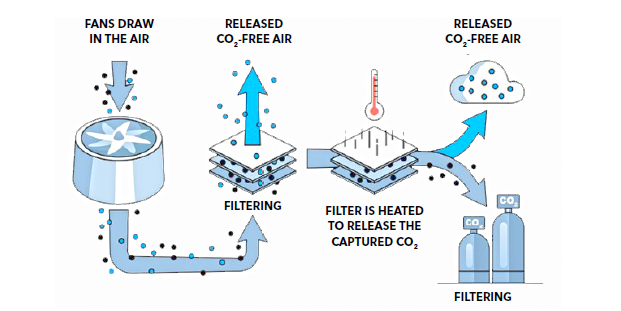
The idea for large-scale Direct Air Capture (DAC) dates back nearly thirty years¹⁰ and works by collecting ambient air, the air in the atmosphere around us, then putting it in contact with alkaline solvents or sorbents to capture different molecules. CO₂ is then separated from the other molecules, after which it can be compressed and transported for storage or additional use.
FIGURE 1. A Simplified Diagram of Direct Air Capture (DAC)¹¹
Point-Source Capture
The Point-Source method is similar to the Direct Air Capture method outlined above, but it aims to capture CO₂ before it is released into the atmosphere. Three common methods exist for capturing the CO₂ produced as a byproduct of power production and the industrial sector: post-combustion, pre-combustion, and oxy-combustion.¹²
Post-Combustion
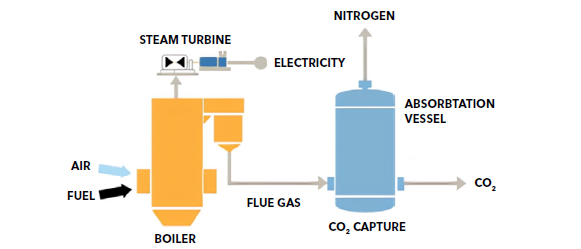
Post-combustion carbon capture involves removing carbon from emissions created from a fuel source (e.g., natural gas, coal, etc.) after the fuel has been combusted in a boiler or furnace. The process uses chemical solvents to separate CO₂ from other particles in the exhaust from the combustion. This process happens in a low-pressure environment, which means more power is required to separate out the CO₂.
FIGURE 2. Diagram of the Post-combustion Method¹³
Pre-Combustion
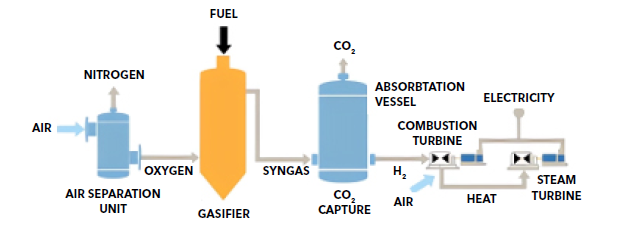
Removing carbon from a fuel source before the fuel is combusted is called “pre-combustion” carbon capture. This involves a higher-pressure system that begins with putting the fuel into a gasifier to create synthesis gas, or “syngas.” The molecules in syngas are much easier to separate (especially at high pressure), so the CO₂ is filtered out, and the remaining gas (composed of hydrogen and other non-carbon molecules) can be used in the combustion process.
FIGURE 3. Diagram of the Pre-combustion Method¹⁴
Oxy-Combustion
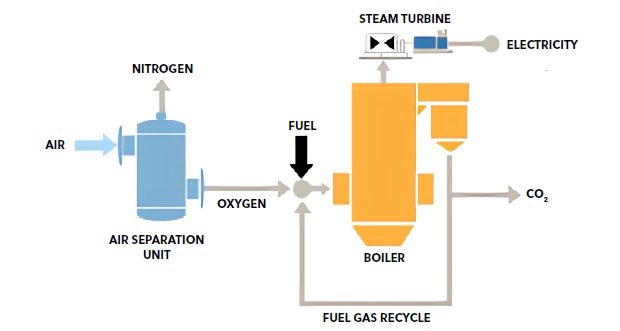
Oxy-combustion carbon capture separates oxygen and nitrogen from the air that initially goes into the system. The pure oxygen, along with fuel, is then used in the combustion process. During the combustion process, the carbon in the fuel mixes with the oxygen and creates pure CO₂. Some of this CO₂ is filtered out for capture, while a small amount of it goes back into the boiler to assist with combustion.
FIGURE 4. Diagram of the Oxy-combustion Method¹⁵
Transportation
Once the CO₂ is captured, it is pressured into a liquid state. This makes it easier to transport, often by pipelines, though trucks or ships might also be used.¹⁶ Across the country, approximately 5,000 miles of pipeline are dedicated to transporting CO₂.¹⁷
In terms of safety, from 1986 to 2021, onshore pipelines for carbon capture had about three incidents per year, though some were more severe than others. According to researchers from the University College London, the majority (80 to 99 percent) of CO₂ pipeline failures are fractures that are about two inches or less. These were likely due to the presence of small amounts of water (a common, unavoidable impurity in the carbon capture process) that led to corrosion. In comparison, 45 percent of natural gas pipeline failures were nearly two inches or smaller; in oil pipelines, the number was 90 percent. These small-sized fractures in CO₂ pipelines mean that failures tend to be continuous releases (CO₂ leaking out slowly) and not large-scale ruptures.¹⁸
However, large-scale CO₂ pipeline ruptures can still occur. These are often due to external interference or ground movement.¹⁹ In 2020, for example, forty-five people were hospitalized and hundreds more were evacuated after a pipeline carrying CO₂ ruptured due to a landslide caused by heavy rains near Satartia, Mississippi.²⁰ In such instances, the CO₂ vaporizes when it escapes the pipeline.²¹ As the gas enters the area, it tends to settle near the ground and, since it is heavier than oxygen, it displaces breathable air and can cause asphyxiation.²²
Utilization and Storage
Industries have found a variety of uses for CO₂, such as the Texas oil producers mentioned in the introduction that use Enhanced Oil Recovery. Other methods include using CO₂ to produce sustainable aviation fuels, chemical manufacturing, and materials such as concrete.²⁴ It can also be used in greenhouses to improve plant growth.²⁵
Enhanced Oil Recovery
Once drilled, oil wells use the natural pressure difference between the underground reservoir and the surface to extract oil (or by using a pump); this is known as “primary recovery.” However, this method usually only yields about 10 percent of a reservoir’s oil.²⁶ After that, Enhanced Oil Recovery (EOR) comes into play. In some forms of EOR, a gas is injected into the well to expand the pressure and force more oil to the surface through the well. Carbon dioxide has become an increasingly common choice for this method, but other gases like natural gas or nitrogen may also be used.²⁷
Depending on the pressure of the well and other factors (such as temperature, etc.),²⁸ the CO₂ will act as a force to push the oil into the well, or it will bond with the oil to make it more viscous, thus making it easier to extract.²⁹ EOR is also considered a carbon capture method when the CO₂ stays in the oil reservoir underground instead of being released into the atmosphere.³⁰ Approximately 80 percent of all CO₂ captured from industrial or power production emissions is used for EOR.³¹
Underground Injection Storage
Unlike CO₂ that is utilized and then stored via processes like EOR, 20 percent of captured CO₂ goes directly to storage underground. The process by which this happens varies. It can be placed in depleted oil and gas reservoirs, or deeper wells can be drilled for storage. The latter are drilled into saline aquifers, which are concentrations of porous and permeable rocks deep underground that are saturated with salty water (brine).³² This type of geological formation is used because its composition generally keeps the CO₂ trapped beneath the ground and prevents it from seeping into the soil above and the air beyond that.
To create a carbon-injected well in a saline aquifer, a well may be drilled as deep as 8,000 feet or more³⁴ in order to maintain the captured CO₂’s dense liquid state.³⁵ Once reaching the necessary depth, the well is drilled horizontally to tap into the maximum available space underground. Depending on the geology of the specific area, the radius for this may go in any direction and could extend to nearly 12,000 feet. Engineers must continually monitor the area to ensure there are no unexpected seepages (e.g., due to improperly shuttered wells on the property, etc.).³⁶
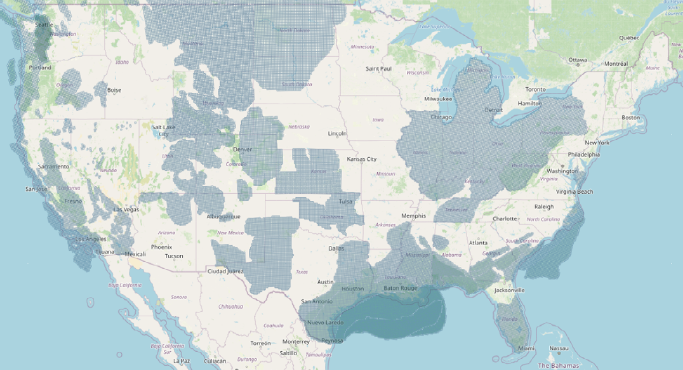
FIGURE 5. Saline Aquifers in the Continental U.S.³³
Pore Space Rights
When considering underground injection storage, the question arises as to who owns the rights to the space beneath the surface where the CO₂ will go. These areas are called “pore space” and can be found in the saline aquifers mentioned above. Because this question relates to laws for land and usage rights, it is usually left to each individual state to determine. Generally, states follow what is known as “The American Rule,” which views the land’s surface owner as the owner of the pore space. This is different from “The English Rule,” which gives pore space ownership to the person or entity that holds the land’s mineral rights.³⁷
The distinction comes from oil and gas exploration where, in a simple case, a landowner might sell the land’s mineral rights to someone either to extract the minerals or to own as an investment. The debate between the two rules exists because, once all or most of the minerals are extracted, the space left behind is open and now a valuable asset for carbon storage. Among others, Alabama and Kentucky have passed specific laws to codify the surface owner’s right to the land’s pore space.³⁸
Onshore vs. Offshore
As shown in the map in Figure 5, underground injection carbon storage is not limited to land-based sites. Like oil and gas, injection wells can be drilled offshore, though these may come with a heftier price tag.³⁹ However, offshore drilling could address many issues with carbon capture storage; the storage capacity is greater, and drilling in state or federal waters means fewer landowners and permitting agencies to manage.⁴⁰ Sites in Louisiana and Texas are already being considered for offshore underground injection carbon storage, but the vast majority of U.S. carbon sequestration is still onshore.⁴¹ In the South, for example, approximately fewer than 10 percent of the 120 wells submitted for permitting consideration are offshore wells.
Profits and Incentives
Enhanced Oil Recovery (EOR) provides a clear revenue stream for companies in the carbon capture industry. Since the captured CO₂ becomes a commodity once it is captured, it can then be sold. These sales incentivize companies to pursue carbon capture and help sustain it.
For storage-only purposes, however, the revenue process is not as simple. In essence, CO₂ that will go directly to storage is not a commodity that can be sold to another company for additional use; it is only stored. Carbon storage companies can charge emitters to store the captured CO₂, but tax credits are the more common method by which the industry is able to support itself.
Tax Credits and Carbon Credits
First introduced in 2008, the federal government has incentivized CO₂ storage through a tax credit program under the IRS’s Section 45Q. This incentive has remained throughout the Obama, first Trump, and Biden administrations.⁴² (For more information on federal support for carbon capture, see the “Changes at the Federal Level” section.) Currently, for projects built in 2023 and onward, the 45Q credit is $17 per metric ton of CO₂ ($36 for Direct Air Capture) that is geologically sequestered and $12 per metric ton of CO₂ ($26 for Direct Air Capture) that is geologically sequestered using EOR.⁴³
In addition, carbon capture companies can also gain revenue from selling carbon credits, especially to the private sector. In September 2024, for example, Google agreed to pay a Tennessee-based carbon capture company, Holocene (now owned by Occidental Petroleum), $10 million for capturing 100,000 metric tons of CO₂ by the 2030s.⁴⁴ This represented a milestone in carbon credits as the price of $100 per metric ton is what some have called the “Holy Grail” of affordable carbon credits.⁴⁵
To put this sale in perspective regarding carbon credits, 100,000 metric tons represents less than 0.7% of Google’s carbon footprint in one year.⁴⁶ If Google were to continue to cover its annual carbon footprint at a cost of $100 per metric ton, it would cost the company $1.43 billion a year, assuming its carbon footprint does not increase each year. In 2024, that would have been slightly more than 0.4% of Google’s annual revenue.⁴⁷ This isn’t to say that such an approach isn’t possible, but it may not be probable.
Underground Injection Storage in the U.S.
As mentioned in the “Underground Injection Storage” section, underground injection storage in the U.S. is still a small industry, representing only 20 percent of storage for carbon capture. As of June 2025, at least 25 Class VI underground injection sites across the country have been permitted by the U.S. Environmental Protection Agency (EPA) or state agencies with specific approval to do so.⁴⁸
The reasons why there are so few underground injection sites come down to three main factors: cost, permitting, both of which are discussed below, and public resistance. Public resistance is based on a number of factors, but mainly centers on concerns about nearby pipelines (and, with them, potential leakages), contaminated drinking water, and ground erosion.
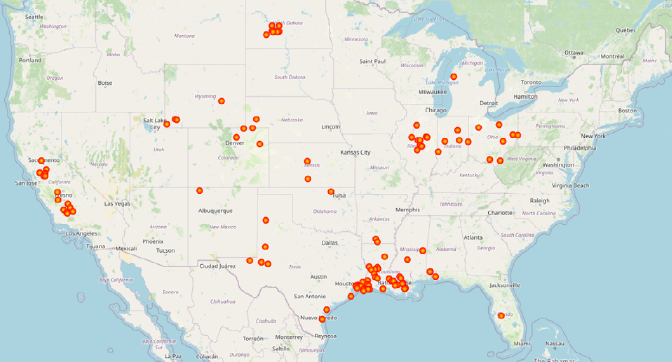
FIGURE 6. Class VI Wells in the US (Current and Under Permitting Review)⁵⁰
Location, Location, Location
The best locations for underground injection wells tend to have two criteria: close to the source of carbon emissions (in order to reduce transportation) and areas with large saline aquifers. For the former, this means drilling wells close to industrial and carbon-emitting power generation facilities or Direct Air Capture facilities. For the latter, according to the U.S. Geological Survey, the coastal basins from Texas to Georgia account for the most storage potential in the country.⁴⁹ Given this and its energy hubs, the South is a key location for underground CO₂ injection storage.
Permitting
The federal government has designated wells that can inject liquified carbon underground as “Underground Injection Control (UIC) Class VI” wells. There are six classes for underground injection control wells, such as Class II, which can be used for EOR, but Class VI wells are designated explicitly for long-term CO₂ sequestration.⁵¹
The U.S. Environmental Protection Agency (EPA) is responsible for issuing these permits, unless the EPA has granted primacy to a state. Otherwise, a state is not permitted to issue UIC Class VI permits within its borders without federal approval. Only four states- Louisiana, North Dakota, West Virginia, and Wyoming- have been granted Class VI primacy for underground injection control wells.⁵³ Eight other states, including Alabama, Mississippi, Oklahoma, and Texas, have submitted applications to the EPA.⁵⁴
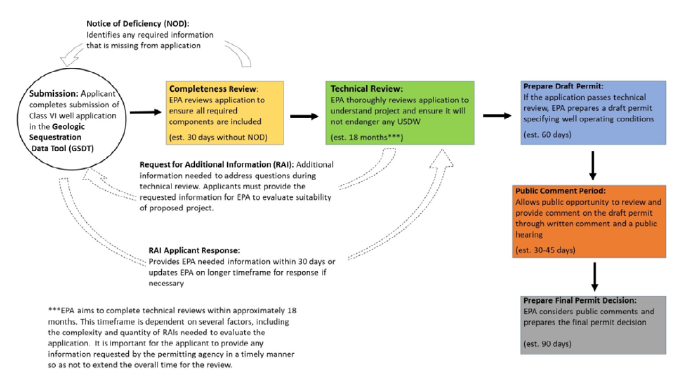
For the remaining states, any potential projects for Class VI underground injection wells must be permitted by the EPA. This includes both onshore and offshore (within state waters) wells.⁵⁵ As of June 2025, 175 applications are currently under review; more than 100 of those applications were received at least 12 months ago. Among Southern states, Alabama, Arkansas, Florida, and Texas have applications under review with a combined total of 67.⁵⁶
Some have cited the permitting bottleneck as a key cause for why carbon capture has not been more widely adopted. In 2015, researchers from MIT cited the lack of a “comprehensive regulatory framework” as a reason for the industry’s slow growth.⁵⁸ Anna Littlefield of the Payne Institute at the Colorado School of Mines reiterated this point ten years later in April 2025, saying, “The primary challenge facing CCUS is the regulatory uncertainty created by current federal policies.”⁵⁹
TABLE 1. Underground Injection Control Well Classes⁵²
| Well Classification | Injection Material/Use |
|---|---|
| Class I | Hazardous and non-hazardous wastes into deep, isolated rock formations. |
| Class II | Fluids associated with oil and natural gas production |
| Class III | Fluids to dissolve and extract minerals |
| Class IV | Shallow wells used to inject hazardous or radioactive waste into or above a geologic formation that contains an underground source of drinking water |
| Class V | Non-hazardous fluids; most Class V wells are used to dispose of waste into or above underground sources of drinking water |
| Class VI | Carbon dioxide (CO2) injected into underground subsurface rock formations for long-term storage, or geologic sequestration. |
FIGURE 7. EPA UIC Class VI Permitting Process⁵⁷
Cost
The cost of capturing and storing CO₂ is also a significant factor as to why the industry has not become more widespread. In 2023, the U.S. Congressional Budget Office estimated that implementation costs ranged from about $15 to $120 per metric ton of CO₂ captured, depending on the sector. In addition, this estimate only factored in capture costs; it did not consider costs associated with transportation and storage. Instead, the main revenues associated with carbon capture come from Enhanced Oil Recovery (EOR), as well as federal tax credits.⁶⁰
For carbon capture projects relying on revenue from EOR, there is a risk that low oil prices could put such projects in jeopardy. For example, beginning in 2020, NRG (the then-operator of the Petra Nova coal-fired power plant in East Texas near Houston) suspended its carbon capture operations for three years when oil prices dropped. Without enough revenue from oil, capturing and transporting CO₂ for EOR became too costly to maintain. NRG estimated that oil prices would need to be at least $60 per barrel in order to make carbon capture financially feasible (adjusted for inflation, it would be $75 per barrel in April 2025).⁶¹
To roll out a full underground injection capture network (capturing 1 billion to 1.7 billion metric tons by 2050), Princeton University estimates that $13 billion would need to be invested in just the preliminary stage of the process (stakeholder engagement, appraisals, permitting, etc.). Another $170 billion to $230 billion would be needed to build the necessary pipelines (approximately 68,000 miles of new pipelines) to transport CO₂ to injection sites, as well as to utilization sites (EOR, etc.).⁶²
Liability
Drilling deep holes into the ground is dangerous work, so considering the liability aspects of carbon capture is crucial. In the oil and gas industry, determining who will be liable for any incidents is usually decided long before a well breaks ground, if not already determined by law. In most cases, the responsibility falls on the well operator, which usually incentivizes strong oversight and best practices.⁶³
However, pumping CO₂ deep into the ground with the intention of leaving it there permanently presents an issue: how long is the well operator responsible for issues with the CO₂ stored there? Assuming that responsible steps are taken, an underground injection site should carry little long-term risk, but the fact remains that traditional tools like insurance and bonds are not usually designed to ensure forever liability. Uncertainty about this issue has been listed among the top reasons for high costs and slow growth of the carbon capture industry.⁶⁴
Louisiana and Wyoming have addressed this by transferring ownership of the site to the state after a set period of time. In Louisiana, the timeframe is fifty years after the injection (or a timeframe approved by the state’s Commissioner of Conservation on a case-by-case basis).⁶⁵ In Wyoming, the site is transferred once a closure certification has been issued by the state.⁶⁶
Changes at the Federal Level
The second Trump administration has signaled its support for carbon capture and storage, specifically in terms of speeding up federal processing.⁶⁷ Secretary of the Interior and former North Dakota Governor (one of the states with primacy for permitting), Doug Burgum, was once called “obsessive about carbon capture”⁶⁸ and, in February 2025, said that “geologic storage makes so much sense for our country.”⁶⁹
In addition, President Trump paused pipeline regulations set during the final days of the Biden administration, thus easing the path for additional pipelines dedicated to carbon storage, albeit with fewer oversight mechanisms.⁷⁰ Therefore, the ongoing changes from Washington, D.C. could benefit the carbon capture and storage industry, or at least maintain the status quo.
However, the industry is still aware of what would happen if the federal government opted not to support carbon capture. Federal tax credits under 45Q, for example, could be taken away, which some fear might significantly reduce the number of carbon capture and storage projects throughout the country.⁷¹ The head of the Carbon Capture Coalition, Jessie Stolark, put it bluntly, saying, “Without the tax credit, pretty much all of those [CCS] projects go away.”⁷²
Others, however, are less concerned. Only a few days after President Trump’s second inauguration, the CEO of CapturePoint, an oil and gas company that uses EOR, spoke on 45Q tax credits, saying, “It’s always been bipartisan… the likelihood of that one changing is probably pretty slim.” ⁷³
Even if the 45Q tax credits are kept in place, the second Trump administration may consider withdrawing funding for carbon capture projects funded under the Biden administration. Across the South, for example, hundreds of millions of dollars were awarded by the U.S. Department of Energy for these projects in 2024 alone (for more information, see the “Recent Activities in Southern States” section). Already, some state leaders in the South are asking those in Washington to carefully consider which projects are defunded.⁷⁴
Effectiveness of Carbon Capture
Carbon capture is not without its critics. For example, some researchers have concluded that the energy that powered Point-Source capture technologies was often generated by sources that emitted more CO₂ than was captured. However, if carbon capture mechanisms are powered by energy sources like wind, this is not likely to be the case.⁷⁵
Others believe that using carbon capture to provide CO₂ for EOR only prolongs society’s dependence on fossil fuels. In addition, claims of “net-zero” energy production through the use of EOR may not factor in transportation’s impact or other CO₂ emissions during production.⁷⁶
Southern States and Carbon Capture
Recent State Laws
Across the South, seven states have enacted laws related to Carbon Capture, Utilization, and Storage (CCUS) in the last three years.
TABLE 2. Enacted Bills related to CCUS in the South (2023–2025)*
| State | Bill | Summary |
|---|---|---|
| Alabama | HB 327 (2024) | Establishes a framework for underground carbon storage; sets key definitions and rights of surface property owners; empowers the State Oil and Gas Board to approve storage facilities, etc.; and creates two funds, the Underground Carbon Dioxide Storage Facility Trust Fund and the Underground Carbon Dioxide Storage Facility Administrative Fund |
| Arkansas | SB 307 (2025) HB 1411 (2025) | Allows utilities to recover costs for feasibility studies and investments in new technology, including carbon capture; rate changes are subject to approval from the Arkansas Public Service Commission. Outlines the authority the Arkansas Oil and Gas Commission has over underground carbon storage; establishes the Carbon Dioxide Storage Fund |
| Louisiana | HB 966 (2024) HB 937 (2024) HB 516 (2024) HB 492 (2024) HB 169 (2024) | Authorizes unitization for carbon dioxide storage projects and details the process for forming a unit Clarifies that landowners have underground usage rights and are not responsible for future liabilities related to carbon sequestration Requires certain provisions related to geologic sequestration of carbon dioxide, including emergency response plans, siting prohibitions for Class VI wells, groundwater testing and monitoring requirements, and reporting requirements Clarifies the landowners’ rights related to eminent domain related to carbon dioxide pipelines; establishes a procedure for operators to acquire private land via eminent domain related to carbon dioxide pipelines Limits the recovery of noneconomic damages in civil liability actions for carbon sequestration; caps compensatory damages related to noneconomic loss (except in certain cases) to $250,000 per person; in exceptional cases, the cap is increased to $500,000 per person. |
| Mississippi | HB 2001 (2024; second special session) | As part of a larger set of initiatives, the bill requires that, among other provisions, electrical generating facilities owned by public utilities must meet at least two of the three criteria: 1) promoting grid resiliency, 2) enhancing fuel diversity, or 3) currently or in the future implementing carbon capture technology |
| Oklahoma | SB 1569 (2024) SB 269 (2025) HB 1543 (2025) | Authorizes the Oklahoma Conservation Commission to create a carbon sequestration certification program Updates state law related to carbon sequestration to provide the Oklahoma Corporation Commission with exclusive jurisdiction for overseeing Class VI CO2 injection wells and the injection of CO2 for carbon sequestration. It also authorizes the Commission to enter into Memorandums of Understanding (MOUs) with any governmental agency to implement such actions allowed by state law. In addition, it sets out the process for well closures, stating that a certification of completion may be issues to the owner 50 years after the cessation of all injections. It also sets out a fee schedule for the state’s Class VI Carbon Sequestration Storage Facility Revolving Fund Allows the Oklahoma Conservation Commission to enter into contracts with Conservation district directors and to work with local tribes |
| Virginia | SB 1107 (2025) SB 1116 (2023) SB 1075 (2023) HB 2386 (2023) | When the Virginia Economic Development Partnership Authority is requesting records from the Department of Workforce Development and Advancement, proprietary information that was shared with a public body for a carbon capture sequestration agreement, but was done so under the promise that the information shall remain confidential, is omitted from said records requests; same as HB 2502, and the 2023 session’s SB 1497 and HB 2394 Permits the Southwest Virginia Energy and Research Development Authority to promote carbon capture research and technologies; same as HB 1781 Requires the Virginia State Corporate Commission to consider utilities’ new power generation facilities’ planned carbon capture technology when deciding on the approval of said facilities; same as or similar to 2023 session’s SB 1265, SB 1420, HB 1770, HB 1776, and HB 1777 Creates the Virginia Power Innovation Fund and authorizes it to “research and development of innovative energy technologies, including nuclear, hydrogen, carbon capture and utilization, and energy storage;” same as SB 1464 |
| West Virginia | SB 627 (2025) SB 162 (2023) HB 5045 (2023) | Removes the state park exception from the 2023 law (see WV SB 162 (2023)), allowing the West Virginia Division of Natural Resources to lease state-owned pore spaces for underground carbon sequestration Authorizes the West Virginia Division of Natural Resources the power to lease state-owned pore spaces (underneath state-owned lands, except for state parks) for underground carbon sequestration Amends and reenacts several portions of the Code of West Virginia related to water pollution and underground carbon sequestration in order to assure and be in line with the guidelines of the EPA (WV was in the process of applying for primacy for UIC Class VI wells at the time) |
Recent Activities in Southern States
Alabama
In 2024, Alabama established a framework for carbon storage using underground injection.⁷⁷ Since then, several access agreements have been made for underground carbon sequestration. For example, in late 2024, Rayonier, a timberland real estate investment trust, made an agreement with Reliant Carbon Capture & Storage that allows Reliant to access approximately 104,000 acres of Rayonier’s land and use it for carbon sequestration.⁷⁸
North of Mobile, a Nebraska-based energy company, Tenaska, is building an underground storage facility that will store CO₂ generated by local industry emissions. The facility is expected to be operational in 2029; it is currently in the permitting process with the EPA.⁷⁹ In central Alabama, Advanced Resources International, a company based out of Virginia, is planning tests for suitable sequestration sites.⁸⁰
Arkansas
In May of 2024, LSB Industries announced a partnership with Lapis Energy to store the CO₂ produced by LSB’s ammonia production underneath the facility in El Dorado, Arkansas. LSB claims that these efforts are the equivalent of taking 11 percent of the cars registered in Arkansas off the road.⁸¹
A Canadian carbon capture company, Svante Technologies, is testing new post-combustion capture technologies at the Ashdown Pulp Mill, fifteen miles north of Texarkana. The process will use low-grade waste heat, which is expected to reduce the energy needed to capture carbon.⁸²
Florida
Governor Ron DeSantis has spoken out against carbon sequestration,⁸³ but others in the Sunshine State believe it has potential, including some of the state legislature like Senator Ana Maria Rodriguez and Representative Lindsay Cross who introduced companion bills to create a taskforce on carbon sequestration.⁸⁴
In 2024, Virginia Tech was announced as the technical lead for Project ACCESS (which stands for “the Atlantic Coast CO₂ Emissions Storage Sink”), which will explore and evaluate the potential carbon sequestration in southern Florida, just northwest of Miami.⁸⁵
The Tampa Electric Company has submitted an application to the EPA for three underground wells in Bradley Junction. Nearby Hillsborough County recently approved a test program to capture carbon from a waste-to-energy plant.⁸⁶ Waste-to-energy plants incinerate municipal solid waste; the combustion is then used to power a generator. Though not common in most Southern states, Florida has a dozen such facilities.⁸⁷
The project, run by a South Korean climate tech company called LowCarbon, aims to capture one metric ton per day during the pilot stage,⁸⁸ which amounts to what the average car produces in three months.⁸⁹
Georgia
The Peach State’s largest utility, Georgia Power, began tests in 2024 to consider suitable locations for carbon sequestration, one northwest of metro Atlanta in Bartow County and two in the southeastern part of the state in Brantley and Wayne counties.⁹⁰
In the southeastern part of the state, Carbon America (based in Arvada, Colorado) was awarded nearly $68 million by the U.S. Department of Energy for a pilot project that will assess the geological viability of carbon sequestration.⁹¹
Kentucky
The Cane Run Generating Station in Louisville was awarded nearly $5 million from the U.S. Department of Energy to begin a large-scale carbon capture pilot project in 2024. The pilot will use technology developed by the University of Kentucky to capture as much as 95 percent of the CO₂ from a portion of the station’s emissions.⁹²
Louisiana
Carbon capture remains a hotly debated topic in Louisiana. In addition to the five laws listed in Table 2, Louisiana discussed at least sixteen bills in the 2025 session, ranging from making carbon sequestration illegal⁹³ to requiring pipeline developers to get consent from 95 percent of the affected landowners before seeking a state permit.⁹⁴ These bills reflect increasing community opposition to carbon storage across the state.
The state’s Department of Energy and Natural Resources is currently reviewing 50 well applications from 33 projects. Louisiana was granted primacy on permitting Class VI wells in 2024, but there are not yet any active carbon sequestration wells in the state.⁹⁵ Of the sites being considered or that have applied for permitting, at least two would be offshore facilities.
In 2024, the U.S. Department of Energy awarded nearly $37 million in total to two carbon sequestration projects. The first is an expansion phase of a project with several locations in the River Parishes (the project is aptly named the River Parish Sequestration Project), and the second is to develop the Evergreen Sequestration Hub in Beauregard and Calcasieu parishes in the southwestern part of the state.
Mississippi
Like the Cane Run Generating Station in Kentucky, the Vicksburg Container Mill was also selected by the U.S. Department of Energy to conduct a pilot study on large-scale carbon capture; the project was awarded $4.4 million. The mill is a containerboard supplier for boxes used by Amazon and, if successful, it could capture 90 percent of the mill’s CO₂ emissions, the equivalent of 27,000 gas-powered cars.⁹⁶
In Yazoo City, ExxonMobil entered into an agreement in 2024 to transport and store approximately 500,000 metric tons of CO₂ from CF Industries Nitrogen Complex.⁹⁷ ExxonMobil was also slated to begin carbon sequestration operations in Simpson and Copiah counties after acquiring Denbury Inc. in February 2024,⁹⁸ but it withdrew the permitting application with the EPA in August of that same year.⁹⁹ Mississippi Power also had plans to develop a sequestration site, but it too withdrew its permitting application with the EPA in March 2024.¹⁰⁰
Missouri
In Ste. Genevieve, a carbon capture company, Nuada, paired with MLC (formerly Mississippi Lime)’s facility, which makes products for various sectors, from construction to food production. Nuada’s technology is similar to what Svante Technologies is using in Arkansas and aims to capture up to 95 percent of emissions from the MLC facility.¹⁰¹
North Carolina’s Greenhouse Gas Inventory was one of the first in the world to include data on the natural carbon capture of submerged aquatic vegetation, such as seagrasses, which led to a commitment to preserving and regenerating such vegetation.
North Carolina
In 2021, North Carolina enacted HB 951, which established goals for reducing carbon emissions by 70 percent from 2005 levels by 2030.¹⁰² This led the state to conduct a greenhouse gas inventory (GGI) that included submerged aquatic vegetation (SAV) such as seagrasses. This was one of the first GGIs in the world to include data on SAVs.¹⁰³
The GGI discovered that, while 50 percent more of the CO₂ stored naturally by SAVs comes from other sources (thus making them a natural direct air carbon capture and storage mechanism), the SAVs in North Carolina are declining at a rate of more than 1.5 percent a year.¹⁰⁴ The state has committed to preserving and regenerating SAVs, along with natural carbon capture mechanisms that it says will account for capturing 34 percent of greenhouse gas emissions in North Carolina.¹⁰⁵
Oklahoma
Northeast Oklahoma, near Shidler in Osage County, is the home of one of the world’s largest constructed Direct Air Capture facilities.¹⁰⁶ Project Bantam is a partnership between Heimdal, a carbon capture company, and CapturePoint, an oil and gas company that uses EOR. It has the capacity to capture 5,000 metric tons of CO₂ annually. The project involves heating quarried limestone, exposing it to the air to absorb CO₂ and other molecules, and then heating it again to separate and capture the CO₂.¹⁰⁷ According to Heimdal, the cost of this will be less than $200 per metric ton, which is potentially much cheaper than similar direct-air carbon capture projects.¹⁰⁸ CapturePoint then takes the captured CO₂ and uses it for EOR in nearby Class II wells.¹⁰⁹
In addition, the University of Oklahoma, in partnership with CapturePoint and the Los Alamos National Laboratory, was awarded $18.7 million by the U.S. Department of Energy in 2024 to conduct geological research on potential Class VI carbon sequestration sites; the project is called the Oklahoma Carbon Hub.¹¹⁰ However, the permit application submitted by CapturePoint to drill the Class VI wells as part of the project was withdrawn in January 2025. CapturePoint says that it needs at least two more years to study the area before drilling.¹¹¹
South Carolina
South Carolina’s Office of Resilience released the “South Carolina Priority Climate Action Plan” in 2024. The report recommended increasing carbon sequestration and storage mechanisms, including unique approaches like studying the feasibility of woody biomass for carbon capture.¹¹²
Tennessee
In Knoxville, a carbon capture company called Holocene opened an industrial direct-air capture pilot facility in May 2024. The goal of the pilot facility is to capture ten metric tons of CO₂ per year, with plans for future projects to increase this amount significantly.¹¹³ In September 2024, Google agreed to pay Holocene $10 million for capturing 100,000 metric tons of CO₂ by the 2030s.¹¹⁴ In April 2025, Occidental Petroleum purchased Holocene with plans to continue the company’s CO₂ capture, then either store it in Class VI wells or use it for EOR.¹¹⁵
Though not solely in Tennessee, the Tennessee Valley Authority (TVA) mainly serves the Volunteer State and, in a 2024 report, stated that direct-air carbon capture innovations will be necessary to achieve its goal of net-zero emissions by 2050. TVA is also researching point-capture carbon capture for two of its natural gas plants.¹¹⁶
Texas
Like Louisiana, Texas is buzzing with carbon capture activity, including offshore exploration. In April 2025, the first Class VI permit for carbon storage in the Lone Star State was issued by the EPA to Project Stratos near Odessa in west Texas. The site is owned by Occidental Petroleum after it acquired Carbon Engineering in 2023 for $1.1 billion (Occidental also purchased the Tennessee-based carbon capture company, Holocene, in April 2025). The facility is still under construction and, once complete, is expected to capture 500,000 metric tons of CO₂ per year.¹¹⁷ This would make Project Stratos one of the world’s largest carbon capture facilities.
Texas still has 54 Class VI well applications under review by the EPA, making it the second highest among states without primacy (behind California, which has 55 applications).¹¹⁸ In late 2022, Texas submitted an application to the EPA for primacy to permit Class VI wells.¹¹⁹
One of the many sites still awaiting its permit is Pineywoods CCS Hub in southeast Texas outside of Houston. The 100,000-acre hub aims to serve as an underground injection site for captured CO₂, though the underground storage area is estimated to only cover 20,000 acres during the project’s 30-year lifespan.¹²⁰ In 2024, Carbon Solutions LLC was awarded $4.5 million from the U.S. Department of Energy to, among other things, conduct a CO₂ source feasibility study, a CO₂ pipeline Front End Engineering Design (FEED) study, and a business strategy to prepare for construction.¹²¹
Offshore, in March 2022, the Texas General Land Office (GLO) signed the first lease for offshore underground carbon storage in state waters anywhere in the country.¹²² Then, in October 2024, the Texas GLO signed a lease agreement with ExxonMobil to develop carbon capture on 271,068 acres of offshore land in state waters, making it the largest such lease agreement in the country.¹²³
Virginia
The Virginia Department of Energy is developing a CO₂ storage hub in Wise County in southwestern Virginia, along the border with Kentucky. The sequestration sites being considered by the project have the potential to store hundreds of millions of metric tons of CO₂. The project is still in its early stages as the Virginia Department of Energy gathers information and researches the site’s potential.¹²⁴
Farther east, Virginia Tech is studying potential sequestration sites in Botetourt County. Aptly named “Project Cardinal,” the initiative received $9 million from the U.S. Department of Energy in 2024, and its lead researcher, Ryan Pollyea, says the site could store an amount of CO₂ that would be the equivalent of 350,000 gas-burning cars.¹²⁵
West Virginia
As mentioned previously, the EPA granted West Virginia primacy for Class VI underground injection carbon storage wells in February 2025. As of May 2025, it is not clear how many permit applications have been logged with the state’s Department of Environmental Protection. Three sites, however, two in the northern counties of Hancock and Marshall and one in Mason County to the west, are currently looking at underground injection carbon capture.¹²⁶
The Central Appalachia CO₂ Storage Hub Project in Marshall County was awarded $44 million by the U.S. Department of Energy in 2024 and will be located near the planned Appalachian Regional Clean Hydrogen Hub, which spans across parts of Ohio, Pennsylvania, and West Virginia.¹²⁷
Conclusion
With activity in the carbon capture industry occurring in each Southern state, state-level governments are recognizing the impact of the growing sector and the need to address potential issues that arise from it. Some states have already moved ahead on issues slowing the industry down, such as Louisiana and West Virginia’s federal approval to oversee Class VI permitting within their own borders. Other states have taken different approaches, like North Carolina’s inclusion of natural carbon capture into its carbon reduction strategy.
As the second Trump administration signals its willingness to support the industry, carbon capture seems poised to continue growing. Therefore, the issue is likely to continue being discussed inside state capitols and outside in open fields with plentiful pore space underneath. Carbon capture may therefore be more than a pipedream and could provide big profits to Southern states.
End Notes
- “Energy-Related CO2 Emission Data,” U.S. Energy Information Administration, October 29, 2024.
- Robert Roger Bottoms (1930), Process for Separating Acidic Gases, U.S. Patent No. 1783,901, New York, NY, U.S. Patent and Trademark Office.
- “A New Era for CCUS,” International Energy Agency, accessed April 22, 2025.
- Nathan Musick, “Carbon Capture and Storage in the United States,” Congressional Budget Office, December 2023.
- Anna Littlefield, “Carbon Capture Technology is Ready. Permitting Needs to Catch Up,” Utility Drive, April 24, 2025.
- Nidhi Raina, Matteo Zavalloni, & Davide Viaggi, “Incentive Mechanisms of Carbon Farming Contracts: A Systematic Mapping Study,” Journal of Environmental Management, Vol. 352, February 14, 2024; “Carbon Farming: Opportunities for Agriculture and Farmers to Gain From Decarbonization,” S&P Global, July 28, 2022.
- Jonas Pigeon, “Underground as a Controversial Mitigation of Climate Change Option: Example Of Carbon Capture and Storage (CCS) implementation,” reseaerchgate.net, 2019.
- J. Sekera and A. Lichtenberger, “Assessing Carbon Capture: Public Policy, Science, and Societal Need,” Biophysical Economics and Sustainability, Vol. 5, Iss. 14, 2020.
- UN Intergovernmental Panel for Climate Change, “Annex VII: Glossary,” edited by Matthews et al, Climate Change 2021: The Physical Science Basis. Contribution of Working Group I to the Sixth Assessment Report of the Intergovernmental Panel on Climate Change, Cambridge University Press, pgs 2215–2256, August 9, 2021.
- Klaus Lackner, Hans-Joachim Ziock, and Grimes, Patrick, “Carbon Dioxide Extraction from Air: Is It An Option?,” Technical Report LAUR- 99–583 (Los Alamos National Laboratory), February 1, 1999.
- Eric J. Klein, “Overview of CO2 Capture Technology,” Long International, January 9, 2023.
- “Carbon Dioxide Capture Approaches,” National Energy Technical Laboratory, accessed April 22, 2025.
- “Climate Change Concerns Drive Projects to Curb CO2,” Power Magazine, June 15, 2007.
- Ibid
- Ibid
- “What Is Carbon Capture and Storage?,” National Grid, accessed April 23, 2025; Eden Weingart, “How Does Carbon Capture Work?,” The New York Times, March 19, 2023.
- “Are There Risks to Transporting Carbon Dioxide in Pipelines?,” MIT Climate Portal, July 10, 2024.
- Jiahuan Yi, Sergey Martynov, & Haroun Mahgerefteh, “Puncture Failure Size Probability Distribution for CO2 Pipelines,” International Journal of Greenhouse Gas Control, Vol 125, May 2023.
- Ibid
- “Failure Investigation Report – Denbury Gulf Coast Pipelines, LLC – Pipeline Rupture/ Natural Force Damage,” Office of Pipeline Safety – Accident Investigation Division, Pipeline and Hazardous Materials Safety Administration, May 26, 2022.
- Ibid
- MIT Climate Portal, 2024.
- Accident Investigation Division, Pipeline and Hazardous Materials Safety Administration, 2022
- Kate Whiting, “Explainer: What is Carbon Capture and Utilization?,” Centre for Nature and Climate, World Economic Forum, August 20, 2024.
- Howard Herzog, “Carbon Capture,” MIT Climate Portal, January 20, 2023.
- “Enhanced Oil Recovery,” U.S. Department of Energy, accessed April 24, 2025.
- “What is the Difference between Primary, Secondary & Enhanced Recovery for Oil Extraction?,” Petro Industry News, accessed April 24, 2025.
- Eman Mohamed Ibrahim Mansour, “Carbon Dioxide-Oil Minimum Miscibility Pressure Methods Overview,” IntechOpen, November 2, 2022.
- U.S. Department of Energy, accessed April 24, 2025.
- “Commercial Carbon Dioxide Uses: Carbon Dioxide Enhanced Oil Recovery,” National Energy Technical Laboratory, accessed April 22, 2025.
- Yuting Zhang, Christopher Jackson, & Samuel Krevor, “The Feasibility of Reaching Gigatonne Scale CO2 Storage by Mid-Century,” Nature Commons, Vol. 15, August 28, 2024.
- Samantha McCulloch et al, “Energy Technology Perspectives 2020,” International Energy Agency, September 2020.
- NATCARB Atlas Saline Basin 10km Grid, CCUS Map, accessed April 29, 2025.
- Discussion between Dr. Karsten Thompson of the Craft & Hawkins Department of Petroleum Engineering at Louisiana State University and Tom Opdyke of the Council of State Governments, South, in-person, Baton Rouge, October 24, 2024.
- McCulloch et al, 2020.
- Thompson, 2024.
- R. Lee Grisham and Owen Anderson, “Legal and Commercial Models for Pore-Space Access and Use for Geologic CO2,” 72 U. Pitt. L. Rev. 701, 2011.
- Alabama Code § 9-17-161; Kentucky Rev Stat § 353.800.
- Daniel P. Schrag, “Storage of Carbon Dioxide in Offshore Sediments,” Science, Vol. 325, September 25, 2009.
- Muriel Hague, “A Hitchhiker’s Guide to Carbon Capture and Sequestration Regulation in Texas and Beyond,” Houston Law Review, Vol. 61, Iss. 4, April 29, 2024.41 “Underground Injection Control (UIC) Class VI Permit Tracker,” U.S. Environmental Protection Agency, April 25, 2025; “Class VI Carbon
- Sequestration Program,” Louisiana Department of Natural Resources and the Environment, accessed April 29, 2025.
- Fernanda Ferreira, “How Much is Captured CO2 Worth?,” MIT Climate Portal, January 23, 2023.
- Angela Jones & Donald Marples, “The Section 45Q Tax Credit for Carbon Sequestration,” Congressional Research Service, August 25, 2023.
- Randy Spock, “Our First-of-its-kind Direct Air Capture Deal Forges a Path to Lower Costs,” Google, September 10, 2024.
- “Holocene is Redefining the Future of Direct Air Capture Solutions,” Breakthrough Energy, November 21, 2024.
- Justine Calma, “Google’s Carbon Footprint Balloons in Its Gemini AI Era,” The Verge, July 2, 2024.
- “Alphabet Announces Fourth Quarter and Fiscal Year 2024 Results,” Alphabet, accessed April 30, 2025.
- 48 Shelby Webb, “States Start Their Own DOGE Efforts, Ensnaring Oil and Gas Regulators,” Politico, April 1, 2025.
- USGS, accessed April 24, 2025; Thompson, 2024.
- Class VI Wells, NATCARB Atlas Saline Basin 10km Grid, CCUS Map, accessed May 2, 2025.
- Underground Injection Control Well Classes, U.S. Environmental Protection Agency, accessed April 30, 2025.
- “General Information About Injection Wells,” U.S. Environmental Protection Agency, accessed May 23, 2025.
- Angela Jones, “Class VI Carbon Sequestration Wells: Permitting and State Program Primacy,” Congressional Research Service, April 16, 2024; 40 C.F.R. § 147.2450.
- Carlos Anchondo, “States Jockey for Carbon Storage Authority from Trump EPA,” Politico, February 6, 2025.
- T. C. Grant et al, CCS Opportunity Along the Gulf Coast Corridor [Conference Presentation], 2024 Offshore Technology Conference, Houston, Texas, May 6, 2024.
- U.S. Environmental Protection Agency, April 25, 2025.
- “Class VI – Wells used for Geologic Sequestration of Carbon Dioxide,” U.S. Environment Protection Agency, accessed April 25, 2025.
- Monica Lupion, Holly Javedan, & Howard Herzog, “Challenges to Commercial Scale Carbon Capture and Storage: Regulatory Framework,” Massachusetts Institute of Technology, 2015.
- Littlefield, 2025.
- Musick, 2023
- McCulloch et al, 2020.
- E. Larson et al, “Net-Zero America: Potential Pathways, Infrastructure, and Impacts,” Princeton University, October 29, 2021.
- Scott Anderson, “States Should Not Weaken Liability Laws for CCS Projects,” Environmental Defense Fund, May 3, 2022.
- Eames and Fewell, 2008.
- Louisiana Rev Stat § 30:1109
- Wyoming Stat § 35-11-319
- Jeff Young, “The Climate Technology That Trump’s Administration Wants to Expand,” Newsweek, February 19, 2025.
- Adam Willis, “North Dakota Wants Your Carbon, But Not Your Climate Science,” Bloomberg, November 13, 2024.
- Young, 2025.
- Tristan Baurick, “Trump Withdraws New Pipeline Rules Inspired by CO2 Leaks in Mississippi, Louisiana,” Louisiana Illuminator, March 8, 2025.
- John Biers, “Carbon Capture Industry Tweaks Message for the Trump Era,” AFP, March 16, 2025.
- Ibid
- Chloe Bennett-Steele, “Oklahoma’s Oil Fields Could Be Key to Remedy Carbon Emissions,” The Oklahoman, January 26, 2025.
- James Bikales, Josh Siegel, Kelsey Tamborrino, and Ben Lefebvre, “Lawmakers and Industry Groups Blast Away at DOE Project Kill List,” Politico, March 29, 2025.
- Mark Z. Jacobson, “The Health and Climate Impacts of Carbon Capture and Direct Air Capture,” Energy & Environmental Science, Iss. 12, October 21, 2009.
- Michael Buchsbaum, “When a Climate Solution Is Used to Produce More Oil,” Deutsche Welle, June 9, 2021.
- AL Code §9-17-160 to §9-17-166
- Violet George, “Rayonier And Reliant Partner For Carbon Capture And Storage In Alabama,” Carbon Herald, December 27, 2024.
- Mary Helene Hall, “Nebraska-based Company Plans to Inject Captured CO2 Emissions into the Ground in Mobile County,” AL.com, March 28, 2024.
- “Project Selections for FOA 2711: Carbon Storage Validation and Testing (Round 3),” U.S. Department of Energy, accessed April 29, 2025.
- “What Is The El Dorado Carbon Capture & Storage Project?,” LSB, accessed April 28, 2025.
- Sasha Ranevska, “Svante’s Pulp & Paper CO2 Removal Project Selected For $1.5M Cost-Sharing DOE Agreement,” Carbon Herald, January 31, 2025.
- Florida Governor Ron DeSantis [@GovRonDeSantis], “Florida’s Republican supermajority is spending time on so-called carbon sequestration. Injecting carbon into our soil, aquifers, and even our ocean floor is a non-starter. Carbon sequestration is a scam. A GOP supermajority is a terrible thing to waste,” X, March 31, 2025.
- Jacob Ogles, “Ana Maria Rodriguez, Lindsay Cross Seek Carbon Sequestration Task Force,” Florida Politics, January 7, 2024.
- “Innovations and Partnerships,” Virginia Polytechnic Institute and State University, accessed April 29, 2025.
- Jessica Meszaros, “Carbon Capture Pilot Project is Coming to Hillsborough, Despite Pushback from Clean Energy Advocates,” WUSF, April 18, 2024.
- “March 2025: Preliminary Monthly Electric Generator Inventory,” U.S. Energy Information Administration, accessed April 29, 2025.
- Meszaros, 2024.
- Matthew Conlen, How Much Carbon Dioxide Are We Emitting?, National Aeronautics and Space Administration, July 15, 2021.
- Drew Kann, “Georgia Power is Drilling Holes More Than a Mile Underground. Here’s Why,” The Atlanta Journal-Constitution, August 23, 2024.
- U.S. Department of Energy, accessed April 29, 2025.
- Sonal Patel, “Carbon Capture Projects at Gas-Fired Cane Run 7, Coal-Fired Four Corners Get Federal Awards,” Power Magazine, September 19, 2024.
- An Act to enact R.S. 30:2.2, relative to the legality of carbon dioxide sequestration; to make carbon capture and sequestration illegal; and to provide for related matters, HB 396, 2025 Regular Session of the Louisiana State Legislature, Louisiana, 2025.
- An Act to amend and reenact R.S. 19:2(10) and (11) and R.S. 30:1107(B) and to enact R.S. 19:2.3 and R.S. 30:1108(A)(4), relative to carbon dioxide sequestration et al, HB 601, 2025 Regular Session of the Louisiana State Legislature, Louisiana, 2025.
- Louisiana Department of Natural Resources and the Environment, accessed April 29, 2025.
- Spencer Kimball, “Big Oil is Racing to Scale Up Carbon Capture to Slash Emissions but the Challenges Are Immense,” CNBC, April 6, 2024.
- Amy Power, “ExxonMobil and CF Industries in Mississippi Have Signed a Carbon Capture Agreement,” CCUS Expo, July 29, 2024.
- Olivia Quesada, “ExxonMobil’s Recent Strategic Move: Transforming the Landscape of CO2 Capture, Storage, and Sequestration,” TGS, February 2, 2024.
- U.S. Environmental Protection Agency, April 11, 2025.
- Ibid
- Violet George, “Nuada And MLC Join Forces To Decarbonize Lime Production With Carbon Capture,” Carbon Herald, January 27, 2025.
- An Act to authorize the utilities commission et al, HB 951, 2021 Regular Session of the North Carolina General Assembly, North Carolina, 2021.
- Sylvia Troost, “How North Carolina Incorporated Seagrasses Into Its Blue Carbon Inventory,” The Pew Charitable Trusts, November 14, 2023.
- Ibid
- Jennifer Allen, “State’s Climate Plan Adds Carbon Sequestration Component,” Coastal Review, March 7, 2024.
- Bennett-Steele, 2025; “CapturePoint’s Oklahoma Carbon Hub becomes the World’s First Multi-Modal Carbon Management Site with the Launch of Heimdal’s Project Bantam Direct Air Capture (DAC) Facility,” CapturePoint, accessed April 30, 2025.
- Michelle Ma, “Altman-Backed Startup Opens Largest US Facility to Pull Carbon from Air,” Bloomberg, August 13, 2024.
- Carlos Anchondo, “Largest US Direct Air Capture Plant Opens in Oklahoma,” Politico, August 13, 2024.
- CapturePoint, accessed April 30, 2025.
- U.S. Department of Energy, accessed April 29, 2025
- Allison Herrera, “Carbon capture not slated for Osage Reservation – Just Yet,” Osage News, January 13, 2025.
- “South Carolina Priority Climate Action Plan,” South Carolina’s Office of Resilience, March 1, 2024.
- Daniel Dassow, “A Knoxville Machine is Turning Pollution on its Head, Inhaling CO2 Instead of Releasing It,” Knoxville News Sentinel, May 14, 2024.
- Spock, 2024.
- Sasha Ranevska, “Occidental Buys Holocene, Marking Its Second DAC Technology Purchase,” Carbon Herald, April 17, 2025.
- “The Valley Pathways Study,” Tennessee Valley Authority, February 2024.
- Ranevska, 2025.
- U.S. Environmental Protection Agency, April 25, 2025.
- Jones, 2024; “Geologic Storage of Carbon Dioxide (CO2),” Railroad Commission of Texas, accessed May 27, 2025.
- “Liberty County Hears Updates on Pineywoods CCS Carbon Capture Project,” Bluebonnet News, March 13, 2025.
- U.S. Department of Energy, accessed April 29, 2025
- “Carbon Storage Beginning Later This Decade,” Bayou Bend, accessed May 1, 2025.
- “Texas Land Commissioner Buckingham Secures Largest Carbon Sequestration Lease in the United States,” Texas General Land Office, October 10, 2024.
- U.S. Department of Energy, accessed April 29, 2025.
- Tad Dickens, “Virginia Tech Team Receives $11 Million to Lead Carbon Storage Project,” Cardinal News, November 15, 2024.
- “Tri-State CCS Redbud,” Tri-State CCS Hub, accessed May 27, 2025; “Fidelis New Energy selects Battelle Carbon Services as its Subsurface Contractor for Carbon Capture and Sequestration in Support of the Mountaineer GigaSystem Hydrogen Project in West Virginia,” Battelle, September 5, 2023.
- U.S. Department of Energy, accessed April 29, 2025; “Appalachian Regional Clean Hydrogen (ARCH2) Selected by the Department of Energy (DOE) to Develop Multi-State Clean Hydrogen Hub,” Battelle, accessed May 1, 2025.