
 DOWNLOAD
In December 2025, a U.S. district judge ruled that several poultry companies in Oklahoma near the Illinois River Watershed must pay penalties related to phosphorus pollution found in the watershed, and fund the river’s cleanup over the next 30 years.1 Local growers contracted with the poultry companies say they followed state-approved nutrient management plans and made efforts to ensure water quality.2 Now, in the wake of the lawsuit, those growers are concerned that contracts could be cancelled for any poultry operations within the watershed, which also includes northwest Arkansas.3
Much of the issue is regulated by the federal government, in partnership with state agencies tasked with environmental management, including how animal cultivation operations, such as poultry farms, are classified and what that means for
waste management.
However, the regulatory process is still complex and, in the wake of cases like the one in Oklahoma, it raises questions about how the regulatory process works and what state-level actions are being taken to ensure clear outcomes.
Federal Laws for Animal Feeding Operations
Part of raising animals is having a plan to feed and care for them. Even pet owners navigate this by selecting pet food, purchasing bowls or containers to put that food in, determining where the pet will sleep, and potentially buying a few extra cleaning products to tidy up. The same is true for farmers raising animals; they must develop plans to house and feed their animals. They must also manage any issues related to waste—and animal waste is where raising animals and regulations related to water meet.
Each year, animal cultivation (animal agriculture) produces hundreds of millions of pounds of manure,4 and that waste, especially if used as fertilizer and then excessively applied to the land, can wind up in waterways via runoff, infiltration, and irrigation return flows. Rainfall and snowmelt can also transport animal waste to waterways.5
Under the Clean Water Act, federal law regulates some aspects of animal waste to protect waterways from pollution. The Clean Water Act established federal jurisdiction over “waters of the United States,” which includes almost all connected waterways,6 and regulates certain operations that house animals, specifically “Animal Feeding Operations” (AFOs). AFOs are defined as operations that confine livestock and feed them in non-vegetated areas for more than 45 days a year.7
However, the federal government does not regulate every AFO. Rather, the law focuses on large to medium-scale operations known as “Concentrated Animal Feeding Operations,” or CAFOs.8 Being designated as a CAFO means that these operations must adhere to certain standards, including minimizing the amount of chemicals—namely phosphorus and nitrogen—that reach waterways.9 CAFOs must also operate under a nutrient management plan that includes ensuring appropriate practices to control runoff of pollutants to waterways.10
The line between an AFO and a CAFO is determined by several factors, including the size of the AFO, the amount of waste reaching waterways, how that waste reaches waterways, and the AFO’s location relative to waterways.11 It is also determined, in part, by the number of animals confined. For example, a cattle ranch might be designated a “Large CAFO” if it has 1,000 or more cattle, but only a “Medium CAFO” for 300 to 999 cattle. A horse farm, however, is considered a Large CAFO if it has 500 horses and a Medium CAFO for 150 to 499 horses.12
For some animals, such as chickens and pigs, other factors are also considered. For example, CAFO designations for chicken farms (with just laying hens or broilers) depend on the manure-handling system. For pigs, weight is a factor, with farms with pigs weighing less than 55 pounds having different metrics than farms with heavier hogs.13
Table 1. CAFOs in Southern States
| State | CAFOs |
|---|---|
| Alabama | 558 |
| Arkansas | 776 |
| Florida | 100 |
| Georgia | 828 |
| Kentucky | 150 |
| Louisiana | 250 |
| Mississippi | 589 |
| Missouri | 515 |
| North Carolina | 1,222 |
| Oklahoma | 322 |
| South Carolina | 201 |
| Tennessee | 74 |
| Texas | 1,049 |
| Virginia | 206 |
| West Virginia | 2 |
| TOTAL | 6,842 |
States’ Role in Oversight
The U.S. Environmental Protection Agency (EPA) has authorized state-level environmental agencies in 47 states (including all 15 Southern states) to designate whether an AFO should be considered a CAFO.15 For example, in Alabama, the Alabama Department of Environmental Management is authorized to designate CAFOs. In West Virginia, it is the Division of Water and Waste Management within the West Virginia Department of Environmental Protection.16 A key goal of these agencies is to ensure waterways remain healthy for the people, plants, and animals within their respective state; designating CAFOs helps these agencies monitor any pollution from the animal industry. Regional EPA Administrators may also make this designation.17
Allowing most states to designate CAFOs is part of the EPA’s wider partnership with state-level environmental management agencies to enforce the Clean Water Act. In addition, states can implement additional water-related standards. The EPA notes
these standards and publishes documents outlining them, while also clarifying which standards are not in effect for Clean Water
Act purposes.18
For example, the Arkansas Pollution Control and Ecology Commission adopted an expanded version of its revised water quality standards in 2025 that included sections not in effect for Clean Water Act purposes.19 In addition, Arkansas has also adopted stricter permitting requirements for any AFO using liquid animal waste management systems,20 which are often used by
poultry farms.
State environmental management agencies can also guide growers on acceptable levels of chemicals in animal waste. One of these is phosphorus, and animal manure is the primary source of how phosphorus eventually reaches waterways.21 Animal manure rich in phosphorus makes good fertilizer, so it is often used or sold by animal farming operations. Most soils can retain large amounts of phosphorus, but excessive fertilizer can leave more phosphates in the top layer of soil, increasing the likelihood that they will be transported to waterways via erosion and runoff.22 While phosphorus is a natural component of waterways, elevated concentrations can contribute to algal blooms, oxygen depletion, and declines in aquatic life. In some cases, these blooms may also produce toxins that pose risks to human health. These blooms can also produce toxins harmful to human health. 23
There are no nationwide standards for soil phosphorus levels.24 Therefore, some state agencies, like those in Mississippi, North Carolina, and Tennessee, work with agricultural extensions—services that are usually paired with a state’s land grant institutions to work closely with farmers—to develop phosphorus standards and guidelines.25 Other states, such as Florida, have codified certain aspects of phosphorus testing into law.26
State of Oklahoma v. Tyson Foods
The lawsuit mentioned in the introduction, involving poultry companies and watershed pollution in northwest Oklahoma, was filed by the state more than 20 years ago. It targeted several major poultry companies, including Cargill, George’s, Tyson, and Simmons, for violating federal and state environmental laws.27 However, it did not target the local growers contracted by the companies, as the lawsuit claimed that the companies set the standards for nearly every aspect of production and, therefore, should have mitigated any pollution problems.28 The case was overseen by a federal judge who issued several rulings throughout the last 20 years,29 but the latest is the most impactful and likely to be one of the last in the case. As of March 2026, the remaining rulings are likely to focus on settlement amounts from at least four of the six defendants.
The crux of the case was the amount of phosphorus found in nearby waterways. The state of Oklahoma alleged that the poultry companies knowingly applied excessive amounts of fertilizer produced by chicken waste at their contracted facilities to land within the watershed.32 This wasn’t the only area with a phosphorus focus in Oklahoma, either; only two years before the Illinois River Watershed suit was filed, Oklahoma and Arkansas had reached a court settlement that included developing a phosphorus management system for the Eucha-Spavinaw Watershed just north of the Illinois River Watershed.33
Figure 1. Oklahoma Counties with the Most Poultry Production
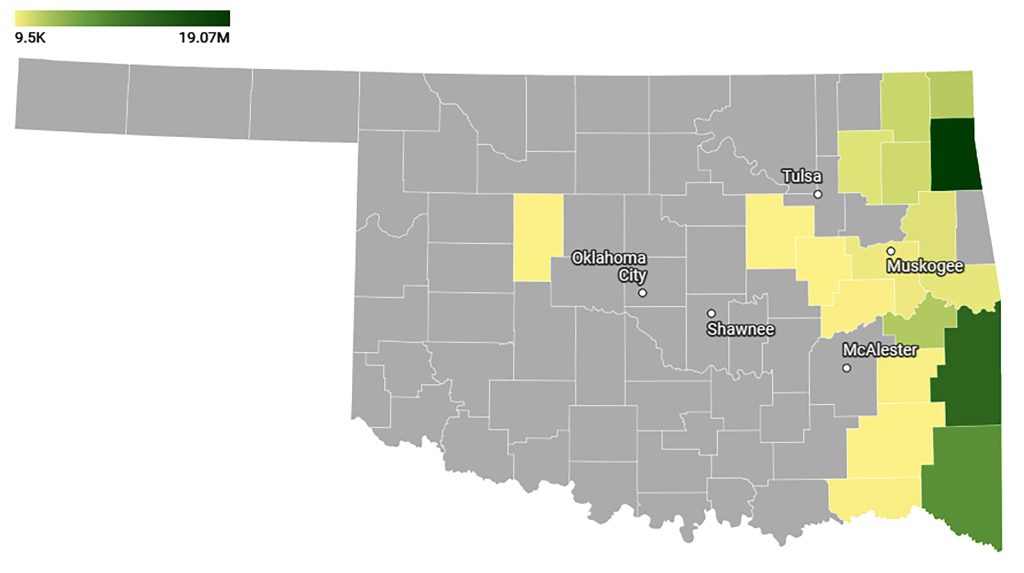
The ruling in the Illinois River Watershed case set the allowable phosphorus level in soil without risking excessive runoff into nearby waterways. It was decided that 120 pounds per acre of soil-to-phosphorus was acceptable, though this is more than the state’s request of 65 pounds per acre.35
Figure 2. The Eucha-Spavinaw and Illinois River Watersheds
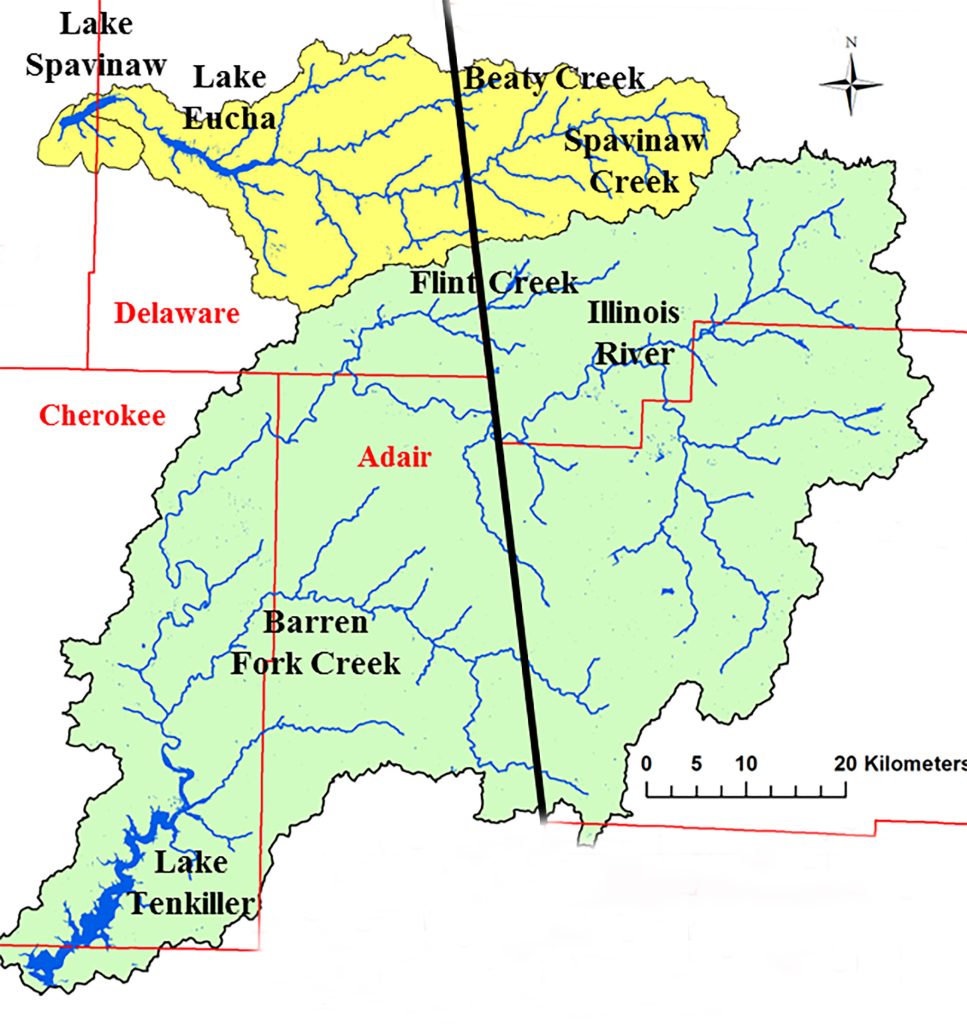
This amount is fairly specific and was determined by local Oklahoma scientists for the soil in northwest Oklahoma,36 but it still has poultry farmers in Oklahoma and neighboring Arkansas concerned about how to manage the change.37 Reducing soil phosphorus levels will likely mean growers will need to use alternatives to poultry litter as fertilizer, which are usually more expensive. In addition, as demand for poultry litter fertilizer declines, growers who sell it will lose income.38
State Actions
Since the suit was first filed in 2005, the Oklahoma legislature has taken steps to change how the state oversees the poultry industry. In 2023, a law was passed that set the total phosphorus criterion for designated waterways in the Oklahoma section of the Illinois River Watershed.39 In 2024, Governor Kevin Stitt signed SB 1424, which requires poultry operations to register with the State Board of Agriculture and provide detailed information about ownership, environmental history, and nutrient management plans.
It also limits civil liability for poultry operations that are in compliance with the state’s nutrient management plan.40
In Virginia, fertilizer from chicken waste and crop soil needs are addressed under the state’s laws for nutrient management plans. Specifically, phosphorus (and nitrogen) amounts from waste fertilizer may not exceed the recommendations for the respective crop soil.41 In other words, fertilizers may not be overused to the point where the soil cannot absorb more elements, which would make runoffs higher in phosphates.
In North Carolina, the highest concentration of CAFOs in the country lies along the lower Cape Fear River, particularly in Duplin and Sampson counties.42 Among these are poultry farms that use dry waste storage systems (as opposed to the liquid waste systems used by other poultry facilities). So long as these facilities keep dry waste covered for the majority of the year (no more than 15 days) and store it more than 100 feet from streams, waterbeds, or wells, they are allowed to operate without a state or federal permit (unless they house more than 30,000 chickens).43
Figure 3. CAFOs in North Carolina
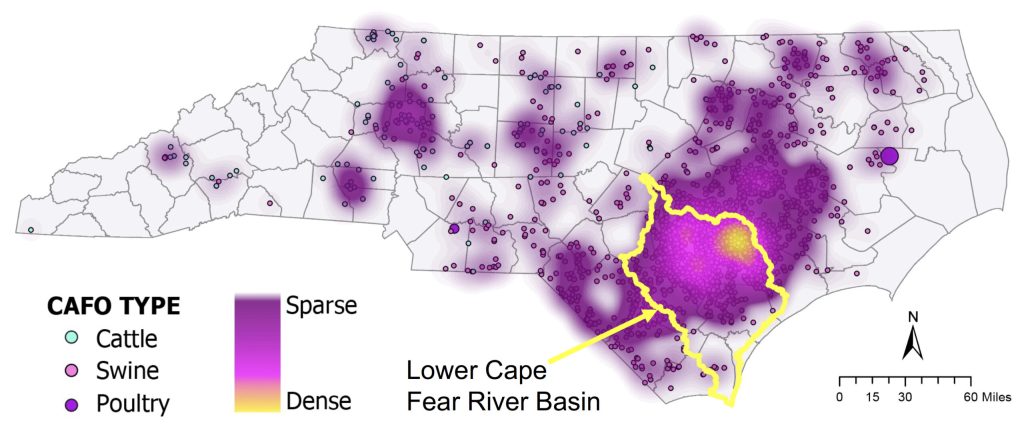
However, there is some concern that dry storage systems can still be susceptible to runoff and therefore risk polluting waterways, and this was one of the reasons cited for current legislation in the North Carolina legislature.45 HB 867 would revise the permitting program for dry litter poultry operations and mandate a comprehensive study by the Environmental Review Commission on the environmental and health impacts of these operations.46 The bill also seeks to strike a balance between phosphorus application rates and phosphorus requirements for crops.47
Conclusion
In the wake of State of Oklahoma v. Tyson Foods, poultry farmers throughout the South may be left wondering how it will affect their operations and the future of their farms. As such, state legislatures in the region may soon consider which avenues to pursue to address the industry’s needs while balancing environmental concerns such as water pollution. States like Oklahoma and North Carolina offer examples of potential legislation, either by limiting poultry companies from civil lawsuits if they comply with state law or by identifying and addressing potential oversights in animal waste regulation. These issues are not exclusive, and it will be up to each state to determine how future legislation can affect one of the region’s largest agricultural industries.
End Notes
- State of Oklahoma v. Tyson Foods, Inc. et al, No. 4:2005cv00329 – Document 3161, Northern District of Oklahoma, 2025 https://oklahoma.gov/ content/dam/ok/en/oag/newsdocuments/2025/ december/Oklahoma%20v.%20Tyson%20Foods%20Judgment.pdf; Roby Brock, “Oklahoma Court Ruling Threatens Poultry Industry in Arkansas,” Talk Business & Politics, December 24,2025, https://talkbusiness.net/2025/12/oklahoma-court- ruling-threatens-poultry-industry-in-arkansas/
- Kristin Bakker, “Judge Denies Poultry Companies’ Motion for Stay in Oklahoma Case,” Feedstuffs, January 20, 2026, https://www.feedstuffs.com/agribusiness-news/judge-denies-poultry-companies-motion-for-stay-in-oklahoma-case
- Bakker, December 4, 2025.
- Estimated Animal Agriculture Nitrogen and Phosphorus from Manure, U.S. Environmental Protection Agency, accessed January 26, 2026, https://www.epa.gov/nutrientpollution/estimated-animal-agriculture-nitrogen-and-phosphorus-manure
- “Polluted Runoff: Nonpoint Source (NPS) Pollution,” U.S. Environmental Protection Agency, accessed January 26, 2026, https://www.epa.gov/nps/nonpoint-source-agriculture.
- 40 CFR 120.2(b)
- 40 CFR 122.23(b)
- 40 CFR 122.23(b)(2)
- 40 CFR 412.4(c)
- 40 CFR 122.42(e)
- 40 CFR 122.23(b)(2)
- 40 CFR 122.23(b)(4); 40 CFR 122.23(b)(6)
- Ibid.
- “NPDES CAFO Permitting Status Report: National Summary,” The National Pollutant Discharge Elimination System, July 18, 2025, https://www.epa.gov/system/files/documents/2025-09/cafo-status-report-2024.pdf
- “Animal Feeding Operations – NPDES CAFO Permitting,” U.S. Environmental Protection Agency, accessed January 22, 2026, https://www.epa.gov/npdes/animal-feeding-operations-npdes-cafo-permitting
- “State and Territory Agency Contacts,” U.S. Environmental Protection Agency, accessed January 22, 2026, https://www.epa.gov/npdes/contact-us-animal-feeding-operations-afos#:~:text=206%2D553%2D6354)-,State,-and%20Territory%20Agency
- 40 CFR 122.23(c)(1)(i)
- “State-Specific Water Quality Standards Effective under the Clean Water Act (CWA),” U.S. Environmental Protection Agency, accessed January 27, 2026, https://www.epa.gov/wqs-tech/state-specific-water-quality-standards-effective-under-clean-water-act-cwa?utm_source=chatgpt.com
- “8 CAR § 21: Rule Establishing Water Quality Standards for Surface Waters of the State of Arkansas,” U.S. Environmental Protection Agency, December 19, 2025, https://www.epa.gov/sites/default/files/2014-12/documents/arwqs.pdf
- “Liquid Animal Waste Management Systems,” Arkansas Pollution Control and Ecology Commission, August 28, 2015, https://www.sos.arkansas.gov/uploads/rulesRegs/Arkansas%20Register/2015/sept2015/014.00.14-003.pdf
- Estimated Animal Agriculture Nitrogen and Phosphorus from Manure, U.S. Environmental Protection Agency, accessed January 26, 2026, https://www.epa.gov/nutrientpollution/estimated-animal-agriculture-nitrogen-and-phosphorus-manure
- Hailin Zhang, “Managing Phosphorus from Animal Manure,” Oklahoma State University, 2004, https://extension.okstate.edu/fact-sheets/print-publications/pss/managing-phosphorus-from-animal-manure-pss-2249.pdf
- “Nutrients and Eutrophication,” U.S. Geological Survey, March 3, 2019, https://www.usgs.gov/mission-areas/water-resources/science/nutrients-and-eutrophication
- Rona Kobell, “Proposed National Standard for Phosphorus Derailed by Critics,” Bay Journal, June 19, 2020, https://www.bayjournal.com/news/policy/proposed-national-standard-for-phosphorus-derailed-by-critics/article_e9f9429e-0be3-5519-b77b-178a166980a2.html
- David Crouse et al, “The North Carolina Phosphorus Loss Assessment Tool (PLAT): A Guide for Technical Specialists,” North Carolina State University Extension, December 2014, https://content.ces.ncsu.edu/the-north-carolina-phosphorus-loss-assessment-tool-plat-a-guide-for-technical- specialists?utm_source=chatgpt.com#:~:text=A%20North%20Carolina% 20interagency%20group; “Phosphorus in Mississippi Soils,” Mississippi State University Extension, 2023, https://extension.msstate.edu/sites/default/files/publications/3961_web.pdf; Forbes Walker and Shawn Hawkins,“Guidelines for Using the Revised Tennessee Phosphorus Risk Index,” University of Tennessee Extension, 2023, https://utia.tennessee.edu/publications/wp-content/uploads/sites/269/2023/10/W372.pdf?utm_source=chatgpt.com
- 62-640.210(2), F.A.C.
- State of Oklahoma v. Tyson Foods, Inc. et al, No. Case 4:05-cv-00329-GKF-SAJ – Document 18, Northern District of Oklahoma, 2005, https://turtletalk.blog/wp-content/uploads/2008/11/oklahoma-v-tyson-foods-amended-complaint.pdf
- Ibid.
- “Attorney General of the State of Oklahoma et al v. Tyson Foods, Inc. et al,” Justia, accessed January 29, 2026, https://dockets.justia.com/docket/oklahoma/okndce/4:2005cv00329/22038
- “Total Birds and Houses by County,” Oklahoma Department of Agriculture and Forestry, October 2, 2023, https://www.documentcloud.org/documents/24003421-odaff_fy19_total-birds-and-houses-by-county-latlong-2
- Ben Felder, “Oklahoma Governor Signs Bill Shielding Poultry Companies from Lawsuits Over Chicken Litter Pollution,” Investigate Midwest, June 10, 2024, https://investigatemidwest.org/2024/06/10/oklahoma-governor-signs-bill-shielding-poultry-companies-from-lawsuits-over-chicken-litter-pollution/
- State of Oklahoma v. Tyson Foods, Inc. et al, 2005.
- P.B. DeLaune et al, “The Eucha/Spavinaw Phosphorus Index: A Court Mandated Index for Litter Management,” Journal of Soil and Water Conservation, January 7, 2025, https://www.tandfonline.com/doi/abs/10.1080/00224561.2006.12435863
- Aaron Mittelstet, “Quantifying Phosphorus Loads and Streambank Erosion in the Ozark Highland Ecoregion Using the SWAT Model.”Doctoral dissertation, Oklahoma State University, December 2015, https://www.researchgate.net/publication/304497817_QUANTIFYING_ PHOSPHORUS_LOADS_AND_STREAMBANK_EROSION_IN_THE_OZARK_HIGHLAND_ECOREGION_USING_THE_SWAT_MODEL
- State of Oklahoma v. Tyson Foods, Inc. et al, 2025.
- State of Oklahoma v. Tyson Foods, Inc. et al, 2025; Zhang, 2004.
- M. Scott Carter, “Poultry Companies Respond to Court Filing in 20-Year Lawsuit,” Southwest Ledger, January 13, 2026, https://www.southwestledger.news/news/poultry-companies-respond-court-filing-20-year-lawsuit; Brock, 2026.
- Chris Moore, “20-Year Case Between Tyson, Others Will Go on a Little Longer,” Meeting Place, December 30, 2025, https://meatingplace.com/20-year-case-between-tyson-others-will-go-on-a-little-longer
- OK Admin Code 252:730-5-19(3); 40 OK Reg 327.
- An Act relating to the Oklahoma Registered Poultry Feeding Operations Act, 2024 Regular Session of the Oklahoma State Legislation, SB 1424, Oklahoma,2024, http://www.oklegislature.gov/BillInfo.aspx?Bill=SB1424&Session=2400
- 9 VA Admin Code 25-630-30.
- Mapping the Impacts of North Carolina’s Poultry Industry, North Carolina State University, Office of Research and Innovation, Aprill 11, 2025, https://research.ncsu.edu/mapping-the-impacts-of-north-carolinas-poultry-industry/
- NC Gen Stat § 143-215.10C; North Carolina State University, 2025.
- North Carolina State University, 2025.
- An Act to Create A Permitting Program for Dry Litter Poultry Operations, 2025 Regular Session of the North Carolina General Assembly, North Carolina, 2025, https://www.ncleg.gov/Sessions/2025/Bills/House/PDF/H867v1.pdf
- Ibid.
- Ibid.