

A CSG South First Look
Prediction markets are marketplaces where participants buy and sell contracts based on the outcome of future events. Participants aren’t betting against the house as they are in a traditional casino or sports wagering platform. Instead, they’re trading with other participants.
Prediction markets have been around for decades, but have evolved rapidly over the last few years and are now at the center of major federalism questions. Do states have a role in regulating prediction markets, or are they the exclusive domain of federal regulators? To answer that, a final determination must be made as to whether they are, at their core, financial derivatives or simply a new form of gambling.
Historical Context: From Sports Betting to Prediction Markets
Sports Betting’s Evolution
Sports betting has long been legal in the United States, but for many decades, Nevada was the exclusive jurisdiction for legal sports betting (that changed slightly in the 1970s as Delaware, Montana, and Oregon began to offer sports betting products through their state lotteries). In 1992, with casino gaming legalized in New Jersey in the 1970s and seven other states between 1989 and 1992, Congress decided to act to halt the expansion of sports wagering.
In 1992, Congress passed the Professional and Amateur Sports Protection Act (PASPA). The bill outlawed sports betting nationwide, but grandfathered in Nevada and the three states that operated some form of sports lottery. PASPA had the effect of forcing sports bettors to either travel to Las Vegas to wager or find an illegal bookmaker.
The growth of the internet transformed the illegal sports wagering market in the mid- to late-nineties. Online sportsbooks based largely in the Caribbean quickly sprouted up, claiming the U.S. government had no jurisdiction. In 2006, Congress passed the Unlawful Internet Gambling Enforcement Act (UIGEA), which prohibited the use of most payment systems for depositing or withdrawing funds from offshore accounts, and many offshore sites stopped offering wagering to U.S. residents.
New Jersey spearheaded the effort to overturn PASPA by enacting legislation to legalize sports betting in 2012, eventually bringing a case to the U.S. Supreme Court, which struck down PASPA in May 2018. By the end of 2018, seven states had joined Nevada in offering sports wagering, with additional states coming online each year. Missouri became the 39th state to offer sports wagering in December 2025.
Where Prediction Markets Fit In
Prediction markets date back to at least the 19th century, when they were popular during presidential elections. The modern version started as an academic exercise when three University of Iowa economists created the Iowa Electronic Markets (IEM) in 1988, receiving a CFTC exemption to operate for research purposes. The system is still in operation today.
With the growth of the internet, new prediction markets emerged online. The largest, Intrade, opened in 2001 and predicted the 2008 and 2012 U.S. Presidential elections. After the 2012 election, the CFTC sued Intrade for violating the Commission’s ban on off-exchange options trading, and the platform closed in 2013. Several companies then filled the gap with blockchain-based markets.
The evolution into the current version of prediction markets started in 2020 with the creation of Polymarket, followed in 2021 with the founding of Kalshi. Polymarket eventually ran into regulatory trouble with the CFTC and ceased operating in the United States in 2022. Kalshi, on the other hand, sought and received recognition from the CFTC as a Designated Contract Market before accepting its first contracts, starting with limited offerings before expanding into politics and cultural events.
By 2024, the CFTC blocked Kalshi from offering political event contracts, but Kalshi sued and a federal District Court found the contracts were legal under the Commodity Exchange Act. Kalshi began offering contracts on sports in January 2025, clearing over $1 billion in trades in the first five months. By the end of the year, sports contracts were nearly 90% of those traded on the platform. The Commodity Exchange Act (CEA) provides the framework for the CFTC’s oversight of prediction markets. The CFTC has defined derivatives broadly to include futures contracts, commodity options, and swaps, and has defined commodities broadly to include not just traditional goods like oil, grains, and metals, but also interest rates, currencies, and events.
Federal vs. State Authority
The future of prediction markets boils down to whether federal law preempts state gambling laws. The Federal government has claimed exclusive jurisdiction over prediction markets under the Commodity Exchange Act (CEA). By broadly defining derivatives, the Commission has given itself wide latitude on what offerings are considered to be valid under the CEA. And if an event contract is a financial instrument under the Act, it is not gambling and thus not under the purview of individual states. Insider trading and market manipulation were among the concerns cited by federal regulators under the prior administration when evaluating whether to approve prediction markets, and those concerns have carried over into state legislative responses.
State regulators and AGs see prediction markets differently. Since operators began offering event contracts on sporting events, states have argued that if it looks like sports betting, it is sports betting. They argue that companies can’t get around state laws on sports wagering simply by dressing up a sports bet as an “event contract.” There is also a tax revenue angle. The American Gaming Association estimates that states have lost more than $700 million in gaming tax revenue.
Litigation Addressing the Preemption Question
Litigation surrounding prediction markets has exploded since the start of 2025, and the actions have been brought by all sides: states suing or charging prediction market operators, prediction market operators suing states, the federal government suing states, and Native American tribes suing operators.
At least 12 states have filed civil actions against prediction market operators. The civil actions generally seek to force prediction market companies from operating in the state, claiming they are violating state betting laws. The state actions have been largely bipartisan, and 39 state AGs have signed on to an amicus brief supporting state enforcement actions.
Federal courts have reached conflicting conclusions. In Tennessee, a U.S. District Court granted Kalshi a preliminary injunction in February 2026, finding that its products are likely legal swaps under the CEA and that federal law preempts state law. Courts in New Jersey have similarly sided with Kalshi, and on April 6, the Third Circuit ruled in a 2-1 decision that states cannot stop Kalshi from offering election and event-based contracts. On the other hand, courts in Nevada, Maryland, and Ohio have ruled in favor of the states. Several of these cases are now before circuit courts, and if the circuits split, the fate of prediction markets may ultimately lie with the U.S. Supreme Court.
In early April, the CFTC made good on Chair Michael S. Selig’s February threat that the Commission would “see you in court” and entered the litigation arena directly, suing Arizona, Connecticut, and Illinois to challenge their enforcement actions against prediction market operators. The move signals that the federal government intends to actively defend its claimed jurisdiction rather than wait for the courts to sort it out, putting states that have taken enforcement action on notice that they may face a federal challenge as well.
2026 Legislative and Industry Activity
State Legislation During the 2026 Legislative Sessions
Legislators in 11 states have introduced legislation to regulate prediction markets in 2026, including Kentucky and Tennessee. States are taking a variety of different approaches, ranging from full authorization and regulation to a full ban. Several states have bills that would prohibit prediction markets from offering event contracts based on events such as politics, athletic events, securities, and catastrophic events, and some focus on prohibiting marketing to minors. Some state bills also include consumer protection provisions, such as requirements for operators to refund cancelled wagers and protect customer winnings.
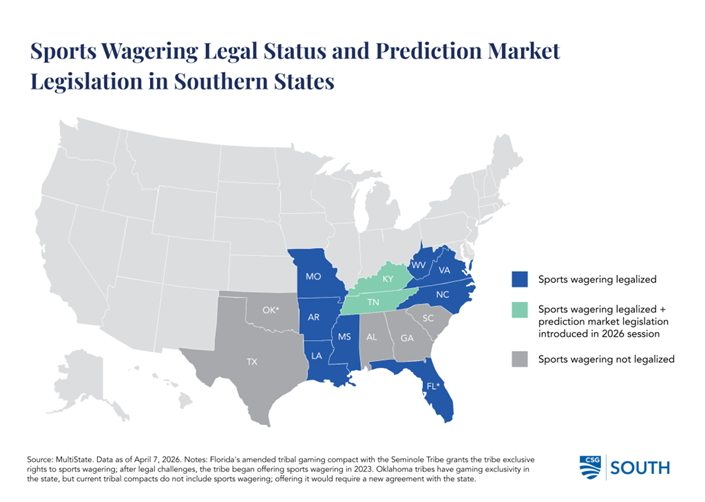
Kentucky legislators passed HB 757 defining an event contract to include a contract or swap in an excluded commodity based on the event of an occurrence, or contingency other than a change in the price, rate, value or levels of a commodity defined in the CEA. The bill exempts swaps on certain commodities such as agriculture. It also imposes a 14.25% tax on the prediction market operator’s transaction fees. The bill is awaiting action by Governor Beshear.
The similar bills introduced in Tennessee are more limited in scope. They seek to make it a felony to engage in conduct intended to influence the outcome of an event if the person will benefit from a contract on a prediction market. The Senate version, SB 1992, has passed out of the Judiciary Committee and is on the Senate floor, while the House version, HB 2079, has passed out of the Judiciary Committee and has a hearing scheduled in the House Finance, Ways and Means Subcommittee April 14.
Congressional Legislation
At the federal level, there have been 13 bills introduced in Congress this session. They include bills limiting certain actors from participating if they have non-public information on an event, prohibiting certain types of event contracts from being offered (such as betting on sensitive events), or banning all event contracts based on sports or casino-style games. Other bills seek to clarify the regulatory authority over prediction markets.
Industry Activity
In addition to the legal, legislative, and regulatory battles, industry coalitions are forming to weigh in on the future of prediction markets. Kalshi and Crypto.com launched the Coalition for Prediction Markets in December to advocate for the industry. On the other side, the American Gaming Association has maintained strong opposition to allowing prediction markets to operate outside the traditional state gaming regulatory system, and a new coalition called Gambling Is Not Investing launched last month to push back on the industry’s expansion.
Even within the sports world, leagues have taken opposite sides. The NCAA has formally asked the CFTC to block event contracts based on college sports. Meanwhile, Major League Baseball, the National Hockey League, and Major League Soccer all have marketing deals with at least one prediction market operator, while the NBA and NFL have not announced any such deals.
Future Outlook
With litigation taking place all over the country and the federal courts seemingly split on whether prediction markets are offering gambling products or derivatives, the future of prediction markets in the United States will likely be decided by the U.S. Supreme Court in the next few years. If the Court rules that prediction markets are actually gambling under another name, states will retain the power to regulate and tax the industry.
If the Court holds that the CFTC has the authority over prediction markets, the entire sports wagering industry will face a massive disruption. Existing sports wagering operators have already started offering some prediction market wagering. If they can avoid state tax and licensing schemes by significantly shifting to prediction markets, states will lose most of their sports wagering revenues. Large states that have resisted legalizing sports wagering, such as Texas, may have missed their opportunity to create a revenue stream from the operation of sports betting.