

Regional Resource by Senior Policy Analyst, Cody Allen
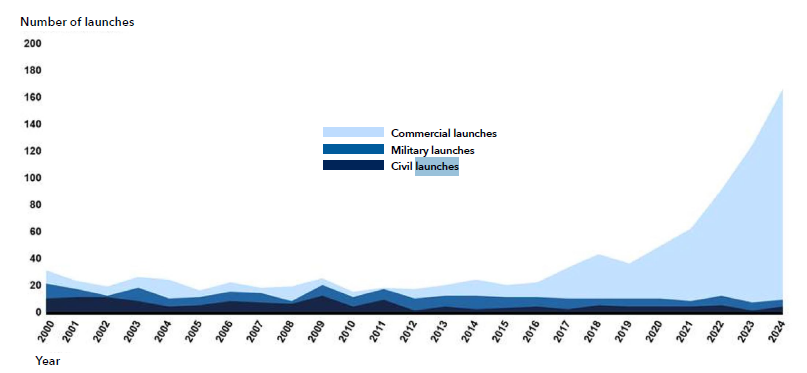
DOWNLOADAcross the country, states are eyeing the stars and the economic potential they offer. By 2035, according to industry estimates, the global space economy is projected to exceed $1.8 trillion as commercial space activities continue to grow in response to increased demand.1 As private space companies expand their launch schedules and the federal government ramps up military and commercial space priorities, states increasingly view spaceports as launch pads and long-term investments in innovation, industry, and infrastructure. In 1996, California became the first state to have a Federal Aviation Administration (FAA) licensed non-federal launch and reentry site — or “spaceport.”2 Since 2000, the total number of launches has more than tripled — according to Government Accountability Office (GAO) analysis of FAA and United States Department of Defense (DoD) launch data — with the primary driver of the explosion in active launches arising from commercial entities.3
FIGURE 1. Historical Launch Trends (2000-2024)
Perhaps nowhere is this more evident than in the booming South. Notable examples of this industry’s rise include Huntsville, Alabama’s successful bid to host the United States Space Force Command, and Virginia’s Mid-Atlantic Regional Spaceport.5 Further, from Texas’s multi-million-dollar grant program to support space technology firms to Florida’s continued expansion at Cape Canaveral, states are actively positioning themselves as key players in the new space economy.6 These efforts extend beyond launches to include economic development, workforce development, and the development of regional technology ecosystems around aerospace innovation.7
Spaceports are becoming strategic economic development assets in a competitive landscape where high-tech jobs, supply chain opportunities, and federal contracts are at stake. The challenges for states are how to turn takeoff momentum into sustained growth while balancing regulation, community impact, and long-term vision — while coming to terms with laws that do not always align perfectly with emerging industries, cutting-edge technologies, or the workforce requirements of the future.
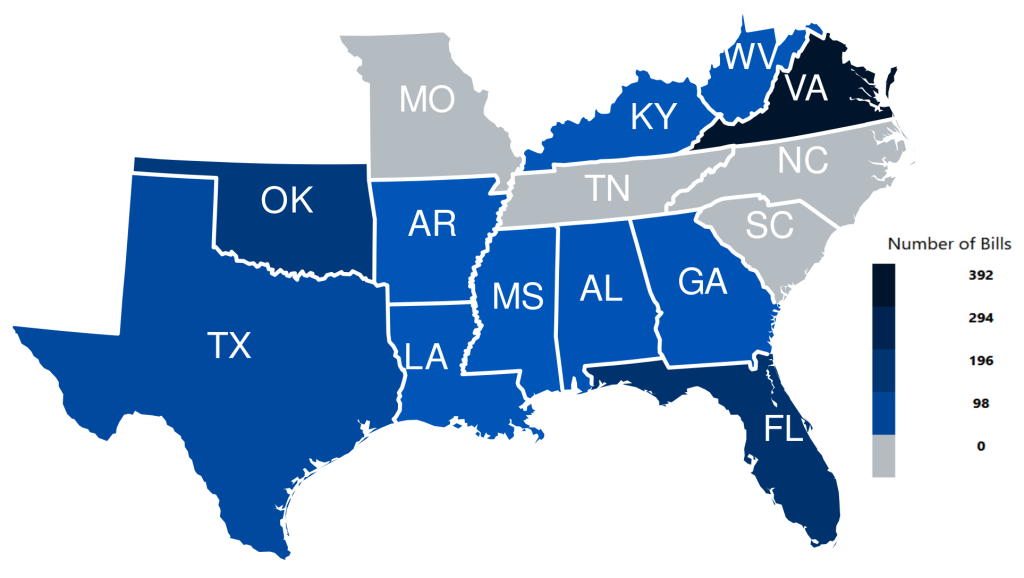
This CSG South Regional Resource examines state laws, policies, and regulations governing spaceports, launch sites, workforce needs, and the unintended consequences (such as space junk or debris) that require policymakers to adapt existing frameworks to emerging technologies and industry needs. With the 15-state CSG South region seeing nearly 900 measures introduced over the past decade to address various policy issues surrounding spaceflight, these issues — ranging from tax credits for aeronautical and spaceflight companies and spaceport investments to aerospace and space-related workforce development — underscore the importance of this topic as the South continues to grow.8
FIGURE 2. Proposed Spaceflight-related Legislation in the South (2014-2026)
While the federal government plays an outsized role in space exploration, funding, and administration — primarily through the National Aeronautics and Space Administration (NASA) and the Federal Aviation Administration’s (FAA) Office of Spaceports — this publication emphasizes the growing role state law and policy are playing in this arena through public-private partnerships, state investments, and a growing regulatory framework.10 However, the 2018 FAA Authorization Act established the Office of Spaceports under the jurisdiction of the U.S. Secretary of Transportation to support the licensing activities for the operation of public and private commercial launch and reentry sites and strengthen the country’s overall commercial space transportation infrastructure and economy.11 This means federal oversight and collaboration will remain a necessity as states join the growing space race.
Preparing for Liftoff: Defining Spaceports, Launch Pads,
and Reentry Sites
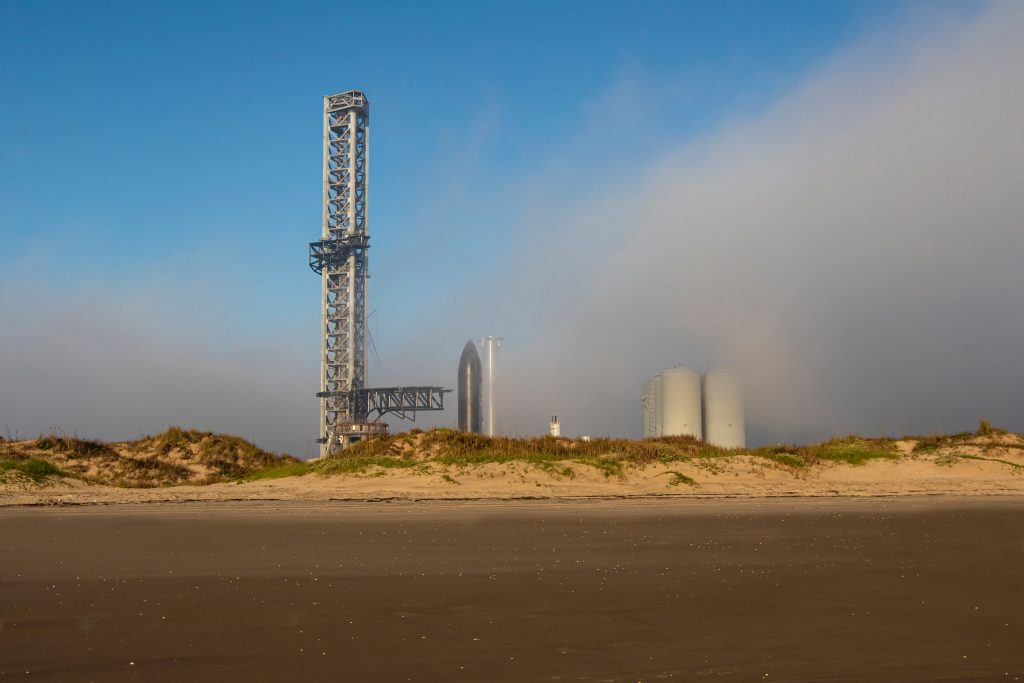
FIGURE 3. Example of Launch Site and Spaceport Facility Infrastructure
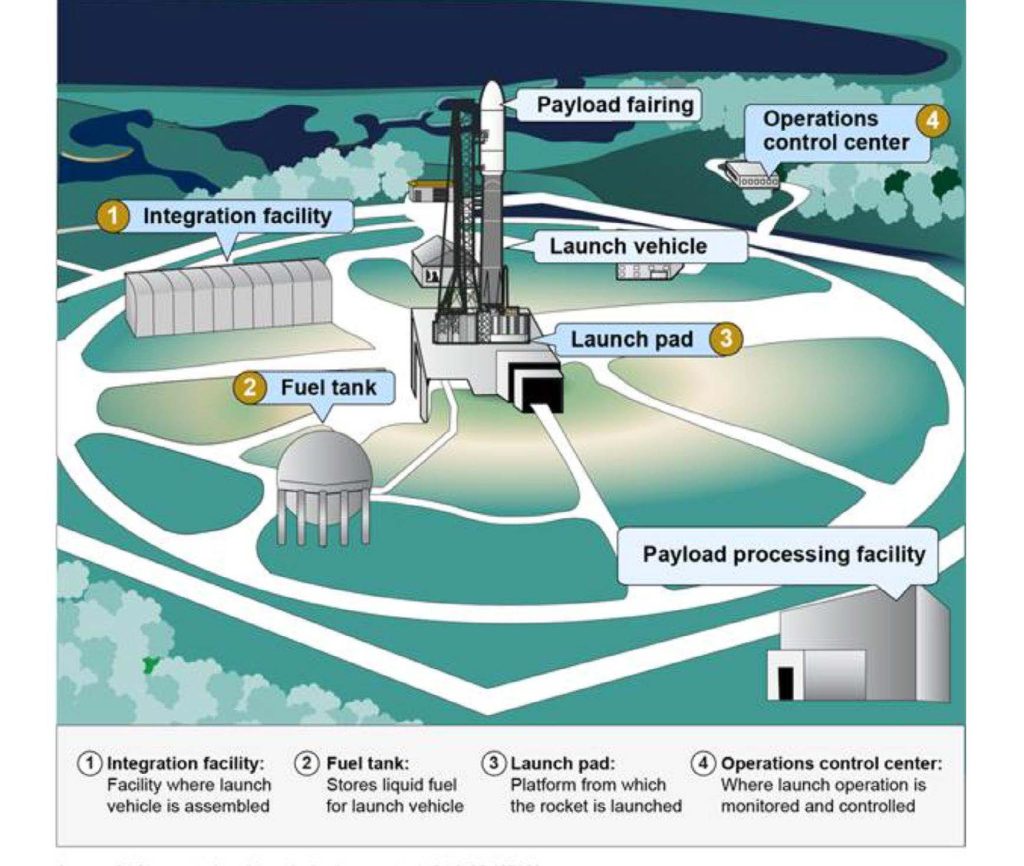
What exactly is a spaceport? While there is no universally agreed-upon definition, the FAA defines spaceports as facilities designed to support the launch and, in some cases, the landing of spacecraft, which are licensed by the U.S. Department of Transportation. Similar to how airports serve aircraft, spaceports provide the necessary infrastructure, logistics, and regulatory framework to facilitate spaceflight operations along two main types:
1) Vertical launch spaceports, where rockets lift off upright (such as with traditional NASA launches).
2) Horizontal launch spaceports, where vehicles use runways for aircraft-style launches into space.13
Although both are classified as spaceports, vertical and horizontal launch sites feature distinct economic drivers, regulatory needs, and risk analyses. Specifically, lawmakers may wish to look to airport policies when developing horizontal launch sites, given their analogous suborbital profiles. In contrast, vertical launch sites are more unique and are the only facilities that allow launches to lower Earth orbit and beyond. It should be noted, however, that industry studies have shown that 90 percent of all launches are vertical despite more than 64 percent of spaceports operating as horizontal launch sites.14
Additionally, a recent development features facilities that may also be used for specialized purposes, such as orbital reentry. These facilities are licensed for land vehicles and spacecraft returning to orbit, which require additional infrastructure and capabilities to support vehicle recovery. In the U.S., only spaceports in Alabama and Florida have such capabilities.15
FIGURE 4. U.S. Spaceports and Launch/Reentry Sites by State
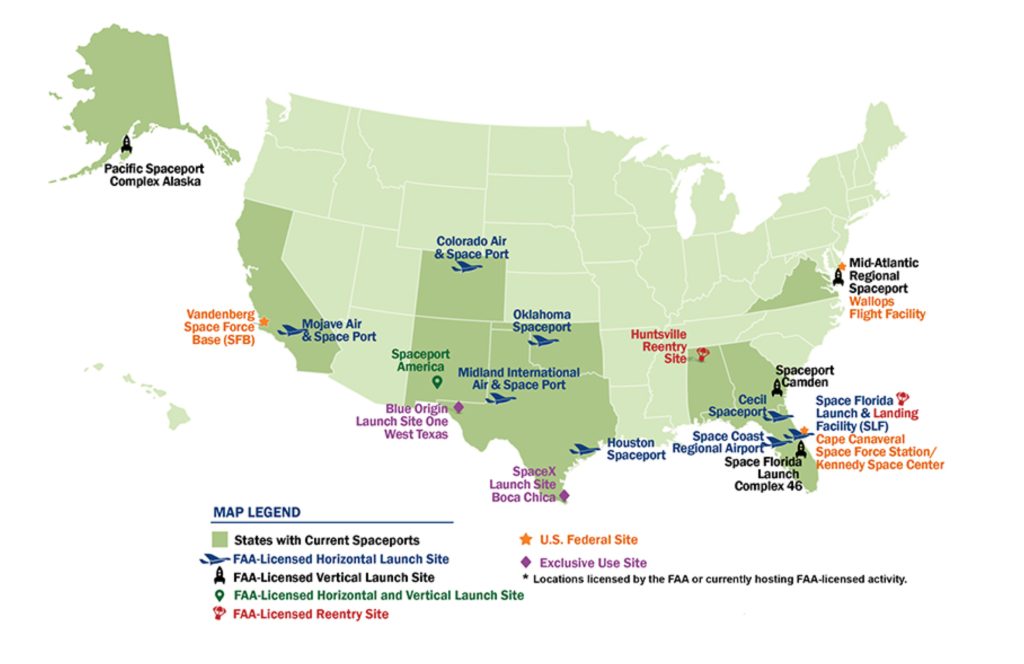
The South is home to six of the ten states that currently host spaceports. According to the Federal Aviation Administration’s (FAA) Office of Spaceports, Alabama and Florida are the only two FAA-licensed reentry sites in the U.S. as of 2025. Additionally, six of the 15 CSG South member states — Alabama, Florida, Georgia, Oklahoma, Texas, and Virginia — have one or more spaceports or launch and reentry sites, by far the most out of any region.17 As this industry continues to grow and realize more significant public-private partnerships, the after-effects of these activities may also merit increased oversight.
TABLE 1. Federally Licensed State Spaceports
| State | Facility | License | Launch Type |
|---|---|---|---|
| Alabama | Huntsville International Air and Space Port | FAA | Orbital Reentry |
| Alaska | Pacific Spaceport Complex | FAA | Vertical Launch |
| California | Mojave Air and Space Port | FAA | Horizontal Launch |
| Vandenberg Space Force Base | FAA and Federal | Vertical and Horizontal Launch | |
| Colorado | Colorado Air and Space Port | FAA | Horizontal Launch |
| Florida | Cape Canaveral Space Force Station | Federal | Vertical and Horizontal Launch |
| Kennedy Space Center (NASA) | Federal | Vertical and Horizontal Launch | |
| Space Florida Launch Complex 46 | FAA | Vertical Launch | |
| Space Florida Launch and Landing Facility | FAA | Horizontal Launch and Orbital Reentry | |
| Cecil Air and Space Port | FAA | Horizontal Launch | |
| Space Coast Regional Airport | FAA | Horizontal Launch | |
| Georgia | Space Port Camden | FAA | Vertical Launch |
| New Mexico | Spaceport America | FAA | Horizontal and Vertical Launch |
| Oklahoma | Oklahoma Spaceport | FAA | Horizontal Launch |
| Texas | Launch Site One West Texas (Blue Origin) | Private — Exclusive Use | Not Specified |
| Boca Chica (SpaceX) | Private — Exclusive Use | Not Specified | |
| Houston Spaceport (Ellington Airport) | FAA | Horizontal Launch | |
| Midland Spaceport | FAA | Horizontal Launch | |
| Virginia | Mid-Atlantic Regional Spaceport | FAA | Vertical Launch |
| Wallops Flight Facility | Federal | Vertical Launch |
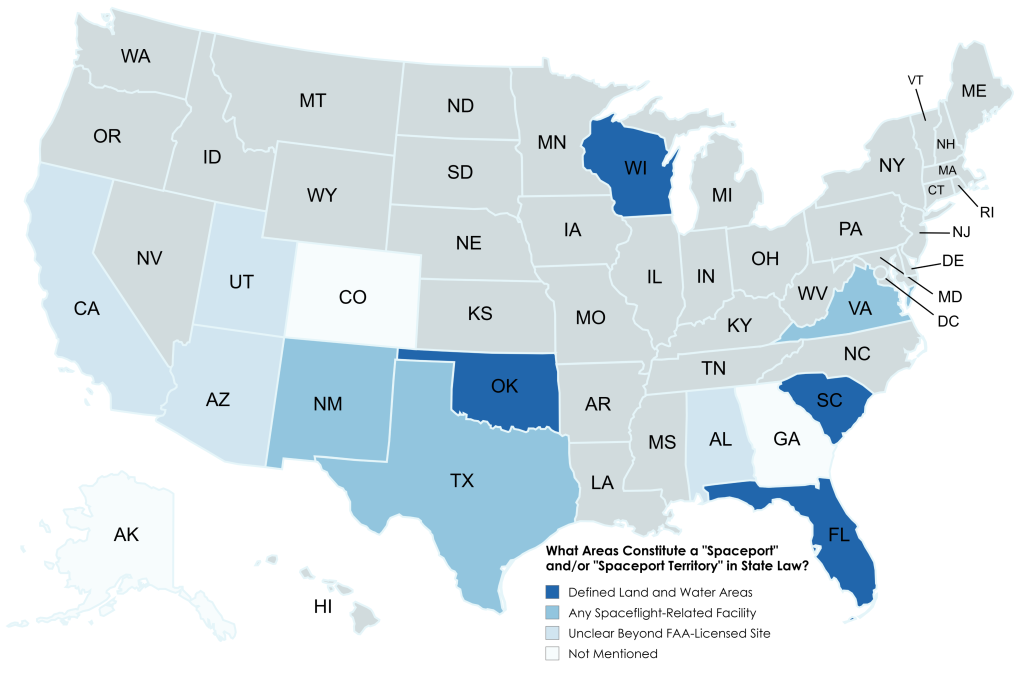
Despite multiple states having federally licensed spaceports, not all states define or recognize what constitutes a spaceport or related facility in statute. Some, such as Florida and Oklahoma, feature robust geographically defined criteria, while others, such as Alabama, Texas, and Virginia, are silent on definitions or broadly reference “spaceflight” activities.
Outside the South, only Wisconsin features a clear definition of land and water constituting a spaceport’s territory, while New Mexico only specifies that any area featuring spaceflight activities constitutes a spaceport.19,20 Arizona, California, and Utah are non-specific beyond noting the requirement that a site be federally licensed to operate as a spaceport or launch site.21,22,23
FIGURE 5. Comparison of State Statutory Definitions for Spaceports or Spaceport Territory
Alabama
The Yellowhammer State’s code on aerospace and spaceport infrastructure and capabilities does not specify much about what constitutes a spaceport. At most, it notes the necessity of FAA licensure and oversight by a state or governmental subdivision authority for sites involved in space or aerospace-related activities, technologies, and/or infrastructure.2
Florida
State statute defines “spaceports” as any area of land or water, or any manmade object or facility located within said area, intended for the launch, takeoff, and landing of space- and/or aircraft. Such areas are designated and developed by the responsible state entity and include any abutting areas used or intended for public or private use, buildings and facilities, spaceport-related research and development projects, or associated rights-of-way and infrastructure.25
It also explicitly notes seven geographic areas of the state which are classified as “spaceport territory” — primarily former and current military, airport, and NASA sites — as well as any other real property licensed by the FAA and designated by the directors of Space Florida as spaceport land.26 Space Florida, a state entity created to oversee the state’s aerospace industry and detailed further in the following section, can also designate additional land and facilities as spaceport territory.27
Oklahoma
The Oklahoma Space Industry Development Act defined “spaceports” as any area of land or water and any facilities located within such areas intended for public or private use for the launching, takeoff, and landing of air- and spacecraft. These areas and facilities — as designated by the state’s authority — may include buildings, facilities, infrastructure, rights-of-way, propulsion systems, spaceflight systems, or other appurtenant areas developed for such use.28 Like Florida, the Sooner State’s code defines the spaceport territory as real property located within Washita County — to the West of Oklahoma City in Central Oklahoma — and permits the authority to acquire, lease, or otherwise acquire real property as needed beyond the aforementioned territory designated within Washita County.29,30
South Carolina
Despite not having any active FAA-licensed spaceport facilities, the Palmetto State’s aeronautics code includes “spaceports” in its statutory definition for airports and any land or water area used for public or private landing and take-off of aircraft.31 This predefined use may serve lawmakers in the event of a future launch pad or spaceport-type facility being developed in South Carolina.
Texas
Local Government Code defines “spaceports” as areas and facilities used or intended to be used for spaceflight activities — including any related building, facilities, launching or landing pads, and rights-of-way.32
Virginia
Unlike other Southern states — such as Florida and Oklahoma — the commonwealth does not robustly define “spaceports” in state code, instead only noting that — for tax and governance purposes — a spaceport is an orbital or suborbital space facility — owned, operated, and/or leased on behalf of or directly by the commonwealth’s spaceflight authority — conducting spaceflight-related activities.33
Who Watches the Spacemen? State Oversight and Governance of Spaceports
While state-created authorities that oversee commercial spaceflight, academic research, spaceport operations, and other aerospace-related projects vary, they most often fall under a state’s Department of Economic Development or Aviation and feature representative boards of directors with relevant experience and input from governors, state senate, and house leaders. Most also take advantage of statutory powers to enter into public-private partnerships and other methods to lease property or facilities to commercial space entities.34 Despite these similarities, there are also a few quirks, such as Texas’s unique statutory mechanism for local governments to individually or collectively establish authorities to promote, develop, and otherwise govern commercial spaceports.35 These diverse methods and levels of governance offer many distinguished models for other Southern states considering joining the space race.
TABLE 2. Comparison of State Governmental Aerospace and/or Space Entities
| State | Entity | Year Established | No. of Employees* | FY 2025 Operating Budget |
|---|---|---|---|---|
| Alabama | Alabama Space Authority | 2017 | — | — |
| Florida | Space Florida | 1989 | 54 | $20.5 million |
| Oklahoma | Oklahoma Space Industry Development Authority | 1999 | 8 | $1.1 million |
| Texas | Texas Space Commission | 2023 | 17 | $160.3 million |
| Virginia | Virginia Spaceflight Authority | 1995 | 90 | $23.2 million |
*Estimates based on public-facing data and reports.
Alabama
In 2017, lawmakers enacted House Bill 176 to establish the Alabama Space Authority as an office within the Alabama Department of Economic and Community Affairs (ADECA).36 Per statute, the authority is comprised of representatives from or designated by the:
- Governor (one member);
- State Finance Director (one member);
- Senate President Pro Tem (two members);
- Speaker of the House of Representatives (two members);
- President of the University of Alabama — Huntsville;
- President of Alabama Agricultural and Mechanical University;
- Director of the Auburn University Aviation Center;
- Secretary of the Alabama Department of Commerce;
- Director of the Alabama Department of Transportation; and
- Director of the ADECA.
Notably, the governor’s designees, the finance director, and the legislative leaders must be individuals with knowledge of or experience in the aerospace, aviation, space technology, or related industries.37
As an office within the ADECA, the Alabama Space Authority received administrative support from the department and assistance in securing grant funding to finance the authority’s operations.38 Its operations include the promotion of research and development of new aerospace and space technologies for exploration and transportation, sponsorship of educational and business roundtables and conferences to support and promote aerospace, aviation, and related industries in the state.39 To further this mission, state law provides the authority with the power to acquire and hold title to real property as well as lease any facilities or property of the authority in furtherance of its duties.40
More recently, the chairman of the Alabama Space Authority — Alabama State Senator Sam Givhan — sponsored a measure enacted during the 2026 session that will rename the entity to the Alabama Aerospace and Defense Authority and expand its membership to include two new representatives. The reformed authority will also be able to adopt bylaws and policies to further the development of aerospace and spaceport infrastructure in the state, while remaining under the ADECA’s purview.41 Effective October 1, 2026, the authority’s new name and membership will take place. Per the Alabama Legislative Services Agency, ADECA’s expenses — mostly negligible, as the authority does not have full-time employees and other pays members’ per diems — would likely increase by only $400 per meeting to cover the new representatives.42
Florida
The first iteration of the state’s space-specific governmental entity was the Spaceport Florida Authority established in 1989 as an independent state entity whose role is to foster the growth of an innovative, sustainable, and competitive aerospace industry in the state by facilitating business financing, operating spaceports and launch sites, researching new technologies, developing educational and workforce programs, and overseeing the myriad public and private contracts and negotiations necessary for operating spaceports and facilities across the state.43,44
In 2006, lawmakers enacted House Bill 1489, which combined the former space authority with the Florida Space Research Institute and the Florida Aerospace Finance Corporation. The new comprehensive Space Florida entity was established to better coordinate the state’s civil, commercial, and military space, aerospace, and aviation industries.45
In Fiscal Year 2025, the state appropriated $8 million from its general revenue fund to support Space Florida, with an additional $12.5 million appropriated from the state’s economic enhancement and development trust fund. Of the funds from the economic enhancement and development trust fund, $1 million in recurring funding is allocated to support Space Florida’s memorandum of understanding with the State of Israel to collaborate on aerospace research, development, and commercialization projects.46 Currently, Space Florida reports a workforce of 54 employees, totaling more than $7.1 million in payroll and compensation.47
Space Florida is overseen by a 12-person board of directors consisting of the:
- Governor, or designee;
- Secretary of Transportation, or designee;
- Five gubernatorial appointees with at least five years of experience in a related industry;
- One appointee from the Senate President with at least five years of experience in a related industry;
- One appointee from the Speaker of the House of Representatives with at least five years of experience in a related industry;
- Jacksonville Aviation Authority representative;
- Titusville-Coca Airport Authority representative; and an
- Employee or official from a port district or port authority in the state.
All board members serve four-year, staggered terms and are limited to two four-year terms.48
State law grants Space Florida significant legal and operational authority to manage and promote the aerospace industry through its broadly granted corporate and governmental functions. These include the power to acquire property, execute contracts, and manage financial assets — including the issuance of bonds and the provision of loans, which are covered in more depth later in this report.49 Its statutory mandate also covers the construction and oversight of spaceport infrastructure, such as launch pads, laboratories, and specialized transportation systems. Beyond the construction and maintenance of technical facilities, Space Florida is also responsible for essential public services ranging from utility management and safety operations to pest control and environmental conservation on its owned, operated, or leased property. Furthermore, the agency is empowered to foster research and innovation by protecting intellectual property and supporting research and development of experimental aerospace technologies.50 With a multimillion-dollar budget, robust workforce, and comprehensive statutory guidance and oversight powers, it should come as no surprise that Space Florida has helped establish the Sunshine State as the preeminent state for space exploration, commerce, and development.
Oklahoma
Established in 1999 through the legislature’s passage of Senate Bill 720, the Oklahoma Space Industry Development Authority (OSIDA) is responsible for various oversight, investment, and planning for aerospace and space-related projects in the Sooner State.51 Among its statutorily prescribed duties, OSIDA is responsible for strategic planning for spaceports, spaceport systems, spaceport facilities, and other spaceport projects, as well as for promoting the development and improvement of space exploration and commercialization. Further, the authority is tasked with improving research and development in space commerce and educational programs, as well as supporting research and development projects in the state.52 The authority — and its eight full-time employees — operate a 2,700-acre facility collocated at the Clinton-Sherman Airport in Western Oklahoma. For Fiscal Years 2025 and 2026, OSIDA operated on budgets of $1.1 million and $1.9 million, respectively.53 However, the total funding for FY 2025, including federal funds and additional non-operating budget monies, was more than $26.3 million.54
TABLE 3. Oklahoma Space Industry Development Authority’s Budget and Fund Details (FY 2025)
| Entity | Fund Type | FY 2024 (Actual) | FY 2025 Operating Budget |
|---|---|---|---|
| OSIDA Fund | Revolving Fund | $741,251 | $1,049,035 |
| Okla. Spaceport Management Fund | Revolving Fund | $1,495,290 | $4,391,423 |
| Aerospace Industrial Park Fund | Revolving Fund | $77,356 | $206,043 |
| Progressing Rural Economic Prosperity (PREP) | Revolving Fund | $1,005,573 | $16,822,627 |
| NASA Federal Funds | Federal Fund | $0.00 | $7,500 |
| Statewide Recovery Fund (ARPA) | Federal Fund | $410,255 | $3,829,745 |
| OKLA. SPACE INDUSTRY DEVELOPMENT AUTHORITY TOTALS | — | $3,729,725 | $26,316,373 |
During the 2025 legislative session, lawmakers overwhelmingly passed Senate Bill 912, which significantly reformed OSIDA and renumbered it in the state statute.56 Specifically, the measure increased the authority’s board by two members — from seven to nine — allowing the Senate President Pro Tempore and the House Speaker to each appoint one member to join the seven gubernatorial appointees. All appointees must continue to meet the prior requirement of at least 3 years of relevant experience, with legislative appointees required to have direct experience in the commercial space industry or in federal or state government space administration.57 Lastly, the measure also moves OSIDA to the state Department of Aerospace and Aeronautics, with all of the authority’s employees transferring to the department, and OSIDA is tasked with entering into agreements with the department for all necessary administrative and staff services. However, the new language clearly prohibits commingling the department’s funds with those of OSIDA and requires treating the funds as separate and distinct legal entities.58

PROTECTING AGRICULTURAL LANDS
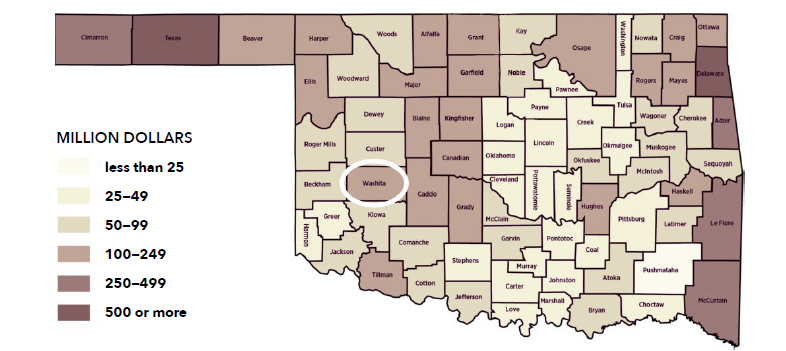
Hidden amongst the comprehensive statutory authority granted to OSIDA is a unique exemption from the authority’s wide-ranging jurisdiction over spaceports and adjacent territory. Agricultural land not purchased or otherwise acquired by OSIDA, but located within spaceport territory, is exempt from the board’s power to enforce its own or other governmental codes and zoning.59 Additionally, the authority may not limit or restrict continued access to water for agricultural purposes. Further, as long as said buildings, both functional and residential, comply with federal laws for licensure as an active spaceport, OSIDA is prohibited from restricting the construction of outbuildings or personal residences on spaceport territory. Such language, when viewed collectively, serves to protect Oklahoma’s longstanding agricultural and ranching culture while still allowing aerospace and spaceport activity.60 This balancing act between modernity and traditional industry is something other states may also wish to consider moving forward, ensuring policies remain “grounded” while “shooting for the stars” — especially in counties (like Washita) with more than $100 million in annual agricultural industry-related impact.
FIGURE 6. Value of Agricultural Products by County, Oklahoma (2024)
Texas
Along with Florida, the Lone Star State is a giant in spaceflight, and its investments and operating structure reflect this preeminent position. The Texas Space Commission — created by lawmakers via House Bill 3447 (2023) — is responsible for governing the disbursement of funds and grants for commercial and research space and aerospace projects and programs supported by its 17 full-time employees. The commission also oversees more than $150 million in economic development and grant funds.62,63 From its inception through Fiscal Year 2026, the commission received nearly $1 billion in revenues to its various funds and had expenditures of $393 million and $160 million in Fiscal Years 2026 and 2025, respectively.64
TABLE 4. Texas Space Commission Revenues (FY 2024-2026)
| Revenue Types | Operating Fund Transfers | Interest and Investment Income | Licenses and Fees | Other Revenues |
|---|---|---|---|---|
| FY 2024 | $155,012,900 | $6,515,932 | — | — |
| FY 2025 | $456,844,390 | $7,891,032 | $466 | |
| Percentage Change | 194.7% | 21.1% | — | — |
| FY 2026 | $387,921,737 | $9,654,141 | — | $27,400 |
| Percentage Change | —15.1% | 22.3% | — | — |
| FY 2024–2026 Percentage Change | 150.3% | 48.2% | — | |
| TOTALS | $999,779,028 | $24,061,105 | $466 | $27,400 |
As part of the commission’s mission to innovate in space commercialization and exploration, promote commercial space opportunities, and further integrate space and aerospace industries into the Texas economy, the commission was established within the Office of the Governor for administrative and personnel support.66 Like other Southern state entities, the Texas Space Commission is overseen by a nine-member board of directors, plus the Executive Director of the state’s Economic Development and Tourism Office as an ex officio nonvoting member. The membership comprises three gubernatorial appointees and three each from the Lieutenant Governor and the Speaker of the House of Representatives. These appointees must have experience in the commercial space industry, governmental space operations or administration, military space activities, space-related economic development, space-related academic research, and/or nonprofit or educational support of space research and economic activities.67
The Texas Space Commission is granted broad statutory authority and powers through its board and executive director as part of its responsibility for strategic planning, managing research funding, and overseeing infrastructure projects to solidify the state’s leadership in space exploration. To support the space industry’s economic growth, the board is empowered to issue grants, facilitate workforce training, and, more generally, market the state as a primary hub for commercial and military aeronautics
using all available levers. Additionally, the commission’s board also maintains the power to form partnerships and enter into agreements with federal agencies, such as NASA and the U.S. Space Force, and manage property to further its technological
and educational objectives.68
Among other powers, the board and commission may purchase, lease, or otherwise procure access to or on spacefaring vehicles, platforms, or infrastructure — including, but not limited to, rockets, shuttles, spaceplanes, satellites, space stations, lunar or planetary bases, and any other orbital, suborbital, or extraterrestrial transportation or habitation systems. As long as the proposal meets a demonstrable need and value to the state, and is discussed in an open meeting, nothing in statute prohibits the Texas Space Commission from acquiring or operating spaceflight vehicles in the future.69
While no such purchase or procurement has been found, lawmakers in Texas still have time to be the first to launch a state-owned space vehicle, as the Texas Space Commission will not sunset until September 1, 2033, unless extended by the legislature.70
THE LOCAL OPTION
Predating the more recent development of a statewide space commission, Texas lawmakers, first in 1999 and later reinstated in 2007, established a process for various governmental subdivisions to create Spaceport Development Corporations (SDCs). Designed as a method to allow aligned municipal and county governments to identify, acquire, and promote land, equipment, facilities, buildings, and improvements necessary for the use and promotion of a spaceport facility, expansion of business enterprises utilizing said spaceport, and/or educational programs or job training related to spaceport-adjacent or direct employment.71
These corporations may mortgage, purchase, lease, convey, sell, or otherwise dispose of property designated for use as a spaceport — including using eminent domain to acquire property, provided the governing locality(ies) approve a public resolution and comply with the proper legal procedures governing local government property in state code. Further, SDCs may impose spaceport service or use fees, borrow funds, loan funds to spaceport entities, and/or invest monies under the corporation’s control.72
Notably, any county, municipality with a population equal to or greater than 2 million, or any such combination of counties or cities, is eligible to form such a development entity.73 This option for local collaboration may also serve as a useful model for states looking to build a more permissive environment for developing a space economy without centralized state investment.
Virginia
Operating the Mid-Atlantic Regional Spaceport, the Virginia Commercial SpaceFlight Authority (VSA) is a political subdivision of the Commonwealth of Virginia in 1995 through the General Assembly’s passage of House Bill 2199 (1995).74 In the biennial budget enacted for Fiscal Years 2025 and 2026, the VSA was allocated more than $23.2 million and $24.7 million, respectively, from appropriations to the Commonwealth’s Transportation Fund.75 The authority’s approximately 90 employees span executive officers, security, education and workforce development, legal counsel, finance, conservation and environmental protection, engineering and technology, and facilities and operational management.76
The VSA board of directors comprises nine members, including the Secretary of Transportation and the Director of the Virginia Department of Aviation, or their respective designees. The other seven members are all gubernatorial appointees who, upon legislative confirmation, serve four-year terms with a two-term limit. Unsurprisingly, these appointees must have demonstrable professional experience in aerospace, finance, marketing, scientific technology research or development, and/or higher education.77 Unlike the other governance models seen in previously highlighted states, the VSA’s executive director must report to the board every four years a strategic plan — subject to board approval — that analyzes current operational performance by the authority and trends in the aerospace industry, a detailed analysis of economic impacts in the current term, and projected future impacts.78
The authority, as is typical among these entities, is given the statutory power to acquire any property or project by purchase, lease, gift, or sale, and to charge sales and service fees for services, leases, and rentals of real and personal property to other public or private entities. Additionally, the VSA can enter into agreements or contracts with any federal, state, or local government entity, as well as private-sector entities and educational institutions, provided that such agreements are necessary to comply with the authority’s board-approved strategic plan.79 It may also receive appropriations by any government and can conduct property transactions with cities or counties within the authority’s region.80,81
From Ad Astra to Ad Valorem: Spaceport Economic Impacts and Tax Considerations
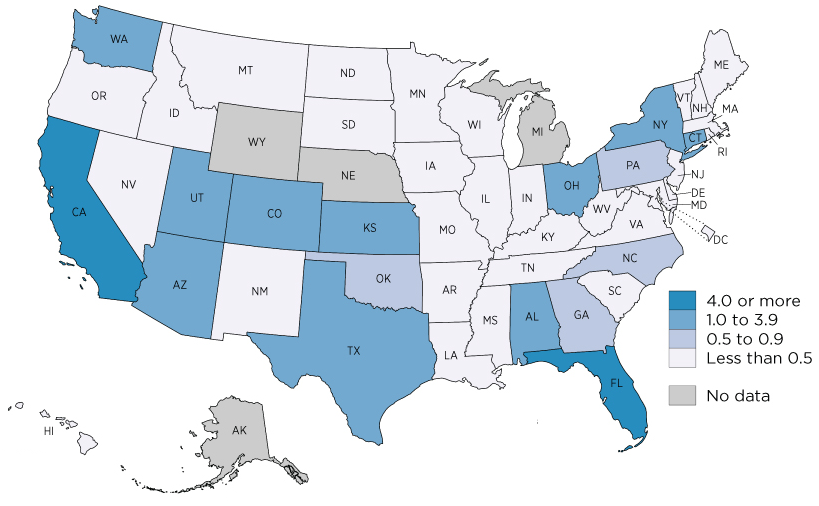
It should come as no surprise that STEM fields — those in the Science, Technology, Engineering, and Math disciplines — account for more than 83 percent of all space workforce occupations, according to a 2025 Bureau of Economic Analysis report. These occupations are often high-paying and can provide economic and tax benefits to states, contributing to increased state-level interest in developing space-related industries. To that end, this section examines the various state fiscal and tax policies for the space industry, which have helped establish the South as the Northstar of the industry.82 Further, more than half of all hires in 2024 for space industry-related jobs were under age 35, giving the South a significant demographic advantage — as the figure below illustrates. Six CSG South member states — Alabama, Florida, Georgia, North Carolina, Oklahoma, and Texas — are among the country’s leading states for new, young hires in this growing industry.83
FIGURE 7. State Shares of New Space Economy Hires Under Age 35 (2024)
✝Ad astra is Latin for “to the stars,” while ad valorem is Latin for “according to value.”

BONDS, SPACE BONDS
On July 4, 2025, Congress passed, and the President signed House Resolution 1, also known as the One Big Beautiful Bill Act, into law. Public law included a provision that added spaceports to the qualified tax-exempt category for private-activity bonds, enabling tax-exempt bond financing nationwide. Spaceport tax-exempt bonds can now assist in the transformation of spaceports in states across the U.S., and particularly the South, by enabling more modern and robust capabilities to be constructed at lower infrastructure development costs, in effect mirroring the longstanding financing methods used by airports and seaports. Future improvements to spaceports across the nation, enabled by this policy change, will enhance the resilience of these sites and increase their utility for public and private sector partners to leverage them
more effectively.87
Aligning spaceports with other modes of transportation in terms of financing highlights a positive trend that is necessary to meet the challenges presented to the nation in space operations; spaceports will now be another step closer to being treated the same as other modes of transportation at the federal level, offering a great point of departure for future policy initiatives to enable even further growth across the national spaceport ecosystem. This law shows that lawmakers have come to understand that spaceports are more than just launch or re-entry sites, and this new financing tool also supports related and collocated facilities for related manufacturing, research, engineering, and other industrial applications critical to the spaceport ecosystem.88
As part of the support for this burgeoning industry, governments at all levels — federal, state, and local — have typically used tax levers as well as bonds to support their state’s investments into attracting, retaining, and expanding aerospace companies and investments. Bonds issued by governments are typically used to finance large, expensive, and long-term capital projects — such as infrastructure, including roads and bridges, airports and spaceports, other transportation facilities, and buildings.85 While current revenues are used for some investments, the use of these bonds allows the cost burdens for these projects to be spread out over multiple years through debt servicing by taxes, fees, tolls, or other sources. Interest payments on government bonds are typically tax-exempt at the federal level and sometimes at the state and local levels as well, providing greater flexibility for governmental borrowers on projects within their territory. However, interest payments on bonds in other jurisdictions are typically subject to taxation.86 While airports and other ports have a longstanding history of tax exemptions, spaceports — as a newer transportation model — are subject to greater variation at the federal and state levels. A recent federal policy development — H.R. 1 — further shapes this landscape.
Florida
Bonds, Funds, and Economic Impacts
According to a 2023 economic impact study, Space Florida was responsible for nearly 20 percent of the state’s aerospace workforce with an estimated economic impact of more than $5.3 billion from 2023 to 2028 — an average of nearly $1.1 billion per year. Additionally, the authority’s activities have generated an estimated $548 million in federal, state, and local revenues through taxes, leases, and other sources.89
TABLE 5. Economic Impacts from Space Florida Projects (2022)
| Area of Impact | Direct Impact | Indirect Impact | Total Impact |
|---|---|---|---|
| Employment/Workforce (Jobs) | 13,026 | 16,124 | 29,151 |
| Household Income ($ million) | $831 | $912 | $1,743 |
| Value-Added Gross Domestic Product ($ million) | $1,274 | $1,499 | $2,773 |
| Total Economic Impact ($ million) | $3,074 | $2,816 | $5,890 |
| Federal, State, and Local Revenues ($ million) | $208 | $340 | $548 |
Space Florida is granted a diverse set of financial and development tools to operate programs that retain, attract, and expand new aerospace and space businesses in the Sunshine State. For bond purposes, however, the authority must still have a board vote before issuing revenue bonds, unlike other state-backed bonds, which are exempt from any vote requirements.91,92 The bonds are eligible to be secured or paid by revenues derived by Space Florida from any:
- Charges, fees, rates, rentals, tolls, fares, assessments, or other payments collected from any users or Space Florida facilities or projects;
- Revenue-producing activities of Space Florida; and/or
- Sources other than state appropriations.
Further specifying that these bonds are secured by Space Florida and not the full faith and credit of the state.93 Additionally, due to it fulfilling a “governmental purpose,” real and tangible property owned by the federal government or Space Florida for space exploration or spaceport activities is exempt from property taxes as well as any taxes on issued bonds.94,95 However, according to the 2024 Comprehensive Financial Report, Space Florida does not currently have any outstanding bonds but did receive more than $30.7 million in revenues from fees and other charges for services provided — more than double the amount of state appropriations for the same Fiscal Year 2024 period.96
More recently, in 2025, lawmakers passed Senate Bill 1516 (2025), establishing an International Aerospace Innovation Fund (IAIF) to draw on international collaborations to fund aerospace projects in the state. The IAIF allows Space Florida to leverage private-sector investments, contributions from foreign industry development organizations, and state appropriations to fund space technology projects. To be eligible for these funds, the authority is directed to consider projects that:
- Involve at least one Florida-based aerospace company or entity;
- Feature an international private sector, governmental, academic, space entity, or research institute partner; and
- Demonstrate the potential or intent for space commercialization.97
Lawmakers expressed support that this new fund will further the role of Space Florida as an engine for space-related advancement, as, through June 30, 2024, Space Florida had already established a solid track record by funding more than 160 projects with $101.9 million in funds, generating an estimated $5.6 billion in capital investments across the state’s spaceport territories.98
Lawmakers also enacted Senate Bill 1662 (2025), which further expanded Space Florida’s fiscal authority. Particularly, the law allows spaceports or space-industry-related facilities collocated on existing seaport property to qualify for the Florida Seaport Transportation and Economic Development Program funds, and it ensures that spaceport-related assets collocated on seaport land are not eligible for repurposing to non-space-related activities without the consent of Space Florida. Perhaps most notably, it also permits the state Department of Transportation (FDOT) to review and fund infrastructure projects associated with aerospace or launch support outside spaceport territory, provided an agreement is reached post-review among the FDOT, the state Department of Commerce, and the state Department of Environmental Protection.99 These 2025 actions further expand the tools in Space Florida’s portfolio to grow the state’s space industry.
Tax Exemptions
Due to the “special dirt” provision, which governs land owned directly by any federal, state, or local government entity in Florida, entities operating in spaceports or spaceport territory overseen by Space Florida are exempt from property taxes on real and intangible property. As such, Space Florida prioritizes partnerships and investments with new buildings and facilities located on these “special dirt” lands, given the ability to more easily secure property and rights to infrastructure for commercial use. However, this does not apply to private companies’ acquisition and placement of equipment, machinery, and tools.100 Although other tax benefits may offset this exclusion, space industry actors may also be eligible for sales and use tax benefits.
Businesses that purchase industrial machinery or equipment for exclusive use in spaceport activities or for use in new businesses that operate in fixed locations within spaceport territories may be eligible for sales and use tax exemptions. To qualify, a new business must use the equipment for manufacturing or spaceport activities, while an expanding facility must demonstrate a 5 percent increase in productive output. Eligible entities must obtain a temporary permit or request a refund of taxes paid, provided they maintain rigorous documentation for potential audits. Certain sectors, such as electric utilities and communications firms, are explicitly excluded from these benefits, though mining operations remain eligible.101
Furthermore, the equipment must have a depreciable life of at least three years and be an essential component of the production process. Failure to meet these criteria or begin operations as scheduled results in the immediate repayment of exempted taxes plus penalties. Space technology products, for purposes of these exemptions, mean products that are specifically designed or manufactured for application in space activities, which include, but are not limited to, space launch vehicles, spaceflight vehicles, missiles, satellites or research payloads, avionics, and associated control systems and processing systems, and components of any of the foregoing. Notably, equipment or machinery designed for general commercial aviation — even if incidentally used in space-related applications — is ineligible for this exemption.102
Texas
Funding to Support Economic Impacts
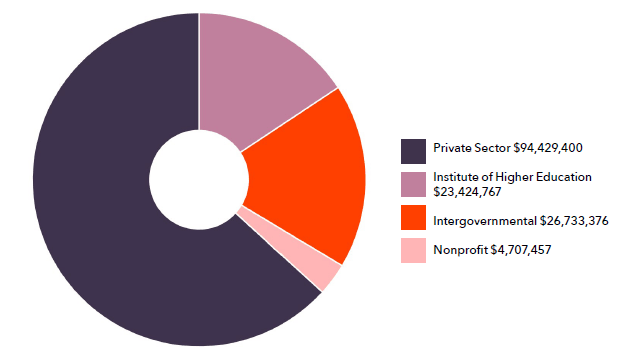
Instead of a series of tax exemptions, Texas primarily focused on directly supporting the aerospace industry’s economic development through nearly $150 million in competitive grants awarded by the Texas Space Commission through February 2026. This includes more than $94 million to private entities, more than $26 million to other governmental subdivisions, and more than $23 million to institutions of higher education in the state, all to support spaceport development, space-related technology, research, and workforce development.103 As illustrated by the figure below, this diverse list of grant recipients — including nearly $5 million to a Science, Technology, Engineering, Arts, and Math nonprofit — highlights the varied portfolio the state commission has invested in to ensure the Lone Star State remains pivotal to the U.S. space race.
FIGURE 8. Texas Space Commission Grant Awardees by Type and Amount
The aforementioned local Spaceport Development Corporations (SDC) do, however, have access to certain tax benefits, including an exemption from state and local taxes levied on tangible personal property located at the spaceport — including vehicles, spacecraft, and other launch equipment. Additionally, the property, income, and operations of the SDCs are exempt from all state and local taxes.105 However, these exemptions do not apply to tangible personal property purchases for use by an individual or business for use in a spaceport, and, in lieu of ad valorem taxes, the corporations pay each government subdivision in which the corporation’s land is located a payment equal to the amount that would be assessed on the land if owned by a private entity.106
Virginia
Aerospace Business Tax Deductions and Exemptions
As an authority of the commonwealth, the Virginia Spaceport Authority provides economic and operational benefits to customers and stakeholders utilizing the VSA’s Mid-Atlantic Regional Spaceport, including deductions, which incentivize spending by subtracting certain expenses from gross incomes, and exemptions, which exclude certain income sources from tax assessments from the start.107 Among the statutory development benefits, legislation, and trade zones established to encourage commercial space business is the Virginia “Zero Gravity, Zero Tax” Act of 2009, which provides state income tax incentives to locate and headquarter spaceflight launch and training operations in Virginia.108
Specifically, the Zero G Act provides tax deductions for realized gains from the sale of launch services to spaceflight entities or participations, as well as training or experiential launch services that are not an actual launch. The second part of the statute includes an additional deduction for realized gains from resupply services for delivering payloads to spaceflight entities — including NASA operations. All launch services must be performed in the commonwealth or originate from a spaceport located within Virginia.109
The state code outlines specific sales and use tax exemptions designed to support the aerospace industry in the commonwealth. These exemptions waive costs associated with the sale, lease, or storage of space-bound equipment, including satellites and propulsion systems. The financial relief also extends to specialized fuels and the machinery required to maintain launch and processing facilities. To qualify for these benefits, the equipment and services must be utilized for spaceport activities managed by the Virginia Commercial Spaceflight Authority. Notably, these tax advantages remain protected even if a mission fails, is delayed, or is destroyed.110 For Fiscal Years 2014 to 2024, the spaceport users’ exemption totaled approximately $8.3 million in tax savings for businesses, or an average of $800,000 per year. Per the Joint Legislative Audit and Review Commission, this represented a small amount of the total foregone revenue the state lost due to tax exemptions during the same period.111
CASE STUDY: GEORGIA’S SPACEPORT CAMDEN
While there has been tremendous success and growth in the space industry across the South, like any new industry or investment, there has also been significant risk. In 2012, the Camden County Joint Development Authority, in Southeast Georgia, voted to explore the feasibility of developing a horizontal and vertical launch spaceport on a 400-acre site along the Atlantic Coast in order to attract commercial spaceflight companies. After an initial environmental and economic review, the county authority projected that launches could begin as soon as 2020, with an estimated annual revenue of $22.5 million to the region once fully developed and with regular launches.112 However, due to the site’s proximity to nationally protected conservation areas and concerns over possible launch and flight paths, the project received significant residential pushback.
Despite these concerns, the FAA approved a draft environmental impact statement for the spaceport and, late in December 2021, issued the first launch site operator license for limited spaceflight operations.113 However, the saga continued to develop as citizens launched a ballot referendum in 2022 to cancel the project. In a March 2022 vote, 72 percent of voters rejected the spaceport project, vetoing the county’s prior approval of the project. The debate continued in the courtroom, with local government officials arguing that voters cannot veto a previously approved commission resolution after the fact and attempting to continue the project.114
Ending this cycle, in a February 2023 decision, the Georgia Supreme Court unanimously ruled that the county must abide by the will of the voters and, as a result, was on the hook for more than $12 million due to the cancelled project.115 As of March 2026, there has been no attempt to recoup or redevelop the property, resulting in the cancellation of the Spaceport Camden project.116
Look Out Below: Other Regulatory and Liability Considerations
FIGURE 9. Vertical Spaceflight Launches in the U.S. by State (1957-2026)
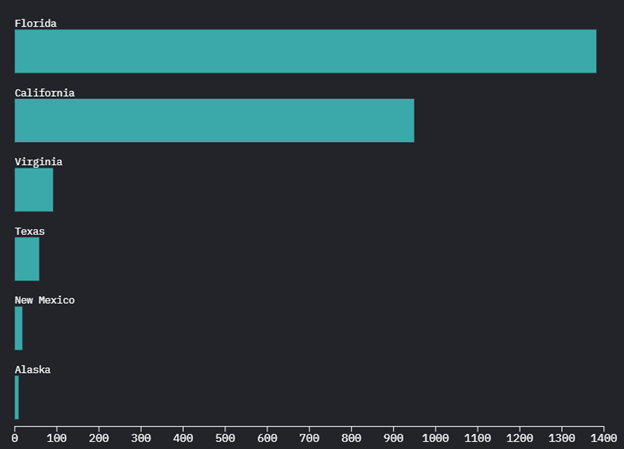
From land use, liability, property ownership, and other regulatory considerations, states have also ensured that existing legal and regulatory laws apply properly to an industry that was nothing more than a dream when state statutes were first written. For example, both Alabama and Florida are the only two states in the South to explicitly include spaceports as “critical infrastructure” for purposes of restricting certain foreign entities from owning land within a spaceport’s territory.118 Likewise, as noted below, Florida is the only state in the U.S. to have a “space junk” proviso in its state law.119 These varied state regulatory environments reflect the diverse needs of states, based on the locations, breadth, and number of spaceflight launches and activities within their sovereign territory, as governments attempt to “futureproof” the regulatory and legal landscape.120
Alabama
While the Yellowhammer State does not appear to have a specific carveout for civil and/or criminal liability for spaceflight or launches, it does offer the industry a unique regulatory protection. Notably, when state lawmakers enacted the Alabama Property Protection Act of 2023, aerospace and spaceport infrastructure was included amongst the list of critical infrastructure facilities, and as such, foreign entities or government-affiliated entities from such countries — including China, Iran, North Korea, and Russia — cannot purchase land, buildings, facilities, or other property within 10 miles or less of spaceport territory.121
Florida
Like Alabama, Florida’s foreign ownership of land restrictions include spaceports as critical infrastructure, with the same 10-mile restriction.122 Further, spaceflight businesses are protected from being held civilly or criminally liable for accidents or harm, including the loss of life, via statute. However, this does not protect aerospace companies from situations of gross negligence or willful disregard of safety precautions and requires all spaceflight participants to consent and sign a waiver before any launch or spaceflight.123 However, these protections only apply to federally licensed launch sites or spaceports.
“Space Junk”
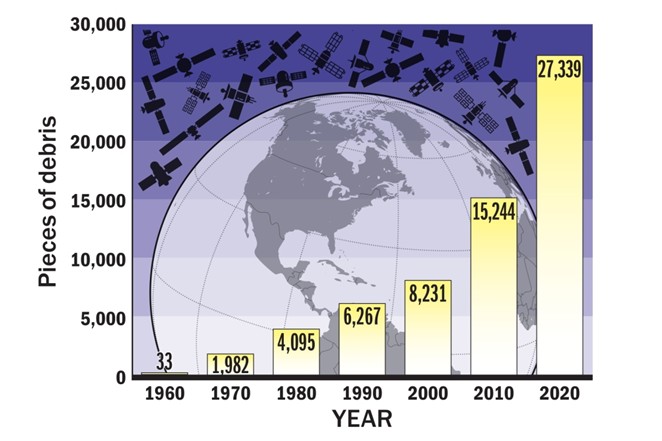
Since the advent of the “Space Age” in 1957, more than 7,170 rockets have been launched, placing more than 25,170 satellites into the Earth’s orbit. This amounts to more than 15,800 tons of objects in orbit — although experts caution that these are just the objects, debris, and space junk that can be accurately identified and cataloged remotely, making the threat of space debris or junk a real one.124
FIGURE 10. Increase in Reports of Space Debris or Junk Over Time
With so many launches resulting in so much debris — both designed and that from unanticipated collisions — it’s no surprise that human curiosity leads many individuals to try to grab a souvenir of this or other such extraordinary vessels and debris beyond an exciting photograph or video. Sadly, this is a legitimate concern — even in tragic circumstances. In 2003, the New York Times reported that recovered debris from the Space Shuttle Columbia and Challenger tragedies was listed for auction on eBay.126 With the growing number of spaceflight launches and other atmospheric vehicles, there may be an ever-increasing risk that debris or reusable assets will be discovered by individuals, regardless of their ownership rights.
While “finders keepers” may be the law of the land on the playground or schoolyard, there is little actual state-level law specifically governing this newfound territory of “extraterrestrial,” outer space, or suborbital policy. Existing property rights and other public safety laws regarding the failure to return a public or private asset to the proper authorities typically result in moderate to severe criminal penalties. However, the newsworthiness of high-altitude or space flights may make this topic particularly interesting to lawmakers in states with booming space industries.
Home to Cape Canaveral and the Kennedy Space Center, the Sunshine State addressed the growing number of high-altitude and atmospheric vehicle launches by addressing concerns about the potential for scavenging landings or wrecks for valuable and/or reusable debris. In 2021, Florida Governor Ron DeSantis signed House Bill 221, which nearly unanimously passed both chambers, to establish procedures and penalties for failure to return spaceflight assets. Specifically, the law defines these assets as any items or parts owned by an entity used in spaceflight activities, including but not limited to:
- Crewed and uncrewed capsules;
- Launch vehicles;
- Parachutes;
- Landing aids; or
- Any ancillary equipment used or attached to the launch vehicle for launch, orbit, or reentry.127
The law requires individuals who discover any equipment or parts to report the description and location to the relevant law enforcement agency. Law enforcement must make reasonable efforts to identify and return the assets to the owner. Courts may order restitution payments if a person damages the asset. At the same time, failure to report or attempt to keep the debris is now a first-degree misdemeanor punishable under Florida law by up to one year in prison and a fine of up to $1,000. The legal definitions of the covered vehicles and assets refer to “suborbital” launches or activities.128
Besides the private property components, a significant concern raised by Florida lawmakers and NASA officials was the safety of the recovery of manned assets. Specifically, in August 2020, the U.S. Coast Guard was forced to order groups to disperse after private boaters hampered recovery efforts following the splashdown of the SpaceX Crew Dragon capsule, in a race to collect “souvenirs.”129
Another piece of legislation in Florida — Senate Bill 1086 (2021) — addressed this concern by establishing a “buffer zone” around spaceflight or other water recovery operations. These temporary protection zones for spaceflight-related launches and recovery extend to 500 yards from the launch or recovery site. If the head of the law enforcement agency or entity overseeing protection determines that a larger zone is in the public’s interest, the buffer may extend as far as necessary. The temporality of this buffer may not exceed 72 hours pre- or post-activity. It may also extend within 500 yards of any vessel transporting assets to or from the launch or recovery area. Violators of this section may be charged with a second-degree misdemeanor.130
To date, Florida remains the only state to enact legislation governing the ownership of “spacejunk.” Given the growing number of public, private, and international high-altitude launches and assets — as well as the industry’s growing economic importance to the CSG South Region — it is likely that this legislative trend merits future consideration — from a range of stakeholders and public safety perspectives.
Georgia
As part of the previously highlighted Spaceport Camden project, Georgia lawmakers attempted to preemptively address regulatory concerns during the 2017 legislative session. The General Assembly passed House Bill 1 (2017), which limited the civil and criminal liability of a spaceflight or launch entity for injuries sustained by flight or launch participants arising from acts of ordinary or unintentional negligence.131 The Georgia Spaceflight Act also added statutory definitions for spaceflight activities, launches, and operations, and included a statutory waiver form that participants must sign with informed consent. Lastly, the law mandated that participants must sign the waiver before participating in any spaceflight or related activities. Notably, nothing in the act limited the liability of spaceflight entities for gross negligence or intentional acts, nor does it prevent suits from anyone other than the spaceflight participant injured by malfeasance.132
Texas
Like Florida, lawmakers in the Lone Star State enacted Senate Bill 115 (2011) to enshrine into law certain legal liability protections for spaceflight and aerospace activities.133 Specifically, spaceflight entities are protected from damage claims arising from testing, launching, reentering, or landing, or subject to any claim for nuisance arising from testing, launching, reentering, or landing. Likewise, individuals must sign a waiver before engaging in spaceflight from a licensed site in the state, which limits the ability to hold spaceflight or launch entities civilly or criminally liable for damages — unless the harms are caused by gross or intentional negligence.134
Virginia
Similarly, in 2007, the General Assembly passed the Spaceflight Liability and Immunity Act, establishing specific legal protections for organizations conducting suborbital or orbital launches.135 Under this law, spaceflight entities are generally shielded from civil lawsuits arising from injuries or fatalities sustained by participants during flight activities. To qualify for this immunity, companies must obtain informed consent and ensure every passenger signs a mandatory warning statement acknowledging the inherent dangers of travel. However, these legal protections do not apply if an entity displays gross negligence or causes harm through intentional misconduct. Ultimately, the statute defines the legal relationship between commercial aerospace providers and private citizens by shifting the primary burden of risk to the participant, unless the events involve intentional negligence or disregard of safety precautions.136
Conclusion
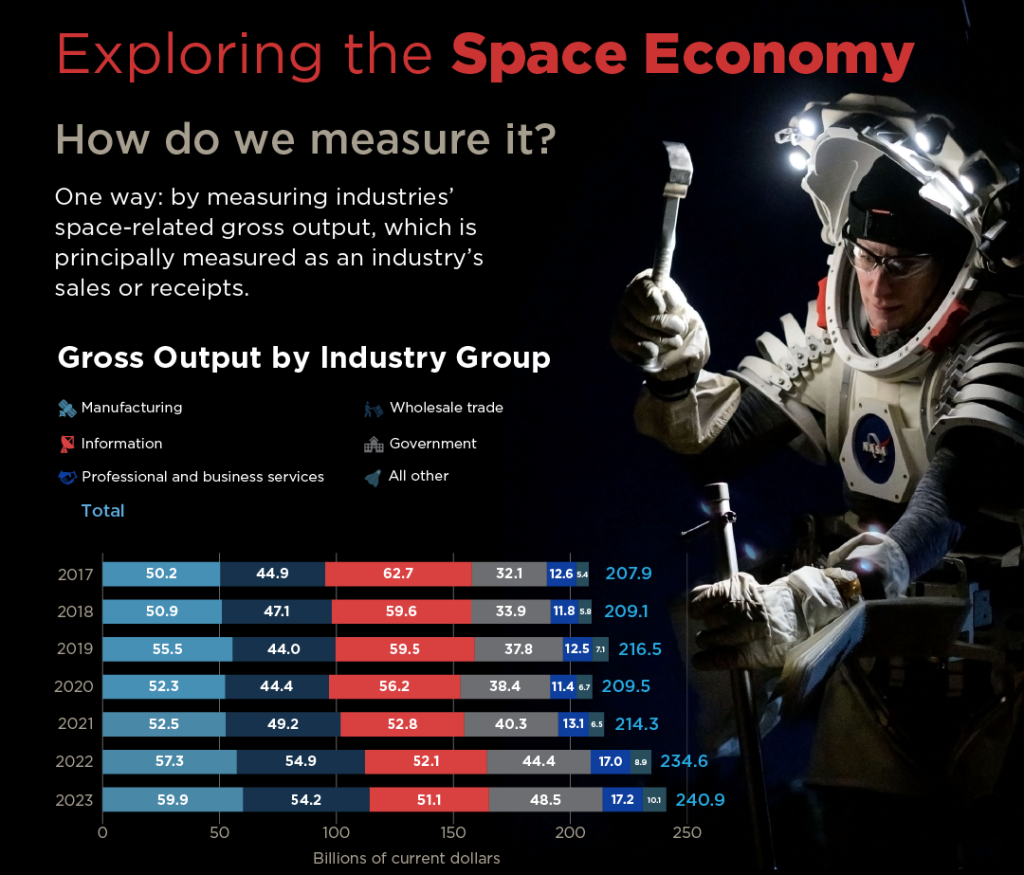
With the commercialization of the space economy expected to continue to grow, experts anticipate the U.S. domestic space industry reaching more than $326 billion by 2035 — a 9 percent annual growth rate. It is no wonder that governments at all levels are racing to innovate, research, and develop commercial and exploratory spaceflight activities in this new industrial revolution.137 Representing this ever-growing economic sector, the White House issued two presidential Executive Orders in the span of four months, designed to emphasize the U.S. role in leading in spaceflight and improving commercial spaceflight permitting.
FIGURE 11. The Impact of the U.S. Space Economy
The first order, aimed at promoting commercial space innovation and competition, directed the Secretary of Transportation to audit existing permitting requirements and reviews for launch and reentry sites to identify unnecessary regulatory burdens or delays to spaceport facilities. It also orders the Secretaries of Defense, Transportation, and NASA’s administrator to create a streamlined process for authorizing novel spaceflight activities that do not easily fit within existing regulatory frameworks.139 The second order emphasized the role of public and private actors in advancing spaceflight, exploration, and defense innovations — even prioritizing the use of extraterrestrial facilities or resources for energy. It also builds upon the need for public-private partnerships in space exploration, commercialization, and defense activities, including identifying pathways for commercial space entities to support and upgrade the International Space Station’s mission.140
However, the industry’s continued growth is constrained by aging infrastructure, a shortage of trained personnel, and the need to coordinate launches across federal and military sites. With these operational and financial bottlenecks, particularly at federal launch sites, serving as limiters on spaceflight activities, it is no wonder states have joined the space race with a diverse policy portfolio of regulatory, tax, and infrastructure benefits designed to lure, retain, and grow commercial and exploratory spaceflight capabilities in their states.141 As the data in this report has illustrated, Southern states — namely Florida, Texas, and Virginia — have long led the way with newcomers, such as Alabama and Oklahoma, further joining the ranks of state space leaders. For state policymakers, states are increasingly evaluating how to engage in the evolving space economy and how best to structure governance and incentives while balancing risks.
End Notes
- “FY 2025 Space Florida Annual Report,” Space Florida, September 30, 2024, https://cdn.prod.website-files.com/66c8a3fe36eef11411f2b1ef/6929eefe320e7521b010c737_Annual-Report-2025-V10-compressed.pdf.
- “FAA Licenses Private Facility for Space Launches,” Los Angeles Times, September 20, 1996, https://www.latimes.com/archives/la-xpm-1996-09-20-mn-45694-story.html.
- “NATIONAL SECURITY SPACE LAUNCH: Increased Commercial Use of Ranges Underscores Need for Improved Cost Recovery,” United States Government Accountability Office Report to Congressional Committees, GAO-25-107228, published June 2025, https://files.gao.gov/reports/GAO-25-107228/index.html.
- Ibid.
- “U.S. Space Command Headquarters is moving to Huntsville,” City of Huntsville, Alabama Press Release, September 2, 2025, https://www.huntsvilleal.gov/u-s-space-command-headquarters-is-moving-to-huntsville/.
- Angelica Reyes, “The Economic Engine of Texas and Florida in Space,” The Space Foundation Panel, https://vimeo.com/1118864993.
- Brian Odom and Casey Dreier, “Space Policy Edition: NASA and the American South,” Planetary Radio, July 5, 2024, https://www.planetary.org/planetary-radio/spe-nasa-and-the-american-south.
- “Space-related Legislation in the South (2014-Present),” Quorum, https://www.quorum.us/spreadsheet/external/seDYIwpvgzNqqVPaVatu.
- Ibid.
- “U.S. Spaceports,” Office of Spaceports, Federal Aviation Administration, United States Department of Transportation, published March 2025, https://www.faa.gov/space/office_spaceports.
- 51 U.S. Code § 51501, https://uscode.house.gov/view.xhtml?req=granuleid:USC-prelim-title51-section51501&num=0&edition=prelim.
- “NATIONAL SECURITY SPACE LAUNCH: Increased Commercial Use of Ranges Underscores Need for Improved Cost Recovery,” GAO-25-107228.
- Karen Jones, Lindsay DeMarchi, and Priyanka Dhopade, “Spaceportopia: A Primer For Successful Launch Site Planning,” Center for Space Policy and Strategy, July 2025, https://csps.aerospace.org/sites/default/files/2025-07/Jones_Spaceportopia_20250630.pdf.
- Ibid.
- Mauricio La Plante, “JAA to apply for orbital reentry license at Cecil Spaceport, aims to attract aerospace innovation,” Jacksonville Business Journal, August 1, 2025, https://www.bizjournals.com/jacksonville/news/2025/08/01/jaa-to-apply-for-space-reentry-license-at-cecil.html.
- “U.S. Spaceports,” Office of Spaceports, FAA, U.S. DOT.
- Ibid.
- “Spaceports by State,” Office of Spaceports, FAA, U.S. DOT, accessed February 2026, https://www.faa.gov/space/spaceports_by_state.
- Wisconsin Statutes Annotated § 114.002, https://docs.legis.wisconsin.gov/document/statutes/114.002.
- New Mexico Statute § 58-31-3, https://law.justia.com/codes/new-mexico/chapter-58/article-31/section-58-31-3.
- Arizona Revised Statutes § 41-1551, et seq., https://www.azleg.gov/ars/41/01551.htm.
- California Government Code § 14007.2, https://leginfo.legislature.ca.gov/faces/codes_displaySection.html?lawCode=GOV§ionNum=14007.2.
- Utah Code § 72-10-1301, https://le.utah.gov/xcode/Title72/Chapter10/72-10-S1301.html.
- Alabama Code § 41-23-170, et seq., https://alison.legislature.state.al.us/code-of-alabama?section=41-23-170.
- Florida Statute § 331.303, https://www.leg.state.fl.us/statutes/index.cfm?App_mode=Display_Statute&Search_String=&URL=0300-0399/0331/Sections/0331.303.html.
- Fla. Stat. § 331.304, https://www.leg.state.fl.us/statutes/index.cfm?App_mode=Display_Statute&Search_String=&URL=0300-0399/0331/Sections/0331.304.html.
- Fla. Stat. § 331.329, https://www.leg.state.fl.us/statutes/index.cfm?App_mode=Display_Statute&Search_String=&URL=0300-0399/0331/Sections/0331.329.html.
- Oklahoma Statutes Title 3 § 512, https://www.oscn.net/applications/oscn/DeliverDocument.asp?CiteID=548602.
- 3 O.S. § 523, https://www.oscn.net/applications/oscn/DeliverDocument.asp?CiteID=548707.
- 3 O.S. § 530, https://www.oscn.net/applications/oscn/DeliverDocument.asp?CiteID=548774.
- South Carolina Code § 55-1-5(4), https://www.scstatehouse.gov/code/t55c001.php.
- Texas Local Government Code § 507.001(3), https://statutes.capitol.texas.gov/?tab=1&code=LG&chapter=LG.507&artSec=.
- Virginia Code § 58.1-609.3(13), https://law.lis.virginia.gov/vacode/title58.1/chapter6/section58.1-609.3/.
- Karen Jones, Lindsay DeMarchi, and Priyanka Dhopade, “Spaceportopia: A Primer For Successful Launch Site Planning,” Center for Space Policy and Strategy.
- Tex. Local Gov’t Code § 507.001, et seq., https://statutes.capitol.texas.gov/?tab=1&code=LG&chapter=LG.507&artSec=.
- 36 Ala. House Bill 176 (2017), https://adeca.alabama.gov/wp-content/uploads/Space-Authority-Legislation.pdf.
- Ala. Code § 41-23-171, https://alison.legislature.state.al.us/code-of-alabama?section=41-23-171.
- Ala. Code § 41-23-172, https://alison.legislature.state.al.us/code-of-alabama?section=41-23-172.
- “Alabama Space Authority,” Alabama Department of Economic and Community Affairs, https://adeca.alabama.gov/space/.
- Ala. Code § 41-23-174, https://alison.legislature.state.al.us/code-of-alabama?section=41-23-174.
- Ala. Senate Bill 228 (2026), https://alison.legislature.state.al.us/files/pdf/SearchableInstruments/2026RS/SB228-reenr.pdf.
- Jennifer Farish, “Fiscal Note: SB228,” Alabama Legislative Services Agency, February 16, 2026, https://alison.legislature.state.al.us/files/pdf/SearchableInstruments/2026RS/FiscalNotes/FN-6YSYB31-2.pdf.
- Fla. Senate Bill 1469 (1989), https://edocs.dlis.state.fl.us/fldocs/leg/actsflorida/1989/1989V1Pt3.pdf.
- Fla. Stat. § 331.302, https://www.leg.state.fl.us/statutes/index.cfm?App_mode=Display_Statute&Search_String=&URL=0300-0399/0331/Sections/0331.302.html.
- Fla. House Bill 1489 (2006), https://laws.flrules.org/2006/60.
- “Specific Appropriation 2129,” Fla. Senate Bill 2500 (2025), https://www.flhouse.gov/Sections/Documents/loaddoc.aspx?FileName=SB%202500%20As%20Introduced.pdf&DocumentType=Bill&BillNumber=2500&Session=2025.
- “FY 2025 Space Florida Annual Report,” Space Florida.
- Fla. Stat. § 331.3081, https://www.leg.state.fl.us/Statutes/index.cfm?App_mode=Display_Statute&Search_String=&URL=0300-0399/0331/Sections/0331.3081.html.
- Fla. Stat. § 331.305, https://www.leg.state.fl.us/Statutes/index.cfm?App_mode=Display_Statute&Search_String=&URL=0300-0399/0331/Sections/0331.305.html.
- Ibid.
- Oklahoma Senate Bill 720 (1999), https://www.oscn.net/applications/oscn/DeliverDocument.asp?CiteID=368871.
- 3 Okla. Stat. § 511, et seq., https://www.oscn.net/applications/oscn/DeliverDocument.asp?CiteID=548604.
- “Oklahoma Space Industry Development Authority,” Transparent Oklahoma Performance Portal, State of Okla., updated January 5, 2026, https://oklahoma.gov/top/agency/346.html.
- “Budget HQ: FY-2025 OSIDA,” Appropriations and Budget Subcommittees – Transportation, Okla. House of Representatives, https://former.okhouse.gov/fiscal/FY2.aspx.
- Ibid.
- Okla. Senate Bill 912 (2025), https://www.oscn.net/applications/oscn/DeliverDocument.asp?CiteID=548238.
- 3 Okla. Stat. § 84, https://www.oscn.net/applications/oscn/DeliverDocument.asp?CiteID=64660.
- 3 Okla. Stat. § 516, https://www.oscn.net/applications/oscn/DeliverDocument.asp?CiteID=548694.
- 3 Okla. Stat. § 527, https://www.oscn.net/applications/oscn/DeliverDocument.asp?CiteID=548752.
- Ibid.
- Mickinzi Ferguson, “Agriculture in Numbers: Economics,” Oklahoma Farm Bureau, Summer 2024, https://www.okfarmbureau.org/agriculture-in-numbers.
- Texas House Bill 3447 (2023), https://capitol.texas.gov/tlodocs/88R/billtext/html/HB03447F.htm.
- “About,” Texas Space Commission, updated 2026, https://space.texas.gov/about.
- “Revenue Portal: Texas Space Commission,” Texas Comptroller of Public Accounts, March 17, 2026, https://bivisual.cpa.texas.gov/CPA/opendocnotoolbar.htm?document=documents%5CTR_Master_UI.qvw.
- Ibid.
- Tex. Government Code § 482.101, et seq., https://statutes.capitol.texas.gov/?tab=1&code=GV&chapter=GV.482&artSec=.
- Tex. Gov’t Code § 482.105, https://statutes.capitol.texas.gov/?tab=1&code=GV&chapter=GV.482&artSec=.
- Tex. Gov’t Code § 482.107, https://statutes.capitol.texas.gov/?tab=1&code=GV&chapter=GV.482&artSec=.
- Tex. Gov’t Code § 482.108, https://statutes.capitol.texas.gov/?tab=1&code=GV&chapter=GV.482&artSec=.
- Tex. Gov’t Code § 482.103, https://statutes.capitol.texas.gov/?tab=1&code=GV&chapter=GV.482&artSec=.
- Tex. House Bill 2278 (2007), https://capitol.texas.gov/tlodocs/80R/billtext/html/HB02278F.HTM.
- Tex. Local Gov’t Code § 507.001, et seq., https://statutes.capitol.texas.gov/?tab=1&code=LG&chapter=LG.507&artSec=.
- Ibid.
- Virginia House Bill 2199 (1995), https://legacylis.virginia.gov/cgi-bin/legp604.exe?951+ful+CHAP0758.
- “Item 421,” Va. House Bill 1600 (2025), https://budget.lis.virginia.gov/item/2025/1/HB1600/Chapter/1/421.
- “Staff,” Va. Spaceport Authority, https://www.vaspace.org/our-team.
- Va. Code § 2.2-2203, https://law.lis.virginia.gov/vacodefull/title2.2/chapter22/article2.
- Va. Code § 2.2-2203.2, https://law.lis.virginia.gov/vacodefull/title2.2/chapter22/article2.
- Va. Code § 2.2-2204, https://law.lis.virginia.gov/vacodefull/title2.2/chapter22/article2.
- Va. Code § 2.2-2216, https://law.lis.virginia.gov/vacodefull/title2.2/chapter22/article2.
- Va. Code § 2.2-2217, https://law.lis.virginia.gov/vacodefull/title2.2/chapter22/article2.
- Abby R. Goldman , Asha Balakrishnan , and Tina Highfill, “The Space Economy Workforce and STEM Occupations,” Bureau of Economic Analysis, U.S. Department of Commerce, September 2025, https://www.bea.gov/research/papers/2025/space-economy-workforce-and-stem-occupations.
- David Wasser, “Industry-level Detail Provides New Insights on the Growing Space Economy,” U.S. Census Bureau, January 13, 2026, https://www.census.gov/library/stories/2026/01/space-economy.html.
- Ibid.
- “What are municipal bonds and how are they used?” Tax Policy Center, Urban Institute and Brookings Institution, updated January 2024, https://taxpolicycenter.org/briefing-book/what-are-municipal-bonds-and-how-are-they-used.
- Ibid.
- H.R.1 – 119th Congress (2025-2026): An act to provide for reconciliation pursuant to title II of H. Con. Res. 14. July 4, 2025. https://www.congress.gov/bill/119th-congress/house-bill/1/text.
- Ibid.
- “Space Florida Economic Impact Study,” The Washington Economics Group, January 23, 2023, https://www.spaceflorida.gov/news/space-florida-5-9-billion-economic-impact-on-floridas-economy.
- Ibid.
- Fla. Stat. § 331.340, https://www.leg.state.fl.us/statutes/index.cfm?App_mode=Display_Statute&Search_String=&URL=0300-0399/0331/Sections/0331.340.html.
- Fla. Stat. § 331.331, https://www.leg.state.fl.us/statutes/index.cfm?App_mode=Display_Statute&Search_String=&URL=0300-0399/0331/Sections/0331.331.html.
- Ibid.
- Fla. Stat. § 196.012(6), https://www.leg.state.fl.us/Statutes/index.cfm?App_mode=Display_Statute&Search_String=&URL=0100-0199/0196/Sections/0196.012.html.
- Fla. Stat. § 331.354, https://www.leg.state.fl.us/statutes/index.cfm?App_mode=Display_Statute&Search_String=&URL=0300-0399/0331/Sections/0331.354.html.
- “Financial Statements,” Space Florida, September 30, 2024, https://cdn.prod.website-files.com/66c8a3fe36eef11411f2b1ef/685c39bfec52c73b12fac556_FS%202024%20Audited%20Financial%20Statements%20-%20Space%20Florida.pdf.
- Fla. Senate Bill 1516 (2025), https://www.flsenate.gov/Session/Bill/2025/1516/BillText/er/HTML.
- “Fiscal Impact Statement: SB1516,” Florida Senate Committee on Fiscal Policy, April 1, 2025, https://www.flsenate.gov/Session/Bill/2025/1516/Analyses/2025s01516.fp.PDF.
- Fla. Senate Bill 1662 (2025), https://www.flsenate.gov/Session/Bill/2025/1662/BillText/er/HTML.
- “Financial Toolkit,” Space Florida, https://www.spaceflorida.gov/financial-toolkit.
- Fla. Stat. § 212.08, https://www.leg.state.fl.us/statutes/index.cfm?App_mode=Display_Statute&Search_String=&URL=0200-0299/0212/Sections/0212.08.html.
- Ibid.
- “Grant Awards,” Texas Space Commission, updated February 17, 2026, https://space.texas.gov/grants/awards.
- Ibid.
- Tex. Local Gov’t Code § 507.201, https://statutes.capitol.texas.gov/?tab=1&code=LG&chapter=LG.507&artSec=
- Tex. Local Gov’t Code § 507.202, https://statutes.capitol.texas.gov/?tab=1&code=LG&chapter=LG.507&artSec=.
- “Tax Exemptions, Deductions, and Credits,” Center on Budget and Policy Priorities, updated November 24, 2020, https://www.cbpp.org/research/policy-basics-tax-exemptions-deductions-and-credits.
- Va. House Bill 238 (2008), https://legacylis.virginia.gov/cgi-bin/legp604.exe?081+ful+CHAP0211.
- Va. Code § 58.1-402(22) and (23), https://law.lis.virginia.gov/vacode/title58.1/chapter3/section58.1-402.
- Va. Code § 58.1-609.3(13), https://law.lis.virginia.gov/vacode/title58.1/chapter6/section58.1-609.3.
- “Evaluation: Economic Development Incentives,” Virginia Joint Legislative Audit and Review Commission, November 2025, https://jlarc.virginia.gov/pdfs/reports/Rpt611.pdf.
- “Final Report: Camden County Spaceport,” Camden County Spaceport Senate Study Committee, Georgia General Assembly, 2016, https://www.senate.ga.gov/sro/Documents/StudyCommRpts/2016FinalReportCamdenCountySpaceport.pdf.
- Maggie Lee, “Who benefitted from doomed Spaceport Camden?” The Current, August 23, 2023, https://thecurrentga.org/2023/08/22/5-things-spaceport-camden-spending.
- Gordon Jackson, “Supreme Court upholds spaceport referendum,” The Brunswick News, February 8, 2023, https://web.archive.org/web/20230321161014/https://thebrunswicknews.com/news/local_news/supreme-court-upholds-spaceport-referendum/article_7581f0a5-5ccc-5415-8362-0f785359892b.html.
- Camden County v. Sweatt, et al., Case No. S22A0837 (decided February 7, 2023), https://efile.gasupreme.us/viewFiling?filingId=94d123c5-35e6-47b9-865b-81739a6e3aa5.
- Stephen Clark, “ Rocket Report: DOJ sues SpaceX; a look inside doomed Spaceport Camden,” Arstechnica, August 25, 2023, https://arstechnica.com/space/2023/08/rocket-report-justice-department-sues-spacex-north-korean-launch-fails.
- “Past Rocket Launches,” RocketLaunch.org, updated March 20, 2026, https://rocketlaunch.org/location/united-states.
- Micah Brown and Nick Spellman, “Statutes Regulating Ownership of Agricultural Land,” The National Agricultural Law Center, updated October 5, 2025, https://nationalaglawcenter.org/state-compilations/aglandownership.
- Lawrence Mower, “‘Finders keepers’ doesn’t apply to space junk that may land in your Florida yard,” The Miami Herald, April 26, 2021, https://www.miamiherald.com/news/state/florida/article250948384.html.
- Karen Jones, Lindsay DeMarchi, and Priyanka Dhopade, “Spaceportopia.
- Ala. Code § 35-1-1.1, https://alison.legislature.state.al.us/code-of-alabama?section=35-1-1.1.
- Fla. Stat. § 692.201, et seq., https://www.leg.state.fl.us/statutes/index.cfm?App_mode=Display_Statute&URL=0600-0699/0692/0692.html.
- Fla. Stat. § 331.501, https://www.leg.state.fl.us/statutes/index.cfm?mode=View%20Statutes&SubMenu=1&App_mode=Display_Statute&Search_String=spaceflight&URL=0300-0399/0331/Sections/0331.501.html.
- “Space debris by the numbers,” European Space Agency Press Release, January 16, 2026, https://www.esa.int/Space_Safety/Space_Debris/Space_debris_by_the_numbers.
- Karena Phan, “Space Junk,” TIME Magazine for Kids, October 16, 2020, https://www.timeforkids.com/g56/space-junk-2/?rl=en-870.
- Lee Dembart, “Columbia memorabilia up for bids on auction site,” The New York Times, February 3, 2003, https://www.nytimes.com/2003/02/03/news/columbia-memorabilia-up-for-bids-on-auction-site.html.
- Fla. House Bill 221 (2021), https://www.flsenate.gov/Session/Bill/2021/221/BillText/er/PDF.
- Fla. Stat. § 331.502, https://www.leg.state.fl.us/statutes/index.cfm?App_mode=Display_Statute&Search_String=&URL=0300-0399/0331/Sections/0331.502.html.
- Andrew Krietz, “’Not what we were anticipating’: Boaters surround SpaceX capsule at splashdown,” WTSP 10 Tampa Bay, August 2, 2020, https://www.wtsp.com/article/tech/science/space/boaters-swarm-spacex-crew-dragon-capsule-at-spashdown/67-fa2c9eeb-e3bc-4a0f-8917-bc5a2374254e.
- Fla. Senate Bill 1086 (2021), http://laws.flrules.org/2021/184.
- Ga. House Bill 1 (2017), https://www.legis.ga.gov/legislation/49520.
- Official Code of Ga. Ann. § 51-3-41, et seq., https://law.justia.com/codes/georgia/title-51/chapter-3/article-4.
- Tex. Senate Bill 115 (2011), https://capitol.texas.gov/tlodocs/82R/billtext/html/SB00115F.HTM.
- Tex. Civil Practice and Remedies Code § 100A.001, et seq., https://statutes.capitol.texas.gov/?tab=1&code=CP&chapter=CP.100A&artSec=.
- Va. House Bill 3184 (2007), https://legacylis.virginia.gov/cgi-bin/legp604.exe?071+ful+CHAP0893.
- Va. Code § 8.01-227.8, et seq., https://law.lis.virginia.gov/vacodefull/title8.01/chapter3/article24/.
- Ellis Scherer, “Policy Reforms to Launch U.S. Space Innovation,” Information Technology and Innovation Foundation, January 5, 2026, https://itif.org/publications/2026/01/05/policy-reforms-to-launch-us-space-innovation.
- “Space Economy,” U.S. Bureau of Economic Analysis, March 2025, https://www.bea.gov/data/special-topics/space-economy.
- “Enabling Competition in the Commercial Space Industry,” Executive Order, Office of the President, August 13, 2025, https://www.whitehouse.gov/presidential-actions/2025/08/enabling-competition-in-the-commercial-space-industry/.
- “Ensuring American Space Superiority,” Executive Order, Office of the President, December 18, 2025, https://www.whitehouse.gov/presidential-actions/2025/12/ensuring-american-space-superiority.
- Ellis Scherer, “Policy Reforms to Launch U.S. Space Innovation.”