

Issue Brief by Policy Analyst, Erin Twomey Partin
DOWNLOADIntroduction
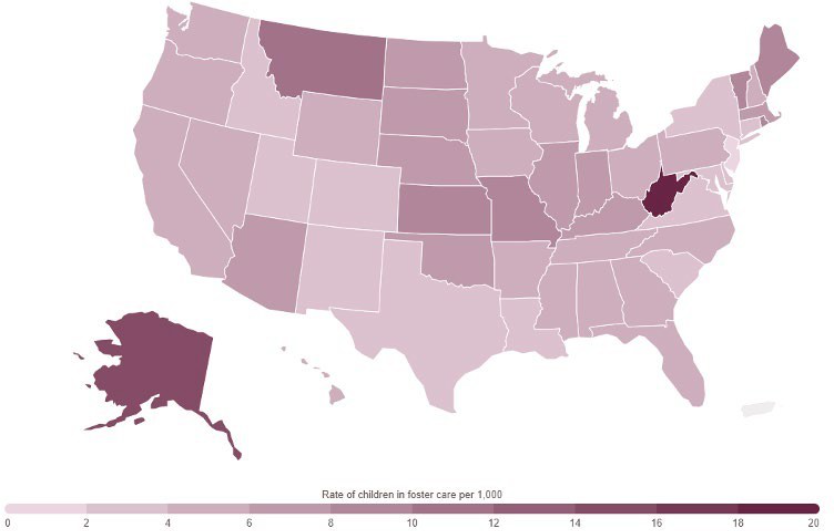
Recent data indicate that the foster care system serves nearly half a million children throughout the United States.1 Figure 1 shows the number of children in foster care by state. Approximately one in four children in foster care has special emotional, behavioral, or medical needs.2 This means that approximately one-quarter of children in foster care require services beyond traditional foster care, often involving support from other government programs. In the CSG South region, West Virginia has the highest rate of children in foster care. According to data from 2024, approximately 18.7 out of every 1,000 children under the age of 18 live in some type of foster care placement.3
FIGURE 1. The Rate of Children in the Foster Care System by State
Source: Casey Family Programs4
The demographic breakdown of children in foster care can provide insight into the cultural needs of foster children. Children between the ages of 1 to 5 years old represent the highest percentage (30 percent) of the total foster care population, with 11- to 16-year-olds following closely behind (28 percent).5 Table 1 provides the percentage and total number of foster children across six age groups.
TABLE 1. The Age of Children in Foster Care
| AGE ON SEPT 30, 2024 | PERCENT | NUMBER |
| LESS THAN 1 YEAR | 7% | 22,097 |
| 1-5 YEARS | 30% | 99,858 |
| 6-10 YEARS | 21% | 70,677 |
| 11-16 YEARS | 28% | 90,596 |
| 17 YEARS | 6% | 19,614 |
| 18-24 YEARS | 7% | 26,105 |
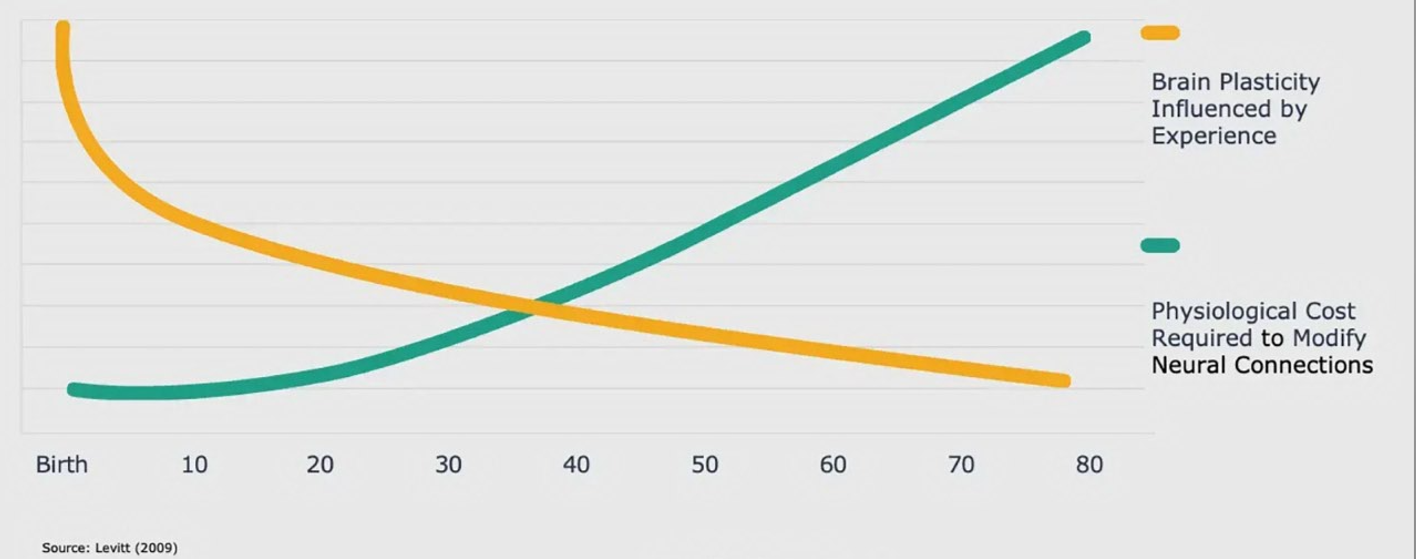
The data in Table 1 show that the majority of children in the foster care system are 10 years old or younger. These early, formative years are essential for brain development and, eventually, physical maturation because this is the period when the brain has the most plasticity — meaning it is the most influenced by experiences during this phase of life.8,9 Because a majority of children in foster care are in early childhood or elementary school years, developmental considerations are especially relevant when evaluating care models. Figure 2 illustrates the brain’s adaptability across various ages. Knowing this developmental period is highly influential, ensuring children entering the foster care system are provided with the best care in the most appropriate setting is paramount.
FIGURE 2. Brain Plasticity and Modification Costs by Age
SOURCE: Center on the Developing Child at Harvard University10
A significant proportion of children in foster care have special needs, including medical, emotional, and behavioral challenges. Among this population, approximately 27 percent are identified as having Special Health Care Needs (SHCN).11 Some estimates suggest that up to 80 percent of children in foster care experience behavioral health challenges or have a diagnosable mental health condition, and 25 percent of foster children will become involved with the criminal justice system.12,13 This brief explores the history of caring for children with complex needs and examines how states are using Treatment Foster Care (TFC), a specialized foster care model designed to serve children with significant medical, emotional, and behavioral challenges.

Key Terms:
Adverse Childhood Experiences: potentially traumatic events that occur in childhood (0-17 years) that can have long-term negative impacts on health, opportunity, and well-being14
Group-home/Congregate care: specialized residential setting with trained staff who provide constant supervision for foster children, often for adolescents or siblings
Guardian: legal terminology for an individual who has been appointed by a court to care for a minor
Permanency: stable, healthy, culturally appropriate, and lasting living situation with at least one committed adult. It also involves reliable, continuous, and healthy connections with siblings, birth parents, extended family, and a network of other significant adults identified by the youth and the family
Permanency Planning: a process designed to secure a stable, healthy, culturally appropriate, and lasting living situation for a child
Relinquishment: the voluntary and independent surrender of legal custody/parental rights of a child
Residential Treatment Center/Institutionalization: community-based providers that offer intensive, short-term, trauma-informed care for children with severe emotional, behavioral, or medical needs
Reunification: processes of returning children to a parent, guardian, or caregiver in their community after they have been involved in a period of foster care placement outside their family home
Traditional Foster Care: a care model where individuals who are not the biological parents of a minor (or in some states, someone below the age of 22) provide short-term care for a child until reunification or another form of permanency has been achieved
Trauma-Informed Care: a specialized approach recognizing that a child’s behavior, emotional struggles, and developmental delays often stem from past trauma like abuse, neglect, or separation
Treatment Foster Care (TFC): a care designation for children with complex behavioral, emotional, or medical needs, often requiring specialized and intensive care
Congregate Care and Complex Needs
In the past, when a child with special care needs was removed from the care of their biological parents, they could be placed in either traditional foster care or congregate care settings. In more severe cases, a child may have been institutionalized. However, long-term institutional placements for children are far less common today than in previous decades. Since the landmark Supreme Court decision in 1999, Olmstead v. L.C., which determined people with disabilities should be served in the least restrictive setting appropriate to their needs, there has been a shift away from residential treatment centers (institutionalization), especially for those with complex medical, emotional, or behavioral needs. Therefore, when children with complex needs enter into foster care, child protective services are meant to find placement for them that allows for community-based, family-like care.
To comply with Olmstead, children with complex needs can be placed in various types of settings. Research from the Center for State Child Welfare Data found that children with complex needs are often put in congregate (group) care settings as an alternative to short-term stays in medical facilities and other institutions.15 Every state has different systems for implementing congregate care, and it is not uncommon for this service to be privatized.
About 15 percent of children in the child welfare system experience congregate care throughout their time in the child welfare system.16 The Family First Prevention Services Act (FFPSA) of 2018 outlines requirements for when and how congregate care may be used to care for children with special needs. It established criteria for qualified residential treatment programs (QRTP), which provide time-limited, trauma-informed treatment services.17
Research has identified several challenges associated with congregate care settings, including lower permanency outcomes and higher rates of re-entry into care.18 Research has also found that children placed in group home settings are approximately 2.5 times more likely to become involved in delinquency and are less likely to graduate from high school.19,20 Congregate care has disproportionate representation of certain demographics. For example, 63 percent of children in group homes are male, and black, multiracial, and American Indian/Native American youth are overrepresented.21
Additionally, group placement can be highly costly to governments. The cost of group placement care steadily increased by 3 percent from 2012 to 2022, with approximately 57 percent of the child welfare funding during this period coming from state and local sources.22
The Family First Prevention Services Act (FFPSA) aims to reduce the use of congregate care settings. FFPSA expands services to help prevent the need for children to enter the foster care system and also limits support for children placed in congregate care unless that setting is necessary for clinical or treatment purposes.23 This shift reflects a broader federal emphasis on family-based and individualized care models.
A federal survey of states found that the FFPSA, has not yet achieved its goal of reducing the need for group home and congregate care. Though the FFPSA limited the federal funding for congregate care settings by shortening the time states can claim Social Security Title IV-E funds to 14 days, some analyses suggest that costs associated with congregate care have increasingly shifted toward state and local funding sources. As a result, these care settings are persisting in nearly half of all states.24
In an effort to decrease the use of congregate care and institutionalization, states have implemented TFC as a family-based alternative for children with complex needs. However, TFC is not uniformly implemented, nor do states have a standardized model for what TFC looks like in practice.
Treatment Foster Care
Traditional foster care is the standard model for foster care, where a child is removed from an unsafe environment and placed in the temporary custody of trained foster parents while permanency planning is underway. Foster care provides children with a safe environment, housing, a guardian, basic medical support, and educational support. It also provides foster parents with financial assistance.
Treatment foster care (TFC) — often referred to as therapeutic foster care — is a specialized foster care model that differs from traditional foster care by offering intensive services and supports to meet the needs of children with complex medical, emotional, or behavioral conditions. The types of care that can be provided through TFC include, but are not limited to, medical therapy, mental health treatment, substance abuse treatment, and behavioral counseling. The goal of TFC is to help children acclimate to their new environment while also receiving additional care services unique to their individual needs.
Regardless of placement, entering the foster care system can produce adverse childhood experiences (ACEs), or potentially traumatic events, due to separation from biological parents. These ACEs can result in heightened severity of mental illnesses for those predisposed.25 Children with special needs experience ACEs like abuse and neglect at higher rates.26 Additionally, children with intellectual, physical, and emotional disabilities have higher morbidity rates than those without disabilities and are less likely to achieve permanency or reunification
than their peers.27,28

TFC parents receive training in trauma-informed care, and case managers check with the child and family more frequently than in traditional foster care settings. This helps ensure that both the child and the entire family unit receive the appropriate level of support and guidance.29 Together with the care team, TFC parents and the case manager work together to provide close supervision and implement the child’s treatment plan.30
Recently, there has been a push to place foster children in kinship care placements, meaning with a biological family member or a close family friend. This type of placement helps maintain family connectivity and reduce trauma for the child.31 About 4 percent of all children in the United States are in kinship care.32 When available and appropriate, kinship care paired with treatment foster care may provide a less restrictive and trauma-informed placement option for some children with special needs.
The Role of Relinquishment
Children may enter TFC through a variety of pathways depending on their circumstances and service needs. In some instances, a child might enter TFC through relinquishment instead of being forcibly removed from their biological parents’ care. Relinquishment requires a parent to voluntarily give up custody of their child. From February 2017 to February 2019, nearly 5 percent of all foster care entrants entered the system through relinquishment, and based on the available data, nearly all of those relinquished children were diagnosed with a behavioral health condition in the year after entering foster care.33
In some cases, parents may pursue relinquishment because they believe it provides access to services that may otherwise be difficult to obtain. In other instances, a parent may fear that without relinquishment and the interventions provided through TFC, their child could be a threat to themselves or others. Children entering foster care are generally eligible for Medicaid coverage, which may provide access to treatments not previously covered by private insurance.34 While some parents may see this as a short-term solution for receiving services before reuniting with their child, available research indicates that approximately half of relinquished children achieve reunification.35
Program Governance
Treatment foster care programs are typically governed by a state’s Department of Human Services (or equivalent). As such, any updates to the program do not necessarily require legislative approval. For example, Alabama’s Therapeutic Foster Care and Therapeutic Foster Care Enhanced programs are governed and overseen by the Alabama Department of Human Resources (DHS), meaning the legislature provides funding, while DHS carries out program implementation, provider selection, and training.
Barriers to Care
Foster Parent Shortage
Across the nation, there is a foster parent shortage, a barrier to service that is only heightened when talking about TFC. As of 2024, nationally, there are 57 licensed foster homes for every 100 children in care.36 Table 2 shows the number of licensed foster homes for each CSG South member state. A major factor contributing to this shortage is the challenge of recruiting and retaining foster parents. There is an estimated 30 to 50 percent turnover rate for foster parents, meaning a large portion of foster parents decide to no longer be a foster parent for the child in their care.37
TABLE 2. Number of Licensed Foster Homes in Each CSG South Member State
| STATE | 2019 2021 2023 2025 | |||
| Alabama Arkansas | 2,031 | 2,039 | 2,474 | 2,697 |
| 1,559 | 1,509 | 1,548 | 1,618 | |
| Florida | 5,442 | 8,867 | 8,712 | 6,699 |
| Georgia | 7,510 | 4,650 | 4,559 | 4,495 |
| Kentucky | 5,262 | 5,679 | 5,185 | 4,516 |
| Louisiana | 2,222 | 1,834 | 1,659 | 2,114 |
| Mississippi | 2,578 | 1,870 | 1,691 | 1,699 |
| Missouri | 5,134 | 4,971 | 4,567 | 5,047 |
| North Carolina Oklahoma | 6,916 | 7,052 | 5,616 | 5,820 |
| 4,897 | 4,958 | 4,281 | 3,820 | |
| South Carolina | 2,820 | 3,040 | 1,040 | 2,151 |
| Tennessee | 4,977 | 5,175 | 4,509 | 4,840 |
| Texas Virginia | 11,419 | 10,746 | 8,683 | 6,911 |
| N/A | N/A | 4,735 | 4,506 | |
| West Virginia | 3,066 | 3,431 | 3,148 | 3,135 |
In instances where a child has complex care needs, it can be even more difficult to secure appropriate placement for the child. As previously discussed, TFC requires foster parents to receive specialized training before caring for a child with special needs. In areas with already low numbers of available foster parents, it is likely there are even fewer TFC-trained foster parents.
Funding
While funding structures for TFC’s vary by state, states generally support community-based therapeutic services through a combination of state child welfare funding, Medicaid behavioral health financing, juvenile justice community-based funds, and federal foster care funds authorized under Title IV-E of the Social Security Act. Because of the intersection of different services and agencies involved in TFC, states do not clearly outline TFC funding in budget reports, making the total cost of TFC by state unknown. However, TFC is notably more expensive to a state than traditional foster care because there are additional services involved.39
Table 3 shows basic per diem rates foster parents receive for each child based on their age. This rate is tax-free and is meant to cover day-to-day expenses like clothing, housing, and food. It is not designed to cover medical or dental co-pays or any special treatments. Those expenses are covered through Medicaid, increasing the total cost of care for the state.
TABLE 3. Maximum Foster Care Stipend in Each State by Age Group per Month
| STATE | AGES 2-8 AGES 9-17 AGES 18-21 | ||
| Alabama Arkansas | $528 | $557 | $571 |
| $451 | $484 | $550 | |
| Florida | $417 | $417 | $417 |
| Georgia | $441 | $463 | $486 |
| Kentucky | $733 | $733 | $790 |
| Louisiana | $407 | $449 | $501 |
| Mississippi | $325 | $355 | $400 |
| Missouri | $325 | $355 | $400 |
| North Carolina | $702 | $745 | $810 |
| Oklahoma | $532 | $613 | $679 |
| South Carolina | $702 | $745 | $810 |
| Tennessee | $897 | $897 | $1,029 |
| Texas Virginia | $400 | $400 | $400 |
| $486 | $568 | $721 | |
| West Virginia | $600 | $600 | $600 |
Recent TFC Legislation from the South
Though treatment foster care is administered by state agencies, a state legislature has the power to influence its TFC program through budget allocations, oversight, and statutory standards of care. Table 4 below highlights recent refinements made by the legislatures of CSG South member states. The noted legislation primarily focuses on promoting kinship care and seeking permanency.
Some states are actively reviewing their programs and assessing areas in need of improvement. Treatment foster care programs require ongoing evaluation and modification to maintain efficacy. The population being served by these programs is evolving as society moves towards more advanced treatments and better trauma-informed care models.
TABLE 4. Recent Legislation on Treatment Foster Care from CSG South Member States
| STATE | MEASURE NUMBER (YEAR) | STATUS | SUMMARY |
| Arkansas | Senate Bill 346 (2023) | Enacted | The bill amends the law to promote permanency and strengthen kinship placements. |
| Florida | Senate Bill 7012 (2025) | Effective | The bill establishes a four-year pilot program for treatment foster care, requiring collaboration with community-based care agencies and an independent evaluation. |
| Georgia | Senate Resolution 622 (2026) | Enacted | This resolution creates a joint study committee to analyze and address the rapidly increasing costs in Georgia’s foster care system. |
| House Bill 943 (2026) | Effective | This bill establishes a five-year pilot program to provide autism screenings, evaluations, and related training and resources to children in Georgia’s foster care system, with phased regional implementation, annual reporting, and a sunset provision following the program’s evaluation. | |
| Louisiana | Senate Bill 151 (2021) | Enacted | The legislation enacts the Foster Youth’s Bill of Rights, ensuring various protections and entitlements for foster youth aged fourteen to eighteen in Louisiana, including privacy, education, health care, and freedom from discrimination. |
| Mississippi | House Bill 1376 (2024) | Enacted | The legislation introduces Qualified Residential Treatment Programs for children in state custody, emphasizing trauma-informed care, family involvement, and independent assessment. |
| Missouri | House Bill 737 (2025) | Enacted | This bill establishes a program for youth with severe behavioral challenges and addresses the placement of children in foster care. |
| North Carolina | House Bill 612 (2025) | Effective | This act provides for major reforms across the state’s child welfare and juvenile justice systems. |
| Virginia | House Bill 27 (2024) | Enacted | This act strengthens kinship foster care requirements and establishes the Parental Child Safety Placement Program in Virginia. |
| West Virginia | Senate Bill 228 (2026) | Enacted | Department of Human Services to implement pilot programs for supplemental caseworker aide services and the use of mobile technology in child welfare investigations. |
| Senate Bill 436 (2026) | Out of Committee | This bill would require West Virginia’s Department of Human Services to develop and implement a statewide, trauma-informed prevention plan for at-risk children and families, with specific service, reporting, and federal funding alignment requirements. |
Conclusion
Children with complex emotional, behavioral, and medical needs represent a significant portion of the foster care population, and their needs require systems of care that extend beyond the parameters of traditional foster care placements. As this brief demonstrates, historical reliance on congregate care and institutional settings has gradually shifted toward more community-based and family-centered approaches, particularly following legal and policy developments that emphasize the least restrictive environment for vulnerable populations. Research has found that children placed in institutional or group settings often experience poorer long-term outcomes in areas such as permanency, education, and involvement with the justice system, highlighting the growing emphasis on alternatives that prioritize family-like environments.
Treatment foster care (TFC) has emerged as a critical strategy for serving youth with complex needs while maintaining the benefits of a family setting. By pairing specialized training, clinical oversight, and enhanced support services with foster family placements, TFC models allow children to receive individualized, trauma-informed care without removing them from community-based environments.
The effectiveness of these programs depends on sustained policy attention, funding, and strong collaboration between child welfare agencies, healthcare systems, and community providers. Improving outcomes for children with complex needs in foster care may depend on continued evaluation of treatment models, funding structures, and coordination across child welfare systems. As states evaluate treatment foster care programs and family-based care models, states in the South may be able to strengthen supports for vulnerable youth, improve permanency outcomes, and strengthen a web of systems that recognize the long-term impact of appropriate care settings.
Citations
1 Review of The AFCARS Dashboard . 2025. U.S. Department of Health and Human Services, Administration for Children and Families, Administration on Children, Youth and Families, Children’s Bureau.
2 “KIDS COUNT Data Center.” 2022. @Aecfkidscount. Annie E. Casey Foundation. 2022. https://datacenter.aecf.org/data/tables/9703-children-with-special-health-care-needs#detailed/1/any/false/2490.
3 “KIDS COUNT Data Center.” 2024. @Aecfkidscount. Annie E. Casey Foundation. 2024. https://datacenter.aecf.org/data/map/6242-children-ages-birth-to-17-in-foster-care?loc=1&loct=2#2/any/true/false/1096/any/20455/Orange/.
4 “Foster Care State Data – Casey Family Programs.” 2018. Casey Family Programs. June 9, 2018. https://www.casey.org/state-data/.
5 Christian Alliance for Orphans. 2024. “Foster Care Statistics.” Christian Alliance for Orphans. 2024. https://cafo.org/foster-care-statistics/.
6 Ibid.
7 “Key Trends in Foster Care and Implications for Improving Outcomes | FosterVA.” 2020. Fosterva.org. 2020. https://www.fosterva.org/blog/key-trends-in-foster-care-and-implications-for-improving-outcomes.
8 Lenroot, Rhoshel K., and Jay N. Giedd. 2006. “Brain Development in Children and Adolescents: Insights from Anatomical Magnetic Resonance Imaging.” Neuroscience & Biobehavioral Reviews 30 (6): 718–29.
https://www.sciencedirect.com/science/article/abs/pii/S0149763406000455?via%3Dihub.
9 HARVARD UNIVERSITY. 2024. “InBrief: The Science of Early Childhood Development.” Center on the Developing Child at Harvard University. December 13, 2024. https://developingchild.harvard.edu/resources/inbriefs/inbrief-science-of-ecd/.
10 Harvard University. 2024. “Brain Architecture – Center on the Developing Child at Harvard University.” Center on the Developing Child at Harvard University. Harvard University. December 18, 2024.
https://developingchild.harvard.edu/key-concept/brain-architecture/.
11 Rosenberg, Rachel, and Kristin Sepulveda. 2026. “More than 1 in 4 Children and Youth in Foster Care Have a Special Health Care Need.” Childtrends.org. Child Trends. March 26, 2026. https://www.childtrends.org/publications/children-youth-foster-care-special-health-care-need.
12 Abrams, Zara. 2023. “Psychologists Work to Support Children and Parents in the Child Welfare System, but More Is Needed.” Apa.org. March 1, 2023. https://www.apa.org/monitor/2023/03/hope-for-foster-kids.
13 Alfian. 2021. “Juvenile Justice | the National Foster Youth Institute.” May 27, 2021. https://nfyi.org/issues/juvenile-justice/.
14 Centers for Disease Control and Prevention. 2024. “About Adverse Childhood Experiences.” U.S. Centers for Disease Control and Prevention. CDC. October 8, 2024. https://www.cdc.gov/aces/about/index.html.
15 The Annie E. Casey Foundation. 2021 “Using Congregate Care.” The Annie E. Casey Foundation. September 29, 2021.
https://www.aecf.org/resources/using-congregate-care.
16 Covington, Clayton C., Sarah Sernaker, and Christopher Wildeman. 2022. “The Cumulative Prevalence of Congregate Care Placement for U.S. Children by Race/Ethnicity, 2019.” Child Maltreatment, October, 107755952211254.
https://journals.sagepub.com/doi/10.1177/10775595221125456.
17 “Reducing the Use of Congregate Care | Child Welfare Information Gateway.” 2018. Childwelfare.gov. 2018.
https://www.childwelfare.gov/topics/permanency/reducing-use-congregate-care/?top=125.
18 Ryan, Joseph P., Jane Marie Marshall, Denise Herz, and Pedro M. Hernandez. 2008. “Juvenile Delinquency in Child Welfare: Investigating Group Home Effects.”Children and Youth Services Review 30 (9): 1088–99. https://doi.org/10.1016/j.childyouth.2008.02.004.
19 Annie E. Casey Foundation. (2015). Every kid needs a family: Giving children in the child welfare system the best chance for success. Retrieved from https://bettercarenetwork.org/library/the-continuum-of-care/foster-care/every-kid-needs-a-family-giving-children-in-the-child-welfare-system-the-best-chance-for-success.
20 Impacts of Group Placements.” 2022. Casey Family Programs. June 29, 2022. https://www.casey.org/group-placement-impacts/.
21 “Ibid.
22 “New Survey Reveals How States Spend Child Welfare Funds – Child Trends.” 2025. Child Trends. 2025. https://www.childtrends.org/news-releases/new-survey-reveals-how-states-spend-child-welfare-funds.
23 “Family First Prevention Services Act (FFPSA).” 2025. Congress.gov. 2025. https://www.congress.gov/crs-product/IN10858.
24 Office, Accountability. 2026. “U.S. GAO – Child Welfare: HHS Should Clarify Guidance on State Spending for Congregate Care.” Child Welfare: HHS Should Clarify Guidance on State Spending for Congregate Care. 2026. https://www.gao.gov/products/gao-26-107592.
25 Gu, Wenjie, Qing Zhao, Chengmei Yuan, Zhenghui Yi, Min Zhao, and Zhen Wang. 2022. “Impact of Adverse Childhood Experiences on the Symptom Severity of Different Mental Disorders: A Cross-Diagnostic Study.” General Psychiatry 35 (2). https://doi.org/10.1136/gpsych-2021-100741.
26 Taylor, Julie, Kirsten Stalker, and Alasdair Stewart. 2016. “Disabled Children and the Child Protection System: A Cause for Concern.” Child Abuse Review 25 (1): 60–73. https://doi.org/10.1002/car.2386.
27 “Children in Foster Care with Disabilities Face Significant Challenges.” 2020. Aap.org. 2020. https://www.aap.org/en/news-room/news-releases-from-aap-conferences/children-in-foster-care-with-disabilities-face-significant-challenges/?srsltid=AfmBOorExgvJ7zruBXw8I7ZvBc-2g-UXCDSUVhkyDma8vPGCUKaRMANf.
28 McLeigh, Jill D. 2024. Review of The Effect of Initial Disability on Permanency Outcomes of Children in Foster Care. In 2024 AAP National Conference-Abstracts.
29 “The Difference between Traditional vs Treatment Foster Care | FosterVA.” n.d. Www.fosterva.org. https://www.fosterva.org/blog/understanding-traditional-foster-care-vs-therapeutic-foster-care-tfc.
30 “State Practices in Treatment/Therapeutic Foster Care.” 2018. ASPE. April 22, 2018. https://aspe.hhs.gov/reports/state-practices-treatmenttherapeutic-foster-care.
31 Child Welfare Information Gateway. 2016. “Kinship Care | Child Welfare Information Gateway.” Childwelfare.gov. 2016. https://www.childwelfare.gov/topics/permanency/kinship-care/?top=123
32 “Kinship Care.” n.d. The Annie E. Casey Foundation. https://www.aecf.org/topics/kinship-care.
33 Ibid.
34 Children in the Child Welfare System.” 2020. MACPAC. March 3, 2020.
https://www.macpac.gov/subtopic/children-in-the-child-welfare-system/.
35 Tiano, Sara. 2026. “Thousands of Kids Enter Foster Care for Mental Health Care.” The Imprint. March 31, 2026. https://imprintnews.org/top-stories/foster-care-for-mental-health-treatment-parents-surrender-thousands-of-kids-each-year-in-search-of-help/273355.
36 “ACF Unveils New Initiative to Strengthen American Families – a Home for Every Child.” 2025. Acf.gov. 2025. https://acf.gov/media/press/2025/acf-unveils-new-initiative-strengthen-american-families-home-every-child.
37 admin. 2017. “Foster Parent Retention Revisited.” Www.fosterfocusmag.com. March 28, 2017. https://www.fosterfocusmag.com/articles/foster-parent-retention-revisited.
38 “Total Licensed Foster Homes 2019–2020 – Who Cares: A National Count of Foster Homes and Families.” 2023. Www.fostercarecapacity.com. 2023. https://www.fostercarecapacity.com/data/total-licensed-foster-homes.
39 Boyd, L. W. (2013). Therapeutic foster care: Exceptional care for complex, trauma-impacted youth in foster care. State Policy Advocacy and Reform Center for Foster Family based Treatment Association. Retrieved from https://firstfocus.org/resource/therapeutic-foster-care-exceptional-care-complex-trauma-impacted-youth-foster-care/.
40 Murphy, Lucy. 2025. “All States At-a-Glance – Families Rising.” Families Rising. October 16, 2025. https://wearefamiliesrising.org/adoption-assistance/adoption-assistance-us/all-states-at-a-glance/.
41 “Quorum | Best-In-Class Public Affairs Software.” 2026. Quorum.us. 2026. https://www.quorum.us/spreadsheet/external/uyyALosnSXsZFoOUgQJe/.