
 DOWNLOAD
A CSG South First Look
Health policy continues to be a leading priority for state legislatures as lawmakers seek to improve healthcare affordability, expand access to care, and address ongoing workforce challenges. While state leaders continue to debate long-standing issues, such as prescription drug costs and insurance practices, lawmakers are also responding to new pressures created by workforce shortages, advances in artificial intelligence (AI), and evolving federal policy. In 2025 and 2026, Southern state legislatures pursued a broad range of health policy reforms impacting the pharmaceutical supply chain, health insurance practices, and healthcare delivery and access.
Pharmacy Benefit Manager Reform
Drug pricing and pharmaceutical supply chain regulation have continued to be areas of focus for state lawmakers as they tackle health care affordability issues. Over the past decade, pharmacy benefit managers (PBMs) have become one of the most regulated stakeholders in the pharmaceutical supply chain, with every single state across the nation enacting legislation to address their role in the supply chain. PBMs act as intermediaries in the supply chain, working with drug manufacturers and pharmacies on behalf of health plans to manage formularies, process pharmacy claims, and negotiate drug prices and rebates. Lawmakers in the South are examining their practices, such as negotiating rebates, setting formularies, and vertical integration, due to concerns over their impact on drug costs, patient access, and independent pharmacies. In 2025 and 2026, Southern states introduced 200 bills related to PBMs, with almost 40 measures enacted. In recent years, state legislatures have increasingly advanced more aggressive pharmacy benefit manager (PBM) reforms, moving beyond transparency and licensing laws.
PBM Pharmacy Ownership Restrictions
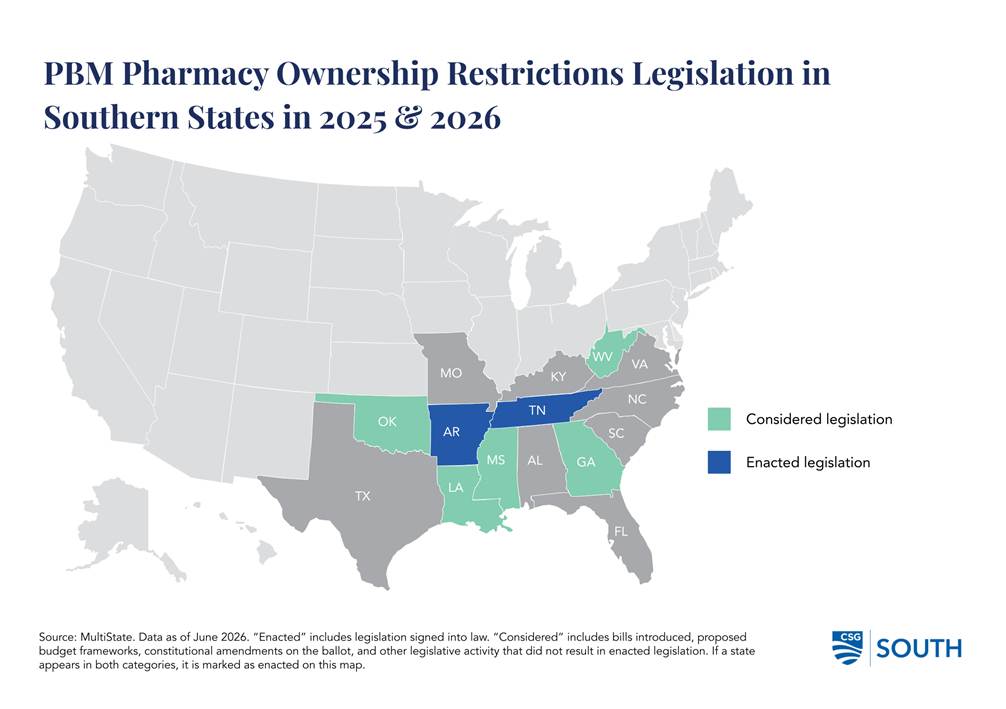
Arkansas led the way in 2025 with an innovative measure (AR HB 1150) and became the first state nationally to address vertical integration between PBMs and pharmacies by banning PBM pharmacy ownership. In 2026, the Tennessee General Assembly followed and enacted legislation (TN SB 2040). Lawmakers in Georgia (GA SB 91), Louisiana (LA HB 919), Mississippi (MS HB 1672, MS SB 2575), Oklahoma (OK HB 3538, OK HB 4457), and West Virginia (WV HB 5430, WV SB 907) also considered legislation to restrict PBM ownership and operation of pharmacies that ultimately failed. Georgia and West Virginia’s bills would have restricted state contracting with PBMs that own pharmacies, rather than outright banning ownership, and West Virginia’s bill was eventually enacted, but the PBM pharmacy ownership provisions were amended out of the final version. Notably, both Oklahoma bills passed their chamber of origin, but did not cross the finish line before adjournment. Arkansas and Tennessee’s laws are facing significant legal challenges, which could be having an impact on other states’ willingness to take up similar reforms.
Rebate Pass Through & Delinking
Several state legislators have started to target PBM reimbursement and revenue structures in an attempt to address drug prices and insurance premium costs. Rebate pass-through legislation requires PBMs to pass 100 percent of drug manufacturer rebates, fees, and discounts directly back to health plan sponsors or enrollees, rather than retaining them. In addition, some states have also considered “delinking legislation” that restructures PBM compensation to a flat-fee service model. This approach fixes PBM compensation to an administrative fee per member, rather than linking it to prescription drug prices or discounts and rebates. In 2025 and 2026, Alabama (AL SB 252), Louisiana (LA SB 387), and Virginia (VA HB 830/SB 669) enacted rebate pass-through laws, and Virginia (VA HB 830/SB 669) became the first Southern state to enact delinking legislation this past session. State efforts parallel federal reforms that will take effect in 2028, restricting Part D PBM compensation to “bona fide service fees” and requiring PBMs for Employee Retirement Income Security Act of 1974 (ERISA) plans to return all manufacturer rebates to the plans.
Utilization Management & Prior Authorization Reform
As state lawmakers have considered health insurance reforms, utilization management practices, such as prior authorization, have emerged as a key consideration for state lawmakers. Health insurers utilize prior authorization to promote cost containment and prevent medically unnecessary care, but providers and patients contend that the increasing use of prior authorization amplifies administrative burden and delays care. In 2025 and 2026, Southern states introduced over 175 bills on prior authorization reform, with over 40 bills enacted.
One of the most prolific areas of prior authorization reform in the South is related to prior authorization prohibitions or limitations for specific conditions, services, or drugs, with the most common restrictions related to behavioral health and cancer care. Some other Southern state legislatures have taken a more comprehensive approach to prior authorization and enacted legislation to require reporting and transparency on approval and denial rates, establish timelines for determinations, and require licensed practitioner review of adverse determinations and appeals.
Gold Carding
Gold carding legislation instructs insurers to allow providers who have a high prior authorization approval rate, typically around 80 to 90 percent, to bypass prior authorization requirements for a certain period of time for the prescriptions or services they routinely get approved for. Georgia (GA SB 5) enacted gold carding in 2025, and Kentucky (KY HB 176) followed in 2026, joining Arkansas, Louisiana, Texas, and West Virginia as Southern states with such programs. Of note, Arkansas (AR HB 1301), Texas (TX HB 3812), and West Virginia (WV SB 833) all made amendments to their programs in 2025, demonstrating that lawmakers are still refining gold carding programs. West Virginia opted to exclude prescription drugs from gold carding, while Texas extended the gold card look-back period from 6 months to one year. Arkansas removed the existing allowance for insurers to withdraw gold card status from a healthcare provider if that provider increases the number of gold carded procedures by 25 percent, and extended the gold card privilege to the provider’s group practice.
AI in Utilization Review
AI in utilization review has emerged as a new focal point within utilization management policy. Health insurers may use artificial intelligence to help automate processes such as prior authorization and claims, but lawmakers have expressed concerns that the technology may be used as a way to delay or deny coverage. Nationally, the majority of states are considering proposals to require documentation or disclosure of such processes, require that insurers make decisions based on individual clinical data, not group data, prohibit using AI to delay or deny coverage, and/or require a “human in the loop” to review decisions, typically a licensed health professional.
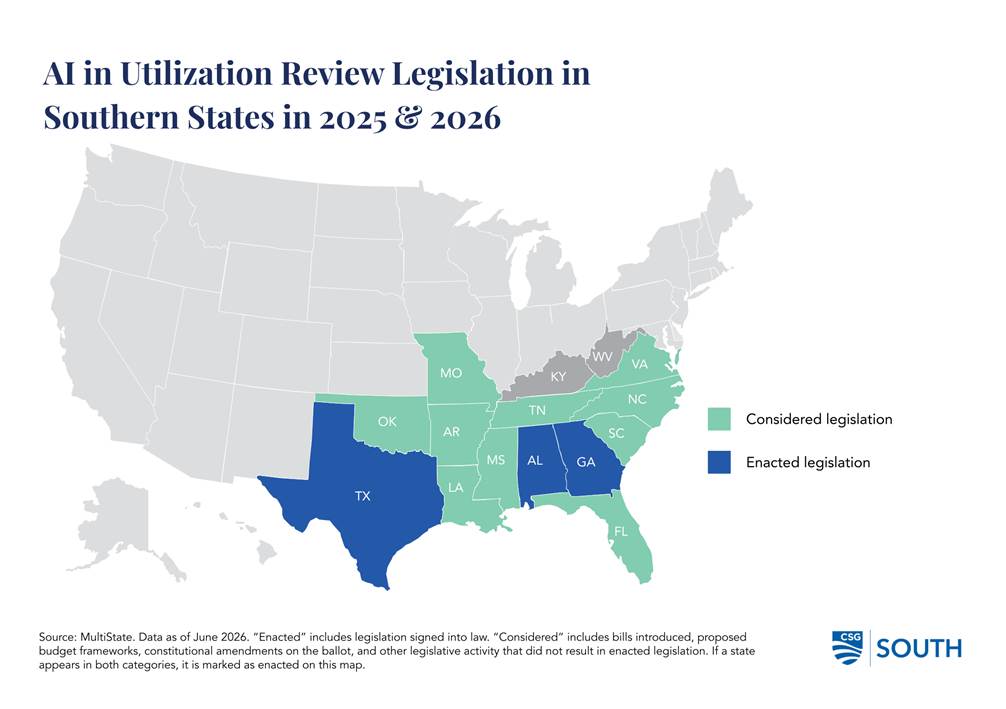
In the South, lawmakers introduced over 30 bills addressing AI and utilization management in 2025 and 2026, with 3 bills enacted. Texas led the way by enacting legislation (TX SB 815) in 2025 that prohibits a utilization review agent from using an automated decision system to make an adverse determination. Alabama and Georgia followed in the 2026 session and enacted legislation. Alabama’s bill (AL SB 63) prohibits a health insurer from using an AI tool to deny, reduce, or defer a request for health care coverage without a final determination by a qualified health care professional. In addition, the Alabama bill requires a health insurer to provide written disclosures to enrollees on AI used to assist in utilization and requires a health insurer to annually certify to the state’s Department of Insurance that its AI tools are fair, accurate, and non-discriminatory. Interest in similar legislation is expected to continue in future sessions, as the number of states with similar laws and the scrutiny of the use of AI in insurance practices grows. In Georgia, enacted legislation (GA SB 444) prohibits the issuance of an adverse determination for healthcare services from being based solely on an AI system or from using the system to supersede the judgment of a clinical peer, and requires adverse determinations made with an AI system to be supplemented with a clinical peer’s participation.
Healthcare Workforce
Healthcare workforce shortages are a critical issue across many Southern states, with a specific focus on rural and underserved areas. Many states are utilizing federal Rural Health Transformation Program (RHTP) funds to address workforce issues, and as part of the RHTP application process, states are incentivized to combine these efforts with legislative action to expand scope of practice and licensure compacts for certain health professions, like physician assistants, nurses, and physicians, with the goal of increasing the healthcare workforce capacity.
Licensure Compacts
Health professional licensure compacts are interstate agreements that allow eligible providers to practice across state lines more efficiently while maintaining state authority to license and regulate professionals. Compacts have been touted as a pathway to streamline cross-state licensure, improve workforce mobility, reduce administrative burdens, and expand access to care, particularly through telehealth. Southern states introduced over 150 bills related to health professional licensure compacts across 2025 and 2026, with 36 bills enacted.
Licensure compacts exist for a variety of health professionals, but as part of the RHTP scoring system, states are eligible for additional points and funding if they commit to joining the following compacts by 2027: the Interstate Medical Licensure Compact (IMLC); Nurse Licensure Compact; Psychology Interjurisdictional Compact; EMS Compact; and Physician Assistant Compact. Several Southern states acted this past session to boost their RHTP application by enacting compacts, with Tennessee (TN SB 1526) extending the IMLC, which was set to expire in 2026, to 2034, and Louisiana (LA HB 486) adopting the Psychology Interjurisdictional Compact.
Outside of the RHTP, there are additional licensure compacts that have seen growing interest from Southern states. From 2025-2026, five states (Arkansas (AR HB 1712), North Carolina (NC HB 231), Oklahoma (OK HB 2261), South Carolina (SC HB 3752), and West Virginia (WV SB 703)) enacted the Social Work Licensure Compact, and five (Alabama (AL SB 181), Tennessee (TN SB 2544), Virginia (VA HB 575), West Virginia (WV HB 5015), and Kentucky (KY HB 36)) enacted the Respiratory Care Interstate Compact. In addition, four states (Arkansas (AR HB 1185), Mississippi (MS SB 2664), Oklahoma (OK SB 805), and Kentucky (KY HB 36 )) adopted the Dietitian Licensure Compact.
Scope of Practice
Scope of practice is a key component of healthcare workforce policy, with states utilizing it as a tool to build workforce capacity and flexibility. Similar to licensure compacts, scope of practice reforms have been accelerated by the RHTP, as states can earn additional points on their applications by demonstrating practice environments that maximize the use of physician assistants, advanced practice registered nurses (APRNs), pharmacists, and dental hygienists.
For APRNs and physician assistants, several Southern states considered reduced physician oversight requirements in favor of independent or collaborative practice. In 2025, the Oklahoma Legislature (OK HB 2298) authorized certain APRNs to practice independently after completing 6,240 hours of supervised practice (about three years of full-time practice) or an accredited residency program. Similarly, Sooner State lawmakers also enacted legislation (OK HB 2584) to similarly authorize independent practice for physicians, and Virginia (VA HB 746) also eliminated the requirements for a written practice agreement for physician assistants with three years of clinical experience. The Kentucky General Assembly also recently enacted legislation (KY SB 116) shifting physician supervision requirements with a written collaboration agreement, and North Carolina (NC HB 67) adopted a team-based practice model for physician assistants.