
 DOWNLOAD
A CSG South First Look
Affordability has been at the forefront of federal and state legislative policy across a wide range of consumer goods and services, with housing affordability as a particular area of focus. Housing affordability challenges stem from a variety of factors. Regulatory and land use restrictions, high labor and construction costs, financing costs, and stagnating income growth are just some of the contributors to declining affordability and housing supply shortages cited in a 2026 report by the Congressional Research Service. These constraints are reflected in a recent report that estimates a housing supply gap of 4.03 million homes in 2025, with the gap most pronounced in the South (1.62 million homes). The report notes that construction of new homes has slowed significantly since the onset of the COVID-19 pandemic due to materials costs and supply chain disruptions, while the Congressional Research Service notes that new or increased tariffs may be further exacerbating these cost and supply issues.
In 2025 and 2026, Southern state legislatures, much like their regional counterparts, introduced over 150 bills that would employ a variety of methods to bolster housing development and increase the housing supply. Commonly proposed efforts included zoning reforms to reduce barriers to new development of single- and multi-family housing, changes to expedite the development permitting process, and the imposition of corporate housing limits and divestment requirements.
At the federal level, the 21st Century ROAD to Housing Act was enacted in July 2026 with strong bipartisan support in both chambers and provides for major, comprehensive reforms to zoning, permitting, financing, and corporate ownership of housing. In light of this new federal law, state lawmakers will likely focus on conforming to many of the residential zoning and permitting provisions incentivized through the creation of new grant programs, as well as implementing the new national corporate-owned housing cap of 350 homes established by the act.
State Action
Zoning, Land Use, and Permitting Reform
States have taken an increasingly direct approach to residential zoning and development permitting processes as one way to spur construction and ease affordability and housing supply challenges. Legislators in southern states introduced over 100 bills related to residential zoning, land use, and permitting reform in 2025 and 2026 and have enacted at least 20 of these measures to date. Florida and Virginia lead the southern states with 13 total zoning-related bills enacted by lawmakers between them, while lawmakers in Arkansas, Georgia, Kentucky, South Carolina, Tennessee, Texas, and West Virginia each enacted at least one zoning bill of those introduced since 2025.
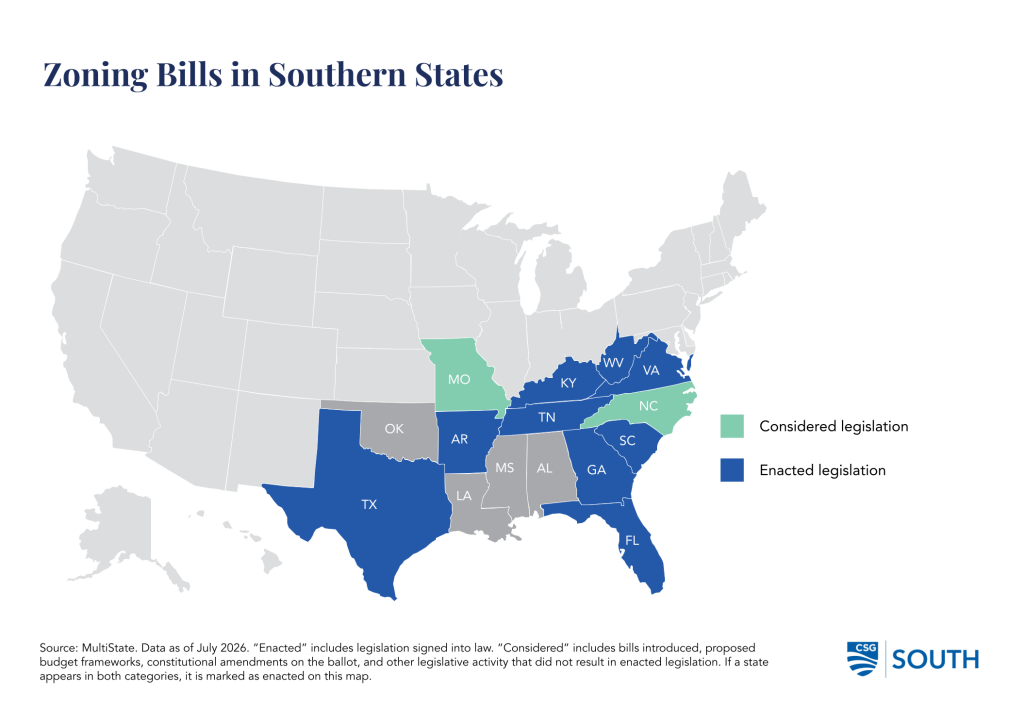
Of the zoning and permitting bills proposed by southern states in 2025 and 2026, over 50 aimed to allow for increased development of residential and mixed-use housing by altering existing zoning restrictions. Methods employed included allowing residential or mixed-use developments in commercial and industrial zones and allowing by-right approval of single-family homes and of multi-family housing on land originally zoned for single-family housing. Notably, Virginia passed HB 1212 this year, which requires localities with a population over 50,000 to permit the development of single-family homes as a by-right use on lots of up to 3,000 square feet. This session, Virginia legislators also enacted SB 74, which allows the development of duplexes, triplexes, and quadruplexes on lots zoned for single-family homes and also permits the conversion of commercial space to residential use. In Florida, lawmakers enacted HB 1389, which authorizes mixed-use developments on additional county-, school district-, and religious-owned lands, and SB 686, which mandates that single-family homes be treated as a conforming use on certified agricultural enclaves.
Lawmakers also focused on reforming the permitting and approval process by imposing clear deadlines for approval, requiring localities to provide detailed feedback when a permit is denied, and even requiring refunds or automatic approval if localities fail to meet statutory deadlines. At least 24 bills related to permitting reform were introduced in Southern states in 2025 and 2026, with Florida, Georgia, Kentucky, Tennessee, Texas, and Virginia seeing multiple proposals on the matter. Florida SB 686 imposes a 90-day deadline for localities to certify an application to develop agricultural enclaves and requires automatic approval if the deadline is not met, while Tennessee HB 2552 requires local government to approve or deny development applications within 30 days. Georgia SB 447 similarly imposes strict deadlines throughout the review process for real property development, including a 45-day initial review period, and requires application fee refunds if deadlines are not met. Georgia HB 309, which passed both chambers but died before enrollment, and Kentucky SB 52, which passed the Senate, each also imposed deadlines for permitting approval or denial and required the use of clear, specific criteria for development applications.
Lastly, accessory dwelling units (ADUs) and manufactured homes have also been consistent topics of zoning bills for legislators, with at least 45 bills introduced in 2025 and 2026 by southern legislatures. ADUs are living structures placed on a lot that already has a primary dwelling unit, and may be attached to or detached from the primary residence. Because of their smaller square footage, ADUs are considered a lower-cost, viable tool for increasing the supply of affordable housing on already existing residential lots. Manufactured homes, sometimes referred to as factory-built or modular homes, are similarly considered a more affordable option than traditional, site-built homes. Lawmakers in Arkansas (HB 1503), Florida (HB 399), Virginia (SB 531), and West Virginia (SB 659) each enacted legislation reforming zoning laws to expand the construction of ADUs or pre-empting localities from conditioning the use of ADUs on the passage of restrictive land use covenants. West Virginia’s new law will require localities to permit at least one ADU on any lot containing a single-family home as a by-right use, while lawmakers in Virginia and Florida have enacted laws allowing the construction of ADUs on lots zoned for single-family homes. Florida, Kentucky, South Carolina, Texas, and Virginia all passed bills to ease land use restrictions for manufactured housing. This includes laws requiring manufactured homes to be a permitted use on land zoned for residential use (FL HB 830, FL HB 399, KY HB 160, TX SB 785), pre-emption of local restrictions on the installation or use of manufactured housing (SC HB 5113), and allowing manufactured homes to be used on non-residential lands (VA HB 655, VA SB 346).
Corporate Housing Bans and Restrictions
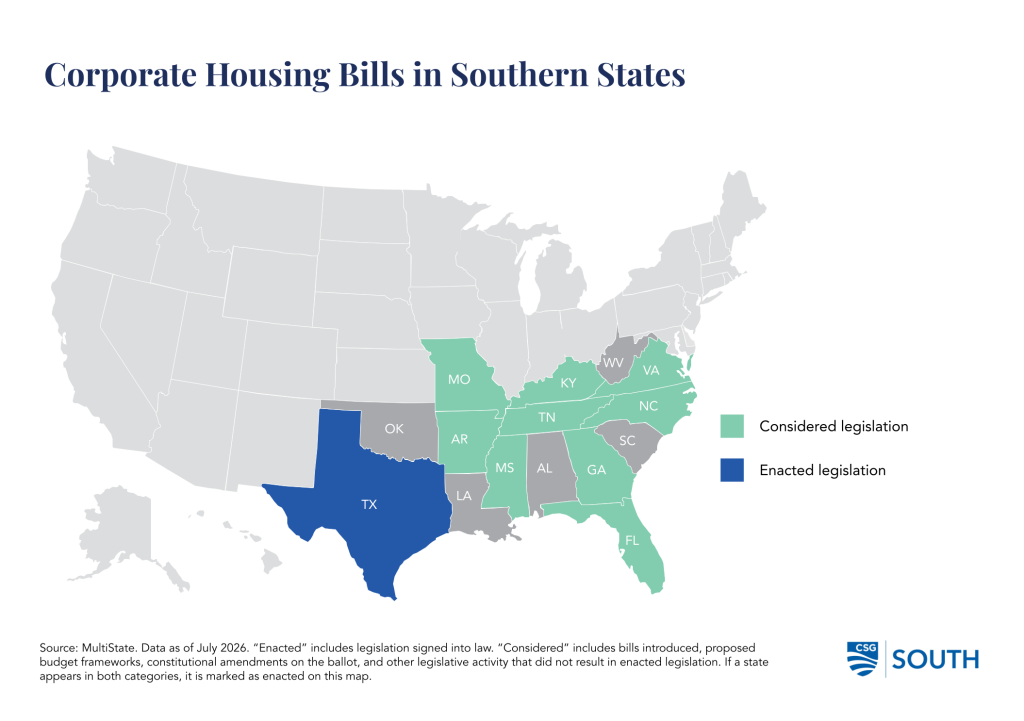
Corporate housing refers to corporate entities owning single-family homes. Corporate entities are usually defined to include real estate trusts, institutional investors, limited liability companies, and hedge funds, though they may also be defined by their total assets. Corporate-owned housing began largely as a result of the 2007-2009 financial crisis, per a report from the US Government Accountability Office, when many households defaulted on their mortgages. Over time and with little intensive scrutiny pre-pandemic, corporate entities have come to own an increasing share of single-family rental homes in urban, high-growth areas, often in Sunbelt states. The US GAO report highlights Atlanta, Jacksonville, Tampa, and Charlotte as cities with a particularly high proportion of corporate-owned, single-family housing used as rentals.
In an effort to improve the supply of available, for-sale single-family homes and reduce competition from corporate entities, legislatures across the country have introduced close to 200 bills aimed at better regulating the purchase of additional single-family homes by corporate entities. In 2025 and 2026, southern state legislatures introduced more than 50 bills addressing corporate housing ownership, though most did not advance beyond committee. While nearly all legislation targeted the same underlying concern, lawmakers pursued five distinct approaches: outright ownership caps or prohibitions, delayed purchase windows or rights of first refusal, tax-based deterrents, disclosure and registration requirements for institutional owners, and annual studies.
Ownership caps or prohibitions have been the most common approach, preventing a person or entity from acquiring additional single-family homes once they reach a set threshold. These thresholds vary widely, from 25 homes (GA HB 1055 and NC HB 1056) to 2,000 homes (GA HB 1115 and GA HB 555), with 50 and 100 homes as the most common cutoffs. Of the bills in Southern legislatures addressing corporate housing ownership, at least 36 bills focused on this ownership cap or prohibition measure; however, a majority did not advance beyond introduction.
Delayed purchase windows and rights of first refusal give individual buyers a head start by barring institutional buyers from making offers until a home has been listed for 30 to 90 days. The goal of delayed purchase windows is to give families and local buyers time to review the property without competing with corporate buyers, who are often able to buy up homes in bulk quickly. Alternatively, rights of first refusal require corporate landlords, when planning to sell the property, to give current tenants the first chance to buy it. Florida’s SB 1592 would have required leases to include a provision regarding the right of first refusal to purchase, along with 60 days’ notice if a landlord chooses not to extend or renew.
Tax-based deterrents make corporate ownership more costly through measures such as reassessing corporate-owned rentals at 100% of fair market value, reclassifying short-term rentals or corporation-owned homes as non-residential for property tax purposes, or imposing deed or documentary stamp taxes on bulk purchasers. For example, Florida’s HB 1471 would have created an additional $50,000 documentary stamp tax on the purchase of a residential property by a purchaser who already owns 15 or more residential properties in the state. Alternatively, disclosure and registration requirements attempt to increase transparency by compelling institutional investors to publicly report to a state agency or register with the Secretary of State. The Georgia House of Representatives introduced legislation (HB 1162) that would have required corporations that own an interest in three or more multifamily residences to report the addresses of the properties to the Secretary of State. Finally, lawmakers have also focused on establishing either legislative study committees or annual research mandates on the impacts on housing.
Among the bills that advanced in southern legislatures, more indirect mechanisms succeeded more often than outright bans. Lawmakers in Missouri introduced nine bills addressing corporate housing; however, almost all bills containing language directly prohibiting institutional investors from acquiring residential property did not advance. Among Missouri’s bills, at least three that passed the first chamber (HB 1768, SB 1066, and SB 1410) all used the property tax reclassification method. Notably, Virginia’s HB 910 was the only bill to become law. It originally proposed a 50-home acquisition ban, but was amended to instead require that institutionally owned parcels be included in the state’s periodic housing-needs assessment, shifting the bill from ownership restriction to data collection. Georgia lawmakers took a slightly different approach with SB 23 by restricting public pension funds from investing in vehicles that buy single-family homes. The bill passed the legislature, but was vetoed by Governor Brian Kemp (R). Based on legislative trends in 2025 and 2026, state lawmakers have found more common ground with indirect methods, such as tax-based deterrents, study and data collection, or disclosure requirements for corporate housing ownership, than with bills prohibiting acquisitions.
Federal Action
21st Century ROAD to Housing
The 21st Century ROAD to Housing Act is among the most comprehensive pieces of housing affordability legislation enacted by Congress in decades. The act touches on numerous policy areas that have also been a focus of state legislatures in recent years, including capping corporate housing and encouraging zoning and permitting reforms to incentivize housing development. The act was initially introduced in December 2025 and received increased legislative attention as the vehicle for major housing policy reform following Executive Order 14376, issued by President Trump in January, which targeted corporate ownership of single-family homes.
Despite heightened action by Congress on corporate housing since January of this year, at least 17 bills aimed at regulating homeownership by corporate entities have been introduced in Congress since 2025. Some bills would have imposed financial penalties or increased taxes on these entities; others would have instituted a cap on the number of single-family homes a corporate entity may own at any given time, ranging from a low of 50 to a high of 350 homes. The 21st Century Road to Housing Act uses the capping method but, through amendments, has incorporated numerous exemptions from its 350-home cap, including for purchases of newly constructed homes and purchases of single-family homes that will ultimately be renovated and managed as rental property.
Unlike corporate housing, zoning and permitting reform is a policy area that is not often legislated upon by Congress, and is instead typically left to states and localities. The 21st Century ROAD to Housing Act includes several key provisions that aim to encourage development and, in turn, reduce the shortage of affordable housing supply. The act creates new grant programs to incentivize states and localities to encourage development, such as through increasing by-right land uses of single- and multi-family housing, reducing or eliminating height, setback, and parking requirements, encouraging production of manufactured housing, and allowing the use of ADUs on residential lots, along with changes to building codes for multi-family homes. It also encourages expedited permitting approvals via set review timelines and use of a non-discretionary review process. In addition to the zoning and permitting-related grant programs created in the bill, the act also includes financing provisions, such as directing a review of the current multi-family development loan limits and the expansion of local lending through increased caps on certain investments and reforms to multiple federal housing programs.
Future Outlook
AI’s Role in Housing Affordability
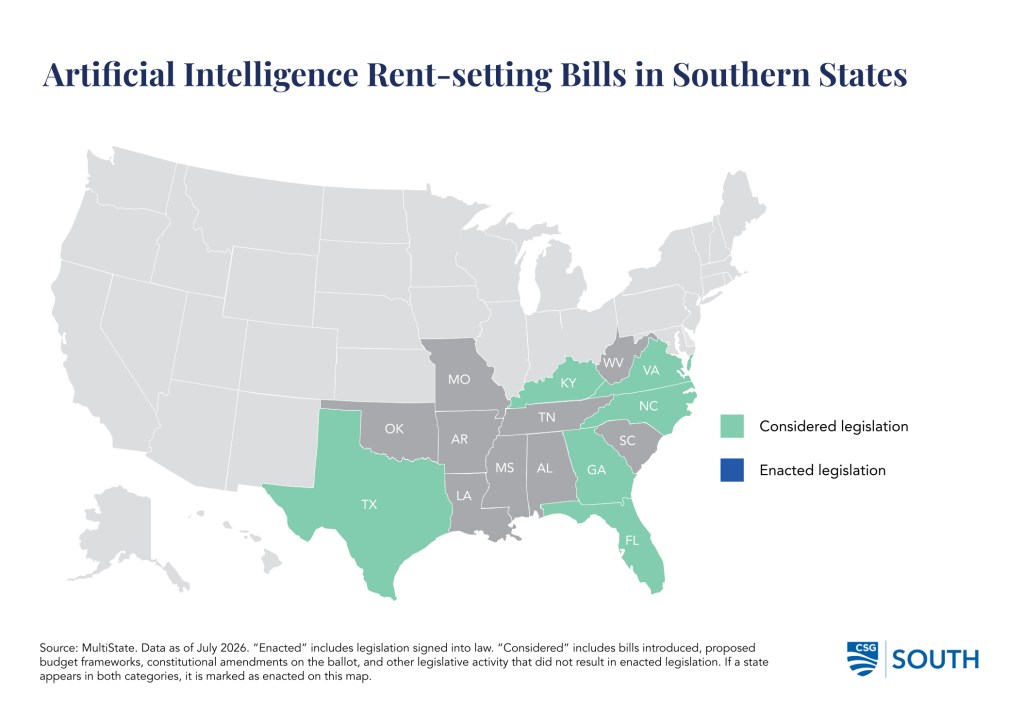
Across the country, state legislators on both sides of the aisle have agreed on the need to regulate and increase oversight of artificial intelligence. The federal government took initial steps in 2024 to restrict the use of algorithmic pricing tools when the Department of Justice sued RealPage, alleging its rental pricing software allowed coordination among competing landlords. Ultimately, the suit was settled. Alongside this federal action, state legislatures have increased activity on AI rent-specific bills, yet few have gained the political traction needed to become law. At the end of 2025, New York became the first state to ban the use of pricing algorithms in setting rental prices. Additionally, the Colorado legislature passed the No Pricing Coordination Between Landlords Act in 2025, but Governor Jared Polis (D) vetoed the measure, citing concerns that it could outlaw some legitimate technologies used by landlords and that violations should already be illegal under Colorado’s Antitrust Act. Most recently, New Jersey lawmakers passed the FAIR Act at the end of June, which would prohibit landlords from using algorithmic rent-setting software to coordinate rental prices. The bill now heads to Governor Mikie Sherrill’s (D) desk for consideration. Throughout the 2025 and 2026 legislative sessions, at least 20 states introduced legislation on this issue, signaling a rising focus at the state level, with the issue poised to remain on lawmakers’ agenda in 2027.
State Responses to Federal Action
Now that the 21st Century ROAD to Housing Act has been enacted, the 2027 session will likely spur increased action by states on numerous areas of housing policy, especially on zoning and permitting. While the 21st Century ROAD to Housing Act does not pre-empt state and local zoning and permitting laws, it does create numerous grant programs as an incentive for states and localities to take action. As a result, the 2027 session could bring an influx of introduced state legislation and local ordinances that aim to align zoning and permitting laws with the key reforms financially incentivized by the act.
The corporate housing provisions of the bill will have the most direct effect on state housing policy through its 350-home cap. States may focus on making necessary statutory or regulatory adjustments to ensure compliance with and enforcement of the act’s corporate housing provisions. California, for instance, has already proposed a bill (SB 880) in anticipation of the federal act becoming law, which creates new protections for tenants residing in corporate-owned housing and prohibits bundled and off-market sales of corporate-owned housing. Additionally, while some states may cool off on the issue with the creation of a 350-home baseline, select states that have historically been impacted by high corporate housing ownership in their urban cores may continue to propose more restrictive caps, especially in Sunbelt states.