

Regional Resource by Policy Analyst, Judah Lebofsky
DOWNLOADShort-term rentals (STRs) are furnished homes or rooms rented for fewer than 30 days, often for tourism or business travel.1 Definitions vary across states, particularly regarding rental duration and property classification.2 Vacation rentals predate online platforms and were traditionally advertised through newspapers and local property managers.3 Online accommodation platforms expanded the visibility and geographic reach of these properties, allowing operators to market directly to travelers across multiple jurisdictions.4 Research estimates that global STR listings increased from approximately 1 million in 2011 to more than 20 million in 2023, a growth of about 20-fold (See Figure 1).5
FIGURE 1. Estimated Short-Term Market Growth
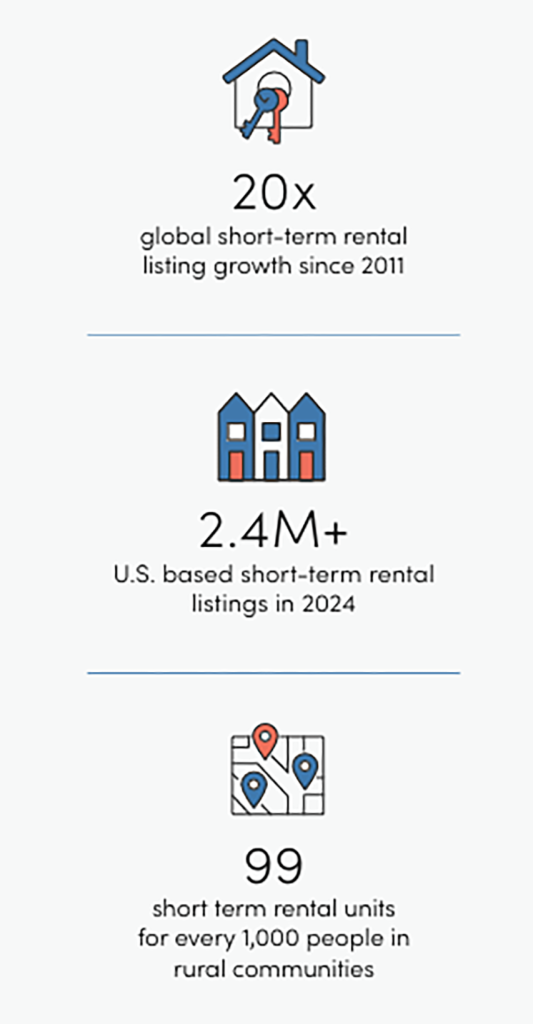
Source: Author’s visualization utilizing data from Granicus.6
These trends contributed to the growth of short-term rentals within the broader accommodations market. Industry forecasts project continued expansion in the U.S. vacation rental market through 2033, with homes accounting for the largest share of projected market activity (See Figure 2).7
FIGURE 2. Estimated U.S. Short-Term Vacation Rental Market
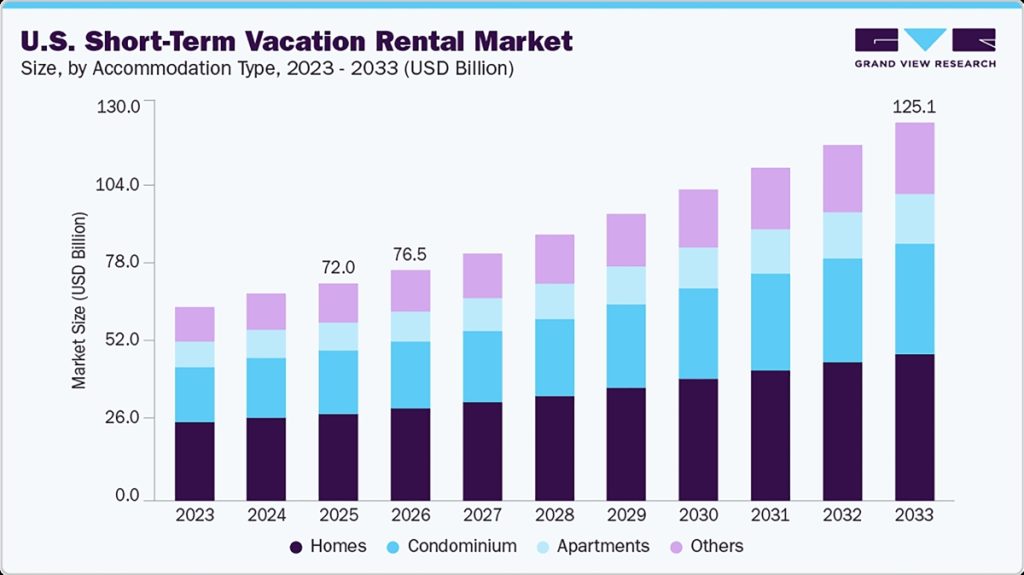
Source: Grand View Research.8
Airbnb is the largest vacation rental platform globally, followed by alternative platforms (See Figure 3).9 Although websites such as Booking.com and Expedia also offer hotel accommodations, their listings include STRs.10 As operators may advertise the same property on multiple platforms, the total number of listings generally exceeds the number of unique rental units. Reports estimate that approximately 2.4 million U.S. listings represented about 1.8 million unique properties in 2024.11
FIGURE 3. Estimated Global STR Listing Growth
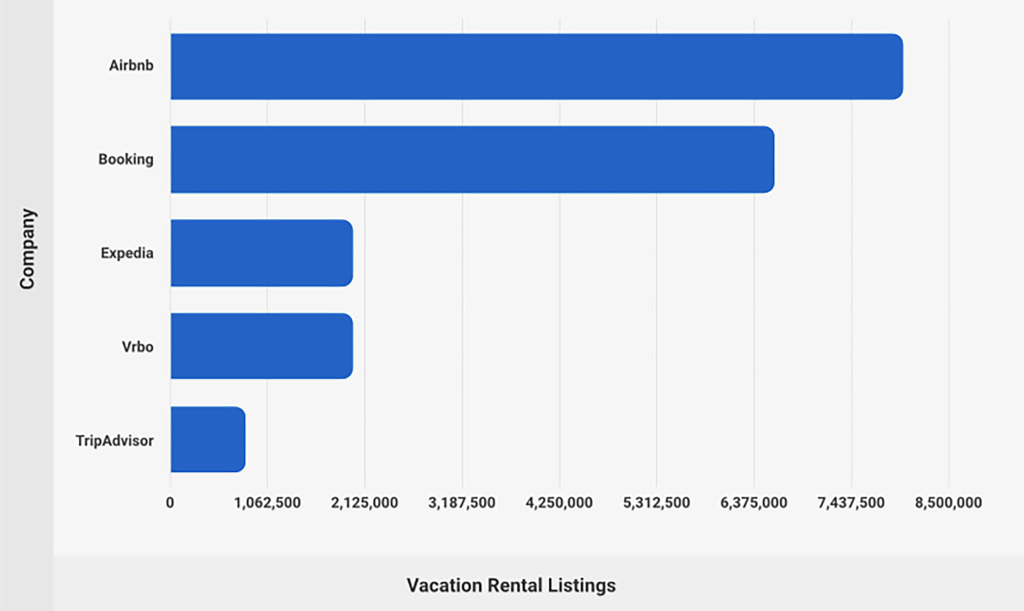
Source: RubyHome.12
Note: Airbnb holds over 80 percent of the North American Short-Term Rental Market.13
Comparable data were unavailable for 2019–2022.
In recent years, Southern tourism destinations have experienced growth in both STR use and rental unit supply (See Table 1). The 15 CSG South states account for approximately 1.16 million listings and 865,534 estimated unique rental units.14 Florida had the region’s largest inventory, with 327,734 rental units, followed by Texas with 143,382 and North Carolina with 82,806.15 Other states also had sizable inventories, including South Carolina with approximately 62,951 rental units, Tennessee with 52,357, and Georgia with 48,672.16 Nationally, STR growth has extended beyond major cities and traditional vacation destinations, with midsized and smaller communities experiencing the strongest demand growth in recent years.17,18
TABLE 1. Short-Term Rental Listings and Estimated Rental Units in the CSG South Region, July 2024
| STATE | LISTING COUNT | RENTAL UNIT COUNT | PERCENT DIFFERENCE | LISTED DAILY RATE | MIN. NIGHT STAY |
| Alabama | 45,905 | 26,241 | -43% | $196 | 2 |
| Arkansas | 18,184 | 13,657 | -25% | $145 | 2 |
| Florida | 425,489 | 327,734 | -23% | $200 | 3 |
| Georgia | 68,396 | 48,672 | -29% | $168 | 2 |
| Kentucky | 17,835 | 13,754 | -23% | $145 | 2 |
| Louisiana | 17,265 | 12,279 | -29% | $150 | 2 |
| Mississippi | 11,666 | 8,632 | -26% | $165 | 2 |
| Missouri | 30,418 | 21,875 | -28% | $146 | 2 |
| North Carolina | 108,393 | 82,806 | -24% | $173 | 2 |
| Oklahoma | 17,275 | 13,221 | -23% | $152 | 2 |
| South Carolina | 87,161 | 62,951 | -28% | $189 | 2 |
| Tennessee | 75,150 | 52,357 | -30% | $190 | 2 |
| Texas | 186,591 | 143,382 | -23% | $150 | 2 |
| Virginia | 44,045 | 31,454 | -29% | $178 | 2 |
| West Virginia | 8,161 | 6,519 | -20% | $160 | 2 |
| TOTAL | 1,161,934 | 865,534 | -25.5% | ||
| UNWEIGHED STATE AVERAGE | 77,462 | 57,702 | -27% | 167 | 2.07 |
Source: Author’s visualization utilizing data from Granicus.19
Note: The counts are third-party estimates, may include duplicate or inactive listings, and are not official state registration totals.
STRs and hotels serve overlapping but distinct portions of the accommodations market. STRs may provide additional space, kitchens, flexibility for larger groups, and lodging in areas with limited hotel availability.20 Hotels more commonly provide standardized services, on-site amenities, and locations near central business districts.21 Unlike a hotel room, STRs typically involve the temporary use of all or part of a residential dwelling.22 As a result, STR regulation may involve considerations related to zoning, housing supply, property rights, and neighborhood standards that differ from those associated with traditional lodging.23
Key Definitions.24
Listing
The individual advertisements created by the host.
Note: A single rental unit may be advertised across multiple listings.
Rental Unit
The physical space or property being rented.
Booking
When a unit is rented out for any period of time.
STR growth has received increasing attention from policymakers across Southern states. In 2023, approximately 2.4 million short-term rentals were identified in the United States, generating an estimated $64 billion in annual revenue. The number of properties actively available at any given time was lower, averaging about 1.5 million in 2023. Based on the 2023 estimate of 2.4 million short-term rentals and approximately 147 million U.S. housing units as of the third quarter of 2024, short-term rentals represented roughly 1.6 percent of the national housing stock.25,26 The geographic distribution of STRs makes the issue relevant beyond major tourism centers. Research indicates that communities with populations below 10,000 had substantially more STR units per 1,000 residents than larger communities.27 Policymakers have raised concerns that converting long-term rentals or owner-occupied homes into STRs may reduce the housing supply available to local residents.28 The extent of any effect may depend on existing housing supply, construction activity, demand, land-use rules, and the concentration of STRs in a given market.29 Research findings vary: some studies associate Airbnb listings with higher rents and home prices, while others find lower prices or no measurable effect.30
The expansion of STRs may support the tourism industry and economic development of a region. STRs may expand lodging options in communities with limited hotel inventory and direct visitor spending toward restaurants, retail establishments, attractions, and other local businesses.31 Reports indicate that expanded accommodation options can support tourism and generate positive employment effects in some hospitality and leisure markets.32 Additionally, STRs may extend tourism activity to both established and lesser-known destinations.33 As of September 2026, responsibility for STR policy is generally shared between state and local governments (See Figure 4).34 States may establish definitions, licensing systems, platform requirements, or limits on local regulatory authority. Local governments commonly administer zoning, permits, occupancy limits, parking requirements, and nuisance standards.35 Together, these state and local responsibilities shape STR regulation across the South.
FIGURE 4. Relationship Between State Short-Term Rental Policy and Local Implementation
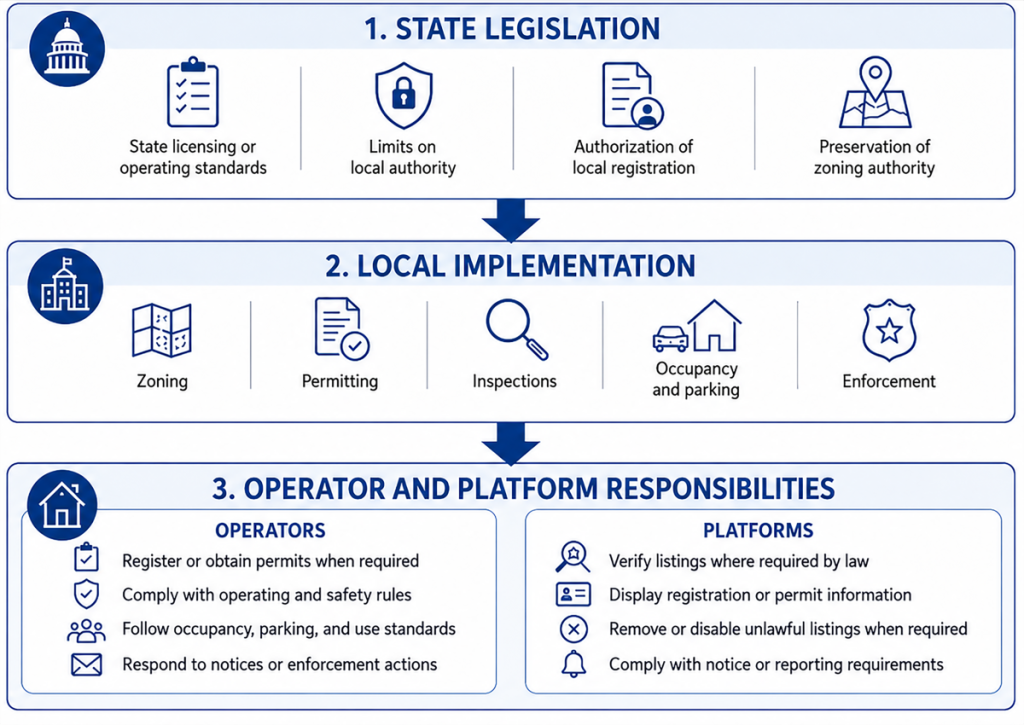
Source: Author’s visualization utilizing data from the Congressional Research Service.36
Understanding the State Policy Landscape
Defining Short-Term Rentals
Most definitions of STRs describe them as rooms or homes rented for fewer than 30 days, although definitions vary among Southern states.37 Common terms to define STRs include “vacation rental” and “transient lodging”.38,39 A listing is not equivalent to a unit because the same property may be advertised on Airbnb, Vrbo, Booking.com, and other platforms.40 As shown in Table 1, the number of estimated unique units was approximately 26 percent lower than the number of listings.41 Whether a property falls under a particular statute may depend on factors such as owner occupancy, property type, rental frequency, and whether the offering includes an entire residence or an individual room.42,43,44,45 State law may classify an STR as a residential use for zoning or property-classification purposes while regulating related transactions as lodging activity.46,47 State statutory information in this report is current through August 5, 2026.
Housing Availability and Affordability
The U.S. STR inventory grew rapidly during the 2010s and early 2020s. Online platforms enabled properties to enter and exit the market more readily than traditional lodging establishments. Reports indicate that the number of available listings in the United States reached approximately 1.37 million in 2022.48 Rising home prices in many Southern communities also increased the cost of acquiring properties during this period, potentially adding to the financial pressures facing prospective buyers, housing providers, and STR operators differently across local markets. (See Table 2).49 Table 2 presents housing-market changes between 2020 and 2023 for CSG South communities included in the source dataset and for which comparable listing or sales-price data were reported. The table is intended to illustrate general housing-market conditions during this period; it does not measure STR activity or establish that STR growth caused the observed changes in home prices. The data also do not account for other factors that may influence housing prices, such as inflation, migration, interest rates, or housing construction. For Table 2, communities are categorized by population as large (250,000 or more residents), medium (100,000 to 249,999), low-mid (50,000 to 99,999), low (10,000 to 49,999), and distributed (fewer than 10,000 residents, generally representing remote suburban and rural communities). A central policy consideration is the extent to which STR activity shifts housing units away from long-term rental or owner occupancy. Any effect may be greater in communities with limited housing supply and few opportunities to replace converted units.50 Where housing construction and supply keep pace with overall demand and STR growth, comparable price pressures may be less likely. Local housing conditions, therefore, influence whether STR activity affects housing costs and, if so, the magnitude of that effect.51
TABLE 2. Changes in Real Estate Listing and Home Sale Prices in Selected Southern Communities, 2020–2023
| CITY | STATE | *AVG. REAL ESTATE LISTING PRICE (NOV 2020) | *AVG. REAL ESTATE LISTING PRICE (OCT 2023) | CHANGE | *AVG.HOME SALE PRICE (NOV 2020) | *AVG.HOME SALE PRICE (OCT 2023) | CHANGE |
| POPULATION TIER: LARGE | |||||||
| Dallas | TX | $419,000 | $500,000 | 19% | $355,000 | $422,500 | 19% |
| Kansas City | MO | $229,000 | $259,400 | 13% | $225,000 | $260,000 | 16% |
| Atlanta | GA | $375,000 | $429,900 | 15% | $322,000 | $402,500 | 25% |
| Virginia Beach | VA | $314,700 | $389,900 | 24% | $310,000 | $365,000 | 18% |
| POPULATION TIER: MEDIUM | |||||||
| Norfolk | VA | $250,000 | $316,480 | 27% | $240,000 | $309,000 | 29% |
| Birmingham | AL | $171,000 | $182,500 | 7% | $190,000 | $176,900 | -7% |
| Knoxville | TN | $294,500 | $440,000 | 49% | $260,000 | $370,000 | 42% |
| POPULATION TIER: LOW-MID | |||||||
| North Miami | FL | $259,250 | $422,500 | 63% | $255,000 | $382,500 | 50% |
| Alpharetta | GA | $546,400 | $799,950 | 46% | $457,500 | $650,000 | 42% |
| Georgetown | TX | $375,819 | $490,000 | 30% | $337,250 | $455,000 | 35% |
| POPULATION TIER: LOW | |||||||
| Bluffton | SC | $379,000 | $599,000 | 58% | $363,000 | $525,000 | 45% |
| Danville | VA | $119,900 | $190,950 | 59% | $130,000 | $130,000 | 0% |
| Boone | NC | $444,900 | $749,000 | 68% | $345,000 | $534,500 | 55% |
| Perry | GA | $273,650 | $308,450 | 13% | $203,900 | $298,900 | 47% |
| DISTRIBUTED | |||||||
| Tybee Island | GA | $525,000 | $777,000 | 48% | $440,000 | $694,750 | 58% |
| Indian Rocks Beach | FL | $627,000 | $1,090,000 | 74% | $739,000 | $994,000 | 35% |
Source: Author’s visualization utilizing data from Granicus.52
*Note: Average real estate listing price is the asking price of the seller. Not market value or transaction price.
Seasonal Housing
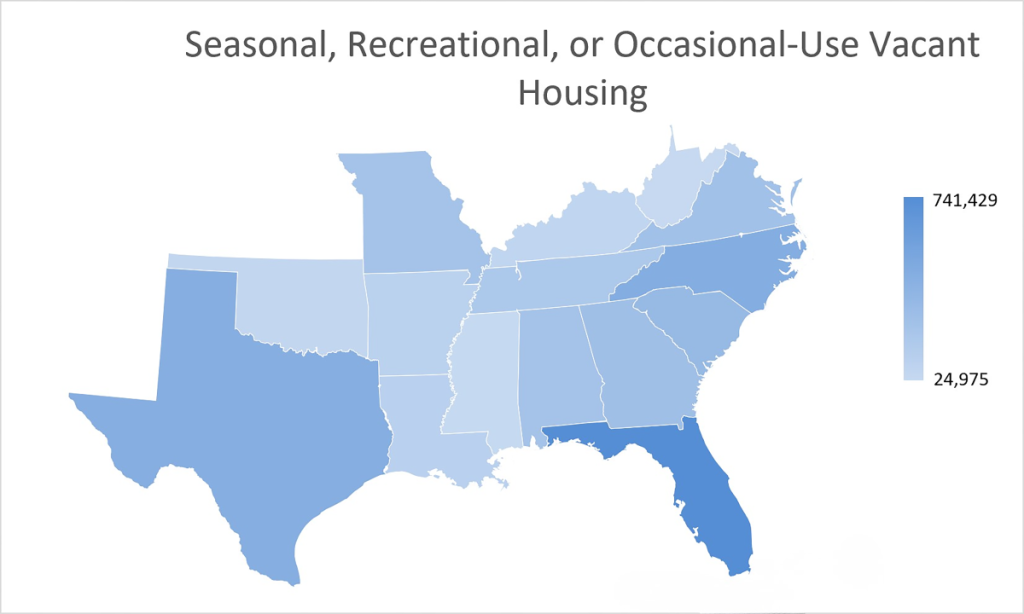
Seasonal, recreational, or occasional-use housing provides context for understanding the concentration of vacation properties and second homes, particularly in tourism-dependent areas (See Figure 5). Across the CSG South region, the number of housing units in this Census category ranged from 24,975 in West Virginia to 741,429 in Florida.53 Florida had the largest total, followed by North Carolina with 179,075 units, Texas with 171,352 units, and South Carolina with 101,368 units.54 However, this census category is broader than the STR market. It may include properties used exclusively by their owners, left vacant for part of the year, rented informally, or offered as long-term or short-term rentals. Accordingly, these figures should not be interpreted as direct measures of STR inventory or combined with platform listing counts. Instead, they provide context for identifying states in which housing may shift among personal, seasonal, and rental uses based on owners’ decisions and market conditions.
FIGURE 5. Seasonal, Recreational, or Occasional-Use Vacant Dwelling Units, 2024
Source: Author’s visualization utilizing data from the United States Census Bureau.55
Investor-Owned Properties
Investor-owned STRs generally involve properties acquired or operated primarily to generate rental income rather than to serve as the owner’s principal residence. In some markets, properties purchased for STR use may compete with prospective owner-occupants or long-term rental investors; in others, they may come primarily from seasonal or tourism-oriented housing stock.57 The extent of any housing effect depends on local supply-and-demand conditions, construction activity, land-use constraints, and the concentration of STRs within a particular market.58 Additionally, some STR owners live outside the jurisdiction, which may make it more difficult for governments to identify responsible parties, communicate regulatory requirements, and monitor local ownership patterns.59
Investor ownership does not produce the same outcome in every community. In areas with sufficient housing construction or a large stock of properties historically used for tourism, investor-operated STRs may have a different relationship to housing availability than in markets with limited supply and strong residential demand.60 For this reason, ownership type is most useful when considered alongside property location, prior use, market concentration, and local housing conditions rather than as an independent indicator of housing effects.
Owner-Occupied Properties
Owner-occupied STRs generally involve a primary residence in which the owner rents a room, an accessory unit, or the entire dwelling for limited periods while retaining the property as a principal home.61 These arrangements may provide supplemental household income without removing a residence from the housing market. They also may operate differently from investor-owned whole-home rentals because the owner remains connected to the property and the surrounding community.62
State laws sometimes distinguish between owner-occupied and non-owner-occupied STRs when addressing permitted uses, registration, owner-presence requirements, rental-frequency limits, or local zoning authority.63,64,65 These distinctions reflect the different policy considerations associated with occasional home sharing and full-time commercial rental activity.
Why States Have Become More Active
The growth and geographic reach of the short-term rental market have increased its relevance as a state policy issue. STRs operate across all 15 CSG South states and are not limited to major tourism destinations.66 They are also found in urban neighborhoods, coastal communities, mountain destinations, smaller cities, and rural areas, each of which may have different housing conditions and tourism patterns.
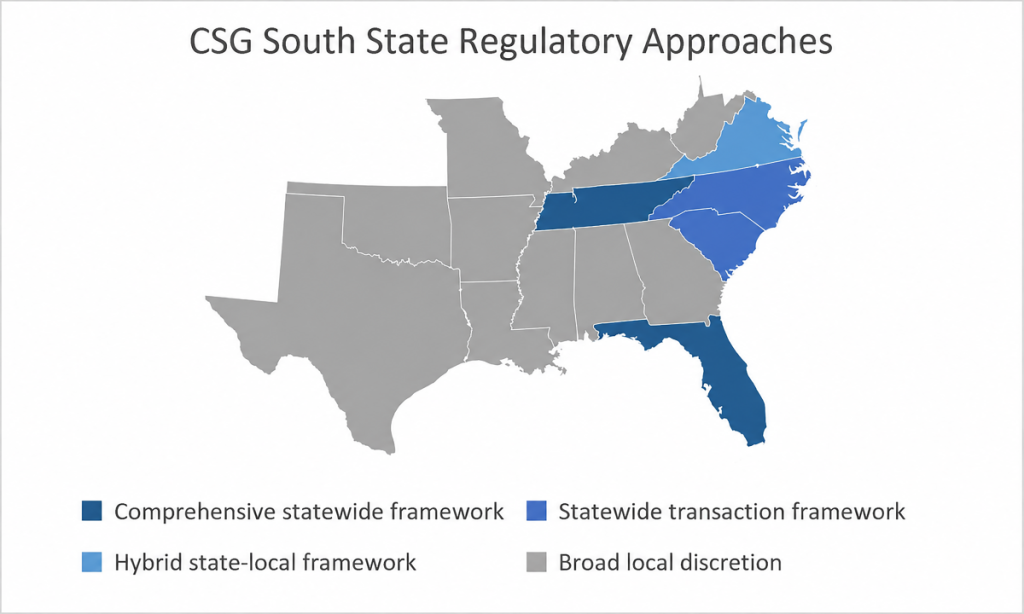
Southern states use several structural approaches to STR regulation (See Figure 6). Southern states use several structural approaches to STR regulation (See Figure 6). These categories reflect the extent and type of state involvement in STR regulation, including whether state law establishes statewide operating requirements, governs rental transactions, shares regulatory authority with local governments, or leaves most regulatory decisions to local jurisdictions. Part 2 of this series examines these distinctions in greater detail and compares the specific forms of state involvement across the Southern region. Florida and Tennessee have comprehensive statutory frameworks governing STR operations and management.67,68 North Carolina and South Carolina use a statewide transactional framework in which state law primarily governs vacation-rental transactions and property-management practices.69,70 Virginia practices a hybrid state-local framework in which state standards coexist with local regulatory authority.71 The remaining CSG South states generally retain broad local discretion but have varying degrees of targeted state involvement.
State legislatures have become more active as they consider whether statewide standards are needed to address differences among local regulatory systems, protect established property uses, and clarify the scope of municipal authority. State policy discussions have also addressed housing availability, registration and enforcement systems, and the responsibilities of online platforms that facilitate STR transactions across jurisdictions. In several states, litigation has further shaped these issues, particularly in disputes over whether local restrictions conflict with state law or exceed authority delegated to local governments.72
FIGURE 6. State Regulatory Approaches to Short-Term Rentals in the CSG South Region
Source: Author’s visualization utilizing data from various state statutes.73,74,75,76,77
Note: Classifications reflect statutes in effect as of August 5, 2026. State and local requirements may change following legislative, regulatory, or judicial action.
Citations
- Schneider, Karl E., and Lida R. Weinstock. “Short-Term Rental Markets: A Primer.” In Focus IF12920. Washington, DC: Congressional Research Service, February 24, 2025.
- Ibid.
- Ibid.
- Ibid.
- Granicus. 2024 Short-Term Rental Benchmark Report for Government. Denver: Granicus, 2024.
- Ibid.
- Grand View Research. “U.S. Short-Term Vacation Rental Market Size, Share & Trends Analysis Report, 2033.” Accessed August 5, 2026. https://www.grandviewresearch.com/industry-analysis/us-short-term-vacation-rental-market-report/request/rs3.
- Ibid.
- Mariotti, Tony. “Vacation Rental Statistics.” RubyHome. February 15, 2026. https://www.rubyhome.com/blog/vacation-rental-stats/.
- Ibid.
- Granicus, 2024 Short-Term Rental Benchmark Report for Government.
- Mariotti, Vacation Rental Statistics.
- Zhang, Jamie. “Where to List Short-Term Rentals: Airbnb vs. Vrbo vs. Booking.com.” AirDNA. Published September 19, 2025. Updated May 6, 2026.
- Granicus, 2024 Short-Term Rental Benchmark Report for Government.
- Ibid.
- Ibid.
- Ibid.
- Schneider and Weinstock, Short-Term Rental Markets: A Primer.
- Granicus, 2024 Short-Term Rental Benchmark Report for Government.
- VTSTRA. “Why Travelers Are Choosing Vacation Rentals.” Vermont Short-Term Rental Alliance, February 16, 2025.
- Schneider and Weinstock, Short-Term Rental Markets: A Primer.
- Building an ADU. “What Is an ADU: Accessory Dwelling Units Explained.” Accessed August 5, 2026. https://www.buildinganadu.com/what-is-an-adu.
- Sage, Scott. “Everything Hosts Need to Know About Short-Term Rental Compliance.” AirDNA. Published February 26, 2024. Updated February 21, 2025. https://www.airdna.co/blog/short-term-rental-compliance.
- Granicus, 2024 Short-Term Rental Benchmark Report for Government.
- AirDNA. The 2023 U.S. Vacation Rental Outlook Report. 2023. https://www.airdna.co/industry-report/2023-us-airdna-outlook-report.
- Schneider and Weinstock, Short-Term Rental Markets: A Primer.
- Granicus, 2024 Short-Term Rental Benchmark Report for Government.
- Schneider and Weinstock, Short-Term Rental Markets: A Primer.
- Koster, Hans R. A., Jos van Ommeren, and Nicolas Volkhausen. “Short-Term Rentals and the Housing Market: Quasi-Experimental Evidence from Airbnb in Los Angeles.” Journal of Urban Economics 124 (July 2021): 103356. https://doi.org/10.1016/j.jue.2021.103356.
- Schneider and Weinstock, Short-Term Rental Markets: A Primer.
- Ames, Jordan. “The Real Economic Impact of Short-Term Rentals on Communities.” Where to Live in Reno, January 20, 2026.
- Schneider and Weinstock, Short-Term Rental Markets: A Primer.
- Granicus, 2024 Short-Term Rental Benchmark Report for Government.
- Virginia General Assembly. “§ 15.2-983. Creation of Registry for Short-Term Rental of Property.” Code of Virginia. Accessed August 5, 2026.
- Ibid.
- Schneider and Weinstock, Short-Term Rental Markets: A Primer.
- Ibid.
- North Carolina General Assembly. “Chapter 42A: Vacation Rental Act.” General Statutes of North Carolina. Accessed August 5, 2026. https://www.ncleg.gov/EnactedLegislation/Statutes/HTML/ByChapter/Chapter_42A.html.
- Florida Legislature. “§ 509.013. Definitions.” Florida Statutes, 2025. Accessed August 5, 2026. https://www.leg.state.fl.us/Statutes/index.cfm?App_mode=Display_Statute&URL=0500-0599/0509/Sections/0509.013.html.
- Granicus, 2024 Short-Term Rental Benchmark Report for Government.
- Ibid.
- Virginia General Assembly, “§ 15.2-983. Creation of Registry for Short-Term Rental of Property.”
- Florida Legislature. “§ 509.242. Public Lodging Establishments; Classifications.” Florida Statutes, 2025. Accessed August 5, 2026.
- Tennessee Department of Revenue. “LOT-3—Definition of Short-Term Rental Unit.” Updated January 14, 2026. https://revenue.support.tn.gov/hc/en-us/articles/360057897431-LOT-3-Definition-of-Short-term-Rental-Unit.
- Louisiana State Legislature. “La. Rev. Stat. § 47:338.221: City of New Orleans; Short-Term Rental Occupancy Tax.” Louisiana Laws. Accessed August 5, 2026. https://legis.la.gov/legis/law.aspx?d=1148922.
- Florida Legislature, “§ 509.242. Public Lodging Establishments; Classifications.”
- Louisiana State Legislature, “La. Rev. Stat. § 47:338.221: City of New Orleans; Short-Term Rental Occupancy Tax.”
- AirDNA, The 2023 U.S. Vacation Rental Outlook Report.
- Ibid.
- Schneider and Weinstock, Short-Term Rental Markets: A Primer.
- Ibid.
- Granicus, 2024 Short-Term Rental Benchmark Report for Government.
- U.S. Census Bureau. “Vacancy Status.” American Community Survey, 2024 ACS 1-Year Estimates Detailed Tables, table B25004. Accessed July 28, 2026. Data Table.
- Ibid.
- Ibid.
- Luxon, Ben. “STR in Real Estate: Definition and Guide for Investors.” Landlord Studio. Published July 24, 2025. Updated August 4, 2026. https://www.landlordstudio.com/blog/str-in-real-estate.
- Barron, Kyle, Edward Kung, and Davide Proserpio. “The Effect of Home-Sharing on House Prices and Rents: Evidence from Airbnb.” Marketing Science 40, no. 1 (2021): 23-47. https://doi.org/10.1287/mksc.2020.1227.
- Schneider and Weinstock, Short-Term Rental Markets: A Primer.
- Granicus, 2024 Short-Term Rental Benchmark Report for Government.
- Barron, Kung, and Proserpio, “The Effect of Home-Sharing on House Prices and Rents.”
- Zhou, Jun. “Owner-Occupied Rental.” AirROI. Published February 10, 2026. Updated May 28, 2026. https://www.airroi.com/glossary/owner-occupied-rental.
- Horton, John J., and Richard J. Zeckhauser. “Owning, Using and Renting: Some Simple Economics of the ‘Sharing Economy.’” NBER Working Paper No. 22029. Cambridge, MA: National Bureau of Economic Research, February 2016. https://doi.org/10.3386/w22029.
- Virginia General Assembly, “§ 15.2-983. Creation of Registry for Short-Term Rental of Property.”
- Tennessee General Assembly. “Senate Bill 1086: Short-Term Rental Unit Act.” 110th General Assembly, 2017-2018. Enacted as Public Chapter 972, May 17, 2018.
- Gauß, Patrick, Sonja Gensler, Michael Kortenhaus, Nadine Riedel, and Andrea Schneider. “Regulating the Sharing Economy: The Effects of Day Caps on Short- and Long-Term Rental Markets and Stakeholder Outcomes.” Journal of the Academy of Marketing Science 52 (2024): 1627-50. https://doi.org/10.1007/s11747-024-01028-7.
- Granicus, 2024 Short-Term Rental Benchmark Report for Government.
- Florida Legislature. “Chapter 509: Lodging and Food Service Establishments; Membership Campgrounds.” Florida Statutes, 2025. Accessed August 5, 2026.
- Tennessee General Assembly, “Senate Bill 1086: Short-Term Rental Unit Act.”
- North Carolina General Assembly, “Chapter 42A: Vacation Rental Act.”
- South Carolina General Assembly. “South Carolina Vacation Rental Act,” S.C. Code Ann. §§ 27-50-210-27-50-270. South Carolina Code of Laws. Accessed August 5, 2026.
- Virginia General Assembly, “§ 15.2-983. Creation of Registry for Short-Term Rental of Property.”
- Tarr v. Timberwood Park Owners Association, Inc., 556 S.W.3d 274 (Tex. 2018).
- Florida Legislature, “§ 509.242. Public Lodging Establishments; Classifications.”
- North Carolina General Assembly, “Chapter 42A: Vacation Rental Act.”
- South Carolina General Assembly, “South Carolina Vacation Rental Act.”
- Tennessee General Assembly, “Senate Bill 1086: Short-Term Rental Unit Act.”
- Virginia General Assembly, “§ 15.2-983. Creation of Registry for Short-Term Rental of Property.”