

Issue Brief by Policy Analyst, Judah Lebofsky
DOWNLOADIntroduction
Major events are a notable component of cultural identity in the United States. This trend is particularly prominent in Southern states, where city landscapes often experience significant changes, small towns host hundreds of thousands of sports fans, and sports rivalries are often a prominent aspect of community engagement.
Regional characteristics contribute to the South’s capacity to host major events with large influxes of attendees. Southern states have hosted 35 Super Bowls (and will host another in 2028 in Georgia), 16 National Collegiate Athletic Association (NCAA) Division I College Football National Championships (with two more planned for 2028 and 2029 in Louisiana and Florida, respectively), and one Olympic Games.1,2,3 Additionally, annually recurring events such as Mardi Gras in New Orleans, the Masters Tournament in Augusta, Georgia, and the Daytona 500 in Daytona Beach, Florida, contribute to the South’s long history of hosting major cultural and sporting events.
The tradition of hosting major events in the South will increase this year, with four CSG South states (Florida, Georgia, Missouri, and Texas) hosting matches during the 2026 FIFA Men’s World Cup.4 Additionally, the South’s role in the cultural history of the United States sets the stage for various America250 events to be hosted throughout the region, with federal actions such as the January 2025 presidential proclamation, Celebrating America’s 250th Birthday, highlighting national coordination efforts and prompting states to prepare through programming development, supporting tourism, and coordinating infrastructure and interagency planning.5,6
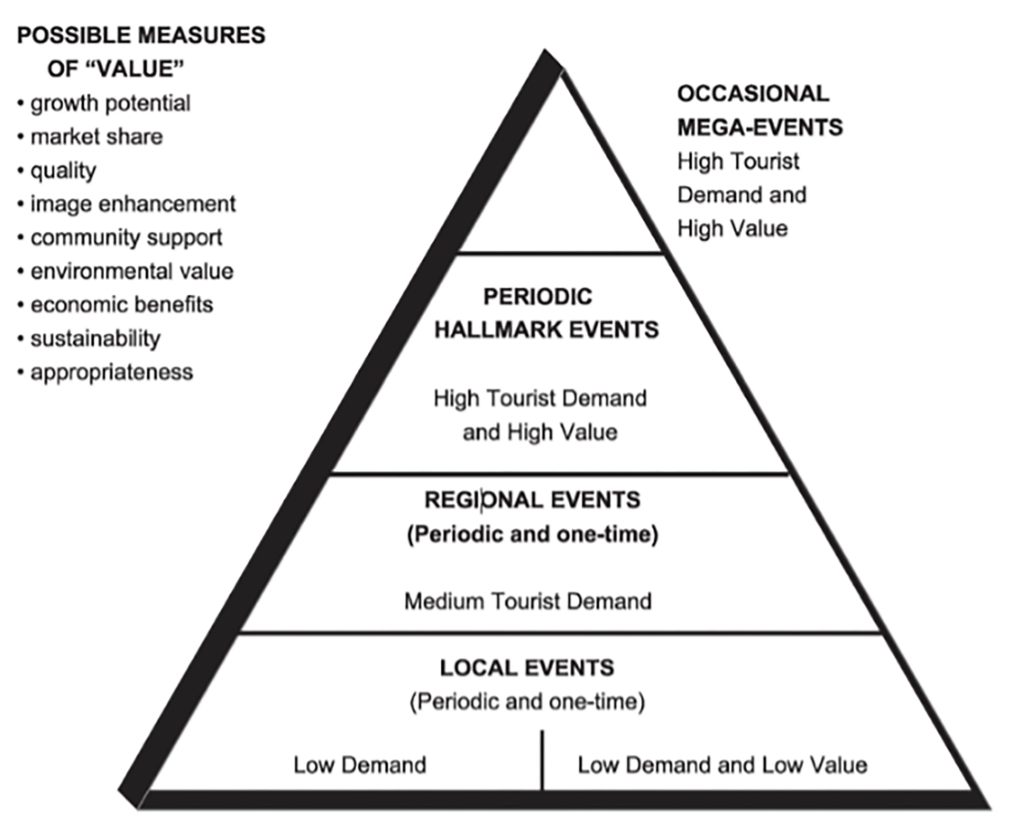
These events vary in scale, frequency, and geographic scope, ranging from one-time mega-events to recurring annual events that shape regional economies and tourism patterns (see Figure 1).
Figure 1. Typology of Major Events
Source: Getz, “Event Tourism.”7
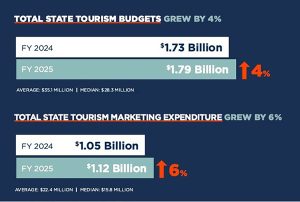
Even though host cities bear the primary responsibility for enhancing infrastructure, establishing security measures, and overall preparation for a major event, state legislatures support host cities by providing resources to manage the event. While federal appropriations and grants are a significant funding stream, state legislatures can appropriate more specified funds for major events in a more timely manner.8 Despite the event being held in a specific host state, the statewide impact on tourism and economic development from hosting major events may generate a return on investment for the state legislature. Recent data indicates that total state tourism budgets increased from approximately $1.73 billion in FY 2024 to $1.79 billion in FY 2025, reflecting a 4 percent increase, while tourism marketing expenditures grew by 6 percent over the same period (see Figure 2).9
FIGURE 2. State Tourism Budgets and Marketing Expenditures, FY 2024–FY 2025
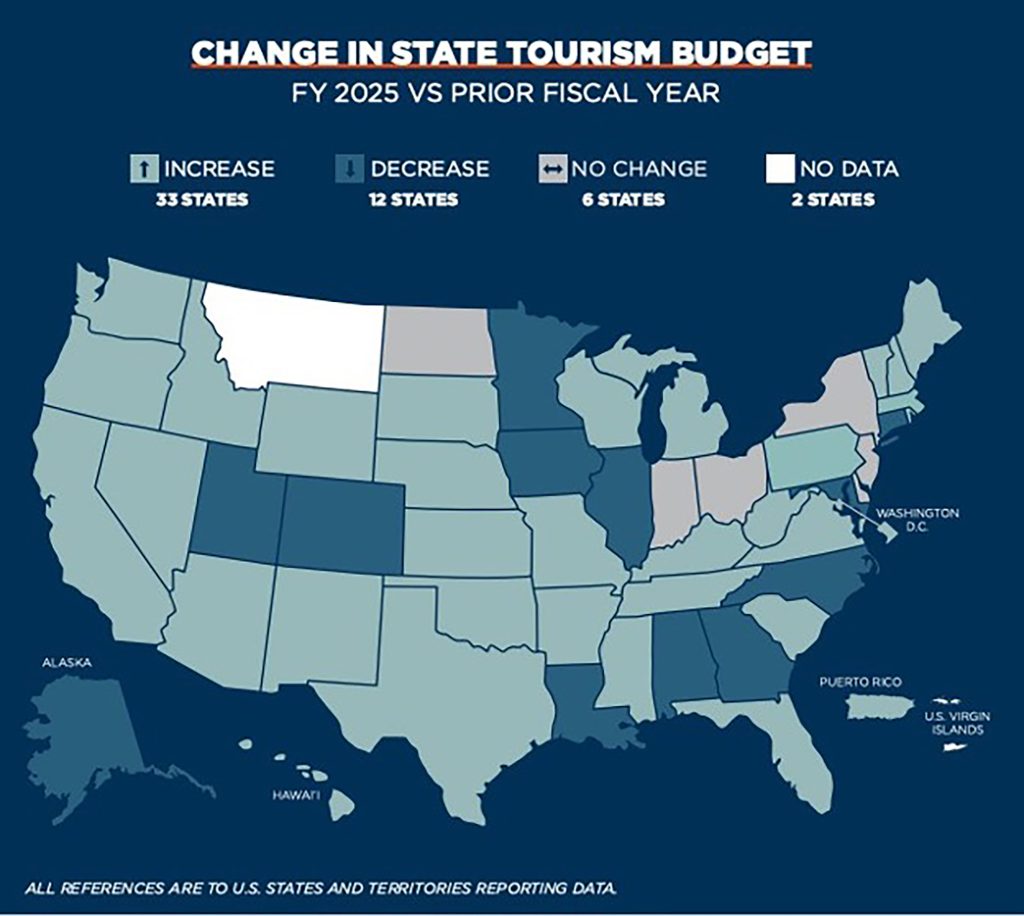
At the same time, changes in state tourism funding vary across the country, with a majority of states reporting increases in tourism budgets, while others reported decreases or no change, illustrating differing approaches to investment in tourism and event-related economic development (see Figure 3). Within the Southern region, where major events are a consistent component of economic activity, these variations in funding levels may influence how states position themselves to attract and support large-scale events, as well as how they coordinate resources across tourism, infrastructure, and workforce systems.
FIGURE 3. Change in State Tourism Budgets, FY 2025 vs. Prior Fiscal Year
Source: U.S. Travel Association11
Policy-Relevant Dimensions of Major Event Hosting
Economic Development and Tourism Effects
Visitor Spending
Hosting major events is a significant undertaking and investment by a host state. These investments are often evaluated based on their economic impact and financial outcomes. Economic impact estimates for major events can vary depending on methodology, assumptions, geographic scope, and the time horizon considered. In the context of major event hosting, visitor spending represents one of the primary economic mechanisms through which events generate revenue. The U.S. Bureau of Economic Analysis (BEA) defines visitor spending as all goods and services purchased by tourists, people who travel for any reason.12 Some core industries in tourism spending include lodging, food and beverages, transportation, retail, and entertainment.13 Visitors concentrate spending during a short period, sometimes restricted to overnight or day visitors, as in a weekend event such as a music festival on the Gulf Coast.14 The economic effect of visitor spending is increased revenue in industry sectors targeting tourism. State governments may see an influx of revenue due to increased tax collections, such as sales taxes on products or lodging. Policymakers may evaluate the policy implications of visitor spending from a sector-specific perspective. While each major event may be unique in its needs and visitor volume, they generally result in significant demand on the hospitality, transportation, and service industries.
Business Activity
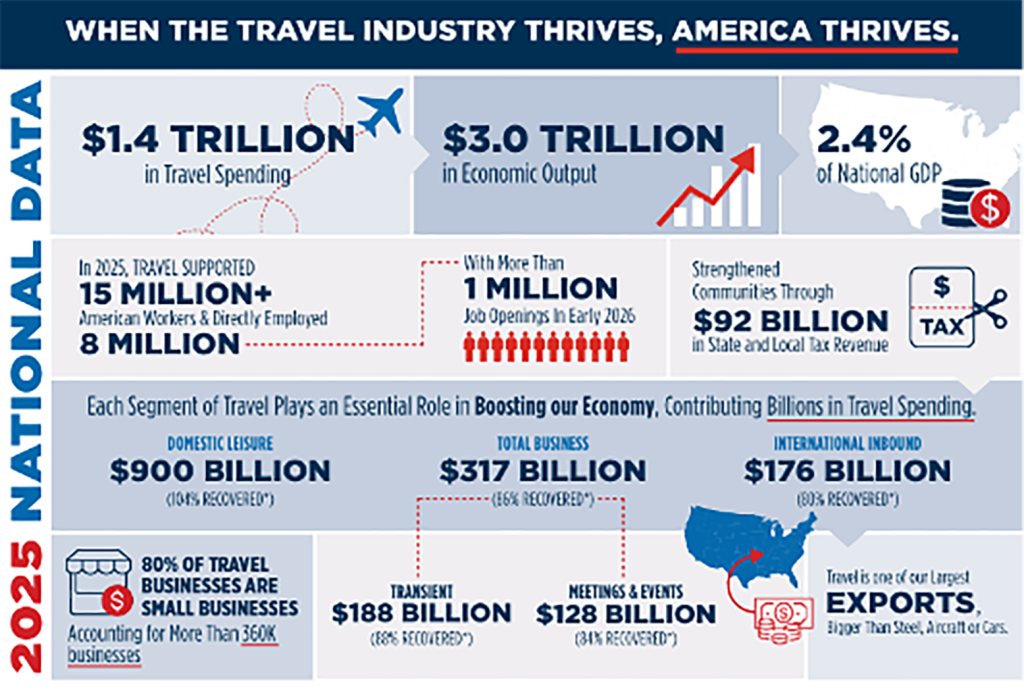
Beyond direct spending, visitor spending associated with major events contributes to broader business activity across the host region, extending beyond the initial point of purchase (see Figure 4). At the state level, this broader business activity may inform decisions related to workforce development, supply chain support, and industry-specific economic policies, particularly in sectors such as hospitality and transportation. Direct spending occurs at hotels, restaurants, and event venues, while indirect spending supports supply chains, including food distributors, transportation providers, and event service vendors.15 In 2025, travelers in the United States spent approximately $1.4 trillion, generating an estimated $3.0 trillion in total economic output, underscoring how initial expenditures can ripple through related industries.16 In addition, induced economic activity may occur as employees in event-related industries spend their earnings locally; nationally, travel activity supported more than 15 million jobs and contributed $92 billion in state and local tax revenue.17 These interconnected effects can distribute economic activity across sectors such as hospitality, transportation, and retail. To accommodate increased demand during major events, businesses often adjust operations in key Southern industries, such as hospitality, by expanding staffing levels, extending hours, and increasing inventory, with the scale of these adjustments varying by the size and frequency of the event.18 Understanding how business activity responds to major events provides policymakers with insight into workforce, infrastructure, and industry coordination needs, informing broader considerations of the return on investment associated with hosting these events.
Figure 4. Economic Impact of U.S. Travel Industry, 2025 National Data
SOURCE: U.S. Travel Association19
Return on Investment
Building on these economic effects, analysts use return on investment (ROI) to evaluate the financial outcomes associated with an event by comparing the benefits (e.g., revenue) to the costs incurred by event organizers in planning and executing it.20 Projected short-term returns on investment may occur through visitor spending, government taxes on local businesses, and increased job opportunities in a community, as illustrated by estimates from the 1996 Summer Olympics in Atlanta, which generated approximately $5.1 billion in economic activity across industries such as lodging and amusements ($677.7 million), business services ($610.2 million), and eating and drinking establishments ($412.7 million), while supporting an estimated 77,026 jobs across sectors (see Figure 5).21 Similarly, long-term ROIs arise from exposure of the region to tourists visiting for a specific event, leading them to engage in additional economic activity beyond the event itself. Furthermore, repeated visits to a region for future major events may contribute to a more consistent revenue stream for host state governments. State legislatures may use these ROI assessments when determining whether to allocate public funds, authorize incentives, or support future bids for major events.
FIGURE 5. Economic and Job Impact of the 1996 Atlanta Summer Olympics
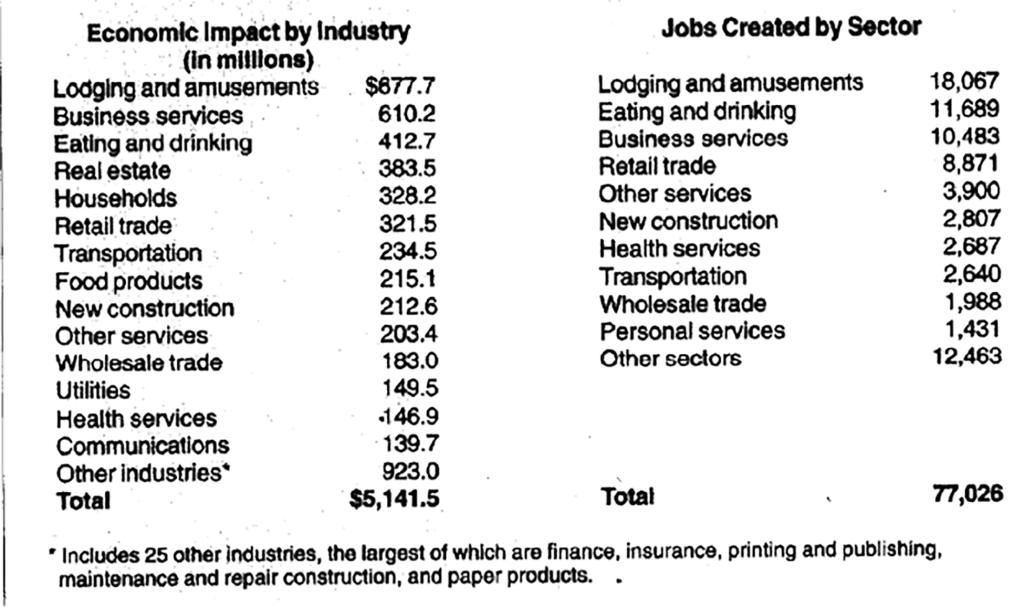
SOURCE: Atkins et al., Economic Impact Analysis 1996 Atlanta Summer Games.22
However, these benefits must be weighed against the costs of hosting such major events, which may span the pre-games, games, and post-games phases of planning and implementation and include expenditures such as initial investment and bid costs, operational expenses during the event, and long-term maintenance of infrastructure (see Table 1). A notable example is security, which is often part of broader operational expenditures during the games phase, where state policymakers may consider how host cities are responsible for maintaining safety for visitors. Security planning may involve coordinating with state and federal agencies, deploying law enforcement personnel, and investing in surveillance, emergency response, and transportation management systems to address increased demand during the event.23
These impacts may also vary by event type, with one-time mega-events often producing concentrated, short-term economic activity, including tourism, construction activity, and event-related employment. In contrast, recurring major events generate more consistent and predictable patterns over time, often tied to ongoing tourism, infrastructure utilization, and regional economic activity. This distinction highlights how different event models can influence both the scale and distribution of economic effects within a host region. For policymakers, understanding these variations helps when evaluating potential investments and determining how event hosting aligns with broader economic development and tourism strategies.
TABLE 1. Economic Benefits and Costs of the 1996 Atlanta Summer Olympics
| BENEFITS COSTS | ||
| Pre-Games Phase | — Tourism — Construction activity | — Investment expenditure — Preparatory operational costs (including bid costs) — Lost benefits from displaced projects |
| Games Phase | — Tourism — Stadium and Infrastructure — Olympic jobs — Revenue from Games (tickets, TV rights, sponsorship etc.) | — Operational expenditure associated with Games — Congestion — Lost benefits from displaced projects |
| Post-Games Phase | — Tourism — Stadium and infrastructure — Human capital — Urban regeneration — International reputation | — Maintenance of stadiums and infrastructure — Lost benefits from displaced projects |
Infrastructure Planning and Legacy Use
In addition to financial considerations, major event hosting requires several components that require significant focus and investment to mitigate potential issues throughout the event.
Transportation Investments
For state legislators, a key consideration is whether a host state has adequate infrastructure and/or a reliable public transportation system to assist attendees in arriving at and moving throughout the event location. Host states often rely on transportation infrastructure that is scalable to meet the short-term demand of an event, while continuing to serve community needs post-event.25 In practice, this may involve state departments of transportation prioritizing roadway improvements, coordinating with regional transit authorities, and allocating funding for traffic management and infrastructure upgrades. Some major events, such as the Olympics, may require years of preparation to ensure adequate transportation to meet demand.26 Ensuring reliable transportation systems before major events is a key consideration to prevent issues and delays for attendees.
Event Safety
Furthermore, state legislatures are often responsible for coordinating or funding public safety efforts to ensure public safety while maintaining accessibility and visitor mobility. For major events that attract large numbers of international visitors, strategies to minimize language barriers in communication and ensure safety are crucial, with some events using digital technologies to bridge language gaps with patrons.27 These efforts often involve coordination among public safety agencies, event organizers, and technology providers to deliver real-time information and guidance to attendees. In addition to communication strategies, planning may include crowd management, emergency response protocols, and accessibility considerations to accommodate a diverse range of visitors. These activities may require legislative authorization for funding, emergency powers coordination, or interagency agreements to support large-scale event operations.
Post-Event Utilization Considerations
State policymakers may evaluate long-term use by considering the post-event role of infrastructure and other investments. For example, reports have highlighted that Olympic venues often fall into disrepair in the years following the event.28 More recent major events have taken note of this trend, with sustainable planning for the reuse of venues and resources in the aftermath.29 Although the impact of a major event is immediate, a key consideration is whether the long-term implications of infrastructure investment will maximize the benefit of the resources. One strategy is to view a major event as the foundation for broader, long-term economic development and tourism strategies.30 Although the immediate benefits of hosting an event may be substantial, they can also contribute to a more consistent stream of economic activity for the region, capitalizing on the event for years to come. In some cases, states may establish oversight mechanisms, funding requirements, or reporting processes to evaluate whether publicly supported infrastructure continues to provide long-term value.
Workforce
Temporary Job Creation
Beyond infrastructure needs, major events often lead host states’ industries to increase employment to meet the substantial projected demand. For state legislators, this trend raises questions about workforce policy and labor-market impacts. This is particularly evident in the hospitality industry and service jobs, where visitors interact most with these sectors. While major events often support job creation, most new jobs are short-term and may be overstated in projections of the number of jobs they generate in the Southern labor market.31 Additionally, as many of the new jobs are designed to be short-term and specific to the major event, long-term employment effects are typically more limited.32 While job creation is a key policy goal for major event hosting, policymakers may recognize that the influx of jobs resulting from a major event is usually temporary. These dynamics may inform state-level workforce development strategies and labor market planning for event-driven demand.
Volunteers
To further support workforce demands, volunteers are a central component at major events, supporting operations, reducing costs, and contributing to the overall visitor experience. Major events rely on large numbers of volunteers to supplement the workforce needed to accommodate large numbers of visitors.33 Volunteers often represent the largest share of an event workforce.34 Notably, volunteers enable large-scale coordination and execution of event services; they often provide a significant share of event labor.35 Economically, volunteers provide unpaid labor, reducing operational costs for organizers.36 Often, volunteers provide unpaid services so they can themselves participate in the tourism of the major event.37 Recognizing the need to supplement major event labor forces with volunteers is a notable policy dimension to evaluate in the context of major event employment. This reliance may also raise considerations for state policymakers regarding workforce substitution, liability, and coordination with formal employment systems.
Typology of Major Events
While policy dimensions apply broadly, the scale and nature of these considerations vary depending on the type of major event being hosted. For this report, major events across the Southern region are classified into three categories, adjusted from previous literature (see Figure 1):
- One-Time Mega-Events,
- Rotating Annual Mega-Events, and
- Annual Hallmark Events.38
One-Time Mega-Events
One-time mega-events are rare, massive-scale events that span multiple cities, states, and countries and can last for weeks.39 Such events attract high levels of domestic and international tourist demand and attendance, as well as a significant economic impact on the host location.40 These types of major events do not typically occur in the same locations.41 Examples of one-time mega-events are the 1996 Atlanta Olympic Games and the 2026 FIFA Men’s World Cup, which spans across Canada, Mexico, and the United States. These events often attract attendance in the millions over their duration; for example, the 1996 Atlanta Olympic Games recorded approximately 8 million ticketed attendances, while the FIFA Men’s World Cup is expected to draw several million attendees across host sites. 42,43
Rotating Annual Mega-Events
Rotating annual mega-events are large-scale, major events held within a single urban area, with the event occurring on a single day.44 However, the festivities can last up to a week beforehand. These major events attract high levels of domestic tourist demand and attendance, as well as a significant economic impact on the host location.45 These events can rotate locations each year, with some cities becoming repeat hosts in future years. Examples of rotating mega-events are the Super Bowl, the NCAA College Football Championship, and the NCAA Men’s Final Four. Attendance for these events is typically concentrated within a shorter timeframe, with individual events often drawing between 60,000 and 80,000 attendees, though associated week-long activities may increase total visitor counts within the host state.46,47,48
Annual Hallmark Events
Annual hallmark events are large-scale, major events held in the same city each year.49 These recurring events can occur on a single day or over several days. Although some of these major events may attract larger attendance than rotating annual mega-events, their regional impact is consistent year after year, actively shaping the host region’s cultural identity.50 Events attract high levels of domestic tourist demand and attendance, as well as a significant economic impact on the host region.51 Examples of annual hallmark events are the Daytona 500, Mardi Gras, and the Masters Tournament.52 These events can attract large but more predictable attendance levels each year; for instance, the Daytona 500 regularly draws crowds exceeding 100,000, while Mardi Gras in New Orleans attracts more than one million visitors annually.53,54 These distinctions are relevant for state legislators, as each event type presents different fiscal, administrative, and workforce considerations.
Comparative Case Studies
To illustrate how these differences manifest in practice, each major event category has its own governance structure, host state selection process, and economic impact on the host region. Furthermore, each category is unique for the roles that the states play to assist in hosting the event. Due to these differences, legislators may choose to focus on distinct policy topics, including:
- Infrastructure planning and transportation systems
- Public safety and security coordination
- Workforce development and staffing needs
- Tourism promotion and economic development
- Intergovernmental coordination and funding mechanisms55,56
The following section provides a deep-dive case study example for each major event category. This section will highlight, when applicable, the bidding and selection process for a host state, the role the state policymakers are responsible for when a city in their state is hosting a major event, the infrastructure required to host each example of event, and the economic impact of the major event for the host state.
One-Time Mega-Event Example: 2026 FIFA Men’s World Cup
FIGURE 7. 2026 FIFA Men’s World Cup Host City Selection and Preparation Timeline
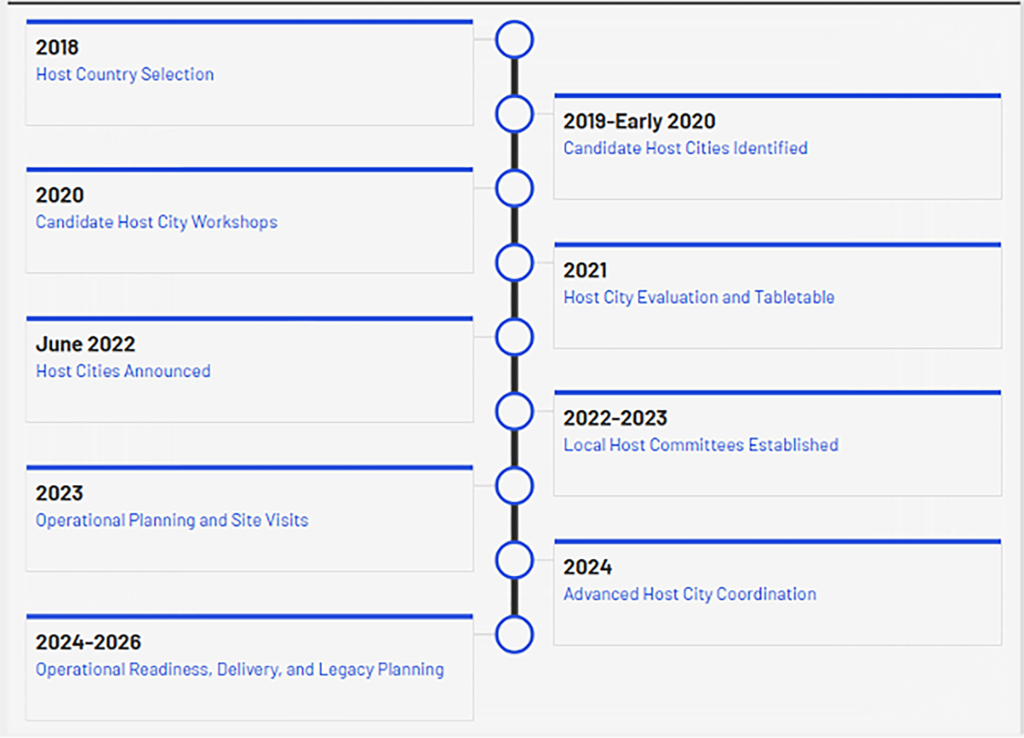
SOURCE: Author’s visualization utilizing information from FIFA.57
Host City Selection and State Involvement
The 2026 FIFA Men’s World Cup is expected to be one of the largest sporting events ever staged, with planning and logistics underway for nearly a decade.58 The 2026 FIFA Men’s World Cup host city and preparation timeline consists of nine phases (see Figure 6).
In terms of state policymakers, the following is an overview of the FIFA Men’s World Cup host selection processes, with an emphasis on the increasingly involved role of state legislatures across each stage.
Early Stages (Limited State Involvement)
During the early stages of the FIFA Men’s World Cup bidding process, FIFA establishes the framework for host selection and evaluates national and local proposals. FIFA designs and publishes its Guide to the Bidding Process, outlining how countries can submit applications and establishing requirements for viability.59 Prospective host countries then submit bid proposals, which FIFA evaluates and scores before a final selection is made.60
Following host country selection, cities express interest in hosting matches and submit preliminary materials outlining stadium capacity, transportation, lodging, and anticipated state support.61 After which, FIFA conducts workshops with candidate host cities to outline evaluation criteria, selection methodology, and expectations, and later evaluates prospective host cities through technical reviews and site visits as it establishes the selection timeline.62,63
During these stages, a host state’s role is limited, as it does not yet know if its location will be selected. States may play an indirect or advisory role by providing assurances related to infrastructure capacity, security coordination, or legal authority, and by assessing their willingness to support infrastructure development and public safety coordination. For state legislators, these stages establish the framework for future involvement, shaping expectations regarding funding, statutory authority, and logistical planning, and prompting preliminary discussions of policy and budget considerations.
Host Cities Announced
In June 2022, FIFA officially announced the 16 host cities (11 in the U.S.,* three in Mexico,= and two in Canada‡) for the 2026 FIFA Men’s World Cup.64 Following this announcement, state policymakers have played an increasingly significant role in assisting host cities with planning and logistics. Once a host city is selected, the state policymakers often become formal partners in key areas of security, permitting, and funding. State-level fiscal and operational exposure for state legislators is concrete at this point, signaling continuing reliance by host cities on state legislator aid.
Local Host Committees Established
Each host city establishes a Local Host Committee to coordinate local efforts with FIFA and national organizers.65 During this phase, FIFA executives host workshops to ensure cohesiveness among the 16 host cities.66 Host states are consistently involved in interagency coordination and are beginning to allocate state resources to the host cities. State officials may begin involving state law enforcement officers to prepare security plans and coordinate throughout the event. State legislators are increasingly involved in logistical coordination and support for the host committee, moving beyond their previous advisory role.
Operational Planning and Site Visits
The organization conducts a host city planning tour, during which FIFA experts visit all host cities to assess stadium operations, transportation, security, hospitality capabilities, and pitch management.67,68 Furthermore, the FIFA-contracted logistics company will coordinate with host sites to strategize on how to accommodate the large influx of visitors to the city and mitigate potential bottlenecks that reduce the fan experience and hinder statewide efforts to support the host city.69 The role of the state becomes more prominent in this phase. State agencies often participate directly in coordination efforts with the logistics company, mapping out transportation approaches and assessing potential risks and strategies to mitigate any emergencies. Following these planning sessions, state agencies request funding to support the changes needed to accommodate the FIFA Men’s World Cup event. State legislators may authorize appropriations and statutory changes needed to support these adjustment. Open dialogue between agency officials and state legislators about their needs is crucial to ensure the efficient implementation of required infrastructure and support.
Advanced Host City Coordination
Representatives from all 16 host cities convene at multi-day planning workshops for final groupwide coordination before the final implementations for the last few years before the FIFA Men’s World Cup begins.70 Delegations discuss guest operations, fan festivals, volunteers, and the event legacy following the closing ceremonies. Host states’ support of host cities remains sustained and strategic, focused on multi-agency coordination and on integrating state services into event operations. Furthermore, host states plan how to employ the workforce to operate each facet of the event. State legislators have provided key services to this point, ensuring that host committees have the resources to hire temporary workers to manage and execute event operations.
Operational Readiness, Delivery, and Legacy Planning
The final phase of the World Cup preparation timeline involves FIFA and host cities engaging with Operational Readiness, Activation, and Transition (ORAT) advisors.71 These advisors are directly involved in the delivery and execution of the event, as well as post-event legacy. During this phase, host state involvement peaks. States heavily engage in security operations, transportation management, emergency response, and post-event evaluation metrics. Agencies request intensive operational and fiscal support from state legislators for intensive operational and fiscal assistance in this phase, as a final push before the FIFA Men’s World Cup commences. Furthermore, state legislators are thinking ahead about how the legacy of this event can benefit their region in the following years, continuing to draw tourism even after the event’s conclusion.
Infrastructure and Transportation Considerations
As planning transitions into implementation, infrastructure and transportation considerations become increasingly central to supporting the millions of domestic and international visitors attending the event, especially in states with already high rates of tourist visitors, and to moving them efficiently throughout the region (see Figure 7). For state legislators, these decisions often involve prioritizing projects, allocating funding, and coordinating across agencies. Major events, especially on the scale of the FIFA Men’s World Cup, tend to reshape infrastructure timelines and priorities rather than creating entirely new systems and hosting often accelerates project timelines rather than changing which projects are ultimately built.72 A commonly cited example is the development of the Doha Metro system in Qatar ahead of the 2022 FIFA Men’s World Cup.73 While the metro was part of a broader long-term national development strategy, the tournament accelerated its delivery timeline, with multiple lines and stations completed in advance of the event to facilitate movement between stadiums and key urban areas. Similar considerations are relevant for Southern host states such as Florida, Georgia, and Texas as they prepare for the 2026 FIFA Men’s World Cup, with examples including coordination between the Georgia Department of Transportation and regional transit systems such as MARTA to manage increased ridership, as well as transportation planning efforts in Texas, where TxDOT has outlined roadway and traffic management preparations to accommodate increased travel demand associated with the event.74,75,76
FIGURE 8. America’s Most Visited States by Tourists
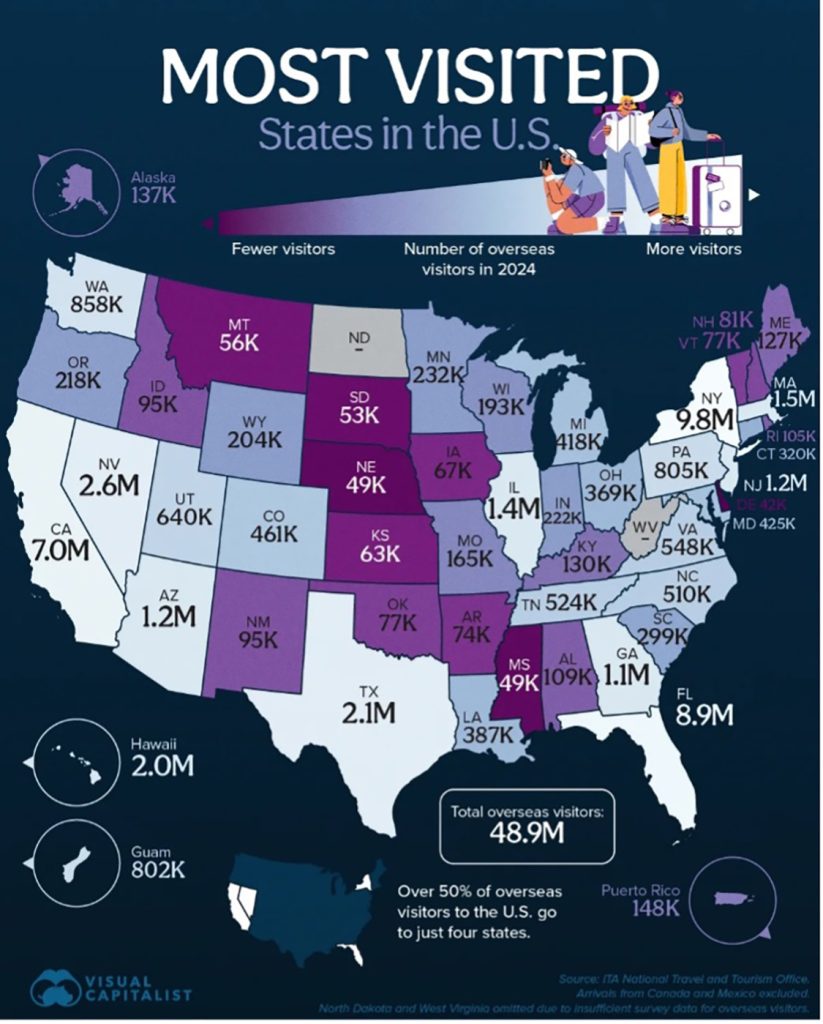
SOURCE: Visual Capitalist, Most Visited States by Tourists.77
This trend is especially profound when coordinating transit projects. Short-term transit decisions can have long-term effects on the transportation systems of the host city, highlighting the need for efficient coordination arrangements that are temporary for the event and later become integrated as a longer-term system improvement.78 While building new infrastructure is crucial to successful event management and hosting, reducing extraneous tasks is equally crucial to the end product. Deferring projects is just as important as accelerating them, ensuring that resources and labor are efficiently managed and dedicated to projects that will have the most profound impact on the FIFA Men’s World Cup.79
Fiscal and Administrative Coordination
In parallel with infrastructure development and transportation considerations, fiscal and administrative coordination is essential for organizers to manage the financial realities of hosting an event on the scale of the FIFA Men’s World Cup. The primary challenges for states are operational costs, governance complexity, and long-term responsibilities. A frequently cited example is the for the 2022 FIFA Men’s World Cup in Qatar, where a centralized administrative body was established to coordinate planning, infrastructure delivery, and event operations across multiple sectors.80 While Qatar made significant capital investments in stadiums and transportation infrastructure, a substantial portion of public spending was also directed toward operational requirements, including security, event management, transportation services, and workforce mobilization during the tournament period.
A key consideration to note is that the operational costs of hosting a major event may exceed one-time capital investments, with ongoing maintenance continuing to burden the state after the event’s conclusion.81,82,83 The maintenance costs of event infrastructure may exceed the initial construction costs.84 As a result, legislators may consider the long-term implications of infrastructure projects for major events, ensuring that their continued use remains valuable to the region after their original purpose expires.
Beyond immediate planning and costs, continuous, long-term outcomes are primary indicators of the success of a major event in the region. Event legacies can shape public perceptions of the event, especially regarding how event planning and infrastructure construction continue to benefit the region.85 As part of its economic framework, FIFA emphasizes the importance of aligning infrastructure and service investments with both short-term demand during the event and long-term regional needs, avoiding overdevelopment in sectors that may not sustain similar demand after the tournament.86 Aligning host-region infrastructure development with international sustainable development goals enables centralizing services and facilities to meet increased, short-term demand without overextending the region by underutilizing buildings and systems.87 These considerations highlight the importance of state policymakers evaluating how infrastructure investments, fiscal commitments, and long-term planning associated with major events align with broader economic development goals and the ongoing needs of their constituents.
Rotating Annual Mega-Event Example: The Super Bowl
FIGURE 9. Super Bowl Host City Bid Process
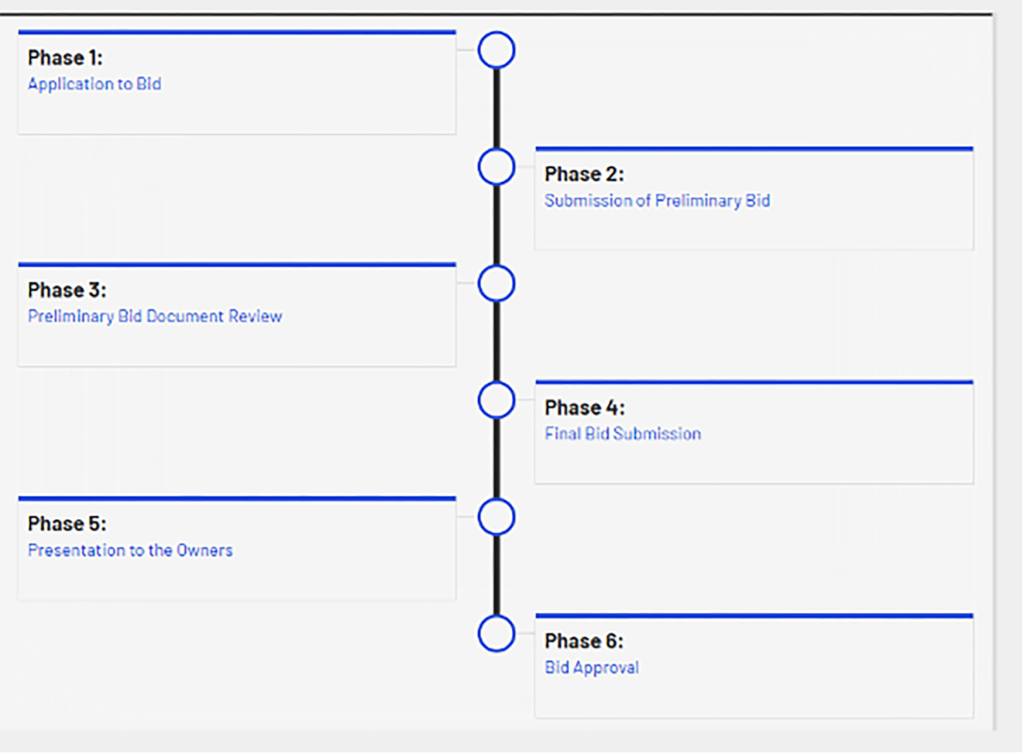
While the FIFA Men’s World Cup is a one-time mega-event that requires long-term planning, other major events follow different timelines and governance models. Some analyses suggest the Super Bowl one of the most economically impactful sporting events in the U.S.89 Attendance at Super Bowl LX in Santa Clara, California, reached 70,823, and, by some estimates, the event generated up to $630 million for the region.90 These economic benefits are even greater in the South, with reports estimating that the 2025 Super Bowl LIX in New Orleans was estimated to generate $1.25 billion in total statewide economic output (see Table 2).91 The process of selecting Super Bowl host cities begins several years in advance, and the NFL ensures that all locations meet their host city bid specifications and requirements.92 The Super Bowl bid process consists of six phases (see Figure 8):
- Phase 1: Application to Bid
- Phase 2: Submission of Preliminary Bid Documents
- Phase 3: Preliminary Bid Document Review
- Phase 4: Final Bid Submission
- Phase 5: Presentation to the Owners
- Phase 6: Bid Approval93
TABLE 2. Total Economic Impact of Super Bowl LIX in New Orleans (in Millions)
| ITEM | IMPACT |
| New Louisiana Output | $1,250.5 |
| New Louisiana Earnings | $395.0 |
| Jobs Created | 9,787 |
| Total Louisiana State and Local Taxes | $82.7 |
Bidding and Hosting Requirements
State policymakers play minor roles during the bid process, often serving as supporters of the potential host city and demonstrating their commitment to assist with infrastructure development and revitalization if chosen.95 Legislative involvement often becomes more prominent in later phases of the bid process or after a host city is selected.96 In some cases, state legislators may take a more direct role by proposing legislation or authorizing funding to help meet bid requirements.97 Some of these requirements include stadium infrastructure, operations, staffing expenditures, and security.98 State legislatures may appropriate funds directly toward Super Bowl-specific grants to assist host cities in meeting these requirements and as part of broader efforts to support the large-scale economic impact generated by the state hosting the event (see Table 9).
Once a host city is selected and bid commitments are finalized, responsibility for planning and executing the event shifts from the bid process to a coordinated structure led by the NFL and local partners.99 The NFL Events Department is the lead entity responsible for planning, managing, and executing the Super Bowl, overseeing all aspects of the game and its related activities.100 The selected host city is responsible for forming a Super Bowl Host Committee at least two years before the designated Super Bowl.101 The Super Bowl Host Committee is responsible for fulfilling the agreement between the NFL and the Bid Community, serving as an extension of the NFL in the community, acting as the city ambassador for attendees, and managing local resources.102 It includes local government representatives, business leaders in the community, tourism organizations, members of the host NFL team administration, and the stadium owner.103 This multi-sector composition reflects the level of coordination required for a region to host the Super Bowl.
Public Financing and Security Costs
A crucial responsibility of the host committee is determining municipal, regional, and state projects undertaken to prepare for the Super Bowl. Many of these “legacy” projects will outlast the Super Bowl event, often targeting road improvements, beautification programs, and park improvements.104 State legislators are directly integrated into these projects. While instigated by the event, these projects will directly impact constituents and statewide operations, particularly if the host city is an economic hub for the state. As such, state legislators may be involved in oversight, funding decisions, or related policy considerations.
Additionally, the federal role may be expanded if the president designates a major public event with national significance as a National Special Security Event (NSSE). Some major events categorized as NSSEs include presidential inaugurations, major international summits held in the United States, major sporting events, and presidential nominating conventions.105 Recent Super Bowls have received the NSSE designation, reflecting their scale, attendance, and national significance.106 NSSEs receive federal funding (see Table 3) to support the planning, coordination, and implementation of event operations. In addition to federal funding, public financing for Super Bowl-related activities may include state and local contributions, such as appropriations, in-kind services, and support for infrastructure and event operations. State and local agencies participate in planning and implementation alongside federal partners, providing personnel infrastructure support and operational coordination with their resources. The extent of these contributions varies by host city and is often determined through agreements established during the bid and planning process. These responsibilities may require legislative action related to appropriations, interagency coordination, and statutory authority.
TABLE 3. NSSE Appropriations, FY 2013-2020 ($ millions)
| FISCAL YEAR | APPROPRIATION |
| 2013 | 4 |
| 2014 | 5 |
| 2015 | 5 |
| 2016 | 5 |
| 2017 | 5 |
| 2018 | 5 |
| 2019 | 5 |
| 2020 | 5 |
After receiving the NSSE designation, the U.S. Secret Service will become the lead federal agency responsible for coordinating, planning, exercising, and implementing security.108 Federal, state, and local agencies plan and implement security through a unified command model.109 Officials assign each participating agency a role based on its experience and jurisdiction, emphasizing specialized event coverage coordinated across all three branches of government.110 The cost of security operations is distributed across federal, state, and local partners, with state governments often incurring additional expenses for personnel, overtime, and logistical support to establish and maintain security operations. In the context of the Super Bowl, responsibilities require extensive coordination among public safety agencies.111 They may prompt legislative involvement in appropriations, interagency coordination, and resource allocation decisions to support event readiness.
Short-Term Economic Activity
State policymakers may invest in large-scale events like the Super Bowl in part due to the economic activity they can generate.112 Economists/researchers report that Super Bowls create a short-term surge in visitor-driven economic activity, particularly in sectors such as accommodations, food services, transportation, and retail purchases, with cities earning revenue from relevant sales, hospitality, and gas taxes.113 The U.S. BEA identifies that these sectors align with core tourism commodities that visitors purchase, the food, hospitality, transportation, and retail industries serving as the largest contributors to tourism output growth in 2023.114 Overall, the highly concentrated nature of the Super Bowl over a short period leads to temporary increases in business revenue, which are often cited in discussions of the costs associated with hosting.115
The short-term economic impacts of the Super Bowl extend beyond direct visitor spending, but the magnitude and distribution vary. Indirect economic activity includes the behind-the-scenes work that allows providers to sell goods and services to visitors. Examples of indirect economic activity include food supplies, fuel distributors, logistics teams, and event services. Calculations from the BEA estimated that in 2023, every $1 of direct tourism output generated an additional $0.73 in indirect output.116 Due to differences between direct and indirect output, it is difficult to determine the total economic impact of the Super Bowl, with estimates ranging from several hundred million dollars to more than $1 billion.117 Additionally, a large portion of Super Bowl revenue flows outside of the host state, benefiting the NFL and large multi-state corporations such as hotel chains. Due to this trend, the net local income may be smaller than gross spending figures.118 However, host states still experience measurable economic activity that is often evaluated in relation to the investments required to prepare for Super Bowl visitors.
Annual Hallmark Event Example: The Daytona 500
Contrasting with rotating mega-events like the Super Bowl, the Daytona 500 is a unique type of economic event. Unlike those two types of major events, which rotate locations each time they are held, the Daytona 500 is hosted annually in the same city, Daytona Beach, Florida. As part of the broader “Speedweeks” event, the Daytona 500 is the marquee event, drawing 150,000 of the 450,000 overall Speedweeks attendees.119 For a small, beachside community with a year-round population of a little more than 92,000, the Daytona 500 has become a long-term component of the local and regional economy.120 Characterized by its predictable and repeatable economic effects as an annual event, the Daytona 500 is an integral part of the cultural community.
Longstanding Economic Role in Host Region
The Daytona International Speedway serves as a long-term economic driver of the region. Studies estimate that the Daytona International Speedway has an annual local economic impact of about $1.6 billion, with more than $1.9 billion in direct economic impact associated with the Daytona 500.121,122 These estimates include direct visitor spending, as well as indirect spending related to supporting tourism and other infrastructure industries.123 Note that the Daytona 500 does not provide a one-time major economic boost to the region. Instead, the event serves as an ongoing economic driver, consistently attracting visitors to the region and exposing them to other tourism industries (e.g., beaches) that are vital to the regional economy.124 For state legislators, this consistent activity may influence decisions related to tourism investment, infrastructure planning, and regional economic strategy.
Due to the substantial integration of the Daytona 500 with local businesses, the local economy relies on and adapts to the event’s recurring demands to accommodate the influx of visitors. At the state level, agencies such as state tourism offices and departments of transportation may coordinate marketing efforts, infrastructure maintenance, and traffic management to support recurring visitation during Speedweeks. Specifically in the hospitality sector, hotels, restaurants, and other local attractions see major increases in visitor activity.125 Furthermore, some local establishments report that a significant share of their annual revenue is earned during the race period.126 The economic activity surrounding the Daytona 500 involves all sectors: visitors initially arrive in Daytona Beach for the racing events, then spend money on dining, shopping, and local attractions. For local governments specifically, a large share of income comes from increased bed taxes on accommodations during the Daytona 500, with approximately $1.4 million in February collections in the Halifax-Daytona Beach area attributed to event-related demand, generating revenue that may continue to support the tourism industry.127 Overall, the effect of the Daytona 500 on the local economy is not an isolated event but a key facet of the region’s larger tourism industry. At the state level, these revenue patterns may contribute to broader tourism-related tax collections and inform statewide budgeting and investment in tourism infrastructure.
Predictability and Recurring Revenue Patterns
A significant characteristic of the Daytona 500 is its predictability of attendance and repeat visitation from attendees. This predictability also allows state agencies to plan for recurring resource needs, such as coordinating law enforcement support, managing transportation systems, and aligning tourism promotion efforts with anticipated visitor demand. The Daytona 500 has a long-term history of annual attendance and a high rate of repeat visitors.128 Routines of repeat visitors are so consistent that attendees often return to the same hotels and restaurants they visited years earlier.129 Based on consistent visitor behavior, local businesses can forecast the demand surge they will experience during the event period and adequately prepare for the large number of visitors. This predictability helps state policymakers to anticipate better resource allocation and policy needs associated with the event. Compared to major events like the FIFA World Cup and the Super Bowl, demand for the host city for the Daytona 500 is consistent and predictable year to year.
Similar to the predictability of attendance and resource demand, the annual nature of the Daytona 500 allows businesses to recognize the cyclical nature of their revenue spikes while also planning to retain substantial seasonal employment to meet business demand. The Daytona 500 timing leads to a substantial spike in government revenue in February, particularly from lodging taxes.130 The predictable patterns enable accurate community budget forecasting and operational planning for local employment to sustain industries during event spikes. Despite being cyclical, the revenue spikes are reliable, allowing the regional economy to plan accordingly.
Relationship to Regional Tourism Identity
Beyond economic and operational considerations, the Daytona 500 represents the pinnacle of motorsports as a core element of the region’s identity. Daytona Beach has a long history of racing, with roots dating back to early land-speed records on the beach. The coastal region is often referred to as the “World Center of Racing”, with the Daytona International Speedway serving as the focal point for this identity.131 The Daytona 500 is the most prominent and recognizable event with this racing identity, the defining feature of the area’s primary regional branding and external perception. Tourism messaging emphasizes racing as the primary reason to visit, not just the Daytona 500, but Speedweeks as a whole. This sustained visitation contributes to state and local tax revenues through lodging, sales, and tourism-related taxes, particularly during peak event periods when visitor volumes increase.132 Other regional tourist attractions support the racing identity, such as the Motorsports Hall of Fame and tours of the speedway and historically significant locations to auto racing. The Daytona 500 is not just an event for the city of Daytona Beach; it is a notable component of the region’s deep historical and cultural identity.
The Daytona 500 represents a different model of economic development than other major events. The predictable nature of visitors to the region, compared to one-time spikes, allows local businesses to plan better for resource needs to meet demand.133 Furthermore, state governments can accurately identify infrastructure needs and undertake projects before the event.134 Since the event occurs annually, infrastructure projects can focus on long-term benefits for the region rather than solely on managing the large-scale influx of visitors.135 For state policymakers, this model may require ongoing coordination rather than one-time investments, including sustained support for tourism promotion, infrastructure maintenance, and public safety operations tied to recurring events.
Note that while the Daytona 500 is a major event for the region, it is nowhere near the scale of mega-events such as the FIFA Men’s World Cup or the Super Bowl. As a result, the annual economic impact is smaller for the host states when measured strictly in financial terms. Instead, the trade-off is the sustained, cumulative effect on the region, culturally and as a consistent source of revenue.136 Although different from mega-events, the Daytona 500 has a significant economic impact on a region that is culturally ingrained in it. This type of recurring, large-scale event may also be more representative of the types of events most states encounter, as one-time mega-events such as the Olympics, FIFA Men’s World Cup, or Super Bowl occur less frequently and are limited to a smaller number of host locations.137
Cultural and Community Impacts
Role of Major Events in Regional and State Identity
Major events can influence how residents and visitors perceive a city or region, shaping narratives around identity, culture, and place.138 For example, the geographic distribution of venues across the Atlanta region during the 1996 Olympic Games illustrates how major events can extend beyond a single site and engage multiple communities (see Table 4). For state policymakers, these shifts in regional identity may influence statewide tourism branding strategies, economic development positioning, and decisions about future event recruitment. In addition to economic and infrastructure outcomes, these major events often serve as moments for host states to present a curated image to national and global audiences.139 These dynamics are particularly relevant in Southern states, where cultural identity, regional branding, and external perceptions are closely linked to major events. The 1996 Atlanta Olympic Games provide a prominent example of how a major event can contribute to regional identity formation and place-based branding while engaging local communities in different ways.
TABLE 4. Venues and Sports in the 1996 Atlanta Summer Olympics
| EVENT | LOCATION |
| Opening Ceremony | Olympic Stadium |
| Closing Ceremony | Olympic Stadium |
| Archery | Stone Mountain Park |
| Badminton | Georgia State University |
| Baseball | Atlanta-Fulton County Stadium |
| Basketball | Morehouse College; Georgia Dome |
| Beach Volleyball | Jonesboro GA |
| Boxing | Alexander Memorial Coliseum (Georgia Tech) |
| Canoeing (Slalom) | Ocoee River |
| Canoeing (Sprint) | Lake Lanier |
| Cycling (Mountain) | Georgia International Horse Park |
| Cycling (Road) | Buckhead area |
| Cycling (Track) | Stone Mountain Park |
| Diving | Georgia Tech Aquatic Center |
| Equestrian | Georgia International Horse Park |
| Fencing | World Congress Center |
| Field Hockey | Atlanta University Center |
| Gymnastics | Georgia State University Coliseum; Georgia Dome |
| Judo | World Congress Center |
| Modern Pentathlon | World Congress Center; Georgia Tech’s Aquatic Center; Georgia International Horse Park |
| Rowing | Lake Lanier |
| Shooting | Wolf Creek Shooting Complex |
| Soccer | Athens GA |
| Softball | Columbus GA |
| Swimming | Georgia Tech Aquatic Center |
| Synchronized Swimming | Georgia Tech Aquatic Center |
| Table Tennis | World Congress Center |
| Tennis | Stone Mountain Park |
| Team Handball | World Congress Center |
| Track and Field | Olympic Stadium |
| Volleyball | University of Georgia Coliseum; The Omni |
| Water Polo | Georgia Tech Aquatic Center |
| Weightlifting | World Congress Center |
| Wrestling | World Congress Center |
| Yachting | Savannah GA |
Major events can contribute to the development or reinforcement of regional and state identity by elevating a location’s visibility and shaping how both residents and external audiences understand it. These outcomes also influenced Georgia’s broader economic development and tourism positioning at the state level. Following the 1996 Olympic Games, Georgia received significant international attention, contributing to its positioning as one of the Southeast’s business and sports hubs.141 The audience began to view Atlanta as a global destination city.142 Civic and business leadership used the Olympics to promote Atlanta as an “international city”, establishing the basis for future event bidding opportunities.143 Among the city’s physical venues, Centennial Olympic Park stands as a lasting civic symbol and gathering space, continuing to highlight the state’s association with the event.144 Similar to the 1996 Olympic Games in Atlanta, major events hosted in Southern states can elevate regional visibility and tourism identity, reinforcing perceptions of the South as a region capable of hosting large-scale international events. In this way, major events can shape both a region’s internal identity and its external image, often leaving symbolic and institutional markers that persist beyond the event itself. At the state level, these outcomes may support broader efforts to position the state as a destination for business investment, tourism, and future large-scale events.
Community Engagement and Place-Based Branding
Major events also involve efforts to engage local communities and promote place-based branding, although the extent and outcomes of that engagement can vary across neighborhoods and populations. Major events showcase local culture, heritage, and community narratives to visitors, such as the Festival of the American South, which is being hosted in Centennial Olympic Park to reflect the regional identity.145 Cultural assets such as the arts, museums, and public spaces often contribute to tourism and branding strategies.146 A key consideration to note is that the impact of major events is uneven across communities. During development for the 1996 Atlanta Olympics, the city directed millions of dollars toward new venues and infrastructure, contributing to more than $2 billion in subsequent downtown development, such as areas affected by the demolition and redevelopment of public housing sites, like Techwood Homes, which saw residents relocated and raised concerns about displacement or limited access to the benefits of Olympic-driven infrastructure improvements.147,148 Overall, the efforts cities make to project a specific image to visitors may not fully reflect conditions across all communities. As a result, while major events can serve as tools for community engagement and place-based branding, their impacts may differ across communities, reflecting a range of experiences within the host city. These variations may also inform state-level considerations related to equitable development, infrastructure investment, and community impact, particularly as policymakers evaluate how to balance regional branding objectives with the distribution of benefits across communities.
Key Observations for Policy Makers
Patterns Observed Across Event Types
Across a range of event types within the Southern region, these case studies highlight several broader patterns. First, major events tend to follow a consistent economic structure across all types. All major events generate direct spending by visitors on lodging, food, transportation, and retail shopping. Furthermore, all major events generate indirect and induced effects, such as supply chain work behind the scenes or event employees spending their salaries on event-related purchases. Mega-events like the FIFA Men’s World Cup and the Olympics have significant economic impacts on host states. In contrast, smaller major events like the Daytona 500 have a smaller economic impact, but on a recurring, sustained basis. These findings reflect patterns observed in Southern host locations, including at CSG South’s own events. Major events such as the Southern Legislative Conference have a substantial economic impact on host states, with Charleston 2023 generating about $8 million (see Table 5), Greenbrier 2024 generating $6.4 million
(see Table 6), and Birmingham 2025 generating $6.2 million (see Table 7).149,150,151 These patterns provide insight for state legislators evaluating the potential benefits and trade-offs of hosting various major events.
TABLE 5. Economic Impact of the 2023 SLC in South Carolina
| IMPACT | EMPLOYMENT (FTE) | LABOR INCOME | OUTPUT |
| Direct | 49 | $1,713,279 | $4,576,724 |
| Indirect | 10 | $616,195 | $1,747,067 |
| Induced | 10 | $535,922 | $1,693,221 |
| Total | 69 | $2,865,396 | $8,017,012 |
| TAXES | Local | $321,554 | |
| State | $255,403 | ||
| Federal | $494,027 | ||
| Total Taxes | $1,070,983 | ||
TABLE 6. Economic Impact of the 2024 SLC in West Virginia
| DIRECT IMPACT | INDIRECT & INDUCED IMPACTS | TOTAL IMPACT | |
| Output ($) | 4,091,031 | 2,341,697 | 6,432,728 |
| Employment (jobs) | – | 56.4 | 56.4 |
| Employment Compensation ($) | – | 2,127,462 | 2,127,462 |
| Tax Revenue ($) | – | – | 461,919 |
TABLE 7. Economic Impact of the 2025 SLC in Alabama
| EFFECT TYPE | EMPLOYMENT | LABOR INCOME ($) | OUTPOUT ($) |
| Direct | 30 | $1,132,541 | $3,595,373 |
| Indirect | 9 | $493,609 | $1,522,808 |
| Induced | 6 | $315,381 | $1,063,975 |
| Total | 45 | $1,941,532 | $6,182,156 |
Additionally, event-driven economic activity, particularly visitor spending, is a focal point for all event types.155 Regardless of the event size, visitor spending is a primary driver of economic activity.156 International visitors for major international events, as well as domestic and repeat visitors for recurring major events, are central to the host state’s economy.157 Due to trends in tourism spending, public revenue is generated consistently across all major events, though the scale varies.158 The types of taxes levied on consumers vary by host state, including local, state, and federal taxes.159 Ultimately, all event types contribute to public revenue, but the amounts vary.
Differences in Fiscal Exposure and Administrative Demands
As states and localities consider hosting major events, several key factors may shape how they evaluate and pursue these opportunities. Policymakers often align event planning with existing infrastructure, fiscal capacity, and workforce, which is a key consideration to minimize strain on the host state. Mega-events often require new investments and infrastructure to support the large influx of visitors to host states, and these projects can be expensive and affect local civilians.160 Utilizing existing mechanisms may help limit the financial burden on the host state and reduce potential disruptions or fiscal strain on residents and local systems.
Considerations for Future Hosting Decisions
As Southern state legislatures consider whether to support or pursue major event hosting opportunities, policymakers may evaluate the intended outcomes and the short- and long-term impacts on the host state.161 This may include whether to plan for massive, short-term economic activity from hosting a single mega-event or for long-term economic positioning through annual, recurring events.162 Additionally, identifying if the return on investment will justify the costs of hosting a major event is a key consideration.163 Policymakers may consider the legacy effects of hosting a major event and whether the investments they make will be durable, continuing to benefit the host state’s community in the years following the event.164 These considerations provide information on ongoing discussions among state policymakers regarding how to structure and support major event hosting, including recent legislative efforts to facilitate and manage these opportunities.
Recent State Legislation Focused on Hosting Major Events
State legislatures may use tax incentives or exemptions to attract event organizers to host in their state. During legislative sessions between 2022 and 2026, approximately 19 state tax policy bills related to major events were proposed in seven Southern states.§ Of these 19 bills, seven were enacted. Among these measures, common approaches include sales and admissions tax exemptions for events such as the Super Bowl and FIFA Men’s World Cup in Florida, Georgia, and Missouri, the use of tourism-related taxes to fund facilities and event promotion Florida and Georgia, and the expansion or consolidation of major events incentive funds in Louisiana, along with proposals to support infrastructure and public safety costs in Mississippi. Some states have also explored more distinct strategies, such as extending event funding frameworks to film and television production and requiring post-event economic impact reporting in Texas, reflecting different approaches to structuring and evaluating event-related tax policy.
§ Florida, Georgia, Louisiana, Missouri, Mississippi, North Carolina, and Texas
TABLE 8. CSG South State Tax Legislation for Major Events (2022-2026)
| STATE | BILL (YEAR) | STATUS | SUMMARY |
| Florida | House Bill 7031 (2025) | Enacted | Revises Florida tax law to support sports tourism and major events by allowing tourist development tax revenues to be used for sports stadiums and related public facilities, while also continuing admissions tax exemptions for events including the Super Bowl, FIFA Men’s World Cup matches, and the Daytona 500. |
| Florida | House Bill 7071 (2022) | Enacted | Broad tax package that includes multiple sales tax exemptions (e.g., admissions for major events like FIFA Men’s World Cup matches, Formula One races, and Daytona 500), temporary tax holidays, and expanded tax credits and property tax relief programs. |
| Florida | House Bill 7033 (2025) | Substituted by Companion Bill | Would have overhauled Florida tax policy by reducing various taxes, restructuring the use of the tourist development tax, and requiring most revenues to be redirected toward property tax relief. |
| Georgia | House Bill 1034 (2022) | Enacted | Expands Georgia’s sales tax exemption for major sporting events by explicitly including FIFA Men’s World Cup matches and extending the sunset of the exemption through 2031. |
| Georgia | Senate Bill 497 (2022) | Died in Committee | Would have authorized certain municipalities to levy additional hotel/motel taxes (up to 8%) and would have directed increased revenues toward tourism promotion, convention business, and securing major events at large venues. |
| Louisiana | House Bill 614 (2024) | Died in Committee | Would have expanded and refined Louisiana’s Major Events Incentive Program by allowing grant funding for bidding, marketing, and hosting major events and tying funding to incremental tax revenue generated by those events. |
| Louisiana | 6 House Bill 786 (2024) | Enacted | Transfers significant state funds, including reallocating money into the Major Events Incentive Fund, to support infrastructure, economic development, and event-related funding capacity. |
| Louisiana | Senate Bill 341 (2024) | Enacted | Consolidates Louisiana’s event incentive programs by eliminating the Events Incentive Fund and strengthening the Major Events Incentive Fund to provide grant funding for major events like the Super Bowl and FIFA-related events. |
| Louisiana | House Bill 550 (2023) | Enacted | Transfers state surplus funds, including allocating money into the Major Events Incentive Fund, to support Louisiana’s ability to attract and host major sporting and entertainment events. |
| Missouri | Senate Bill 652 (2022) | Enacted | Creates a temporary sales tax exemption (June–July 2026) on admissions to FIFA Men’s World Cup matches held in qualifying counties in Missouri. |
| Mississippi | House Bill 1384 (2023) | Died in Committee | Would have required that 10% of funds from the Capitol Complex Improvement District be allocated to compensate the City of Jackson for providing police and fire protection services during major events within the district. |
TABLE 8 CONTINUED. CSG South State Tax Legislation for Major Events (2022-2026)
| STATE | BILL (YEAR) | STATUS | SUMMARY |
| Mississippi | Senate Bill 2078 (2022) | Died in Committee | Would have increased funding capacity and revenue sources for the Capitol Complex Improvement District, including support for infrastructure and public safety services associated with major events. |
| North Carolina | House Bill 384 (2025) | In Committee | Would revise the allocation of sports wagering tax proceeds, including distributions to collegiate athletic programs and the state’s major events fund. |
| Texas | House Bill 2212 (2025) | In Committee | Would expand Texas’s major events framework to include film and television productions by making them eligible for event reimbursement funding, creating new film-related trust funds, and supporting workforce development through virtual production institutes. |
| Texas | House Bill 3259 (2025) | In Committee | Would allow smaller municipalities and counties to opt out of state event funding programs in exchange for receiving a share of hotel occupancy tax revenue, while restricting event funding eligibility in jurisdictions that opt out. |
| Texas | House Bill 3349 (2025) | In Committee | Would consolidate Texas event funding programs by abolishing certain legacy trust funds and updating the events trust fund structure, including changes to funding formulas, eligibility rules, and local contribution requirements. |
| Texas | House Bill 5088 (2025) | In Committee | Would increase transparency and accountability in Texas’s major events funding programs by requiring post-event economic impact studies and public reporting, while modifying local funding contribution requirements. |
| Texas | House Bill 4419 (2023) | Died in Committee | Would have expanded Texas’s major events funding framework by including film and television productions, creating new tax-backed trust funds, and tying funding to incremental tax revenue from events such as the Men’s World Cup and Super Bowl. |
State legislatures may appropriate funds from the state general fund or grant programs to assist host cities financially with the costs of hosting planned major events. During legislative sessions between 2022 and 2026, approximately 19 appropriation bills for major events were proposed in seven Southern states,of which seven were enacted.** These measures include appropriations in Georgia and Missouri to support public safety, infrastructure, and logistics for events such as the FIFA Men’s World Cup and College Football Playoff, as well as funding in Louisiana to support Super Bowl-related activities through state allocations and incentive fund adjustments. In addition, North Carolina incorporated funding for both international and cultural events into broader budget legislation, reflecting variation in how states structure and prioritize event-related investments.
** Georgia, Louisiana, Missouri, and North Carolina
TABLE 9. CSG South State Appropriations for Major Events (2022-2026)
| STATE | BILL | STATUS | SUMMARY |
| Georgia | House Bill 915 (2024) | Enacted | Provides $29,250,000 to the Georgia World Congress Center Authority for public safety and infrastructure costs related to the 2026 FIFA Men’s World Cup and 2025 College Football Playoff National Championship. |
| Georgia | House Bill 911 (2022) | Enacted | Appropriates $250,000 to the Georgia World Congress Center Authority for public safety and security expenses associated with hosting the Federation Internationale de Football Association (FIFA) Men’s World Cup in 2024. |
| Louisiana | House Bill 1 (2024) | Enacted | Appropriates $5,000,000 out of the State General Fund for economic development initiatives related to Super Bowl LIX. |
| Louisiana | House Bill 782 (2024) | Enacted | Includes supplemental appropriations and reduces $5,000,000 from the Major Events Incentive Fund, impacting funding available for events like the Super Bowl and similar large-scale tourism events. |
| Louisiana | House Bill 1 (2023) | Vetoed | Would have appropriated $5,000,000 from the State General Fund to the Marketing Program for the Greater New Orleans Sports Foundation, on behalf of the New Orleans Super Bowl Host Committee. |
| Missouri | House Bill 2008 (2026) | Enrolled | Appropriates $59,522,190 for the FIFA World Cup Grant Program and an additional $12,000,000 for security and services related to the 2026 Men’s World Cup |
| Missouri | House Bill 2014 (2026) | Enacted | Appropriates $59,522,190 for the FIFA World Cup Grant Program and an additional $12,000,000 for security and services related to the 2026 Men’s World Cup |
| Missouri | Senate Bill 1757 (2026) | Died in Committee | Supplemental appropriations bill that would have included $59.5 million for the FIFA World Cup Grant Program as part of broader FY2026 state funding adjustments across multiple agencies. |
| Missouri | House Bill 2005 (2024) | Enacted | Appropriates $17,500,000 to the not-for-profit organization contracted with the International Federation of Association Football for planning and logistics related to the 2026 Men’s World Cup activities. |
| North Carolina | House Bill 623 (2025) | In Committee | Would appropriate $500,000 to Greensboro for 2025 event-related costs, including $250,000 for FIFA Club Men’s World Cup hosting expenses and $250,000 for the North Carolina Folk Festival. |
| North Carolina | House Bill 259 (2023) | Enacted | Provides broad biennial state appropriations and includes a $25 million appropriation from the World University Games Reserve to support North Carolina hosting the World University Games, a major international event. |
Additionally, states pass legislation to create an environment that supports cities hosting major events by developing infrastructure and financial programs. During legislative sessions between 2022 and 2026, 23 bills related to supporting major events were proposed in eight Southern states, of which 11 were enacted.== Many of these measures focused on expanding or refining existing event incentive programs and eligibility criteria, such as Louisiana’s repeated updates to its Major Events Incentive Program and Texas’s addition of specific events, such as South by Southwest, INDYCAR races, and rodeos, to its reimbursement framework. Other states pursued complementary strategies, including creating new grant programs in Virginia, addressing infrastructure and permitting challenges in Georgia, and exploring funding structures or studies to support future event attraction in Oklahoma and West Virginia.
TABLE 10. Other CSG South State Legislation Related to Major Events (2022-2026)
| STATE | BILL (YEAR) | STATUS | SUMMARY |
| Georgia | House Resolution 947 (2025) | Died In Committee | Would have created a House study committee to examine delays in permit issuance for the Five Points MARTA Station rehabilitation project. |
| Louisiana | House Bill 389 (2026) | Died In Committee | Would have expanded Louisiana’s Major Events Incentive Program to include major stadium events, such as college football playoffs and large-scale concerts. |
| Louisiana | House Bill 461 (2025) | Enacted | Transfers surplus state funds and establishes multiple infrastructure, economic development, and investment funds across Louisiana. |
| Louisiana | Senate Bill 201 (2025) | Enacted | Expands Louisiana’s Major Events Incentive Program and broadens the list of qualifying events eligible for state funding. |
| Louisiana | Senate Bill 265 (2024) | Enacted | Revises public works bond rules by allowing sureties to assert contractor defenses, setting payment timelines for material suppliers, and creating a temporary exemption for certain Super Bowl-related projects. |
| Louisiana | Senate Bill 404 (2024) | Enacted | Expands Louisiana’s Major Events Incentive Program by broadening the definition of qualifying events and eligible site selection organizations. |
| Louisiana | House Bill 1015 (2022) | Enacted | Establishes and expands Louisiana’s Major Events Incentive Program to provide state funding for attracting and hosting large-scale events like the Super Bowl and similar major sporting events. |
| Missouri | Senate Bill 821 (2025) | Died In Committee | Would have allowed temporary 24-hour alcohol sales during the 2026 FIFA Men’s World Cup, subject to local opt-out authority. |
| Mississippi | House Bill 1068 (2026) | Died In Committee | Would have allowed state funds to be used to reimburse police and public safety costs associated with hosting major events in the Capitol Complex district. |
TABLE 10. Other CSG South State Legislation Related to Major Events (2022-2026)
| STATE | BILL (YEAR) | STATUS | SUMMARY |
| Oklahoma | Senate Bill 1378 (2026) | Died In Committee | Would have created a revolving fund to finance Oklahoma’s efforts to host the 2028 Olympics, including directing spending toward in-state businesses. |
| Texas | House Bill 3883 (2025) | In Committee | Would expand eligible events for Texas’s major events reimbursement program to include additional international competitions. |
| Texas | House Bill 4396 (2025) | Enacted | Adds the American Performance Horseman and the American Rodeo as eligible events for state event funding. |
| Texas | House Bill 4811 (2025) | In Chamber | Would add the South by Southwest (SXSW) Conference and Festivals as an eligible event for state reimbursement funding. |
| Texas | Senate Bill 1718 (2025) | Enacted | Adds NRA Annual Meetings and Exhibits as eligible for Texas’s major events reimbursement program. |
| Texas | Senate Bill 2004 (2025) | Enacted | Adds the INDYCAR Grand Prix of Arlington as an eligible event for Texas’s major events reimbursement program |
| Texas | House Bill 4264 (2023) | Died In Committee | Would have added the National Reined Cow Horse Association Championship Series as an eligible event for funding under Texas’s major events reimbursement program. |
| Texas | Senate Bill 1118 (2023) | Died In Committee | Would have broadened the list of eligible events for state funding to include additional major competitions, such as Professional Bull Riders events and other large-scale sporting events. |
| Texas | Senate Bill 1158 (2023) | Enacted | Clarifies that each Men’s World Cup host site’s series of matches is treated as a separate event for funding eligibility purposes. |
| Texas | Senate Bill 2325 (2023) | Enacted | Expands and refines Texas’s major events reimbursement program by adding new eligible events and clarifying event classification rules for funding |
| Texas | Senate Bill 874 (2023) | Died In Committee | Would have expanded eligibility for state funding to include major cricket events such as the T20 World Cup and Major League Cricket. |
| Virginia | Senate Bill 927 (2025) | Enacted | Establishes the Virginia Sports Tourism Grant Program to fund and attract competitive sporting events to the state. |
| West Virginia | House Concurrent Resolution 80 (2024) | Died In Committee | Would have urged the governor to forgive a $1M lien to assist in reviving the Twin Branch Motorsports Complex and enable redevelopment or sale. |
| West Virginia | House Concurrent Resolution (2024) | Died In Committee | Would have requested a legislative study on creating a state program to fund and attract major events. |
Conclusion
Southern states are scheduled to host several major events in the coming years, increasing their visibility at the national and international levels. The 2026 FIFA Men’s World Cup is expected to draw millions of international visitors to Southern host states, while events such as the Super Bowl’s return to Atlanta, Georgia, in 2028 will continue to bring large numbers of domestic visitors to the region.168,169 Together, these events reflect the South’s ongoing role as a frequent host for large-scale sporting and cultural gatherings.
Major events vary in scale, frequency, and impact.170 One-time mega-events may generate significant short-term economic activity and require substantial infrastructure and operational planning, while recurring events often contribute to more consistent economic patterns and become integrated into regional identity.171 As a result, return on investment may differ depending on factors such as tourism exposure, infrastructure use, and long-term legacy outcomes. These differences highlight that state planning and funding approaches may vary based on the type and scale of the event.
The South’s existing infrastructure, tourism base, and history of hosting major events have contributed to the region’s continued role in hosting large-scale events.172 At the same time, state policymakers are increasingly involved in shaping how events are planned, funded, and implemented.173 As major events continue to intersect with economic development, infrastructure planning, and regional identity, Southern states are likely to remain central to national and international event hosting, with policymakers continuing to play an ongoing role in evaluating and managing these opportunities.
Citations
- Super Bowl Hosts,” Topend Sports, accessed April 9, 2026, https://www.topendsports.com/events/super-bowl/hosts/index.htm.
- College Football Playoff National Championship Sites,” College Football Playoff, October 13, 2019, https://collegefootballplayoff.com/sports/2019/10/13/champ-sites.aspx.
- Atlanta 1996,” Olympics.com, accessed April 9, 2026, https://www.olympics.com/en/olympic-games/atlanta-1996.
- Host Cities: FIFA World Cup 2026,” FIFA, accessed April 9, 2026, https://www.fifa.com/en/tournaments/mens/worldcup/canadamexicousa2026/host-cities.
- America250 Calendar of Events,” America250, accessed April 9, 2026, https://america250.org/calendar/.
- The White House, Celebrating America’s 250th Birthday, presidential proclamation, January 2025, https://www.whitehouse.gov/presidential-actions/2025/01/celebrating-americas-250th-birthday/.
- Donald Getz, “Event Tourism: Definition, Evolution, and Research,” Tourism Management 29, no. 3 (2008): 403–428, https://www.researchgate.net/publication/270760957_Getz_D_2008_Event_tourism_Definition_evolution_and_research_Tourism_Management_29_3_403-428.
- Travel, Tourism, and Outdoor Recreation,” U.S. Economic Development Administration, accessed April 9, 2026, https://www.eda.gov/funding/programs/american-rescue-plan/travel-tourism-and-outdoor-recreation.
- U.S. Travel Association, State Tourism Office Budget Dashboard (FY 2024-2025), accessed April 19, 2026, https://www.ustravel.org/research/state-tourism-office-budget-dashboard.
- Ibid.
- Ibid.
- Travel and Tourism Satellite Accounts, 3rd Quarter 2011,” U.S. Bureau of Economic Analysis, 2011, https://www.bea.gov/index.php/news/2011/travel-and-tourism-satellite-accounts-3rd-quarter-2011.
- Tourism Satellite Accounts Data Sheets,” U.S. Bureau of Economic Analysis, accessed April 9, 2026, https://www.bea.gov/data/special-topics/travel-and-tourism/tourism-satellite-accounts-data-sheets.
- Gulf Coast Jam,” Gulf Coast Jam, accessed April 9, 2026, https://gulfcoastjam.com/.
- U.S. Bureau of Economic Analysis, Travel and Tourism Satellite Accounts, 3.
- U.S. Travel Association, Economic Impact of the U.S. Travel Industry: 2025 National Data, accessed April 19, 2026, https://impact.ustravel.org/national.
- Ibid.
- Massiel Leyva, “Daytona 500 Race Brings Excitement, Economic Boost for Restaurants, Hotels in the Area,” Spectrum News, February 13, 2026, https://mynews13.com/fl/orlando/news/2026/02/13/daytona-500-race-brings-excitement–economic-boost-for-restaurants–hotels-in-the-area.
- U.S. Travel Association, Economic Impact of the U.S. Travel Industry: 2025 National Data, 4.
- What Is Event ROI? Definition, Benefits, and Formula,” Ortus Club, accessed April 9, 2026, https://www.ortusclub.com/k-hub/what-is-event-roi-definition-benefits-and-formula/.
- Victor A. Matheson, “Mega-Events: The Effect of the World’s Biggest Sporting Events on Local, Regional, and National Economies,” College of the Holy Cross, Department of Economics Faculty Research Series, Paper No. 06-10, October 2006.
- Jordan Atkins, Matthew Smedick, Emily Strupczewski, and Connor O’Malley, Economic Impact Analysis on the 1996 Atlanta Summer Olympics, PDF, accessed April 19, 2026, http://mattsmedick.yolasite.com/resources/PDFs/Economic%20Impact%20Analysis%20on%20the%201996%20Atlanta%20Summer%20Olympics%20FINAL%20COPY.pdf.
- Shawn Reese, “National Special Security Events: Fact Sheet,” Congressional Research Service, January 11, 2021, Error! Hyperlink reference not valid..
- Jordan Atkins, Matthew Smedick, Emily Strupczewski, and Connor O’Malley, Economic Impact Analysis on the 1996 Atlanta Summer Olympics, 8.
- Scalable Infrastructure for Large Events,” HNTB, accessed April 9, 2026, https://www.hntb.com/think/scalable-infrastructure-for-large-events/.
- Mayor Unveils LA Metro ‘28 by 28’ Olympic Transportation Projects Initiative,” Metro Magazine, accessed April 9, 2026, https://www.metro-magazine.com/news/mayor-unveils-la-metro-28-by-28-olympic-transportation-projects-initiative.
- HNTB, Scalable Infrastructure for Large Events, 7.
- Owen Gibson, “Rio Olympic Venues Already Falling into a State of Disrepair,” The Guardian, February 10, 2017, https://www.theguardian.com/sport/2017/feb/10/rio-olympic-venues-already-falling-into-a-state-of-disrepair.
- Paris 2024: Sustainable Games,” International Olympic Committee, accessed April 9, 2026, https://www.olympics.com/ioc/paris-2024-sustainable-games.
- The Economic Impact of Hosting Large Sporting Events,” HLB Global, accessed April 9, 2026, https://www.hlb.global/the-economic-impact-of-hosting-large-sporting-events/.
- Matheson, Mega-Events: The Effect of the World’s Biggest Sporting Events on Local, Regional, and National Economies, 5.
- Tom Baum and Leonie Lockstone, “Volunteers and Mega Sporting Events: Developing a Research Framework,” International Journal of Event Management Research (n.d.), https://strathprints.strath.ac.uk/15582/#:~:text=research%20framework%20%2D%20Strathprints-,Volunteers%20and%20mega%20sporting%20events%20:%20developing%20a%20research%20framework,for%20some%20recent%20major%20events.
- Ibid.
- Mina Kim, Hany Kim, and Daehwan Kim, “Volunteers of Mega-Events as Co-Creators of Host Destinations: Volunteers’ Experience, Value, and Satisfaction toward Host Destination,” Tourism Management Perspectives 44 (October 2022): 101044, https://doi.org/10.1016/j.tmp.2022.101044.
- Baum and Lockstone, Volunteers and Mega Sporting Events: Developing a Research Framework, 8
- Kim, Kim, and Kim, Volunteers of Mega-Events as Co-Creators of Host Destinations: Volunteers’ Experience, Value, and Satisfaction toward Host Destination, 9.
- Ibid.
- Ibid.
- Getz, Event Tourism: Definition, Evolution, and Research, 4.
- Ibid.
- Ibid.
- Atlanta Committee for the Olympic Games, Official Report of the Centennial Olympic Games, Volume I: Planning and Organization (Atlanta: Atlanta Committee for the Olympic Games, 1997), https://digital.la84.org/digital/collection/p17103coll8/id/31894/.
- Fédération Internationale de Football Association (FIFA), FIFA World Cup Qatar 2022™ Audience Report, accessed April 19, 2026, https://inside.fifa.com/tournament-organisation/audience-reports/qatar-2022.
- Getz, Event Tourism: Definition, Evolution, and Research, 4.
- Ibid.
- Statista, “Super Bowl Attendance from 1967 to 2024,” accessed April 19, 2026, https://www.statista.com/statistics/1362951/super-bowl-attendance/.
- College Football Playoff, “Attendance History,” accessed April 19, 2026, https://collegefootballplayoff.com/sports/2021/9/7/attendance-history.
- WTHR, “NCAA Releases Numbers for Men’s Final Four in Indianapolis 2026,” accessed April 19, 2026, https://www.wthr.com/article/sports/local-sports/ncaa-releases-numbers-mens-final-four-indianapolis-2026/531-18894f43-6355-46c0-842a-20f914611bd1.
- Getz, Event Tourism: Definition, Evolution, and Research, 4.
- Ibid.
- Ibid.
- Ibid.
- Zach Allen, “Daytona 500 Attendance, Crowd Size and Fans During Speedweek,” The Daytona Beach News-Journal, February 15, 2026, https://www.news-journalonline.com/story/sports/nascar/2026/02/15/daytona-500-attendance-crowd-size-fans-speedweek/88696330007/.
- Ellie Cowen, “Mardi Gras Brings Over 2 Million Visitors to the City, 10% Increase from Last Year,” Tulane Hullabaloo, accessed April 19, 2026, https://tulanehullabaloo.com/73359/news/mardi-gras-brings-over-2-million-visitors-to-the-city-10-increase-from-last-year/.
- HNTB, Scalable Infrastructure for Large Events, 7.
- Matheson, Mega-Events: The Effect of the World’s Biggest Sporting Events on Local, Regional, and National Economies, 5.
- “FIFA Publishes Guide to Bidding Process for the 2026 FIFA World Cup”, FIFA, accessed April 9, 2026, https://inside.fifa.com/tournaments/mens/worldcup/canadamexicousa2026/news/fifa-publishes-guide-to-bidding-process-for-the-2026-fifa-world-cuptm-2916170.
- Front Office Sports via X,” X (formerly Twitter), accessed April 9, 2026, https://x.com/FOS/status/2031786331542602047.
- FIFA, FIFA Publishes Guide to Bidding Process for the 2026 FIFA World Cup, 14
- 2026 FIFA World Cup Bid Books Now Available,” FIFA, accessed April 9, 2026, https://inside.fifa.com/tournaments/mens/worldcup/canadamexicousa2026/news/2026-fifa-world-cup-bid-books-now-available.
- Update on FIFA World Cup 2026 Candidate Host City Process,” FIFA, accessed April 9, 2026, https://inside.fifa.com/tournaments/mens/worldcup/canadamexicousa2026/media-releases/update-on-fifa-world-cup-2026-candidate-host-city-process.
- FIFA Concludes FIFA World Cup 2026 Candidate Host City Workshops,” FIFA, accessed April 9, 2026, https://inside.fifa.com/tournaments/mens/worldcup/canadamexicousa2026/news/fifa-concludes-fifa-world-cup-2026tm-candidate-host-city-workshops.
- FIFA Reveals World Cup 2026 Host City Selection Timetable,” Host City, accessed April 9, 2026, https://www.hostcity.com/news/event-bidding/fifa-reveals-world-cup-2026-host-city-selection-timetable.
- FIFA Unveils Stellar Line-Up of FIFA World Cup 2026 Host Cities,” FIFA, accessed April 9, 2026, https://www.fifa.com/en/articles/fifa-unveils-stellar-line-up-of-fifa-world-cup-2026-tm-host-cities.
- 2026 World Cup Local Host Committees,” U.S. Soccer Players, accessed April 9, 2026, https://ussoccerplayers.com/soccer-fact-sheets/2026-world-cup-local-host-committees.
- FIFA President Hosts Cities Workshop,” FIFA, accessed April 9, 2026, https://www.fifa.com/en/tournaments/mens/worldcup/canadamexicousa2026/articles/fifa-president-host-cities-workshop.
- FIFA World Cup 2026 Host Cities Making Rapid Progress on Road to Biggest FIFA World Cup Ever,” FIFA, accessed April 9, 2026, https://inside.fifa.com/tournaments/mens/worldcup/canadamexicousa2026/media-releases/fifa-world-cup-2026-tm-host-cities-making-rapid-progress-on-road-to-biggest-fifa-world-cup-ever.
- FIFA World Cup 2026 Host City Operational Planning Tour Kicks Off in Miami,” FIFA, accessed April 9, 2026, https://ipt.fifa.com/tournaments/mens/worldcup/canadamexicousa2026/media-releases/fifa-world-cup-2026-tm-host-city-operational-planning-tour-kicks-off-in-miami.
- FIFA World Cup Logistics: Rock-It Cargo’s Role,” Supply Chain Digital, accessed April 9, 2026, https://supplychaindigital.com/news/fifa-world-cup-rock-it-cargo-logistics.
- Host Cities Gather in Toronto,” FIFA, accessed April 9, 2026, https://www.fifa.com/en/tournaments/mens/worldcup/canadamexicousa2026/articles/host-cities-gather-in-toronto.
- FIFA World Cup 26 Host Cities,” Arup, accessed April 9, 2026, https://www.arup.com/en-us/projects/fifa-world-cup-26-host-cities/.
- Major Project Management Plan Guidance,” Federal Highway Administration, accessed April 9, 2026, https://www.fhwa.dot.gov/majorprojects/pmp/guidance17.cfm.
- Is Qatar’s Rail Network Ready for the World Cup?” Railway Technology, accessed April 9, 2026, https://www.railway-technology.com/features/is-qatars-rail-network-ready-for-the-world-cup/.
- National Operations Center of Excellence (NOCoE), Preparing for the FIFA World Cup 2026: Lessons from Atlanta and Host Cities Peer Exchange Report, accessed April 19, 2026, https://transportationops.org/publications/preparing-fifa-world-cup-2026-lessons-atlanta-and-host-cities-peer-exchange-report.
- Georgia Department of Transportation, “FIFA World Cup 2026,” Ahead of the Curve Podcast, accessed April 19, 2026, https://aotc.captivate.fm/episode/fifa-world-cup-2026/.
- Texas Department of Transportation, I-45 North Houston Highway Improvement Project: FIFA World Cup 2026 Roadway Preparation Update, October 2025, https://www.txdot.gov/content/dam/project-sites/nhhip/docs/2025/oct/i45-nhhip-oct-2025-txdot-fifa-2026-roadway-preparation.pdf.
- Visual Capitalist, “Mapped: The Most Visited States by Tourists,” accessed April 19, 2026, https://www.visualcapitalist.com/mapped-most-visited-states-by-tourists/.
- Managing Travel for Planned Special Events Handbook, Federal Highway Administration, accessed April 9, 2026, https://ops.fhwa.dot.gov/publications/fhwaop04010/handbook.pdf.
- Traffic Incident Management Handbook, Federal Highway Administration, accessed April 9, 2026, https://ops.fhwa.dot.gov/publications/fhwahop20028/fhwahop20028.pdf.
- Supreme Committee for Delivery & Legacy,” State of Qatar, accessed April 9, 2026, https://www.sc.qa/en.
- Federal Highway Administration, Managing Travel for Planned Special Events Handbook, 15.
- Major Public Infrastructure Projects: Management and Oversight Tools, U.S. Government Accountability Office, GAO-02-140, accessed April 9, 2026, https://www.gao.gov/products/gao-02-140.
- Federal Efforts to Support Major Events and Infrastructure Planning, U.S. Government Accountability Office, GAO-25-107166, accessed April 9, 2026, https://www.gao.gov/products/gao-25-107166.
- Life-Cycle Cost Analysis in Pavement Design,” Federal Highway Administration, accessed April 9, 2026, https://www.fhwa.dot.gov/pavement/lcca/lccafact/.
- Leveraging Culture, Sports and Business Events for Local Development, Organisation for Economic Co-operation and Development, 2024, https://www.oecd.org/content/dam/oecd/en/publications/reports/2024/07/leveraging-culture-sports-and-business-events-for-local-development_950ff8eb/9080aeae-en.pdf.
- Adaptability of Infrastructure and Services,” FIFA World Cup 2022 Sustainability Report, FIFA, accessed April 9, 2026, https://inside.fifa.com/tournament-organisation/world-cup-2022-sustainability-report/economic-impact/adaptability-of-infrastructure-and-services.
- Sustainable Development Goals,” United Nations, accessed April 9, 2026, https://sdgs.un.org/goals
- National Football League, Super Bowl LII Host City Bid Specifications & Requirements, November 2023, https://embed.documentcloud.org/documents/1184220-20140605190910/?mode=document&embed=1.
- Super Bowl LIX: How American Business Scores the Biggest Night in Sports,” U.S. Chamber of Commerce, accessed April 9, 2026, https://www.uschamber.com/economy/super-bowl-lix-how-american-business-scores-the-biggest-night-in-sports.
- Kristen Gonzalez, “Super Bowl LX Draws 70,823 Fans to Levi’s Stadium as Bay Area Eyes $370M Boost,” Silicon Valley Business Journal, February 9, 2026, https://www.bizjournals.com/sanjose/news/2026/02/09/super-bowl-lx-bay-area-final.html.
- Dek Terrell and Nikolas J. Henderson, The Economic Impact of the 2025 Super Bowl on the Louisiana Economy, LSU Center for Economics, Business, and Policy Research, 2025, https://admin.opportunitylouisiana.gov/wp-content/uploads/2025/06/ebpr-economic-impact-2025-super-bowl-la-economy-df-page-view1.pdf.
- CBS Sports. “NFL Requirements for Super Bowl’s Host City Leaked,” CBS Sports, accessed April 9, 2026, https://www.cbssports.com/nfl/news/nfl-requirements-for-super-bowls-host-city-leaked/.
- National Football League, Super Bowl LII Host City Bid Specifications & Requirements, 20
- Dek Terrell and Nikolas J. Henderson, The Economic Impact of the 2025 Super Bowl on the Louisiana Economy, 20.
- National Football League, Super Bowl LII Host City Bid Specifications & Requirements, 20.
- Ibid.
- Ibid.
- National Football League, Super Bowl LII Host City Bid Specifications & Requirements, 20.
- Ibid.
- Ibid.
- Ibid.
- Ibid.
- Ibid.
- National Football League. “NFL Foundation, Bay Area Host Committee, 49ers Foundation Contribute Over $8 Million to Bay Area Community Impact,” NFL.com, accessed April 9, 2026, https://www.nfl.com/news/nfl-foundation-bay-area-host-committee-49ers-foundation-contribute-over-8-million-to-bay-area-community-impact.
- Shawn Reese, National Special Security Events: Fact Sheet, 9.
- Super Bowl LX: Strengthening Preparation, Building Resilience, Fostering Partnerships,” Cybersecurity and Infrastructure Security Agency, accessed April 9, 2026, https://www.cisa.gov/news-events/news/super-bowl-lx-strengthening-preparation-building-resilience-fostering-partnerships.
- Congressional Research Service, Sports-Related Infrastructure: Overview and Issues for Congress, R43522, accessed April 19, 2026, https://www.everycrsreport.com/reports/R43522.html.
- Ibid.
- Ibid.
- Ibid.
- National Special Security Events,” U.S. Congress, 113th Congress, accessed April 9, 2026, https://www.congress.gov/event/113th-congress/house-event/LC26862/text.
- Georgia General Assembly, House Resolution 1681 (2025–2026 Regular Session), accessed April 19, 2026, https://www.legis.ga.gov/api/legislation/document/20252026/245839.
- Andrew Moore, “The Super Bowl’s Economic Impact: Big Game, Big Money, Big Costs,” North Carolina State University College of Natural Resources News, January 23, 2026, https://cnr.ncsu.edu/news/2026/01/the-economic-impact-of-the-super-bowl/.
- Hunter Arcand and Sarah Osborne, “U.S. Travel and Tourism Satellite Account for 2018–2023,” Survey of Current Business, U.S. Bureau of Economic Analysis, February 6, 2025, https://www.bea.gov/data/special-topics/travel-and-tourism.
- Ibid.
- Ibid.
- Moore, The Super Bowl’s Economic Impact: Big Game, Big Money, Big Costs, 20.
- Victor Matheson, Economics of the Super Bowl, Working Paper Series, Paper No. 10-01 (Worcester, MA: College of the Holy Cross, January 2010).
- How Many People Attended the 2026 Daytona 500?” Yahoo Sports, accessed April 9, 2026, https://sports.yahoo.com/articles/many-people-attended-2026-daytona-020548372.html.
- Daytona Beach, Florida Population 2026,” World Population Review, accessed April 9, 2026, https://worldpopulationreview.com/us-cities/florida/daytona-beach.
- DIS’s Ripple Effect Worth $1.6B Each Year,” Performance Racing Industry, May 23, 2016, https://performanceracing.com/magazine/industry-news/05-23-2016/diss-ripple-effect-worth-16b-each-year.
- Daytona Speedway Generates $1.9 Billion Annually,” Ohio University Center for Sports Administration, accessed April 9, 2026, https://ism3.infinityprosports.com/ismdata/2009031000/std-sitebuilder/sites/200901/www/en/news/index.html?article_id=32.
- Ibid.
- Ibid.
- Leyva, Daytona 500 Race Brings Excitement, Economic Boost for Restaurants, Hotels in the Area, 4.
- Ibid.
- Massiel Leyva, “Daytona 500 Race Brings Excitement, Economic Boost for Restaurants, Hotels in the Area,” Spectrum News 13, February 13, 2026, https://mynews13.com/fl/orlando/news/2026/02/13/daytona-500-race-brings-excitement–economic-boost-for-restaurants–hotels-in-the-area.
- Leyva, Daytona 500 Race Brings Excitement, Economic Boost for Restaurants, Hotels in the Area, 4.
- Economic Impact of Major Special Events on Volusia County & the Halifax Area: Speedweeks, Bike Week, Jeep Beach, Welcome to Rockville, Coke Zero 400, Biketoberfest 2023, prepared by Mid-Florida Marketing & Research, Inc., for the Halifax Area Advertising Authority, 2023, https://assets.simpleviewinc.com/sv-daytonabeach/image/upload/v1/cms_resources/clients/daytonabeach/Economic_Impact_of_Special_Events_2023_928bb201-4ea0-4bad-a7ae-f34bc6046d4e.pdf.
- Leyva, Daytona 500 Race Brings Excitement, Economic Boost for Restaurants, Hotels in the Area, 4.
- Daytona Beach Racing,” Daytona Beach Area Convention and Visitors Bureau, accessed April 9, 2026, https://www.daytonabeach.com/events/racing/.
- Leyva, Daytona 500 Race Brings Excitement, Economic Boost for Restaurants, Hotels in the Area, 4.
- Getz, Event Tourism: Definition, Evolution, and Research, 4.
- Ibid.
- Leyva, Daytona 500 Race Brings Excitement, Economic Boost for Restaurants, Hotels in the Area, 4.
- Ibid.
- Getz, Event Tourism: Definition, Evolution, and Research, 4.
- Ibid.
- Ibid.
- Jordan Atkins, Matthew Smedick, Emily Strupczewski, and Connor O’Malley, Economic Impact Analysis on the 1996 Atlanta Summer Olympics, 8.
- Georgia Business History Initiative: 1996 Summer Olympic Games Case Study, Georgia Historical Society, accessed April 9, 2026, https://georgiahistory.com/wp-content/uploads/2018/02/GWCCA-12-4-17.pdf.
- Atlanta 1996 Legacy,” International Olympic Committee, accessed April 9, 2026, https://olympics.com/ioc/legacy/living-legacy/atlanta-1996.
- Centre on Housing Rights and Evictions (COHRE), Atlanta’s Olympic Legacy (Geneva: COHRE, 2007).
- Olympic Legacy,” Georgia World Congress Center Authority, accessed April 9, 2026.
- Organisation for Economic Co-operation and Development (OECD) and International Council of Museums (ICOM), Culture and Local Development: Maximising the Impact—A Guide for Local Governments, Communities and Museums (Paris: OECD, 2019).
- Ibid.
- Atlanta 1996: A Catalyst for Urban Development,” International Olympic Committee, January 3, 2024, https://olympics.com/ioc/news/a-catalyst-for-urban-development.
- Georgia World Congress Center Authority, Olympic Legacy, 23.
- Melinda Patience and Mark Witte, Economic Impact of the 77th Southern Legislative Conference on the Charleston Area (Charleston, SC: College of Charleston, Office of Tourism Analysis, 2023).
- John Deskins, The Economic Impact of the Southern Legislative Conference in West Virginia (Morgantown, WV: Bureau of Business and Economic Research, West Virginia University, Fall 2024).
- Benjamin B. Boozer Jr., The Economic Impact of the 2025 Southern Legislative Conference in Alabama (Jacksonville, AL: Center for Economic Development and Business Research, Jacksonville State University, Fall 2025).
- Melinda Patience and Mark Witte, Economic Impact of the 77th Southern Legislative Conference on the Charleston Area, 29.
- John Deskins, The Economic Impact of the Southern Legislative Conference in West Virginia, 29.
- Benjamin Boozer Jr., The Economic Impact of the 2025 Southern Legislative Conference in Alabama, 29.
- Getz, Event Tourism: Definition, Evolution, and Research, 4.
- U.S. Travel Association, Economic Impact of the U.S. Travel Industry: 2025 National Data, 4.
- Getz, Event Tourism: Definition, Evolution, and Research, 4.
- U.S. Travel Association, Economic Impact of the U.S. Travel Industry: 2025 National Data, 4.
- Congressional Research Service, Sports-Related Infrastructure: Overview and Issues for Congress, 23.
- Ibid.
- Ibid.
- Getz, Event Tourism: Definition, Evolution, and Research, 4.
- Bent Flyvbjerg and Allison Stewart, “Olympic Proportions: Cost and Cost Overrun at the Olympics 1960–2012,” Oxford Review of Economic Policy 32, no. 3 (2016): 329–347.
- International Olympic Committee, Atlanta 1996: A Catalyst for Urban Development, 29.
- Quorum, CSG South State Tax Legislation for Major Events (2022-2026), accessed April 19, 2026, https://www.quorum.us/spreadsheet/external/doAYxVLcZMMJLFZHQPAJ/.
- Quorum, CSG South State Appropriations for Major Events (2022-2026), accessed April 19, 2026, https://www.quorum.us/spreadsheet/external/XUridlRMXPCAdrEXFFwX/.
- Quorum, Other CSG South State Legislation Related to Major Events (2022-2026), accessed April 19, 2026, https://www.quorum.us/spreadsheet/external/YnDspIdQQWylHuMzNIbp/.
- Fédération Internationale de Football Association (FIFA), FIFA World Cup Qatar 2022™ Audience Report, 43.
- Topend Sports, Super Bowl Hosts, 2.
- Getz, Event Tourism: Definition, Evolution, and Research, 4.
- Ibid.
- U.S. Travel Association, Economic Impact of the U.S. Travel Industry: 2025 National Data, 4.
- Congressional Research Service, Sports-Related Infrastructure: Overview and Issues for Congress, 23.