
Issue Brief by Senior Policy Analyst, Tom Opdyke
DOWNLOADAs America’s electricity demands increase, more power production facilities, such as natural gas plants and solar farms, are being built across the country.¹ However, increased power production alone is insufficient to meet the growing demand; the energy these facilities produce must also reach consumers. Yet the country’s electricity grid is aging and insufficient to meet America’s growing needs.
Building a network of high-voltage transmission lines is the long-term solution to this problem.² However, Advanced Transmission Technologies (ATTs) offer cost-effective solutions that may help enhance current infrastructure and fill the transmission gap until more high-voltage infrastructure can be built.
ATTs offer a range of benefits, including alleviating grid congestion, more cost-effective transmission, and faster delivery of power, when compared to building new infrastructure, in addition to boosting energy generation by increasing the capacity for increased power production.³
Utilities across the country have voluntarily rolled out ATTs, but the full scope of this approach is still limited⁴. Across the country, state laws related to ATTs have been enacted, including requiring assessments of how best to utilize ATTs and reducing bureaucratic hurdles to accelerate deployment.
For Southern states continuing to experience population growth, industrial expansion, and increasing power demand, maximizing the productivity of existing infrastructure is crucial. As a result, some state-level policymakers have explored ATT-related legislation as one potential tool to ensure adequate baseloads and reliable electricity.
America’s Aging and Fragmented Power Grid
The first true electric transmission line in the U.S. was constructed in Oregon in 1889 and spanned 13 miles between Oregon City and Portland.⁵ This represented the first time any infrastructure was built specifically to transport electricity over a long distance, as opposed to shorter distances, such as Thomas Edison’s power system in New York City’s financial district in the 1880s.⁶
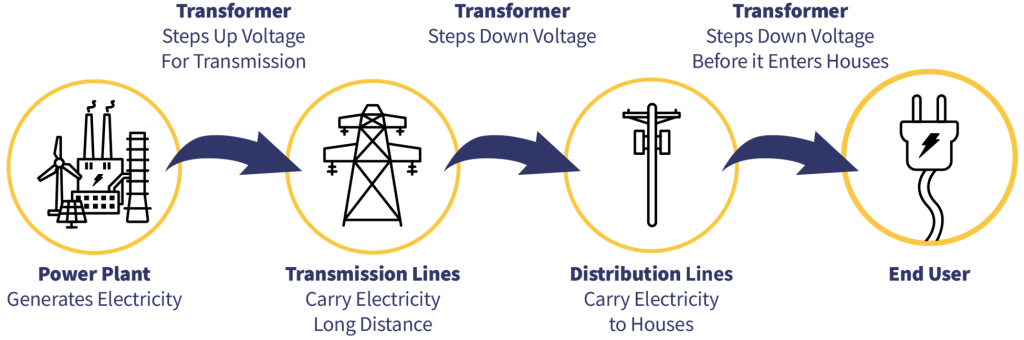
Today, the U.S. electric power grid contains thousands of miles of high-voltage power lines and millions of miles of low-voltage power lines connecting thousands of power plants to hundreds of millions of electricity customers across the country.⁷ As shown in Figure 1, the grid includes groups of transformers and power lines that bring electricity from producers to consumers.
FIGURE 1. Electricity Generation, Transmission, and Distribution
Approximately 70 percent of the grid infrastructure is more than 50 years old,⁹ while increasingly frequent extreme weather events are adding additional stress and wear to the system¹⁰ and causing billions of dollars of damage.¹¹
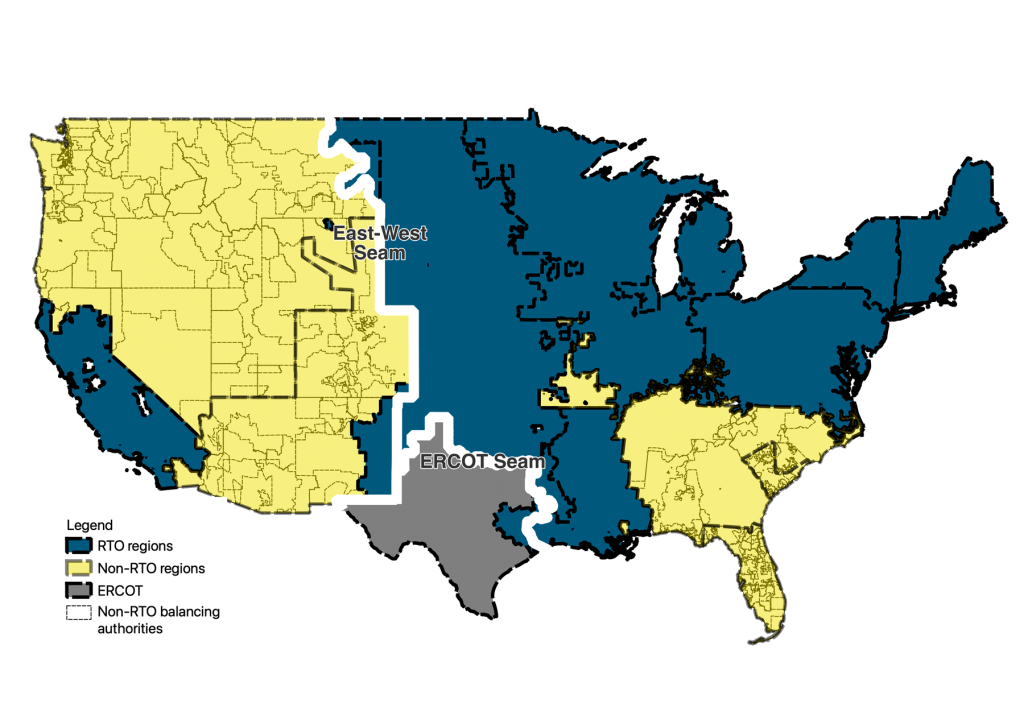
In addition, the country’s grid is not entirely unified; it is broken into three different sections: the Eastern, Western, and the Electric Reliability Council of Texas (ERCOT) interconnections, as shown in Figure 2. Inside these sections are transmission planning regions, all of which, except for ERCOT, are under the jurisdiction of the Federal Energy Regulatory Commission (FERC). Within some of these regions are Regional Transmission Organizations (RTOs) or Independent Service Operators (ISOs) that conduct transmission planning for their respective regions. Regions without RTOs or ISOs tend to have vertically integrated utilities (i.e. a company that owns and controls the entire power supply chain, which includes generation, transmission, and distribution) that tend to handle transmission planning, such as the Southeast region.¹²
FIGURE 2. Major Boundaries Within the U.S. Power Grid System
This fragmented approach can make long-distance transmission planning across the country difficult. In 2022, for example, the Executive Director of Transmission for NextEra Energy, the world’s largest electric utility by market capitalization,¹⁴ described the U.S. grid as “the only macro grid in the world that doesn’t have a plan of any type.”¹⁵
New Challenges
The original design of the American power grid was simple. As shown in Figure 1, power flowed from generation stations via transmission lines to transformer substations, then to distribution lines for the end user, such as a home or business. Though users’ power needs might vary, resources flowed in one direction. This is changing as new technologies and considerations emerge, such as residential solar or data centers built with power-generating facilities. A user that was previously only a consumer may now also be a power provider to the larger grid if they generate excess energy. This has made it more complex for utilities and transmission authorities to oversee the flow of electricity and may require technological upgrades.¹⁶
In addition, electricity consumption in the U.S. is increasing after nearly twenty years of relatively stagnant growth.¹⁷ This growth is placing new strain on the country’s power grid as demand for electricity continues to rise at higher rates than seen in recent years and decades. The increased electrification of certain technologies and sectors, from heat pumps to vehicles, is a significant factor contributing to this increase,¹⁸ along with rising power demands from data centers.¹⁹
Meeting these demand challenges will require increased energy production, which means construction of new facilities, such as natural gas plants and solar farms. However, it will also require improving the grid’s ability to carry this additional electricity from production facilities to end-users. This means investing in new high-voltage transmission lines. Though critical in the short term, building this type of infrastructure can take ten years or more to complete.²⁰

ATTs are not one specific tool, but rather a set of hardware and software
options that can increase transmission lines’ capacity to carry more
electricity, improve reliability, and reduce system congestion.
What Are Advanced Transmission Technologies?
While more high-voltage transmission lines are being built, there is also an option that can address the challenges of increased electricity demand in the short and medium term: Advanced Transmission Technologies (ATTs).
ATTs are not one specific tool, but rather a set of hardware and software options that can increase transmission lines’ capacity to carry more electricity, improve reliability, and reduce system congestion.²¹ They typically require less time to install, ranging from three months to three years.²²
Grid Enhancing Technologies
A subset of ATTs is Grid Enhancing Technologies (GETs). GETs utilize hardware and software to optimize existing grid infrastructure, enabling utilities to safely increase power flow on existing transmission lines, thereby enhancing capacity and reducing bottlenecks without the need for new construction.²³ GETs are often cited as among the fastest and lowest-cost options in suitable locations,²⁴ though implementation can vary based on system conditions and regulatory approval. However, GETs and other ATT options are not mutually exclusive; several options can be installed simultaneously in one area.
A key example of GETs is Dynamic Line Rating (DLR). Currently, most power line capacities are limited, based on scenarios that account for average factors nationwide and not specific to any one region. This is done to ensure that the lines do not overheat, as electricity flowing through a power line heats up due to resistance; too much power means too much heat, which can damage the infrastructure and cause outages. Many current power lines’ ratings factor in wind that blows across the line, which cools the lines and therefore allows them to carry slightly more power without the risk of overheating. However, current line ratings usually only assume winds of two feet per second, whereas many lines may be built in areas with much higher wind speeds. Higher wind speeds mean even cooler lines, which would therefore allow the lines to carry even more power.²⁵
DLR uses sensors and software to measure environmental factors like wind speeds, and allows operators to calculate a line’s actual capacity. This means lines can be better utilized and carry more electricity. According to the Working for Advanced Transmission Technologies (WATT) Coalition, this would increase the capacity of almost all power lines across the country by 10 percent, for the bulk of the time they are in operation. In areas with a favorable climate and geography, this increases to 30 to 50 percent.²⁶
In short, DLR technology could allow providers to use existing infrastructure closer to its actual capacity, rather than relying on older and more conservative limits.
Advanced Conductors
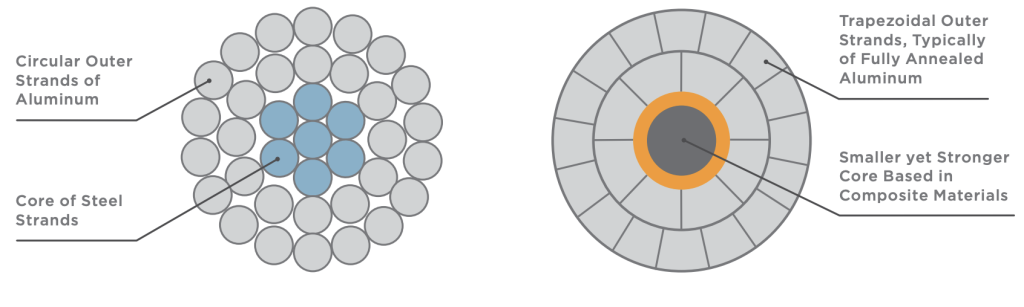
Additional ATT options tend to focus on increasing the grid’s capacity by making physical changes to the infrastructure, without going so far as to build entirely new high-voltage lines. An example of this is advanced conductors. Most power lines in the U.S. transmit electricity along conductive aluminum strands wrapped around a steel core.
Advanced conductors replace these cables with ones that replace steel with a smaller, yet stronger core of composite-based materials or carbon and reconfigure how the aluminum is wrapped around the core. Replacing old power lines, or “reconductoring,” with advanced conductors can significantly increase capacity, in some cases, allowing each line to carry approximately double the amount of electricity.²⁷
FIGURE 3. A Comparison Between Traditional and Advanced Conductors
Other examples of ATTs include building high-voltage conversion stations (known as HVDC conversion) to reduce power losses during transmission and replacing existing towers that hold power lines with more advanced options (known as advanced tower design).²⁹ A comprehensive scope of ATTs, including costs and implementation comparisons, is shown in Figure 4.
FIGURE 4. ATTs Ranked by Speed, Implementation Readiness at Scale, and Cost
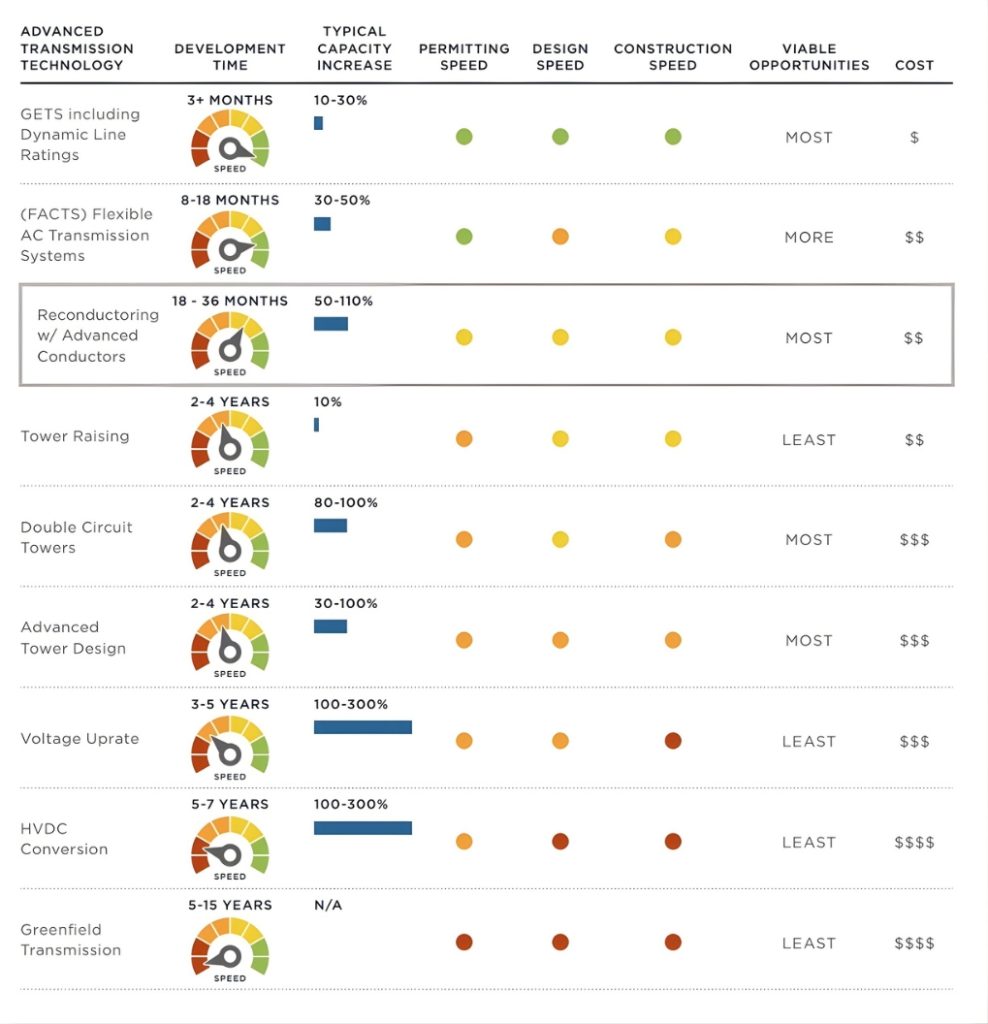
Across the country, hundreds of utilities have successfully deployed ATTs and reported high benefit-cost ratios, ease of implementation, and quick payback periods.³¹ For example, in 2018, American Electric Power (AEP) installed DLR technology in Michigan and Indiana along twenty-five miles of power lines for a cost of $500,000 and the investment was recouped within one month.³²
In Texas, Oncor Electric Delivery Company installed DLR systems on eight lines over three years. The total cost was $7.3 million, resulting in a 6 to 14 percent capacity increase that alleviated 60 percent of congestion issues. Previously, congestion costs had been approximately $174.5 million per year.³³
While AEP and Oncor’s experiences with DLR demonstrate the tangible benefits of ATTs, it is important to note that results and actual gains can vary based on several factors, including potential barriers like up-front costs, permitting, planning and evaluation issues, and lack of coordination among transmission operators.³⁴ These factors have the potential to temper the scale of potential ATT improvements or disincentivize them altogether.
State Legislation
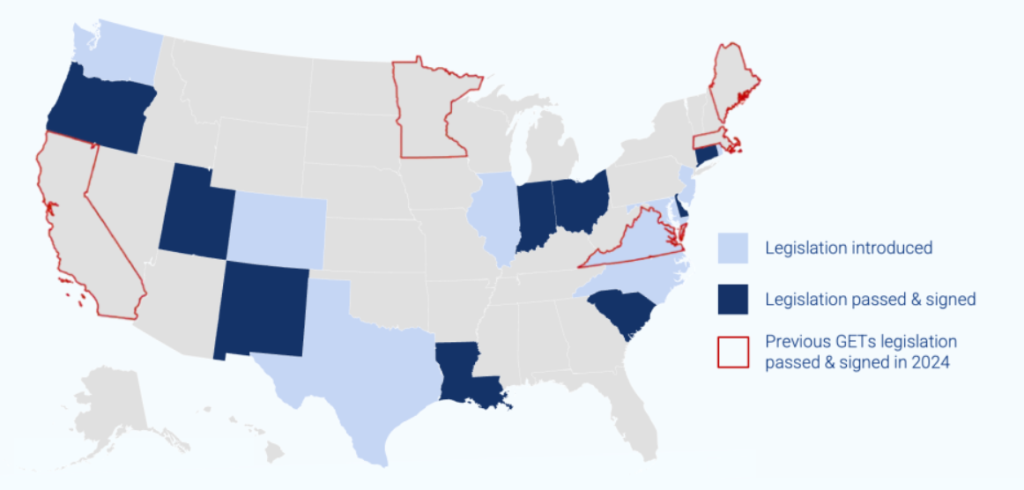
Most ATT projects completed by utilities have been voluntary and limited in scope. However, policymakers across the country are beginning to consider ATT legislation. Since 2023, ten states have adopted ATT legislation, ranging from requirements on utilities to analyze the use of GETs or expansions to the transmission system, to funding studies on the feasibility and benefits of ATTs at the state level. In 2025, seventeen states saw ATT bills introduced.³⁵
In the CSG South region, Louisiana, South Carolina, North Carolina,³⁶ Texas,³⁷ and Virginia³⁸ considered ATT bills, with Louisiana and South Carolina passing legislation in 2025. Louisiana’s legislation appropriated $50,000 in funding to the state’s Department of Conservation and Energy to conduct a study on GETs.³⁹
South Carolina’s legislation requires utilities to include a detailed transmission planning report as part of their integrated resource plan process. The report must detail how the utility evaluated ATTs for addressing interconnection constraints.⁴⁰
In 2024, Virginia passed legislation similar to South Carolina’s 2025 bill. It requires utilities to include comprehensive assessments of grid-enhancing technologies and advanced conductors in their integrated resource plans.⁴¹
Outside of the South, states like Arizona and Colorado have passed legislation to streamline the process of installing ATTs by expediting applications or reducing permitting requirements for replacing conductors.⁴²
FIGURE 5. State Legislation Related to ATTs in 2025
Conclusion
Advanced Transmission Technologies are not the complete solution to meeting growing electricity demand, but rather just one component of responding to the broader challenge. Building a network of high-voltage transmission lines is still necessary to meet the country’s long-term needs, but in the meantime, ATTs may offer short-term solutions to fill the transmission gap. They can alleviate congestion and increase the grid’s capacity to make room for increased power production and do so more quickly and cheaply than building long-term infrastructure. However, the level of their effectiveness may vary depending on system conditions, regulatory structures, and complementary investments.
Although utilities like Oncor in Texas have already begun the process of rolling out ATTs and seen increased capacity and cost savings, the scope of ATTs across the country and in the South is still limited in scope. As such, lawmakers like those in Louisiana, South Carolina, and Virginia have passed legislation for evaluating ATTs throughout the state or requiring utilities to consider them in future planning. As more Southern states wrestle with increasing energy demands and power production needs, policymakers in the region may soon consider a range of approaches, including similar legislation on ATTs.
End Notes
- Jordan Siegwarth, “America’s Energy Demand Is Accelerating – And It’s Changing How We Build,” Construction Connect, July 28, 2025.
- Emily Mercer, “National Transmission Analysis Maps Next Chapter of US Grid Evolution,” National Laboratory of the Rockies, October 3, 2024.
- Yaron Miller, “Advanced Transmission Technologies Can Help States Meet Growing Energy Demand,” The Pew Charitable Trusts, January 15, 2025.
- Joe Hack, “How Advanced Transmission Technologies Can Revamp the Aging US Power Grid,” World Resources Institute, July 10, 2025.
- Tony Furfari and Richard Nichols, “History: The First Electric Power Transmission Line in North America—Oregon City, Oregon,” IEEE Industry Applications Magazine, vol. 9, no. 4, July-Aug. 2003.
- Kyle Mason, “History of the Grid and Major Projects,” Regional Plan Association (RPA).
- “Electricity Explained,” U.S. Energy Information Administration, accessed December 3, 2025.
- “Explainer on the Interconnection Final Rule,” Federal Energy Regulatory Commission (FERC), accessed December 5, 2025.
- Hack, 2025.
- Craig Zamuda et al, “Fifth National Climate Assessment,” U.S. Global Change Research Program, 2023.
- “Economic Benefits of Increasing Electric Grid Resilience to Weather Outages,” President’s Council of Economic Advisers and the U.S. Department of Energy, August 2013.
- Mathias Einberger, “Reality Check: The United States Has the Only Major Power Grid without a Plan,” Rocky Mountain Institute (RMI), January 12, 2023.
- Einberger, 2023.
- Lyle Daly, “The Largest Utilities Companies by Market Cap in December 2025,” The Motley Fool, November 10, 2025.
- “Staff-Led Workshop on Establishing Interregional Transfer Capability Transmission Planning and Cost Allocation Requirements,” FERC, Virtual Workshop, Docket No. AD23-3-000.
- “Advanced Transmission Technologies,” U.S. Department of Energy, December 2020.
- “After More Than a Decade of Little Change, U.S. Electricity Consumption is Rising Again,” U.S. Energy Information Administration, May 13, 2025.
- Jesse Jenkins et al, “Climate Progress and the 117th Congress: The Impacts of the Inflation Reduction Act and Infrastructure Investment and Jobs Act,” Princeton Rapid Energy Policy Evaluation and Analysis Toolkit, July 2023.
- Ian Goldsmith and Zach Byrum, “Powering the US Data Center Boom: Why Forecasting Can Be So Tricky,” World Resources Institute, September 17, 2025.
- Michelle Solomon, “DOE Study Highlights America’s Transmission Needs, But How Do We Accelerate Buildout?,” Utility Drive, March 31, 2023.
- Miller, 2025.
- Louise White et al, “Pathways to Commercial Liftoff: Innovative Grid Deployment,” U.S. Department of Energy, 2024.
- Aaron Larson, “Grid Enhancing Technologies Do Exactly What They Say,” Power, June 2, 2025.
- Emilia Chojkiewicz et al, “Reconductoring with Advanced Conductors Can Accelerate The Rapid Transmission Expansion Required for a Clean Grid,” GridLab, April 2024.
- “Unlock Power Line by Line: Dynamic Line Ratings,” Working for Advanced Transmission Technologies (WATT) Coalition, accessed December 9, 2025.
- WATT Coalition, accessed December 9, 2025.
- Jeff Garvin, “A Game-Changing Transmission Line: Advancements in Conductors Could Create a Higher-Capacity Grid,” Electrical Contractor, March 15, 2025; Bill Kramer, “Advanced Conductoring: What Is It and Why Are States Incentivizing It?,” May 21, 2024.
- Duncan Callaway, “Can Technology Solve Our Transmission Problems?,” The Energy Institute, May 6, 2024.
- Chojkiewicz et al, 2024.
- Chojkiewicz et al, 2024.
- “A Guide to Case Studies of Grid Enhancing Technologies,” Idaho National Laboratory, December 2022.
- Idaho National Laboratory, 2022.
- Idaho National Laboratory, 2022.
- Mike O’Boyle, Casey Baker, and Michelle Solomon, “Supporting Advanced Conductor Deployment: Barriers and Policy Solutions,” Energy Innovation & GridLab, April 9, 2024.
- Hack, 2025.
- An Act promoting the use of advanced conductors and grid enhancing technologies, HB814, 2025 Regular Session of the North Carolina General Assembly, North Carolina, 2025.
- An Act relating to the use of grid enhancing technologies and high-performance conductors in the ERCOT power region, HB5200, 2025 Regular Session of the Texas Legislature, Texas, 2026.
- An Act to amend and reenact §§ 56-580, 56-597, 56-598, and 56-599 of the Code of Virginia, relating to electric utilities; integrated resource plans, HB2413, 2025 Regular Session of the Virginia General Assembly, Virginia, 2025; An Act to amend and reenact §§ 56-580, 56-597, 56-598, and 56-599 of the Code of Virginia, relating to electric utilities; integrated resource plans, SB1021, 2025 Regular Session of the Virginia General Assembly, Virginia, 2025.
- “An Act to appropriate funds and to make certain reductions from certain sources to be allocated to designated agencies and purposes in specific amounts for the making of supplemental appropriations and reductions for said agencies and purposes for Fiscal Year 2024-2025,” HB 460, 2025 Regular Session of the Louisiana State Legislature, Louisiana, 2025.
- An Act to Amend The South Carolina Code of Laws by Enacting The “South Carolina Energy Security Act,” HB 3309, 2025 Regular Session of the South Carolina Legislature, 2025, South Carolina; WATT Coalition, 2025.
- An Act to amend and reenact §56-597 and 56-599 of the Code of Virginia, relating to electric utilities; integrated resource plans; grid-enhancing technologies and advanced conductors, HB 682, 2024 Regular Session of the General Assembly, Virginia, 2024.
- Miller, 2025; An Act Amending Section 40-360.03, Arizona Revised Statutes; Relating to Public Utilities, HB 2003, Second Session of the Fifty-sixth Arizona Legislature, Arizona, 2024; An Act Concerning Measures to Promote Reductions in Greenhouse Gas Emissions in Colorado, and, in Connection Therewith, Making An Appropriation, SB 23-016, 2023 Regular Session of the Colorado General Assembly, Colorado, 2023.
- “State Legislative Momentum Builds for Grid Enhancing Technologies in 2025,” WATT Coalition, April 29, 2025.