
 DOWNLOAD
A CSG South First Look
Congress is currently working to reauthorize the Farm Bill, the omnibus federal law governing agricultural and food policy in the U.S. The 2018 Farm Bill, which expired in 2023, has been extended three times, most recently through September 30, 2026, as part of a November 2025 continuing resolution. Southern states account for a significant share of U.S. crop production, timber, and enrollment in the Supplemental Nutrition Assistance Program (SNAP), meaning that the reauthorization carries financial and administrative implications across multiple program areas.
The Farm Bill is organized into twelve titles, each covering a distinct program area, including commodities, conservation, nutrition, forestry, rural development, research, crop insurance, and trade. Many programs it authorizes are federally funded but state-administered, so changes to federal policy resulting from the Farm Bill often require state agencies and, in some cases, state legislatures to act.
Where Things Stand: Timing and Process
The House of Representatives passed its version of the 2026 Farm Bill, the Farm, Food, and National Security Act of 2026 (H.R. 7567), on April 30, 2026, with a 224-200 vote. The bill would reauthorize and amend programs across all twelve titles through fiscal year 2031.
The legislation now moves to the Senate, where the Agriculture Committee chair has indicated he wants to begin a markup (the formal committee process for amending and advancing legislation) in late May or early June. A scheduled Senate recess beginning in late May will constrain the available calendar. Unlike the House, where a simple majority was sufficient, Senate floor passage requires 60 votes, meaning support from members of both parties is needed. Senate Agriculture Committee leaders have signaled the Senate will likely develop its own version of the legislation rather than taking up the House bill directly, meaning the two chambers would need to negotiate differences through a conference process before a final bill could go to the president.
The current Farm Bill extension expires September 30, 2026. If Congress cannot complete reauthorization by then, lawmakers would face a choice between another short-term extension and the lapse of several program authorizations. The Congressional Budget Office has assumed enactment around the start of August 2026, though that timeline depends on Senate and conference progress.
Nutrition Programs (SNAP)
SNAP, the Supplemental Nutrition Assistance Program, is the Farm Bill’s largest spending title and provides monthly food assistance to eligible low-income households through an electronic benefit card. It is the subject of the most active debate in the current reauthorization.
The federal policy environment for SNAP changed substantially even before the current Farm Bill debate began. H.R. 1, the One Big Beautiful Bill Act (OBBBA), signed into law in July 2025, shifted a portion of SNAP costs from the federal government to states. Previously, the federal government paid all SNAP benefit costs and split administrative costs evenly with states. Under the OBBBA, beginning in FY 2027, states will pay 75 percent of administrative costs, up from 50 percent, and beginning in FY 2028, will also be responsible for a share of benefit costs of up to 15 percent depending on their payment error rate. Southern states could experience significant fiscal impacts. For example, Alabama’s Department of Human Resources has estimated the OBBBA changes will increase state SNAP costs by $35 million in FY 2027 and up to $173 million in FY 2028.
H.R. 7567 (the House version of the 2026 Farm Bill) does not restore the SNAP funding reductions made through the OBBBA. Instead, it embeds the new baseline reflecting those reductions into standing law through 2031. The bill also makes administrative adjustments, including allowing state agencies to contract out SNAP eligibility certification functions and updating standards for retailer participation in the program.
A separate debate concerns whether SNAP benefits should cover certain food and beverage categories. By default, SNAP recipients can use their benefits to purchase nearly any food item. A federal waiver gives a state permission to restrict purchases beyond the standard exclusions of alcohol, tobacco, and hot prepared foods. As of early 2026, 22 states had approved federal waivers allowing them to restrict SNAP benefits from covering items such as sodas and candy (meaning recipients’ EBT cards are declined at checkout for those items in those states). Several southern states are among those with such waivers, including Arkansas, Florida, Louisiana, Missouri, Oklahoma, South Carolina, Tennessee, Texas, Virginia, and West Virginia. Supporters of expanding restrictions nationally argue that food assistance dollars should go toward nutritious options. Opponents argue that such restrictions would add significant administrative and compliance burdens on retailers, particularly small grocery stores and rural markets where SNAP customers represent a large share of business, and that state pilot programs should be evaluated before any national policy change. While H.R. 7567 as passed by the House does not include a national purchase restriction, the measure would affirm that it is Congress’ policy that SNAP should be administered “in a manner that will provide participants, especially children, access to a variety of foods essential to optimal health and well-being.” The national purchase restriction question is expected to surface during Senate deliberations.
SNAP funding continues to be a focal point in bipartisan discussions in the Senate. Members of the Agriculture Committee on both sides have indicated the SNAP funding level is a priority. Because Senate passage requires 60 votes, the final bill will need to attract support from members of both parties, and how the two chambers ultimately resolve the SNAP question will shape both the final cost of the legislation and the administrative and budgetary demands placed on state agencies.
For state policymakers, SNAP-related budget planning is already underway. Regardless of the Farm Bill’s final provisions, the OBBBA cost-sharing changes scheduled to take effect in 2027 are expected to have planning and implementation implications for state human services agencies. Legislative action to appropriate funds for the state share of SNAP benefit costs may be required in some states before those obligations arrive.
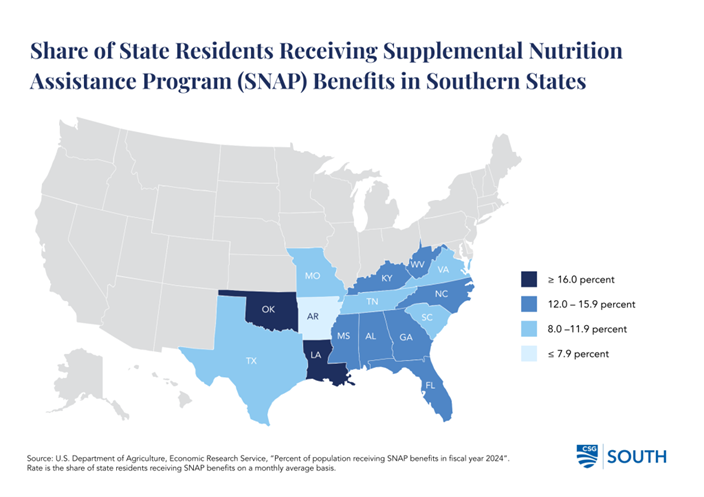
The map below shows SNAP participation rates by state across the Southern region, based on fiscal year 2024 data from the USDA Economic Research Service. Several Southern states have participation rates above the national average of 12.3 percent.
Other Provisions Impacting Southern States
Commodity Programs and Crop Insurance
H.R. 7567 affects the two primary federal farm income support programs. These include Agriculture Risk Coverage (ARC), which pays farmers when crop revenues fall below historical benchmarks, and Price Loss Coverage (PLC), which makes payments when market prices fall below reference prices. Southern producers of cotton, peanuts, rice, and soybeans are among those most reliant on these programs.
Conservation, Land Use, and Forestry
H.R. 7567 reauthorizes three major conservation programs through 2031. The Conservation Reserve Program (CRP) pays landowners to take environmentally sensitive land out of production and is reauthorized at its current 27-million-acre cap. The Environmental Quality Incentives Program (EQIP) and the Conservation Stewardship Program (CSP) help producers implement conservation practices on working land. Both are also reauthorized. The bill reduces EQIP budget authority by approximately $1 billion over ten years, redistributing those funds to other conservation programs, so the title is budget neutral overall. The bill also creates a new Forest Conservation Easement Program.
Pesticide Liability Shield
The House passed H.R. 7567 after lawmakers removed provisions opposed by Make America Healthy Again (MAHA) advocates that would have limited certain consumer lawsuits against pesticide manufacturers. However, a number of lawmakers in southern states are proposing and passing state legislation that includes these pesticide liability shields. Such language was enacted in Georgia in 2025, and recently became law in Kentucky. Similar legislation was considered this session in Florida, Missouri, Oklahoma, and Tennessee.
Rural Development
H.R. 7567 reauthorizes and amends USDA rural development programs through 2031, including funding for broadband expansion, water and wastewater infrastructure, rural health care, and business development. The bill also creates a new initiative to support rural childcare and expands access to telemedicine, with a focus on mental health and maternal care.
What Happens Next
The Senate Agriculture Committee markup, expected in late May or early June, will be the next major milestone in the Farm Bill process. Once the Senate passes its own version, a joint conference committee will negotiate a final package, which must then pass both chambers before going to the president. The September 30 expiration of the current extension creates a firm deadline for that process.