
Issue Brief by Policy Analyst, Judah Lebofsky
DOWNLOADIntroduction
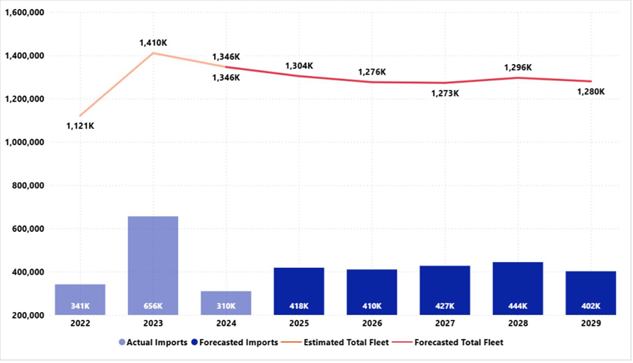
Unmanned Aircraft Systems (UAS) include an unmanned aircraft and associated communication and control systems that enable a pilot to operate the aircraft remotely.1 Once considered science fiction, UAS are increasingly transitioning from experimental to operational use across multiple sectors. The UAS industry is rapidly expanding, with Federal Aviation Administration (FAA) forecasts estimating 400,000 UAS imports to the United States annually from 2025 to 2029 to maintain the existing fleet (see Figure 1).2 UAS technology is increasingly being integrated into industry sectors across the Southern states.3,4
FIGURE 1. mUAS Fleet Estimates and Forecast
SOURCE: Federal Aviation Administration.5
As technology has developed, unmanned aircraft systems are being used in various industries across the South to complement human-driven work. Commercially, UAS aid in delivering products to consumers efficiently, inspecting goods to ensure quality, and assisting workers with construction projects.6 State governments are using UAS technology to continuously monitor transportation infrastructure, such as bridges, to ensure compliance with maintenance and safety standards.7 Additionally, public safety agencies are using unmanned aircraft systems to aid law enforcement officers in their duties and to support disaster response teams.8
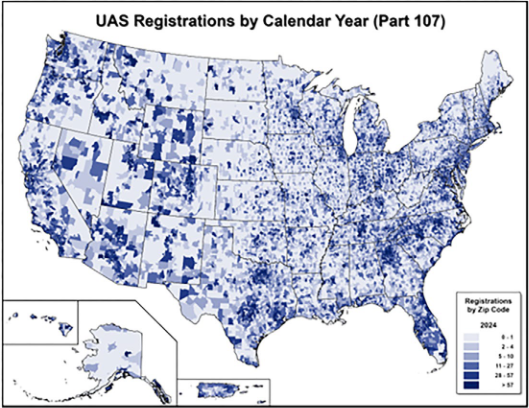
As UAS adoption in the South continues and the number of registered commercial units increases (see Figure 2), Southern states are increasingly involved in regulating the industry.9 Proposed legislation has focused on public safety uses, privacy concerns, and critical infrastructure protection related to UAS technology (see Appendix I).10
FIGURE 2. UAS Registration by Calendar Year (Commercial)
SOURCE: Federal Aviation Administration.11
It is critical to note that, while UAS technology is part of a broader ecosystem of emerging aviation entrants, UAS constitute a distinct industry that requires specific legislative focus.12 The other commonly confused branch of the ecosystem is Advanced Air Mobility (AAM). While UAS technology is strictly unmanned, AAM includes aircraft to transport passengers.13 While these two industries share the same airspace, they include unique policy treatment and require separate considerations.
For Southern states, the expansion of unmanned aircraft systems intersects with several core areas of state responsibility.
States are considering how UAS may support economic development efforts, including manufacturing, research partnerships, and testing initiatives, as well as how these systems can be integrated into existing infrastructure and transportation networks.14 Additionally, Southern policymakers are focusing on how UAS can aid first responders’ emergency response efforts, support disaster recovery across the region, and support law enforcement practices.15 Legislation across Southern states in the last five years reflects these industries, with states addressing UAS incorporation in a variety of ways (see Appendix I).16
Defining Unmanned Aircraft Systems (UAS)
Glossary
Unmanned Aircraft System (UAS)
- An unmanned aircraft and associated elements (including communication links and the components that control the unmanned aircraft) that are required for the pilot in command to operate safely and efficiently in the national airspace system.17
Unmanned Aerial Vehicle (UAV)
- An aircraft operated without the possibility of direct human intervention from within or on the aircraft.18
- Also known as drones.19
Ground Control Station (GCS)
- An on-land system that provides for the human operator with the capability of observation, control, and monitoring of the during their flight 20
Command Control System
- An interface used by the remote pilot to control the flight path of the small unmanned aircraft.21
Large UAS
- An unmanned aircraft weighing 55 pounds or more, including everything that is on board or otherwise attached to the aircraft.22
Small UAS (sUAS)
- An unmanned aircraft weighing less than 55 pounds on takeoff, including everything that is on board or otherwise attached to the aircraft. 23
Micro UAS (mUAS)
- An unmanned aircraft weighing less than 0.55 lbs., including everything that is on board or otherwise attached to the aircraft.24
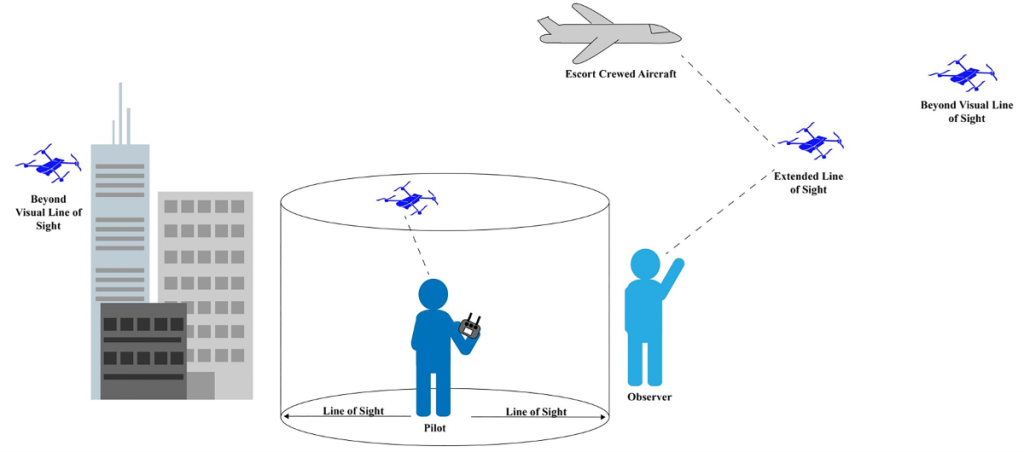
Visual Line of Sight (VLOS)
- The remote pilot in command, the visual observer (if one is used), and the person manipulating the flight control of the small, unmanned aircraft system must be able to see the unmanned aircraft throughout the entire flight with vision that is unaided by any device other than corrective lenses.25
Beyond Visual Line of Sight (BVLOS)
- A broad range of existing and potential UAS operations whose only common factor is the UAV being out of the direct visual line of sight of the remote pilot.26
System and Operations
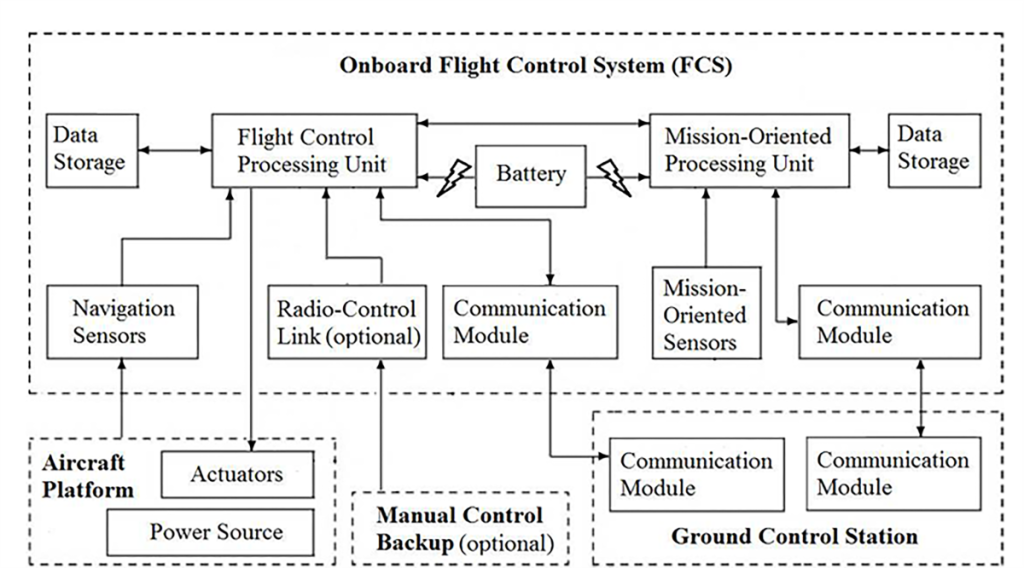
A UAS consists of an aircraft platform, onboard sensors, communication links, and a ground control station (see Figure 3).27 The aircraft platform serves as the center of the UAS, carrying the equipment necessary for the flight and mission.28 Additionally, pilots operate unmanned aerial vehicles (UAVs) remotely from the ground control station, monitoring flight conditions and direction.29 The communication modules connect the ground control station to the UAV, allowing the pilot to transmit commands to the aircraft’s onboard control systems.30 Although not depicted in the diagram, many unmanned aircraft systems include additional technologies, such as sensors or cameras, that enable them to collect information during flight and transmit it back to the control station.31 These system components are relevant for policymakers when considering regulatory definitions, procurement standards, and operational requirements for state agencies using UAS.
FIGURE 3. Block Diagram of a Typical UAS
SOURCE: Cai et al., Survey of Small-Scale Unmanned Aerial Vehicles.32
Types of UAS
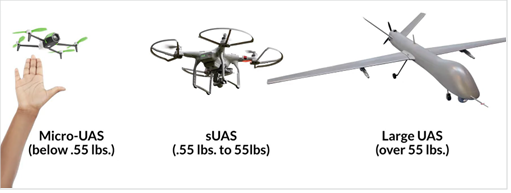
The FAA also categorizes unmanned aircraft systems based on size, capabilities, and intended use (see Figure 4).33 Micro UAS (mUAS) are lightweight systems often used for short-range applications such as training, indoor operations, or localized data collection.34 Small UAS (sUAS) are the most commontype. These UAS are widely used for commercial and industrial purposes (Part 107), such as inspections and mapping.35
Large UAS may be used for commercial applications or by government agencies, particularly when
extended flight range or cargo capacity is required.36 Public sector use includes applications in law
enforcement, emergency response, and infrastructure monitoring, where operational requirements may
vary depending on mission needs.37 These classifications may influence how state policies differentiate
between recreational, commercial, and government uses, particularly in areas such as registration,
procurement, and operational restrictions.
FIGURE 4. Types of UAS
SOURCE: University of Arkansas.38
Capabilities and Limitations
While UAS capabilities continue to expand, technical and environmental limitations still shape their operational ability. When state industries use UAS, the type dictates the aircraft’s range, payload, and endurance.39 UAS operations are also sensitive to weather conditions, including wind and precipitation, which can affect performance and safety.40 Furthermore, regulatory requirements, such as line-of-sight requirements and federal authority over airspace above Southern states, require coordination across levels of government to reduce limitations on states’ use of UAS for commercial and industrial purposes.41
Federal Framework and Regulatory Environment
Role of the Federal Aviation Administration (FAA)
The Federal Aviation Administration (FAA) is the federal regulatory body overseeing civil aviation in the United States, including unmanned aircraft systems.42 The FAA controls the National Airspace System and is responsible for maintaining and operating air traffic control and aircraft navigation systems, and for setting aviation safety standards.43 In addition to managing airspace, the FAA establishes certification requirements for operators and aircraft.44 These authorities form the foundation of the federal regulatory framework governing UAS, including rules on commercial operations, remote identification, and emerging operational capabilities. For state policymakers, this federal framework defines the boundaries within which state policy can operate, particularly in areas such as land use, privacy, and law enforcement, while limiting direct authority over airspace and flight operations.
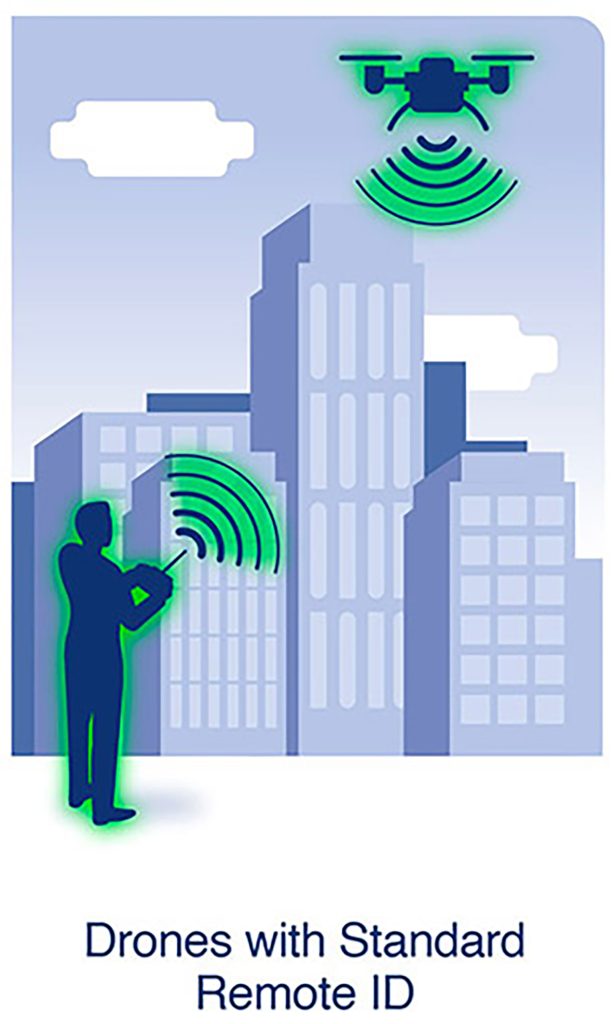
Figure 5. Drones with Standard Remote ID
Source: Author’s visualization sourced from the Federal Aviation Administration.45
Key Federal Policies
Several key federal regulations serve to govern the UAS industry:
Part 107 – Small Unmanned Aircraft Systems46
- The certification of remote, commercial UAS pilots.
- Covers UAVs less than 55 lbs.
- Operations for Which the FAA May Issue a Waiver:
- Operation from a moving vehicle or aircraft.
- Anti-collision lighting requirements for night and civil twilight operations.
- Visual line of sight aircraft operation.
- Visual observer requirements.
- Operation of multiple small unmanned aircraft systems.
- Yielding the right-of-way.
- Operation over people.
- Operation in certain airspace.
- Operating limitations for small unmanned aircraft.
- Operations over moving vehicles.
- Does not apply to recreational UAS operation47
Part 89 – Remote Identification (Remote ID) of Unmanned Aircraft
- Remote ID is the ability of a drone to provide identification and location information while
in flight (see Figure 5).48 - As of 2024, drones that are required to register (recreation, commercial, government) must comply.49
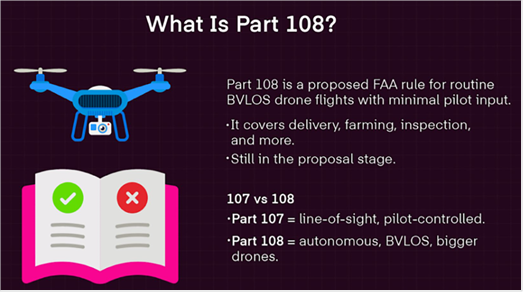
Part 108 – UAS Beyond Visual Line-of-Sight (BVLOS) Operations **(Proposed, as of April 2026)50
- A proposed FAA rule intended to establish a framework for routine beyond visual line-of-sight (BVLOS) operations under specified operating requirements.51
- Covers delivery, farming, and inspections (see Figure 6).52
FIGURE 6. Part 108–UAS Beyond Visual Line-of-Sight (BVLOS) Operations
SOURCE: Author’s visualization sourced from The Pilot Institute.53
State-Federal Interaction
The regulatory framework governing UAS reflects a balance between federal authority over aviation and state authority in related policy areas. The FAA has exclusive authority over aviation safety and airspace efficiency.54 The FAA’s governance extends to all aircraft, including UAS, and covers flight operations, aircraft altitude, and navigation and safety mechanisms.55 States retain the authority to regulate matters within traditional state responsibilities, such as land use, privacy, law enforcement practices, and the protection of critical infrastructure.56 These laws often address how UAS are used rather than where they operate in the airspace. State or local laws that attempt to regulate flight operations or airspace are preempted under federal law.57
In practice, the distinction between federal and state authority can involve areas of overlap and ambiguity. Some state laws are not directly about airspace but still affect UAS operations, such as privacy regulations, infrastructure protections, and requirements for specific facilities.58 Unless these laws impair the use of airspace, they may be valid.59 Broad restrictions that effectively prohibit UAS operations over large areas are more likely to be preempted by federal law.60 Targeted measures, such as restrictions near sensitive facilities, are more likely to be permissible.61 As a result, coordination among federal, state, and local entities is essential to the implementation and enforcement of UAS policies. While the FAA is responsible for enforcing federal aviation regulations, state and local agencies often contribute to public safety efforts.62 They may assist in identifying and responding to unauthorized or unsafe UAS operations.63 These interactions highlight the importance of understanding both the scope of federal authority and the areas where states may develop complementary policies.
Applications and Use Cases
Multiple industries are utilizing UAS technology across a range of sectors, including public safety, infrastructure, agriculture, and commercial industries, rather than being confined to a single application area.64 Their use has expanded in recent years due to advancements in sensor technology, automation, and data processing, thereby enhancing their functionality and accessibility.65 At the same time, UAS operations continue to be shaped by federal aviation regulations, particularly those governing visual line-of-sight and airspace access.66 As a result, state policymakers are increasingly evaluating how UAS can be integrated into agency operations, infrastructure systems, and public safety activities within existing regulatory frameworks. The use of UAS in public safety operations has also generated discussions regarding privacy, civil liberties, and data governance, which many states address through statute or agency policy.
Public Safety and Emergency Response
The use of UAS technology to enhance public safety and emergency response services is among the most established industry applications. Law enforcement agencies, fire departments, and emergency management services have all adopted UAS technology to enable rapid deployment and ensure real-time awareness of issues they address (see Table 1).67 UAS can support active aerial surveillance and monitoring of service areas, thermal imaging, and heat detection to identify persons of interest on the ground, providing first responders with access to hazardous materials or dangerous environments they otherwise couldn’t reach.68 At the same time, the use of aerial surveillance technologies may raise questions regarding privacy, data collection, and the appropriate scope of government use. Legislative activity across Southern states reflects ongoing consideration of these issues, including policies related to privacy protections, law enforcement use, and data governance (see Appendix I)
Public safety operations utilize UAS across a range of situations, with applications typically organized by incident type and operational need. During search and rescue missions, UAS are used to locate missing persons and provide aerial coverage of large or difficult terrain, allowing responders to survey areas more quickly than ground-based teams.69 During fire response, drones support both wildfire and structural incidents by monitoring fire progression, identifying hotspots through thermal imaging, and providing real-time situational awareness to incident command.70 During disaster response, UAS are deployed to assess damage following storms, monitor flooding conditions, and support rapid evaluation of impacted infrastructure and communities.71
TABLE 1. sUAS Public Safety Mission Support and Activities
| EVENT | LOCATION |
| Structural Fire | Overwatch Identification of heat signature |
| Wildfire | Overwatch Fuel Load Assessments Incendiary drops for backfire operations |
| Search & Rescue | Access to Dangerous Terrain or inaccessible areas Coverage of larger search areas Thermal imaging to locate lost persons Delivery of flotation devices or ropes for water rescue |
| HazMat Response | Overwatch Identification of substances and materials Identification of direction of spill Detection/viewing of invisible of invisible plumes, gas clouds or flames Determination of content levels in containers |
| Suspicious Package Investigation | Monitoring suspicious packages in support of bomb squad activities and under direction of the bomb squad |
| Emergency Management | Pre-incident facility planning and #D modeling Post-incident damage survey |
| EMS | Delivery of medical supplies (eg., blood and blood products in response to trauma, rescue medications |
| Forensics | Fire cause and crime investigation with 3D modeling |
| Training | Capture of training activities for subsequent review and lessons learned |
| Traffic | Traffic flow analysis Accident reconstruction |
| Situational Awareness, Intelligence Gathering, and Surveillance For Law Enforcement | Crowd control Pre-tactical reconnaissance Hostage situations and barricades Border protection Crime scene reconstruction |
| Drone as a First Responder | Assess scenes before responders arrive |
During hazardous materials incidents, drones can assist with plume detection, remote inspection of affected sites, and identification of potentially dangerous substances, reducing the need for personnel to enter unsafe environments.72 These functions support a wide range of emergency response activities, as illustrated in Figure 7.
Some operational benefits of UAS integration into public safety services include faster incident response times, reduced risk to personnel responding to calls for service, expanded monitoring coverage of the geographic area an agency is responsible for, and improved administrative decision-making based on real-time data collection.74 These operational benefits are accompanied by a range of considerations that may be addressed through state policy frameworks.75 State policymakers may evaluate how to support coordination among public safety agencies, particularly during multi-jurisdictional incidents where shared UAS resources and communication protocols can affect response effectiveness.76 State policymakers may also consider approaches to training and certification, such as establishing minimum standards or supporting statewide training programs, to ensure consistent and compliant use of UAS.77 The use of UAS in public safety operations may also raise questions related to data governance, including privacy protections, data retention policies, and the admissibility of aerial footage in legal proceedings, which are often addressed through state statute or administrative guidance.78 Beyond public safety, UAS technology is also being applied to infrastructure and transportation systems.
Infrastructure and Transportation
State transportation and infrastructure agencies are increasing their use of UAS technology, focusing on key responsibilities such as inspection procedures, infrastructure maintenance, and traffic monitoring. Traditionally, state agencies would have to conduct manual inspections of transportation and other infrastructure units.79 For transportation, this may result in lane closures that increase congestion and delay traffic.80 Furthermore, the inspection site may include a confined space that is difficult for the inspectors to access, further delaying the project.81 Now, state agencies are utilizing UAS to mitigate these issues. Inspectors are remotely inspecting site areas, eliminating the need for closures that create transportation delays.82 Additionally, UAS can access small spaces that humans cannot, allowing for more efficient data collection and project completion.
Several key use cases highlight the benefits of state agencies using UAS for infrastructure monitoring. Some examples include bridges and tunnels, roadways and traffic systems, rail infrastructure, ports and intermodal systems, and construction monitoring.83 A case study involving bridge inspection demonstrates how UAS can alter traditional inspection approaches (see Table 2).84 As seen in the example, UAS allow the inspection team to achieve significant time savings, reduce the number of inspection personnel required for the project, mprove the team’s access to difficult-to-reach areas, and limit monetary losses.
TABLE 2. Example UAS Infrastructure Inspection and Confined Space Inspection Use Case
| UAS USE CASE | USE CASE TYPE | BASELINE/NON-UAS WORK TASKS | UAS OPERATION OUTPUTS | UAS OPERATION BENEFITS |
| A38 Mardle Viaduct (U.K) | Confined Space Inspection | *A four-person confined spaces inspection team with associated breathing apparatus, winch, and access and monitoring equipment entering a steel box structure in the interior of a major A-road structure | *Video and imaagery for input into NH’s Structures Management System *Livestream footage to onsite NH engineer | *Reduces time from two days to one day (UAS can scan a segment of the bridge deck interior between adjacent access hatches in 10 minutes) *Gained access to the viaduct’s interior, which has remained uninspected for long periods due to the safety of entering *Removed the need for human workers to enter the structure; only need one remote pilot, one visual observer, and one engineer on-site |
| *Minimal monetary loss of less than £1,000 if UAS is lost within the bridge deck interior |
The integration of UAS into infrastructure and transportation systems presents several considerations for state policymakers, particularly as state departments of transportation and related agencies incorporate these technologies into existing operations. State policymakers may evaluate how UAS-collected data can be integrated into asset management systems to support inspection schedules, maintenance planning, and long-term infrastructure investment decisions.86 Procurement and vendor selection processes may also be addressed through state policy, including the establishment of standards for equipment, cybersecurity requirements, and eligibility criteria for approved technologies.87 Furthermore, the collection and storage of large volumes of aerial data may raise concerns about data management, interoperability across agencies, and compatibility with existing information systems.88 Beyond infrastructure systems, UAS are also being adopted across agricultural and natural resource management activities.
Agriculture
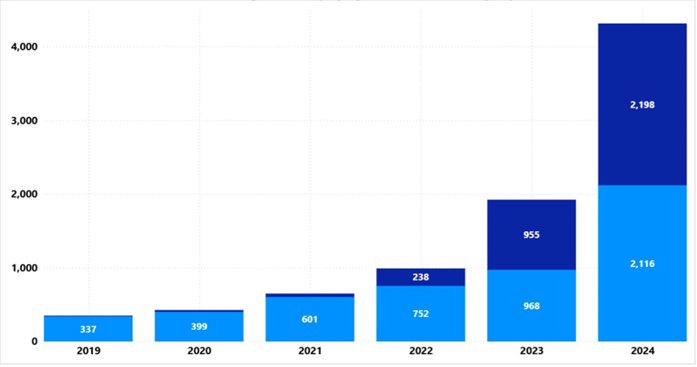
One of the fast-growing application areas of UAS technology is the agriculture industry. The use of UAS for agricultural purposes is particularly relevant to Southern states, where farming is a primary economic industry (see Figure 7).89 Some of the functional capacities of UAS for agriculture include multispectral imaging to remotely detect crop stress, nutrient deficiencies, and water issues before they cause significant damage to crops.90 Furthermore, the precision application of pesticides and seed planting allows workers to manage a larger expanse of farmland more efficiently, which may contribute to more uniform crop management and potentially improved yields .91
FIGURE 7. Growth of Agricultural Spraying Drones in Aircraft Registry
SOURCE: Federal Aviation Administration.92
Several use cases emphasize the benefits of using UAS for agricultural production and maintenance. For example, the use of UAS can aid in analyzing crop health, managing forestry around farmland, monitoring water resources for crops, and continually assessing soil conditions to identify changes in composition.93 The results of incorporating UAS into agricultural practices increase efficiency by reducing the physical labor required of farmers.94 Farming practices may become less labor-intensive, reducing overall labor requirements, even as the ability to produce a large area of crops increases.95 Farmers may be able to identify and respond to crop conditions more quickly.96
The use of UAS in agricultural development also raises several considerations for state policymakers, particularly as adoption expands across both the private and public sectors. State policymakers may evaluate how federal aviation regulations interact with state-level oversight of agricultural practices.97 Coordination with state departments of agriculture may also be a factor in developing guidance, permitting processes, or pilot programs related to UAS use.98 Furthermore, environmental compliance considerations, such as pesticide application, water-use monitoring, and land management practices, may influence how UAS operations are incorporated into existing regulatory frameworks.99,100 Workforce development and training may also be addressed through state policy, including licensing requirements, certification programs, or partnerships with educational institutions to support operator readiness.101 In addition to public-sector and agricultural uses, UAS are increasingly being deployed in commercial and industrial contexts.
Commercial and Industrial Uses
The commercial and industrial sectors are broad, cross-industry sectors driven largely by private-sector adoption of UAS. Some of the key UAS applications in these sectors include energy transmission and pipeline inspection, construction and real estate development, insurance inspections, warehousing and logistics, and media imaging.102 The use of UAS technology allows for sophisticated data collection and monitoring of ongoing operations. Regulations, such as light-of-sight requirements, influence many operational capabilities of UAS commercial applications (see Glossary).103 Line-of-sight requirements mandate that the operator of a UAV maintain the aircraft in their field of vision, which can limit long-distance connectivity for commerce.104 Although legislation is currently progressing to approve beyond-visual-line-of-sight (BVLOS) registration, existing regulations impose significant limitations on the commercial and industrial sectors’ use of UAS (see Figure 8).105 These applications may inform how state policymakers approach economic development strategies, workforce planning, and regulatory considerations for private-sector UAS use.
FIGURE 8. Types of Line of Sight
SOURCE: National Oceanic and Atmospheric Administration.106
The expansion of UAS in commercial and industrial applications also presents several considerations for state policymakers as these technologies become more integrated into private sector operations. State policymakers may evaluate opportunities to support industry development through targeted initiatives, such as pilot programs, research partnerships, or economic development strategies to attract UAS-related businesses.107
Workforce development may also be a consideration, including the establishment of training programs, certification pathways, and partnerships with higher education or technical institutions to support a skilled labor pipeline.108 As technology and regulatory frameworks evolve, new and more integrated use cases are beginning to emerge.
Emerging Use Cases
Emerging use cases focus on early-stage or pilot-phase UAS applications currently undergoing testing or regulatory review. Many of these applications depend on regulatory flexibility, as illustrated by BVLOS regulations.109 Several trends characterize emerging UAS use cases, emphasizing automation, networked drone systems, and integration with sophisticated ground infrastructure.110 These emerging applications may influence future policy discussions as states evaluate how to accommodate new operational models within existing regulatory frameworks.
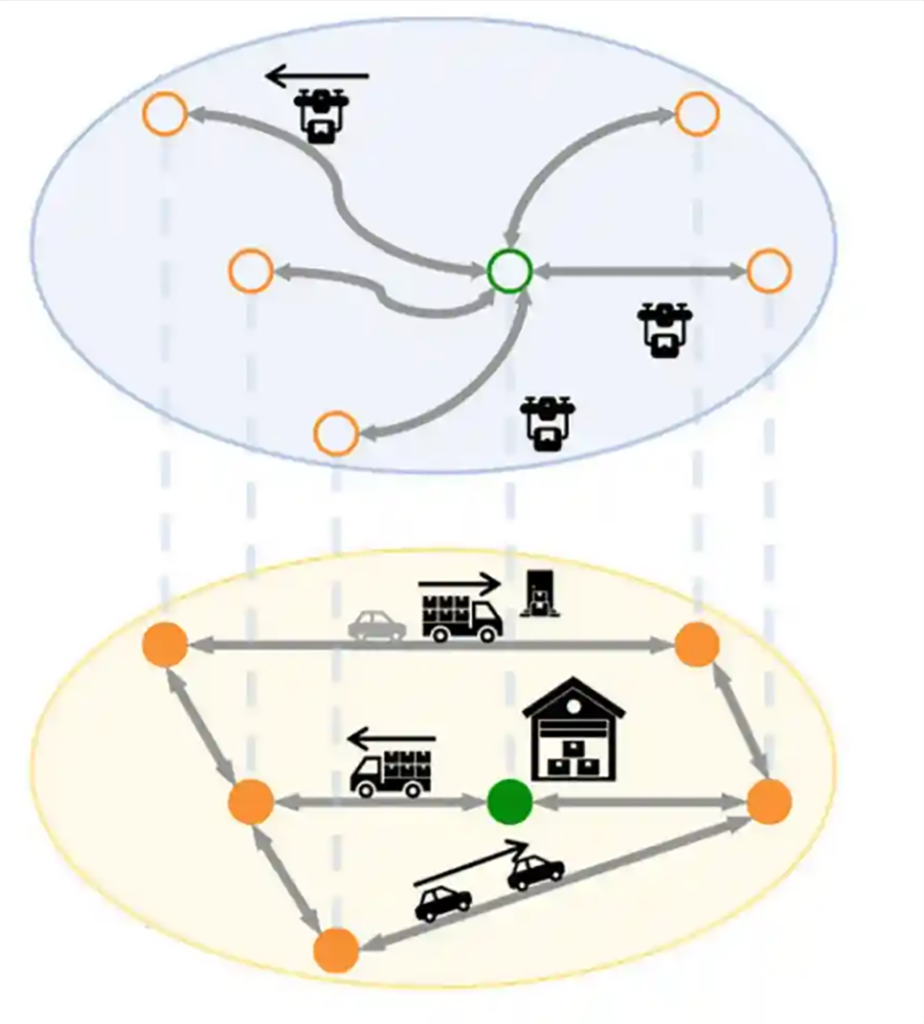
Several emerging UAS applications have been identified by researchers as potential future use cases. Utilizing UAS technology to assist with delivery logistics, specifically the high cost and inefficiency of current practices transporting goods from a distribution hub to the final destination (see Figure 9).111 Furthermore, the use of drones in first-responder programs to quickly respond to calls for service and provide preliminary care before emergency medical services arrive highlights emerging use cases for UAS technology across disciplines.112
Figure 9. The Last Mile Delivery Problem in Retail
Source: TerraDrone Arabia.113
The development of emerging UAS use cases presents a range of considerations for state policymakers as technologies continue to evolve. State policymakers may evaluate the role of regulatory waivers and pilot programs in enabling the testing of advanced applications, particularly those involving beyond-visual-line-of-sight operations or coordinated drone networks. Infrastructure investment may also be a factor, including support for physical assets such as drone ports, charging stations, or integrated systems that allow for continuous or automated operations.115 Furthermore, public acceptance and privacy considerations may influence how these technologies are deployed, particularly in communities where expanded UAS activity may raise concerns about surveillance or data collection.116 As these factors are addressed, emerging UAS applications may continue to develop, shaping how states integrate these technologies into broader policy and operational frameworks.
State Case Examples
UAS adoption varies across Southern states in structure and focus. States are pursuing different strategies based on policy priorities, economic goals, and existing assets.117 Case studies illustrate the integration of UAS into public-sector operations and economic development strategies. Some Southern states actively incorporating UAS technology into industry sectors include Arkansas, North Carolina, and Oklahoma.
Arkansas
Arkansas has developed policies and operational initiatives related to UAS deployment. Arkansas was highly ranked in a 2023 assessment of state preparedness for commercial drone services.118 This national recognition stems from Arkansas’s investment in a broad range of use cases rather than a single flagship program. For example, there is evidence of cross-sector deployment of UAS technology, including for energy infrastructure development and environmental conservation efforts.119 Arkansas is a state where UAS is being applied across industrial, environmental, and commercial contexts, demonstrating operational maturity in putting UAS technology into action beyond just policy intent.120 State policymakers are supporting an environment where multiple sectors can adopt UAS under consistent regulatory and operational conditions (see Appendix I). Arkansas provides an example of a state pursuing broad UAS adoption through regulatory and operational initiatives rather than a centralized infrastructure model.
Additionally, the growth of private-sector UAS activity in Arkansas, including industrial service providers and emerging manufacturing, demonstrates the expansion of UAS-related businesses and job creation in the region.121 The growth in UAS-related businesses coincides with state efforts to support UAS development and procedures. Growth in the UAS sector may increase demand for a variety of workforce-related needs, including hiring skilled operators and engineers and educating and training them.122 Arkansas policymakers have enacted measures to support business expansion, foster innovation, and address industry workforce needs.123 The growth of the UAS industry in Arkansas requires alignment between industry needs and state policymakers124. Arkansas illustrates one approach to UAS ecosystem development that combines policy activity, cross-sector application, and industry growth. Other Southern states have taken more centralized and programmatic approaches to UAS integration.
North Carolina
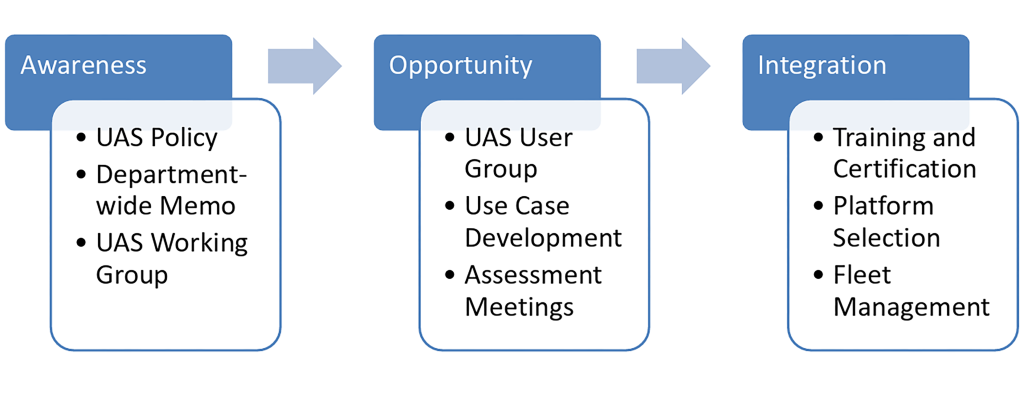
North Carolina demonstrates state agencies directly engaging in implementing UAS technology into their practices. The North Carolina Department of Transportation (NCDOT) introduces a centralized, state-led UAS program.125 Key elements of the NCDOT program include multi-agency coordination, public-private-academic partnerships, and the FAA BEYOND initiative focused on establishing rules and performance standards for UAS.126,127
FIGURE 10. NCDOT UAS Integration
SOURCE: North Carolina Department of Transportation.128
NCDOT is serving as a lead integrator of UAS technology into transportation and public safety-centered deployment.
North Carolina has developed a structured, phased approach to UAS integration across state agencies (see Figure 10). First, NCDOT prioritizes setting the foundation for UAS integration by generating departmental policies.129 These policies result from dedicated working groups that plan seamless UAS integration into NCDOT practices. Following the creation of the UAS policies, NCDOT sent out a department-wide memo to ensure all employees are aware of the developments.130 Following awareness-raising and foundational planning, NCDOT hosts user groups and stakeholders to directly plan use cases for integrating with UAS and identify potential areas of opportunity for integration, resulting from assessment meetings that include the resources available to the department and how to maximize their impact.131 The final stage of NCDOT UAS integration involves rolling out training and certifications to prepare operators to use the technology.132 Furthermore, fleet management becomes a necessity, maintaining the existing UAS and acquiring more units to meet increasing demand.133 The integration stage is ongoing, as more sectors within NCDOT are identified as potential use cases for UAS optimization.
North Carolina’s approach has also been reflected in a range of operational deployments that illustrate how UAS can be integrated into public service delivery. Pilot programs have included the use of drones for medical package delivery, particularly in rural or hard-to-reach areas, as well as coordination efforts during disaster response, such as hurricane recovery operations where aerial data collection supports damage assessment and resource allocation.134 These applications highlight the state’s role in testing operational models in real-world environments, allowing agencies to evaluate effectiveness, scalability, and coordination across jurisdictions. For state policymakers, this coordinated model demonstrates how centralized leadership and interagency collaboration can support both practical deployment and longer-term innovation.135 While North Carolina emphasizes coordinated statewide integration, other states have focused on building large-scale testing infrastructure.
Oklahoma
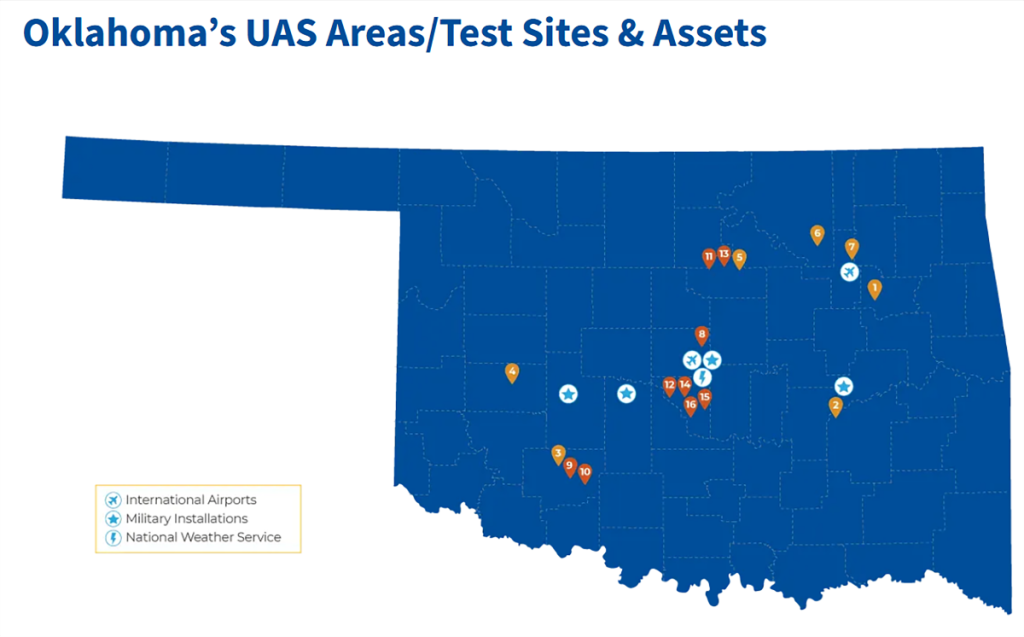
Oklahoma has emphasized the development of large-scale UAS testing infrastructure. The state hosts extensive UAS testing sites spanning 845,000 acres.136 These sites house multiple testing corridors and facilities that integrate with military, university research, and private sector companies.137 Ultimately, Oklahoma’s approach emphasizes geographically distributed testing infrastructure and supporting assets across the state (see Figure 11). The distributed network of test sites throughout the state, as well as proximity between test sites and aviation and defense assets, reflects Oklahoma’s emphasis on developing physical UAS infrastructure.
FIGURE 11. Oklahoma’s UAS Areas/Test Sites and Assets
SOURCE: Oklahoma Department of Commerce.138
Oklahoma’s approach to unmanned aircraft systems also reflects a broader economic development strategy that positions the sector as a driver of long-term growth. The state has supported workforce development through partnerships with universities, technical education systems, and specialized training programs designed to prepare operators, engineers, and technicians for roles in the UAS and aerospace industries.139, 140 These efforts are complemented by industry attraction strategies, including incentives and coordinated support for businesses seeking to locate or expand within the state’s aerospace ecosystem.141 By aligning infrastructure investments with workforce and business development initiatives, Oklahoma’s policies and investments reflect an approach that views UAS as both a technology application and a potential economic development sector.142 For state policymakers, this model illustrates how investments in testing infrastructure, education, and industry partnerships can collectively support growth and innovation objectives. These state-level approaches provide context for understanding how UAS policy is evolving across the region.
While these case studies illustrate different approaches to UAS integration, states have also adopted varying policy frameworks related to privacy protections, government procurement standards, law enforcement use, critical infrastructure security, and public oversight. As UAS adoption expands, policymakers continue to evaluate both operational opportunities and governance considerations when developing state policy approaches.
State Policy Landscape in the South
Legislation related to UAS technology has expanded across Southern states in recent years (see Appendix I for a complete list of legislation). The increase in both introduced and enacted legislation reflects expanding use cases and policy attention to UAS technology and sector-focused integration.143 Additionally, the shift from legislation focused on preliminary operational restrictions to complex frameworks that encompass procurement, privacy laws, law enforcement use, and infrastructure protections reflects a shift from initial operational restrictions toward broader policy frameworks addressing procurement, privacy, public safety, and economic development considerations.144
FIGURE 12. CSG South UAS Legislation (2022-2026)
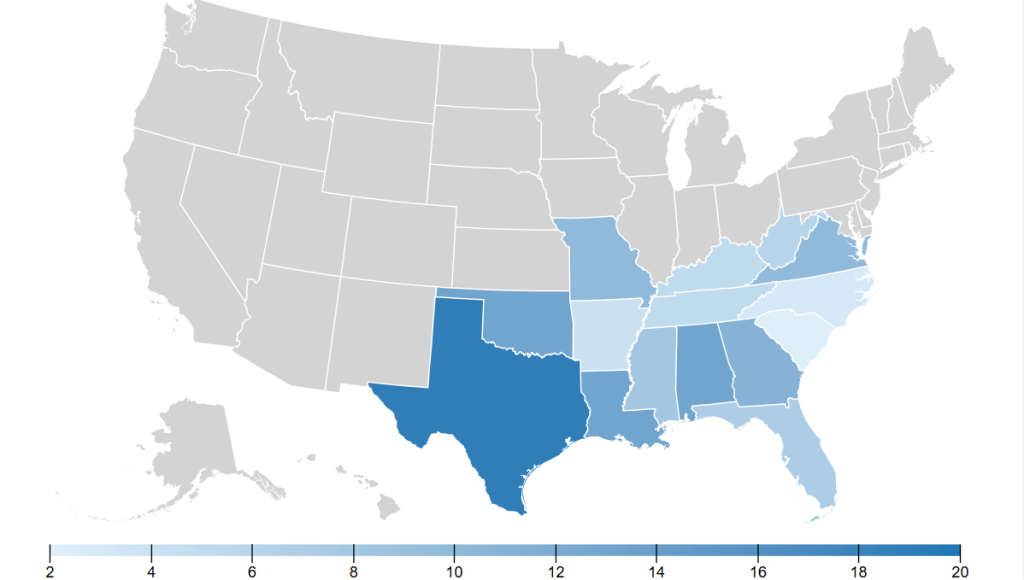
SOURCE: Author’s visualization utilizing data from Quorum.145
Recent legislative activity across the region reflects the number of UAS bills introduced in Southern states over the past five years (see Figure 12). The levels of UAS-related legislation vary across the region, highlighting differences in state policy priorities, capacity to host UAS, and existing UAS ecosystems.146 This legislative activity reflects a range of policy approaches that states are considering as UAS adoption continues to expand across sectors.
Primary Policy Categories of State UAS Legislation 2022-2026147
- Registration and Operation Restrictions
- Privacy and Data Use
- Law Enforcement Use Policies
- Critical Infrastructure Protections
Conclusion
Multiple industries are increasingly integrating UAS technology into their operations. Public safety agencies are using the technology for emergency response efficiency, infrastructure inspection to access difficult-to-reach areas, and for farmers to target crop planting and soil management.148, 149, 150 Applications continue to expand as technology and operational capabilities evolve. The FAA forecasts project continued expansion of commercial UAS fleets across sectors, with high-end projections predicting over a million units (see Table 3).151 Southern states are actively engaging with UAS through a range of policy approaches, reflecting diversified priorities and statewide capacities.
TABLE 3. Commercial UAS Fleet Forecast
| CALENDAR YEAR | LOW | BASE** | HIGH** | |
| Historical | 2024 | 388 | 966 | 966 |
| Forecast | 2025 | 395 | 1030 | 1035 |
| 2026 | 402 | 1089 | 1099 | |
| 2027 | 408 | 1135 | 1151 | |
| 2028 | 411 | 1165 | 1187 | |
| 2029 | 413 | 1180 | 1209 | |
| * Effective/active fleet counts. ** New registration counts based fleet counts. | ||||
Total Commercial/ Non-Model Fleet (Thousands sUAS units)
State policy activity spans multiple areas, from operational regulation to privacy protections.153 Ongoing development at the federal and state levels may continue to influence policy discussions, especially in areas such as airspace integration and emerging technologies.154 State policymakers may consider how UAS intersects with broader priorities, including statewide economic development, infrastructure management, and public safety operations. As UAS technologies continue to evolve, their role across these areas may remain a topic of consideration for state policymakers in the Southern region.
Appendix I. CSG South UAS Legislation (2022-2026)
| STATE | BILL | STATUS | NOTES |
| Alabama | House Bill 429 (2026) | Enacted | Prohibits operating unmanned aircraft systems within a defined distance of ticketed entertainment events, with specified penalties and exemptions. |
| Alabama | Senate Bill 231 (2026) | Effective | Expands Capitol security provisions and establishes restrictions and enforcement authority for unmanned aircraft systems near the State House complex and during legislative events. |
| Alabama | House Bill 274 (2026) | Enacted | Authorizes the Department of Corrections to use mitigation measures, including disabling or intercepting drones, to address unauthorized unmanned aircraft activity near correctional facilities. |
| Alabama | House Joint Resolution 226 (2025) | Effective | Establishes a temporary commission to study unmanned aircraft systems, including security risks and policy considerations related to their use in Alabama. |
| Alabama | Senate Bill 260 (2025) | Introduced or Prefiled | Prohibits state and local governmental entities from purchasing or using unmanned aircraft systems connected to, or supplied by, foreign adversaries or their supply chains. |
| Alabama | Senate Bill 164 (2025) | Introduced or Prefiled | Expands the definition of unauthorized entry of critical infrastructure to include operating unmanned aircraft systems within a specified proximity of such facilities. |
| Alabama | House Bill 201 (2025) | Introduced or Prefiled | Restricts drone operations near public schools and prohibits certain surveillance activities involving unmanned aircraft systems, with associated criminal penalties. |
| Alabama | House Bill 453 (2024) | Enacted | Expands definitions and penalties for unauthorized entry into critical infrastructure, including provisions on the use of unmanned aircraft systems. |
| Alabama | House Bill 345 (2024) | Enacted | Prohibits operating drones near correctional facilities and using them for surveillance or contraband delivery, and establishes penalties and forfeiture procedures. |
| Alabama | Senate Bill 241 (2024) | Introduced or Prefiled | Requires the state to maintain a list of approved unmanned aircraft systems and prohibits local governments from purchasing systems not on that list. |
| STATE | BILL | STATUS | NOTES |
| Alabama | House Bill 321 (2023) | Out of Committee | Requires governmental entities to consult federal sanctions lists and prohibits the purchase of unmanned aircraft systems from certain restricted foreign manufacturers. |
| Alabama | House Bill 527 (2022) | Introduced or Prefiled | Expands criminal surveillance laws to include the use of unmanned aircraft systems to invade an individual’s reasonable expectation of privacy and restricts use by certain individuals. |
| Alabama | Senate Bill 17 (2022) | Enacted | Enhances penalties for unauthorized entry into critical infrastructure, including offenses involving unmanned aircraft systems. |
| Arkansas | House Bill 1148 (2025) | Effective | Establishes the Arkansas Privacy Act, regulating the use of unmanned aircraft systems to capture images and creating criminal and civil penalties for unauthorized surveillance. |
| Arkansas | House Bill 1728 (2023) | Enacted | Updates the statutory definition of “aircraft” to include unmanned aircraft systems explicitly and aligns state law with federal aviation regulations. |
| Arkansas | House Bill 1653 (2023) | Enacted | Prohibits public entities from purchasing or operating unmanned aircraft systems manufactured or assembled by certain foreign entities, with limited waiver authority. |
| Arkansas | House Bill 1125 (2023) | Enacted | Prohibits certain registered sex offenders from owning or operating unmanned aircraft systems for private use, with violations classified as felonies. |
| Florida | Senate Bill 870 (2025) | Introduced or Prefiled | Revises restrictions on operating drones over critical infrastructure facilities by removing certain exceptions and maintaining federal authorization requirements. |
| Florida | Committee Substitute/ Committee Substitute/ Committee Substitute/ Senate Bill 700 (2025) | Effective | Addresses a range of agricultural and regulatory issues, including prohibiting certain unauthorized drone activities on agricultural lands. |
| Florida | Senate Bill 1358 (2025) | Introduced or Prefiled | Requires the state cybersecurity advisory council to regularly assess risks associated with unmanned aircraft systems and provide mitigation recommendations. |
| Florida | Committee Substitute/ Committee Substitute/ Senate Bill 1422 (2025) | Out of Committee | Expands definitions, penalties, and restrictions related to unmanned aircraft systems, including use over critical infrastructure and unauthorized surveillance. |
| STATE | BILL | STATUS | NOTES |
| Florida | Committee Substitute/ Senate Bill 1356 (2024) | Out of Committee | Enhances school safety measures, including prohibiting certain drone operations over schools and establishing related enforcement provisions. |
| Florida | Committee Substitute/ Committee Substitute/ Committee Substitute/ Senate Bill 1068 (2023) | Enacted | Regulates drone delivery services by limiting lo-cal restrictions and establishing standards for drone ports and related infrastructure. |
| Florida | Committee Substitute/ Committee Substitute/ Senate Bill 908 (2023) | Out of Committee | Revises state law governing unmanned aircraft systems, including definitions of critical infra-structure and restrictions on drone operations. |
| Georgia | House Bill 1230 (2026) | Effective | Prohibits drone operations over correctional facilities and at certain events, establishes penalties, and authorizes law enforcement to implement mitigation measures. |
| Georgia | House Bill 946 (2026) | Enacted | Authorizes the use of unmanned aircraft systems to locate feral hogs as part of expanded wildlife management and hunting provisions. |
| Georgia | House Bill 949 (2026) | Out of Committee | Prohibits the launch or landing of unmanned aircraft systems on agricultural land without consent and restricts certain drone operations that interfere with agricultural activities or public events. |
| Georgia | House Resolution 817 (2025) | Out of Committee | Creates a House study committee to examine governmental use of drones and risks associated with unmanned aircraft systems from foreign adversaries. |
| Georgia | House Bill 58 (2025) | Effective | Authorizes restrictions on drone operations over mass public gatherings, including prohibiting flights near ticketed entertainment events with specified exceptions. |
| Georgia | Senate Bill 64 (2025) | Out of Committee | Prohibits state and local government entities from purchasing or using certain foreign-manufactured unmanned aircraft systems and from entering into related contracts with foreign adversaries. |
| Georgia | House Bill 205 (2025) | Passed Original Chamber | Requires the development and maintenance of a state-approved list of unmanned aircraft systems for government procurement and use. |
| Georgia | Senate Bill 159 (2023) | Enacted | Expands penalties for prohibited items in correctional facilities, including unauthorized drone use to photograph or record such facilities. |
| STATE | BILL | STATUS | NOTES |
| Georgia | Senate Bill 493 (2024) | Enacted | Establishes additional penalties and restrictions on registered sexual offenders, including prohibiting certain uses of unmanned aircraft systems. |
| Georgia | House Bill 988 (2024) | Passed Original Chamber | Requires state agencies to report on the use of artificial intelligence and establishes an approved list of unmanned aircraft systems used by government entities. |
| Georgia | House Bill 1277 (2024) | Introduced or Prefiled | Proposes creating an approved list of unmanned aircraft systems for state and local government use and restricting procurement to those systems. |
| Kentucky | Senate Bill 64 (2025) | Effective | Expands protections for key infrastructure as-sets, including prohibiting certain drone opera-tions near such facilities and establishing penal-ties. |
| Kentucky | House Bill 19 (2025) | Effective | Establishes privacy protections governing the use of unmanned aircraft systems, including re-strictions on surveillance and provisions for civil actions. |
| Kentucky | Senate Bill 16 (2024) | Enacted | Prohibits unauthorized use of unmanned air-craft systems and recording devices over agricultural and food production facilities. |
| Kentucky | House Bill 45 (2024) | Passed Original Chamber | Creates comprehensive privacy protections, including limitations on the use of unmanned air-craft systems for surveillance and the establishment of civil remedies for violations. |
| Kentucky | House Resolution 69 (2022) | Enacted | Urges the Federal Aviation Administration to up-date regulations governing agricultural unmanned aircraft systems to reflect evolving technology and practices. |
| Louisiana | House Bill 915 (2024) | Introduced or Prefiled | Prohibits public entities from procuring certain foreign-manufactured unmanned aircraft systems and establishes a state-approved list of secure systems. |
| Louisiana | Senate Bill 127 (2024) | Out of Committee | Authorizes limited use of unmanned aircraft sys-tems for wildlife observation and recovery activ-ities under specified conditions. |
| Louisiana | House Resolution 242 (2025) | Out of Committee | Establishes a state task force to study homeland security threats, including risks associated with unmanned aircraft systems. |
| STATE | BILL | STATUS | NOTES |
| Louisiana | House Bill 940 (2026) | Sent to Governor | Creates a comprehensive framework for law enforcement to detect, mitigate, and investigate unlawful activity involving unmanned aircraft systems. |
| Louisiana | House Bill 265 (2026) | Enrolled | Expands video voyeurism laws to include the use of unmanned aircraft systems to record deceased individuals under certain circumstances. |
| Louisiana | House Bill 1054 (2026) | Enrolled | Establishes procedures allowing law enforcement drone footage to be admitted as self-authenticating evidence in legal proceedings. |
| Louisiana | House Bill 429 (2026) | Sent to Governor | Expands criminal penalties related to critical infrastructure by including unauthorized drone operations and interference as qualifying offenses. |
| Louisiana | House Bill 155 (2026) | Effective | Expands restrictions on drone operations to in-clude additional state government properties and facilities. |
| Louisiana | House Bill 261 (2025) | Effective | Authorizes law enforcement to take mitigation measures against drones and establishes penal-ties for unauthorized drone use at public events. |
| Louisiana | Senate Bill 9 (2025) | Effective | Prohibits unauthorized drone operations over military installations and establishes criminal penalties for related offenses. |
| Louisiana | Senate Bill 466 (2024) | Enacted | Expands criminal trespass laws to include unauthorized drone surveillance over private property. |
| Louisiana | House Bill 167 (2024) | Enacted | Revises penalties and enforcement provisions for unlawful use of unmanned aircraft systems, including operations over restricted areas. |
| Louisiana | House Bill 407 (2023) | Enacted | Renames and extends the State Drone Advisory Committee and directs it to provide policy recommendations on unmanned aircraft systems. |
| Mississippi | House Bill 579 (2026) | Introduced or Prefiled | Updates and consolidates state procurement statutes, including provisions affecting the acquisition of unmanned aircraft systems by public entities. |
| STATE | BILL | STATUS | NOTES |
| Mississippi | House Bill 1494 (2025) | Introduced or Prefiled | Expands state trespass laws to include unauthor-ized operation of unmanned aircraft systems over property |
| Mississippi | House Bill 297 (2024) | Enacted | Revises procurement procedures and includes restrictions and preferences related to the purchase of unmanned aircraft systems. |
| Mississippi | Senate Bill 2661 (2024) | Introduced or Prefiled | Authorizes the use of unmanned aerial vehicles in agricultural practices and directs the development of related regulations. |
| Mississippi | Senate Bill 2853 (2023) | Enacted | Requires state agencies to procure domestically manufactured unmanned aircraft systems and restricts purchases from certain foreign sources. |
| Mississippi | House Bill 839 (2023) | Out of Committee | Establishes a framework outlining rights and authorities for recreational and commercial use of unmanned aircraft systems. |
| Mississippi | House Bill 1032 (2023) | Out of Committee | Prohibits government entities from purchasing or operating unmanned aircraft systems from non U.S. manufacturers and requires inventory tracking. |
| Mississippi | House Bill 1383 (2022) | Introduced or Prefiled | Requires registration of unmanned aircraft sys-tems at the point of sale and establishes penal-ties for misuse, including contraband delivery. |
| Missouri | Senate Bill 296 (2024) | Introduced or Prefiled | Prohibits public entities from using certain foreign-manufactured unmanned aircraft systems and establishes a grant program to replace them. |
| Missouri | Senate Bill 1421 (2025) | Passed Original Chamber | Expands restrictions and penalties for unauthorized drone operations over critical infrastructure and public venues and authorizes law enforcement mitigation. |
| Missouri | House Bill 1807 (2025) | Introduced or Prefiled | Authorizes law enforcement to take mitigation measures against drones that pose a threat to public safety. |
| Missouri | House Bill 1225 (2025) | Introduced or Prefiled | Requires private unmanned aircraft operators to maintain minimum liability insurance coverage. |
| STATE | BILL | STATUS | NOTES |
| Missouri | House Bill 1101 (2025) | Introduced or Prefiled | Establishes a misdemeanor offense for operating unmanned aircraft over crime scenes, emergency incidents, or hazardous material sites. |
| Missouri | House Bill 209 (2024) | Introduced or Prefiled | Restricts drone-based surveillance by law enforcement and private actors without consent or a warrant and establishes related privacy protections. |
| Missouri | House Bill 210 (2024) | Introduced or Prefiled | Prohibits the government from using drones from certain foreign entities and establishes security standards and geofencing requirements. |
| Missouri | House Bill 178 (2022) | Passed Original Chamber | Establishes statewide limits on drone surveillance, including warrant requirements and restrictions on use over private property. |
| Missouri | House Bill 179 (2022) | Introduced or Prefiled | Expands penalties and restrictions for unlawful drone use over open-air facilities. |
| Missouri | House Bill 1619 (2022) | Out of Committee | Prohibits unauthorized drone surveillance of individuals or private property and establishes penalties and exceptions. |
| North Carolina | Senate Bill 670 (2025) | Introduced or Prefiled | Prohibits state and local entities from purchasing drones from certain foreign vendors beginning in 2027. |
| North Carolina | House Bill 192 (2023) | Enacted | Restricts the use of drones for hunting and fishing, while allowing limited observational uses. |
| North Carolina | House Bill 634 (2023) | Introduced or Prefiled | Affirms federal preemption over airspace regulation, limiting conflicting state regulation of unmanned aircraft systems. |
| Oklahoma | Senate Bill 1531 (2026) | Enacted | Expands the state aerospace agency’s authority to develop and coordinate unmanned aircraft systems and related infrastructure. |
| Oklahoma | Senate Bill 920 (2025) | Effective | Requires permits for construction near verti-ports and expands the state’s role in coordinating unmanned aircraft system integration. |
| STATE | BILL | STATUS | NOTES |
| Oklahoma | Senate Bill 488 (2025) | Introduced or Prefiled | Prohibits state agencies from purchasing non-approved drones and establishes a state-managed approved UAS list. |
| Oklahoma | Senate Bill 1912 (2024) | Enacted | Authorizes the development of vertiport infra-structure and the integration of unmanned air-craft systems into statewide aviation planning. |
| Oklahoma | Senate Bill 773 (2023) | Enacted | Expands aerospace programs and establishes funding mechanisms supporting unmanned air-craft systems and advanced air mobility. |
| Oklahoma | Senate Bill 782 (2023) | Enacted | Reorganizes the state aeronautics authority and designates it as the clearinghouse for unmanned aircraft systems development. |
| Oklahoma | House Bill 1760 (2023) | Introduced or Prefiled | Limits drone surveillance over private property and restricts government use to public safety purposes. |
| Oklahoma | House Bill 3171 (2022) | Enacted | Prohibits unauthorized drone surveillance and trespass over private property and establishes misdemeanor penalties. |
| Oklahoma | Senate Bill 1441 (2026) | Enacted | Expands restrictions and establishes penalties for drone operations over critical infrastructure facilities. |
| Oklahoma | House Bill 4396 (2026) | Introduced or Prefiled | Establishes a framework for recognizing unmanned aircraft and for advancing air mobility policy development. |
| Oklahoma | House Bill 2312 (2025) | Passed Original Chamber | Removes certain exemptions and strengthens restrictions on drone operations over critical infrastructure. |
| Oklahoma | Senate Bill 1072 (2025) | Introduced or Prefiled | Prohibits unauthorized drone operations over private property and establishes penalties and civil remedies. |
| Oklahoma | House Bill 3068 (2024) | Introduced or Prefiled | Prohibits public entities from purchasing drones from certain foreign manufacturers with limited exceptions. |
| STATE | BILL | STATUS | NOTES |
| South Carolina | House Bill 4679 (2025) | Passed Original Chamber | Establishes comprehensive statewide regulations and penalties governing drone operations and public safety. |
| South Carolina | House Bill 3945 (2025) | Out of Committee | Authorizes limited use of drones for managing feral hogs and coyotes under a regulated permitting program. |
| Tennessee | Senate Bill 776 (2023) | Enacted | Prohibits public agencies from purchasing drones from manufacturers banned under federal law. |
| Tennessee | Senate Bill 1631 (2026) | Out of Committee | Increases penalties for drone use over correctional facilities and authorizes personnel to disable such drones. |
| Tennessee | Senate Bill 2434 (2026) | Enacted | Creates a misdemeanor offense for knowingly operating an unmanned aircraft over school grounds. |
| Tennessee | Senate Bill 130 (2025) | Out of Committee | Authorizes the use of drones to locate and re-trieve wounded deer under rules set by the wild-life commission. |
| Tennessee | Senate Bill 2428 (2022) | Enacted | Allows emergency management officials to use drones for disaster response and sets limits on data retention. |
| Texas | House Concurrent Resolution 98 (2025) | Effective | Urges Congress to expand coordination and authority for counter-UAS operations at the U.S.-Mexico border. |
| Texas | Senate Bill 2 (2025) | Passed Original Chamber | Establishes broad disaster response reforms, including authority to disable unauthorized drones in disaster areas. |
| Texas | Senate Bill 1 (2025) | Passed Original Chamber | Implements statewide disaster management re-forms, including drone mitigation authority during emergencies. |
| Texas | Senate Bill 2569 (2025) | Effective | Requires large law enforcement agencies to publicly report drone use online. |
| STATE | BILL | STATUS | NOTES |
| Texas | House Bill 1285 (2024) | Passed Original Chamber | Authorizes the Railroad Commission to use drones for inspections of energy infrastructure. |
| Texas | Senate Bill 1197 (2025) | Effective | Creates a criminal offense for unauthorized drone operations over spaceports. |
| Texas | House Bill 3662 (2025) | Out of Committee | Establishes penalties for operating drones over school instructional facilities. |
| Texas | House Bill 4867 (2025) | Out of Committee | Regulates the use of aircraft, including drones, for wildlife management and hunting activities. |
| Texas | House Bill 41 (2025) | Out of Committee | Prohibits government entities from acquiring certain foreign-manufactured drone technologies and establishes a replacement grant pro-gram. |
| Texas | Senate Bill 3010 (2025) | Introduced or Prefiled | Expands lawful drone use to include certain news-gathering activities. |
| Texas | House Bill 676 (2024) | Introduced or Prefiled | Allows drones to locate and retrieve wounded or dead wildlife. |
| Texas | House Bill 2916 (2025) | Introduced or Prefiled | Establishes legal defenses for individuals who disable drones operating unlawfully over their property. |
| Texas | House Bill 470 (2024) | Introduced or Prefiled | Authorizes regulation of drone operations within the Texas Capitol Complex as part of public safety oversight. |
| Texas | Senate Bill 1308 (2023) | Enacted | Criminalizes unauthorized drone operations over airports and military installations. |
| Texas | House Bill 3075 (2023) | Enacted | Establishes penalties for drone operations over correctional or detention facilities. |
| STATE | BILL | STATUS | NOTES |
| Texas | Senate Bill 423 (2023) | Enacted | Expands lawful uses of drones for government, commercial, and research purposes. |
| Texas | Senate Bill 1986 (2023) | Introduced or Prefiled | Prohibits government acquisition and use of drones from certain foreign adversary nations. |
| Texas | House Bill 3489 (2023) | Introduced or Prefiled | Permits drone use for locating and retrieving wounded wildlife. |
| Texas | House Bill 2159 (2023) | Introduced or Prefiled | Clarifies exceptions for lawful drone operations over certain facilities. |
| Virginia | Senate Bill 1272 (2025) | Effective | Expands penalties for unauthorized drone operations over critical infrastructure to include felony offenses. |
| Virginia | Senate Bill 757 (2024) | Enacted | Criminalizes drone surveillance of defense facilities and provides immunity to facility operators who respond to such activity. |
| Virginia | House Bill 2038 (2025) | Introduced or Prefiled | Prohibits public bodies from procuring insecure drones and establishes a grant program to re-place them. |
| Virginia | Senate Bill 1073 (2023) | Enacted | Prohibits drone use for surveillance or for the delivery of contraband at correctional facilities. |
| Virginia | House Bill 950 (2026) | Enacted | Expands exceptions allowing certain public agencies to use drones without a warrant for environmental enforcement. |
| Virginia | Senate Bill 647 (2026) | Enacted | Requires development of a statewide policy governing law enforcement use of drones and clarifies warrant exceptions. |
| Virginia | House Bill 2177 (2025) | Effective | Expands the circumstances under which law enforcement may deploy drones without a war-rant. |
| STATE | BILL | STATUS | NOTES |
| Virginia | House Bill 2532 (2025) | Introduced or Prefiled | Expedites drone-related search warrants and expands warrantless use in emergencies and public safety situations. |
| Virginia | House Bill 2592 (2025) | Introduced or Prefiled | Increases penalties for unauthorized drone trespass and surveillance, including felony provisions. |
| Virginia | House Bill 1583 (2023) | Enacted | Prohibits using drones to spy into dwellings or private spaces without consent. |
| West Virginia | House Bill 5552 (2026) | Introduced or Prefiled | Prohibits public entities from purchasing or using drones from certain foreign manufacturers and establishes a replacement program. |
| West Virginia | Senate Bill 900 (2026) | Passed Second Chamber | Expands drone restrictions to include correctional facilities as protected sites. |
| West Virginia | Senate Bill 812 (2026) | Introduced or Prefiled | Prohibits drone operations over polling places on election day. |
| West Virginia | House Bill 3479 (2023) | Enacted | Establishes statewide requirements and restrictions for drone use, including privacy and safety protections. |
| West Virginia | House Bill 3284 (2023) | Introduced or Prefiled | Proposes regulations governing law enforcement and general drone operations, including privacy protections. |
| West Virginia | Senate Bill 5 (2022) | Passed Second Chamber | Creates a statewide advisory council to support unmanned aircraft systems policy and development. |
| SOURCE: Author’s visualization utilizing data from Quorum.155 | |||
Citations
- U.S. Congress. Public Law 112–95. February 14, 2012. https://www.congress.gov/112/plaws/publ95/PLAW-112publ95.pdf.
- Federal Aviation Administration. Aerospace Forecast Fiscal Years 2025–2045: Unmanned Aircraft Systems and Advanced Air Mobility Full Document. Washington, DC: U.S. Department of Transportation, 2025. https://www.faa.gov/data_research/aviation/aerospace_forecasts/2025-uas-and-aam-full-document.pdf.
- National Urban Security Technology Laboratory. Small Unmanned Aircraft System Program Documentation for Public Safety. Washington, DC, 2025. https://www.dhs.gov/sites/default/files/2025-11/25_11_14_suasprgmdoc.pdf.
- Federal Highway Administration. Unmanned Aircraft Systems in Transportation. FHWA-PL-23-007. Washington, DC: U.S. Department of Transportation, 2023. https://international.fhwa.dot.gov/pubs/pl23007.pdf.
- Federal Aviation Administration, Aerospace Forecast Fiscal Years 2025-2045, 2.
- Terra Drone. “Retail Drone Delivery: Solving Last-Mile Logistics.” Accessed April 30, 2026. https://terra-drone.com.sa/retail-drone-delivery-solving-last-mile-logistics/.
- Federal Highway Administration. Unmanned Aircraft Systems in Transportation, 2.
- National Urban Security Technology Laboratory, Small Unmanned Aircraft System Program Documentation for Public Safety, 2.
- Federal Aviation Administration, Aerospace Forecast Fiscal Years 2025-2045, 2.
- Quorum. “UAS Legislation in CSG South States (2022–2026).” Accessed April 30, 2026. https://www.quorum.us/spreadsheet/external/mkaoReVVniguhoNvbNVa/.
- Federal Aviation Administration, Aerospace Forecast Fiscal Years 2025-2045, 2.
- Ibid.
- Federal Aviation Administration. “Advanced Air Mobility (Air Taxis).” Accessed April 30, 2026. https://www.faa.gov/air-taxis.
- Oklahoma Department of Commerce. “Unmanned Aerial Systems.” Accessed April 30, 2026. https://www.okcommerce.gov/doing-business/business-relocation-expansion/industry-sectors/unmanned-aerial-systems/.
- National Urban Security Technology Laboratory, Small Unmanned Aircraft System Program Documentation for Public Safety, 2.
- Quorum, UAS Legislation in CSG South States (2022-2026), 3.
- U.S. Congress, Public Law 112-95, 2.
- U.S. Department of Transportation, Federal Aviation Administration. 14 C.F.R. § 107.3 (Definitions). https://www.ecfr.gov/current/title-14/chapter-I/subchapter-F/part-107.
- Cornell University Risk Management and Insurance. “Use of Drones.” Accessed April 30, 2026. https://www.risk.cornell.edu/events-and-staffing-main-page/use-of-drones/.
- Zaidi, Sofiane, Mohammed Atiquzzaman, and Carlos T. Calafate. Internet of Flying Things (IoFT): A Survey.” Computer Communications 165 (2021): 53–74. https://doi.org/10.1016/j.comcom.2020.10.023.
- U.S. Department of Transportation, 14 C.F.R. § 107.3, 4.
- Federal Aviation Administration. Aeronautical Information Manual, Chapter 11, Section 1. Accessed April 30, 2026. https://www.faa.gov/air_traffic/publications/atpubs/aim_html/chap11_section_1.html.
- U.S. Department of Transportation. 14 C.F.R. § 1.1 (General Definitions). Accessed April 30, 2026. https://www.law.cornell.edu/cfr/text/14/1.1.
- Federal Aviation Administration, Aerospace Forecast Fiscal Years 2025-2045, 2.
- U.S. Department of Transportation, Federal Aviation Administration. 14 C.F.R. § 107.31 (Visual Line of Sight Aircraft Operation). Accessed April 30, 2026. https://www.ecfr.gov/current/title-14/chapter-I/subchapter-F/part-107/subpart-B/section-107.31.
- Skybrary. “Beyond Visual Line of Sight (BVLOS).” Accessed April 30, 2026. https://skybrary.aero/articles/beyond-visual-line-sight-bvlos.
- Cai, Guowei, Jorge Miranda Dias, and Lakmal Seneviratne. “A Survey of Small-Scale Unmanned Aerial Vehicles: Recent Advances and Future Development Trends.” Unmanned Systems 02(02) (2014): 175-199. https://www.researchgate.net/publication/270723492_A_Survey_of_Small-Scale_Unmanned_Aerial_Vehicles_Recent_Advances_and_Future_Development_Trends.
- Ibid.
- Ibid.
- Ibid.
- Boukoberine, Mohamed Nadir, Zhibin Zhou, and Mohamed Benbouzid. “A critical review on unmanned aerial vehicles power supply and energy management: Solutions, strategies and prospects.” Applied Energy 255 (2019). https://doi.org/10.1016/j.apenergy.2019.113823.
- Cai, Dias, and Seneviratne, A Survey of Small-Scale Unmanned Aerial Vehicles, 5.
- Federal Aviation Administration, Aeronautical Information Manual, Chapter 11, Section 1, 4.
- Federal Aviation Administration. Aeronautical Information Manual, Chapter 11, Section 2. Accessed April 30, 2026. https://www.faa.gov/air_traffic/publications/atpubs/aim_html/chap11_section_2.html.
- Ibid.
- Federal Aviation Administration. Aeronautical Information Manual, Chapter 5, Section 5. Accessed April 30, 2026. https://www.faa.gov/air_traffic/publications/atpubs/foa_html/chap5_section_5.html.
- Ibid.
- University of Arkansas. “[UAS (Drone) – Compliance Overview].” YouTube video. Accessed April 30, 2026. https://www.youtube.com/watch?v=Ha2diOifpIQ.
- Association for Uncrewed Vehicle Systems International. “Global Trends of Unmanned Aerial Systems.” Accessed April 30, 2026. https://www.auvsi.org/advocacy/research-reports/global-trends-of-unmanned-aerial-systems/.
- U.S. Government Accountability Office. Unmanned Aircraft Systems: Current Efforts and Challenges for Integration into the National Airspace System. GAO-23-105189. Washington, DC, 2023. https://www.gao.gov/products/gao-23-105189.
- U.S. Department of Transportation, Federal Aviation Administration. 14 C.F.R. Part 107 (Small Unmanned Aircraft Systems). Accessed April 30, 2026. https://www.ecfr.gov/current/title-14/chapter-I/subchapter-F/part-107.
- Federal Register. “Federal Aviation Administration.” Accessed April 30, 2026. https://www.federalregister.gov/agencies/federal-aviation-administration.
- Ibid.
- Ibid.
- Federal Aviation Administration. “Remote Identification (Remote ID).” Accessed April 30, 2026.
- https://www.faa.gov/uas/getting_started/remote_id.
- Federal Aviation Administration, 14 C.F.R. Part 107, 6.
- U.S. Congress. 49 U.S.C. § 44809 (Exception for Limited Recreational Operations of Unmanned Aircraft). Accessed April 30, 2026. https://uscode.house.gov/view.xhtml?req=granuleid:USC-prelim-title49-section44809&num=0&edition=prelim.
- Federal Aviation Administration, Remote Identification (Remote ID), 7.
- International Trade Administration, U.S. Department of Commerce. “Unmanned Aircraft Systems.” Accessed April 30, 2026. https://www.trade.gov/unmanned-aircraft-systems.
- Federal Aviation Administration. “Normalizing Unmanned Aircraft Systems Beyond Visual Line of Sight Operations; Reopening of Comment Period.” Federal Register, January 28, 2026. https://www.federalregister.gov/documents/2026/01/28/2026-01644/normalizing-unmanned-aircraft-systems-beyond-visual-line-of-sight-operations-reopening-of-comment.
- Federal Aviation Administration. “Unmanned Aircraft Systems Beyond Visual Line of Sight Operations.” Federal Register, May 25, 2023. https://www.federalregister.gov/documents/2023/05/25/2023-11024/uas-beyond-visual-line-of-sight-operations.
- Pilot Institute. “Part 108 Explained.” Accessed April 30, 2026. https://pilotinstitute.com/part-108-explained/.
- Ibid.
- U.S. Department of Transportation. Updated Fact Sheet on State and Local Regulation of Unmanned Aircraft Systems (UAS). 2023. https://www.transportation.gov/sites/dot.gov/files/2023-07/Updated_Fact_Sheet_2023_on_State_and_Local_Regulation_of_Unmanned_Aircraft_Systems.pdf.
- Ibid.
- Ibid.
- Ibid.
- Ibid.
- Ibid.
- Ibid.
- Ibid.
- Ibid.
- Ibid.
- AUVSI, Global Trends of Unmanned Aerial Systems, 6.
- Boukoberine, Zhou, and Benbouzid, A critical review on unmanned aerial vehicles power supply and energy management, 5.
- Federal Register, Unmanned Aircraft Systems Beyond Visual Line of Sight Operations, 8.
- National Urban Security Technology Laboratory, Small Unmanned Aircraft System Program Documentation for Public Safety, 2.
- Ibid.
- Ibid.
- Ibid.
- Ibid.
- Ibid.
- Ibid.
- Ibid.
- International Association of Chiefs of Police. Model Policy: Small Unmanned Aircraft Systems (UAS). Alexandria, VA: International Association of Chiefs of Police, 2019. https://www.scribd.com/doc/279521163/IACP-Model-UAS-Policy.
- Ibid.
- Ibid.
- Federal Highway Administration. Unmanned Aircraft Systems in Transportation, 2.
- Federal Highway Administration. Unmanned Aircraft Systems for Bridge Inspection. FHWA-HRT-21-083. Washington, DC: U.S. Department of Transportation, 2021.
- Federal Highway Administration. Unmanned Aircraft Systems in Transportation, 2.
- Ibid.
- Ibid.
- Ibid.
- Ibid.
- Federal Highway Administration. UAS in Transportation: Infrastructure Inspection and Data Collection Applications. FHWA-HIF-23-065. Washington, DC: U.S. Department of Transportation, 2023.
- U.S. Department of Homeland Security. DHS 4300A Sensitive Systems Policy Directive, Attachment D: Supply Chain Risk Management (SCRM) Organizational Guidance. Washington, DC.
- National Institute of Standards and Technology. NIST Special Publication 1500-1: Measurement Science Roadmap for Unmanned Aircraft Systems. Gaithersburg, MD: U.S. Department of Commerce, 2015. https://nvlpubs.nist.gov/nistpubs/specialpublications/nist.sp.1500-1.pdf.
- U.S. Department of Agriculture, Economic Research Service. “Farm Income and Wealth Statistics: Charts and Maps.” Accessed April 30, 2026. https://ers.usda.gov/data-products/farm-income-and-wealth-statistics/charts-and-maps-about-your-state.
- Wang, Jie, Sebastian T., Meyer, Xijie Xu, Wolfgang W. Weisser, and Kang Yu. “Drone multispectral imaging captures the effects of soil mineral nitrogen on canopy structure and nitrogen use efficiency in wheat” Computers and Electronics in Agriculture 235 (2025). https://doi.org/10.1016/j.compag.2025.110342.
- Yang, Chenghai, Charles Suh, and Bradley K. Fritz. “Effects of flight and processing parameters on UAS image-based point clouds for plant height estimation” Remote Sensing 18(6) (2026). https://doi.org/10.3390/rs18020360.
- Federal Aviation Administration, Aerospace Forecast Fiscal Years 2025-2045, 2.
- Wang, Jingzhe, Silu Zhang, Ivan Lizaga, Yinghui Zhang, Xiangyu Ge, Zipeng Zhang, Wei Zhang, Qiujun Huang, and Zhingwen Hu. “UAS-based remote sensing for agricultural monitoring: Current status and perspectives” Computers and Electronics in Agriculture, 227 (2024). https://doi.org/10.1016/j.compag.2024.109501.
- U.S. Department of Agriculture, Economic Research Service. Farm Sector Income and Finances: Forecasts of Income and Financial Indicators. Accessed April 30, 2026. https://www.ers.usda.gov/publications/pub-details?pubid=105893.
- Ibid.
- University of Florida News. “Celery Disease Research Highlights Agricultural Challenges.” January 2026. https://news.ufl.edu/2026/01/celery-disease/.
- U.S. Department of Transportation, Federal Aviation Administration. 14 C.F.R. Part 137 (Agricultural Aircraft Operations). Accessed April 30, 2026. https://www.ecfr.gov/current/title-14/chapter-I/subchapter-G/part-137.
- U.S. Department of Agriculture, National Agricultural Library. “Research and Extension for Unmanned Aircraft Systems (UAS).” Accessed April 30, 2026. https://www.nal.usda.gov/research-tools/food-safety-research-projects/research-and-extension-unmanned-aircraft-systems-uas.
- U.S. Environmental Protection Agency. “Laws and Regulations.” Accessed April 30, 2026. https://www.epa.gov/laws-regulations.
- Federal Aviation Administration, 14 C.F.R. Part 137, 13.
- Federal Aviation Administration, 14 C.F.R. Part 107, 6.
- Federal Aviation Administration. Integration of Civil Unmanned Aircraft Systems (UAS) in the National Airspace System (NAS) Roadmap, Third Edition. Washington, DC: U.S. Department of Transportation, 2019. https://www.faa.gov/sites/faa.gov/files/uas/resources/policy_library/2019_UAS_Civil_Integration_Roadmap_third_edition.pdf.
- Federal Aviation Administration, 14 C.F.R. Part 107, 6.
- Ibid.
- Federal Aviation Administration, Normalizing Unmanned Aircraft Systems Beyond Visual Line of Sight Operations; Reopening of Comment Period, 8.
- National Oceanic and Atmospheric Administration. “Beyond Visual Line of Sight (BVLOS): What It Is and How It Can Advance NOAA’s Science.” Accessed April 30, 2026. https://www.omao.noaa.gov/uncrewed-systems/news-media/article/beyond-visual-line-sight-bvlos-what-it-and-how-can-it-advance-noaa%E2%80%99s-science.
- Oklahoma Department of Commerce. “Oklahoma-Kansas UAS Cluster Receives $500K from U.S. SBA.” Accessed April 30, 2026. https://www.okcommerce.gov/oklahoma-kansas-uas-cluster-receives-500k-from-u-s-sba/.
- Federal Aviation Administration. “Airport Improvement Program (AIP) and Airport Infrastructure Grant (AIG) Discretionary Grants.” Accessed April 30, 2026. https://www.faa.gov/about/office_org/headquarters_offices/ang/grants/awd.
- Federal Register, Unmanned Aircraft Systems Beyond Visual Line of Sight Operations, 8.
- National Aeronautics and Space Administration. “Unmanned Aircraft System Traffic Management (UTM) Project.” Accessed April 30, 2026. https://www.nasa.gov/directorates/armd/past-armd-projects/utm-project/.
- McKinsey & Company. “Drones Take to the Sky: Potentially Disrupting Last-Mile Delivery.” Accessed April 30, 2026. https://www.mckinsey.com/industries/aerospace-and-defense/our-insights/future-air-mobility-blog/drones-take-to-the-sky-potentially-disrupting-last-mile-delivery.
- National Urban Security Technology Laboratory, Small Unmanned Aircraft System Program Documentation for Public Safety, 2.
- Terra Drone, Retail Drone Delivery, 3.
- Federal Aviation Administration. “BEYOND Program.” Accessed April 30, 2026. https://www.faa.gov/uas/programs_partnerships/beyond.
- Federal Aviation Administration, Aerospace Forecast Fiscal Years 2025-2045, 2.
- Congressional Research Service. Unmanned Aircraft Systems: Current Issues and Policy Considerations. CRS Report R47660. Washington, DC: Library of Congress.
- Federal Aviation Administration, BEYOND Program, 16
- Arkansas Economic Development Commission. “Arkansas Ranked #1 for Commercial Drone Readiness in U.S.” August 18, 2023. https://www.arkansasedc.com/news-events/arkansas-inc-blog/post/active-blogs/2023/08/18/arkansas-ranked-1-for-commercial-drone-readiness-in-u.s.
- The Nature Conservancy. “Using Drones for Conservation in Arkansas.” Accessed April 30, 2026. https://www.nature.org/en-us/about-us/where-we-work/united-states/arkansas/stories-in-arkansas/using-drones-for-conservation/.
- Arkansas Economic Development Commission, Arkansas Ranked #1, 16.
- Design & Development Today. “Drone Swarm Maker Opens New Factory in Arkansas.” Accessed April 30, 2026. https://www.designdevelopmenttoday.com/industries/aerospace/news/22960960/drone-swarm-maker-opens-new-factory-in-arkansas.
- Arkansas Division of Workforce Services. “Workforce Innovation and Opportunity Act (WIOA).” Accessed April 30, 2026. https://dws.arkansas.gov/workforce-services/wioa/.
- Arkansas Economic Development Commission, Arkansas Ranked #1, 16.
- Arkansas Division of Workforce Services, WIOA, 17.
- North Carolina Department of Transportation. “Unmanned Aircraft Systems (UAS) Program.” Accessed April 30, 2026. https://www.ncdot.gov/divisions/aviation/uas/Pages/default.aspx.
- North Carolina Department of Transportation. North Carolina UAS Program Update. May 2019. https://transportation.org/aviation/wp-content/uploads/sites/11/2023/04/NCDOT_Update_2019-05-201.pdf.
- Federal Aviation Administration, BEYOND Program, 16.
- NCDOT, North Carolina UAS Program Update, 17.
- Ibid.
- Ibid.
- Ibid.
- Ibid.
- Ibid.
- Ibid.
- Ibid.
- Oklahoma Department of Commerce. “Unmanned Aerial Systems.” Accessed April 30, 2026. https://www.okcommerce.gov/doing-business/business-relocation-expansion/industry-sectors/unmanned-aerial-systems/.
- Ibid.
- Ibid.
- Oklahoma State University. “Aerospace Centers.” Accessed April 30, 2026. https://go.okstate.edu/aerospace/centers.
- University of Oklahoma. “Radar Innovations Laboratory.” Accessed April 30, 2026. https://arrc.ou.edu/ril.html.
- Oklahoma Department of Commerce. “Site Selection.” Accessed April 30, 2026. https://www.okcommerce.gov/siteselection/.
- Ibid.
- Quorum, UAS Legislation in CSG South States (2022-2026), 3.
- Ibid.
- Ibid.
- Ibid.
- Ibid.
- National Urban Security Technology Laboratory, Small Unmanned Aircraft System Program Documentation for Public Safety, 2.
- Federal Highway Administration. Unmanned Aircraft Systems in Transportation, 2.
- Federal Aviation Administration, Aerospace Forecast Fiscal Years 2025-2045, 2.
- Ibid.
- Ibid.
- National Institute of Standards and Technology. NIST Special Publication 1500-1: Measurement Science Roadmap for Unmanned Aircraft Systems. Gaithersburg, MD: U.S. Department of Commerce, 2015. https://nvlpubs.nist.gov/nistpubs/specialpublications/nist.sp.1500-1.pdf.
- Federal Aviation Administration, Normalizing Unmanned Aircraft Systems Beyond Visual Line of Sight Operations; Reopening of Comment Period, 8.
- Quorum, UAS Legislation in CSG South States (2022-2026), 3.