

Regional Resource by Policy Analyst, Judah Lebofsky
Part 1 of CSG South’s special series, Short-Term Rental Regulation and Housing Affordability in the South, examined the growth of short-term rentals (STRs), their relationship to housing availability and affordability, and the factors contributing to increased state legislative attention. Part 2 examines how Southern states regulate STRs and the division of regulatory authority between state and local governments. It reviews state policy frameworks, including licensing and registration requirements, operating standards, local zoning authority, and restrictions on local regulation. The report also compares approaches across the 15 CSG South states and highlights recent legislative activity from 2022 through 2026.
State and Local Roles in Short-Term Rental Regulation
Traditional Local Authority
Local governments commonly regulate short-term rentals through their general land-use, zoning, licensing, and police powers. The scope of this authority depends partly on each state’s constitutional and statutory framework, including whether local governments operate primarily under home rule, the Dillon Rule, or a combination of the two.1,2 Although these doctrines define the broader relationship between state and local governments, state legislatures may enact STR-specific statutes that expand, limit, or clarify local regulatory authority.
Home rule refers to authority granted by a state constitution or statute that allows local governments to manage certain local affairs without specific legislative authorization.3 The scope of this self-governing authority varies by state and remains subject to state law.4 In most Southern states, local governments have the authority to regulate STRs through their land-use and other local powers.5 In states that limit local authority, municipalities may consult legal counsel to ensure that local regulations comply with applicable state statutes.6
The Dillon Rule limits local governments to powers expressly granted by the state, powers necessarily or fairly implied by those express grants, and powers essential, not merely convenient, to carrying out their authorized purposes.7 When reasonable doubt exists about whether a local government possesses a particular power, courts generally resolve that doubt against the local government.8 Under this framework, a local government regulating STRs must identify the authority that is expressly granted or necessarily implied by state law.9 State legislatures may also preempt, limit, or prohibit local STR regulations when establishing statewide standards.10
Specific Forms of State Involvement
Southern states differ not only in the overall degree of state control over STRs, but also in the particular subjects addressed by state law (see Figure 1). State involvement ranges from comprehensive licensing and operating requirements to more targeted provisions governing rental transactions, local registration, property classification, platforms, accessory dwelling units, and existing STR uses. These distinctions help explain why states within the same broad regulatory category may still take substantially different approaches.
FIGURE 1. Selected areas of state involvement in short-term rental regulation
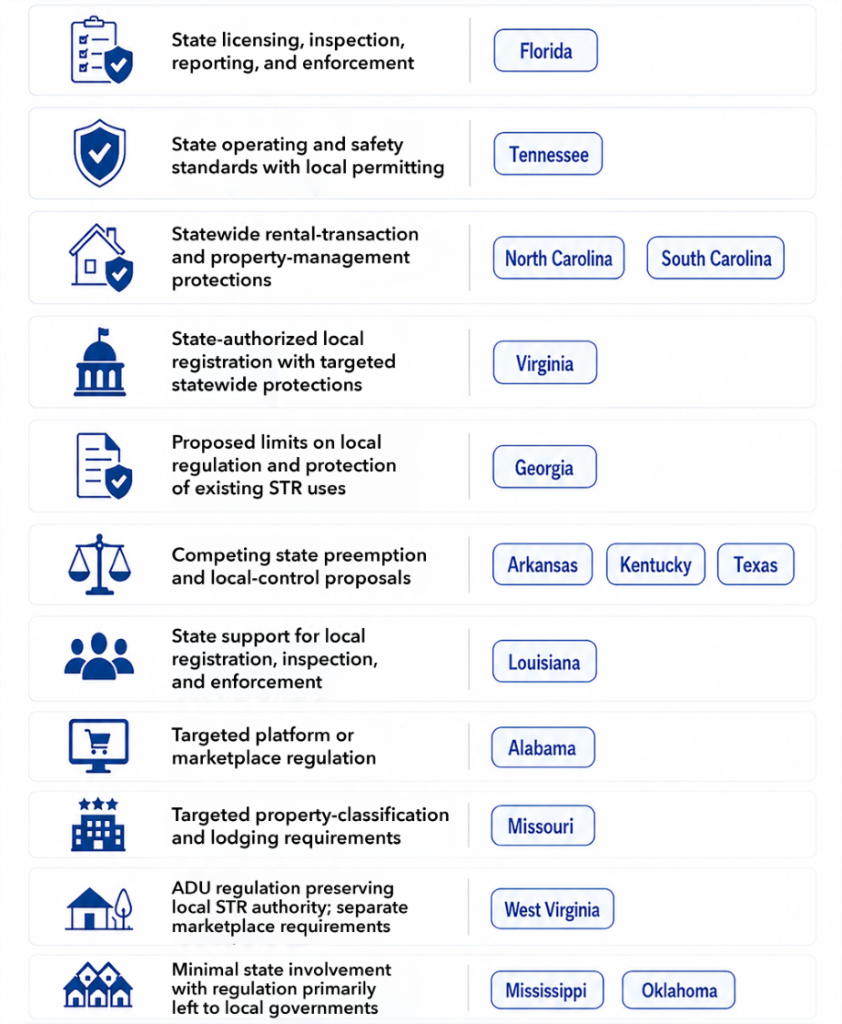
SOURCE: Author’s visualization utilizing data from various state statutes (see CSG South Short-Term Rental Regulation State Profiles).
State Licensing, Inspection, Reporting, and Enforcement
Florida statutes establish a comprehensive statewide regulatory framework for STRs. State law classifies vacation rentals as public lodging establishments.11 Covered vacation rentals must obtain a state license and remain available for inspection upon request.12 The framework establishes property classifications, annual license-renewal requirements, inspection authority, and administrative enforcement procedures.13 Operators must report properties covered by a license, including those advertised or managed online.14
Florida’s statewide regulatory framework operates alongside local ordinances but limits the types of restrictions local governments may impose. Under state law, local governments generally cannot prohibit vacation rentals or regulate their rental duration or frequency, although ordinances adopted on or before June 1, 2011, are exempt from these restrictions. Local governments generally retain authority to administer registration programs and enforce otherwise applicable zoning, parking, noise, and safety requirements.15 Recent legislative proposals have addressed expanded local registration authority, platform responsibilities, and listing-verification requirements. However, the most comprehensive measure passed by the Legislature during the review period was vetoed.16
State Operating and Safety Standards with Local Permitting
Tennessee’s Short-Term Rental Unit Act establishes a comprehensive statewide framework while assigning many implementation responsibilities to local governments. The statute defines a short-term rental unit as a residential dwelling rented wholly or partially for fewer than 30 continuous days. It also provides protection for properties that were operating lawfully before a locality adopted new restrictions.17 At the same time, local governments retain the authority to enforce health, safety, noise, and parking regulations.18
Tennessee regulates short-term rentals through its Short-Term Rental Unit Act and generally applicable building and fire-safety laws. Applicable requirements for smoke alarms, carbon monoxide alarms, and fire sprinklers depend on the property’s classification, construction date, and relevant state or local building standards.19,20 Local governments administer permitting requirements, while permit decisions remain subject to judicial review under state law.21
Statewide Rental-Transaction and Property-Management Protections
North Carolina and South Carolina regulate vacation rentals primarily through statewide laws governing rental transactions and property-management practices. North Carolina’s Vacation Rental Act applies to residential properties rented for vacation, leisure, or recreation purposes for fewer than 90 days to individuals who maintain a different permanent residence.22 The act governs written rental agreements, advance payments, permitted fees, property transfers, mandatory evacuations, expedited evictions, and the responsibilities of landlords and real estate brokers.23 Separately, G.S. 160D-1207(c) generally prohibits local governments from requiring residential rental properties to obtain rental permits or register with the local government, except for properties meeting specified thresholds for housing-code violations or crime and disorder problems. These restrictions do not eliminate otherwise applicable local zoning and land-use authority.24
South Carolina’s Vacation Rental Act similarly governs residential properties rented for fewer than 90 days. Its provisions address written agreements, trust accounts, advance payments, rental-management responsibilities, mandatory evacuations, and property transfers involving future reservations.25 The South Carolina Real Estate Commission may enforce requirements applicable to licensed rental managers.26 Local governments retain authority over land-use and operational regulations, while state law governs rental-management and financial transactions.27
State-Authorized Local Registration with Targeted Statewide Protections
Virginia law authorizes local governments to establish annual STR registries. Localities may collect information about STR properties and their operators and impose fees for noncompliance.28 State law also limits how local registration programs may operate. For example, a locality may not prohibit an STR solely because an authorized operator is a lessee or sublessee.29
Local ordinances adopted after December 31, 2023, also may not require an owner-occupied primary residence used as an STR to obtain a special exception, special-use permit, or conditional-use permit.30 Recent legislative proposals have addressed statewide registration and platform-verification requirements, but Virginia has not adopted a comprehensive state licensing system.31,32 Registration systems are a key distinction among Southern state approaches. Florida has enacted a statewide framework that includes registration requirements, while Virginia has considered legislation to expand registration at the state level (see Figure 2).33,34
FIGURE 2. Enacted and Proposed Statewide Licensing and Registration Requirements
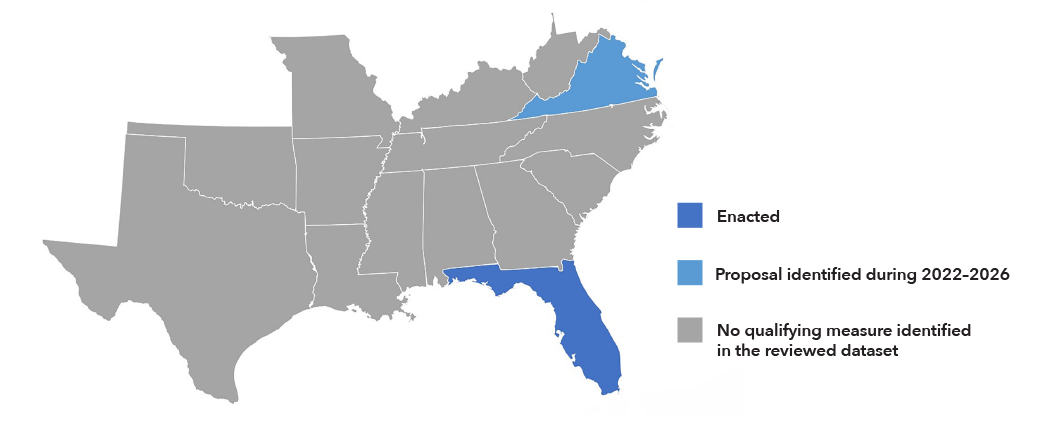
Source: Author’s visualization utilizing data from Quorum.35
Note: Legislative activity reflects qualifying measures identified in the reviewed dataset for 2022–2026, including measures that were introduced, enacted, vetoed, or otherwise did not become law. The absence of an identified measure does not establish that no legislation was considered. Research current through August 5, 2026.
Proposed Limits on Local Regulation and Protection of Existing Uses
Georgia has not enacted a comprehensive statewide framework governing STR registration, operation, or platform compliance. As a result, most zoning, licensing, and enforcement decisions remain with counties and municipalities under their general land-use and police powers. State legislative activity has instead focused on proposals to limit certain local restrictions or protect STRs that were operating lawfully before new local regulations took effect.36
Proposed legislation has addressed whether existing STRs may continue operating after a locality adopts a prohibition, a more restrictive zoning classification, or a new permitting requirement.37 These proposals illustrate the distinction between the regulatory treatment of established STRs and future STR operations.
Competing State Preemption and Local-Control Proposals
Legislative activity in Arkansas, Kentucky, and Texas illustrates differing approaches to balancing state standards with local authority over STRs. Proposed preemption measures have addressed complete local prohibitions, classification of STRs as residential uses, owner-occupancy requirements, rental caps, density limits, minimum-stay requirements, and local permit fees.38,39,40 Other proposals would have preserved local zoning, nuisance, and safety authority or clarified the conditions under which local governments may regulate STRs.41
Arkansas has proposed legislation that would limit local prohibitions and establish uniform registration parameters.42,43 Recent legislative proposals in Kentucky have included both restrictions on local zoning, density, and residency requirements and measures expressly authorizing local regulation of short-term rentals.44,45,46 Texas lawmakers have introduced several state preemption bills, but local governments currently retain primary responsibility for STR zoning, registration, and operating requirements.47
State Support for Local Registration, Inspection, and Enforcement
Louisiana leaves most STR regulation to municipalities and parishes, and proposed state legislation has sought to clarify or expand this local authority. These proposals address local registration, permitting, inspections, compliance with zoning requirements, and enforcement measures.48,49,50 Louisiana’s state-level approach generally supports local regulation rather than replacing it with uniform statewide requirements.
Louisiana law includes a limited definition of STR, with platform-disclosure requirements specific to New Orleans. These provisions relate primarily to the local occupancy-tax structure rather than a broader STR operating framework.51 States also differ in whether a state agency administers or enforces STR-related requirements. Florida. Georgia, South Carolina, and Tennessee have laws assigning state-level enforcement responsibilities to designated agencies.52,53,54 Alabama has considered legislation involving state-level oversight, while other states leave enforcement primarily to local jurisdictions (see Figure 3).55
FIGURE 3. Enacted and Proposed State Enforcement Authority for Selected STR-Related Requirements
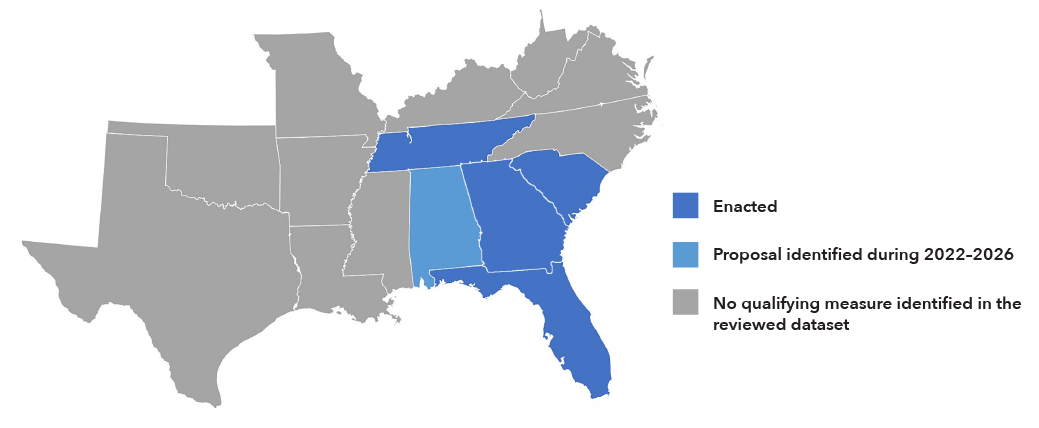
Source: Author’s visualization utilizing data from Quorum.56
Note: State enforcement authority includes statutory powers to administer or enforce selected short-term rental-related requirements, including operator licensing, property-manager obligations, and marketplace oversight. The scope of enforcement varies by state and does not necessarily indicate a comprehensive statewide regulatory framework. Research current through August 5, 2026.
Targeted Platform or Marketplace Regulation
Alabama does not have a comprehensive regulatory framework for STR zoning, registration, or operations. State involvement has included proposed legislation addressing consumer protections and damage guarantees offered by rental marketplaces.57
The proposed marketplace regulations would define platform responsibilities, establish standards for damage-guarantee programs, and authorize state agencies to enforce those requirements.58 These measures differ from platform-verification laws, which generally require an intermediary to confirm that a listing includes a valid registration or license number before it is published.59 No CSG South state had enacted a statewide platform-verification requirement during the review period. Alabama considered targeted regulation of rental-home marketplace guarantees, while Florida, Louisiana, and Virginia considered proposals involving registration information, listing compliance, or removal of unlawful listings (see Figure 4).60,61,62,63 Kentucky separately considered platform notice requirements related to building-code compliance.64
FIGURE 4. State Proposals for STR Platform Registration, License, and Ownership Verification, 2022–2026
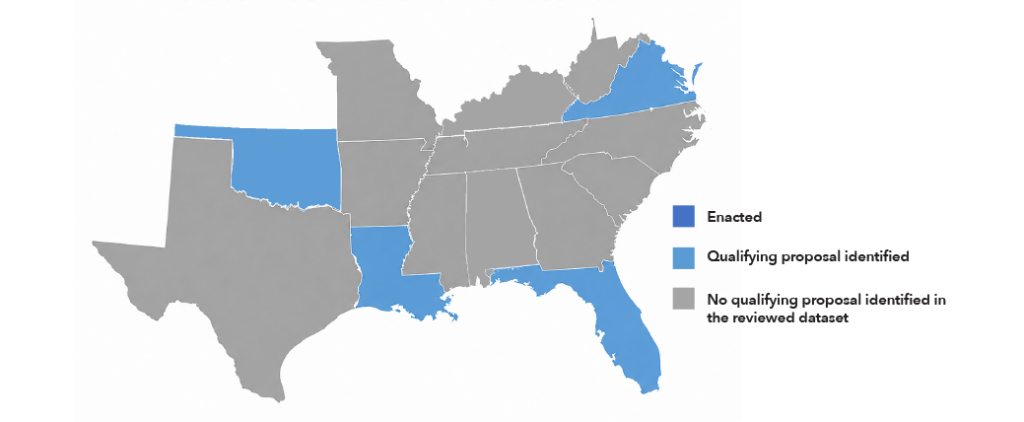
Source: Author’s visualization utilizing data from Quorum.65
Note: This figure identifies state legislative proposals addressing platform verification of short-term rental registration, licensing, or property ownership during 2022–2026. Proposals addressing marketplace guarantees, building-code notices, or other platform responsibilities without a verification component are excluded. The figure reflects measures identified in the reviewed legislative dataset, regardless of final legislative disposition. Research current through August 5, 2026.
Targeted Property-Classification and Lodging Requirements
Missouri does not have a comprehensive STR regulatory framework and defers most zoning, registration, and permitting standards to local governments.66 Recent state legislative proposals have instead focused on property classification and taxation.67 Property classification may affect how a dwelling is treated under state law without establishing a broader STR operating framework.68 Legislation may determine whether a property remains classified as residential when rented for fewer than a specified number of days or whether a particular lodging classification triggers additional regulatory requirements.69 Missouri’s recent proposals, therefore, address property-tax treatment rather than statewide operational standards.70
ADU-Linked Regulation
West Virginia addresses STRs in part through its statewide accessory dwelling unit (ADU) framework.71 The statute limits certain municipal restrictions on the construction and placement of ADUs.72 At the same time, it preserves local authority to determine whether an ADU may be used as an STR.
West Virginia distinguishes between the right to construct an ADU and the right to operate an ADU as a STR.73 A municipality may be required to permit construction of an ADU while retaining authority to impose zoning, registration, and operating requirements on its use as an STR.74
Minimal State Involvement
Mississippi and Oklahoma have limited statewide involvement in STR regulation. Neither state has enacted a comprehensive framework governing STR zoning, registration, or operation. These responsibilities remain with local authorities.75,76
The absence of a comprehensive statewide statute does not necessarily mean that STRs are unregulated. Local governments may regulate STR activity through their general zoning, licensing, building-code, and police powers.77,78 Oklahoma has recently considered broader housing and rental legislation, but these proposals have not established a statewide STR regulatory framework.79
Accessory Dwelling Units (ADUs) and Short-Term Rentals
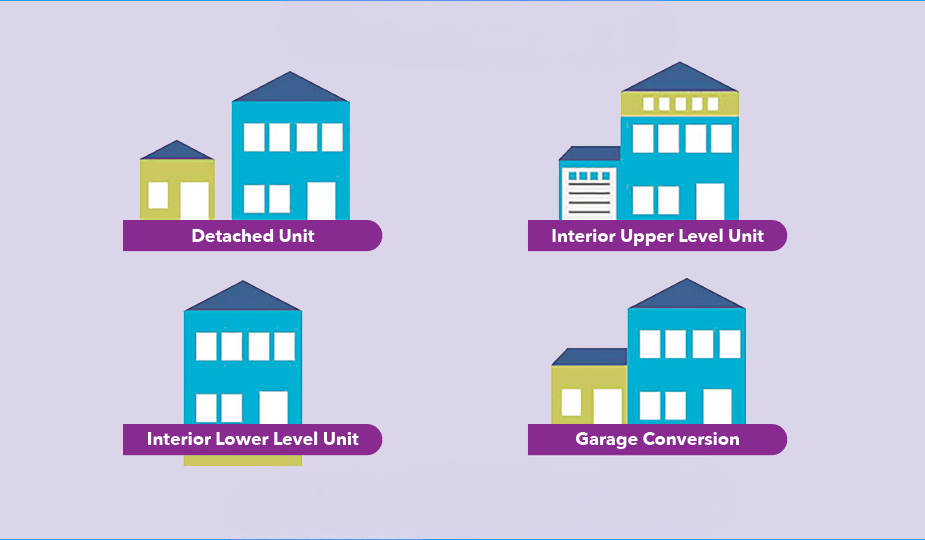
An accessory dwelling unit (ADU) is a secondary housing unit on a single-family residential lot.80 ADUs may be attached to the main home, located within it, created by converting a garage or basement, or constructed as a detached unit (see Figure 5).81 ADUs are often discussed as a way to expand housing options within existing residential neighborhoods.82 They may provide housing for relatives, caregivers, or tenants and can increase the number of available units without requiring a separate subdivision or large development.83
A central policy consideration is whether ADUs will be used as long-term housing for family members or offered as short-term rental units. Some states may require local governments to permit ADU construction while preserving local authority to regulate their use as STRs.84
Several states have enacted or recently considered legislation addressing ADU regulations in the Southern region. Florida has an established statutory framework for these units. Since 2004, state law has authorized local governments to permit ADUs in single-family residential areas and has linked qualifying units to efforts to expand affordable rental housing.85 The statute does not itself establish statewide requirements governing the use of ADUs as short-term rentals.
Arkansas, Virginia, and West Virginia recently enacted statewide ADU legislation. Arkansas and West Virginia require local governments to allow qualifying ADUs while limiting selected zoning and development restrictions and preserving local authority over short-term rental use.86,87 Virginia will require localities to permit qualifying ADUs but allows them to establish a minimum rental term of 30 consecutive days, permitting local governments to restrict short-term use.88
Kentucky, Tennessee, and Texas recently considered legislation that would establish statewide ADU development standards and address the relationship between ADUs and short-term rentals. The Kentucky proposals would allow planning units to prohibit or restrict ADU rentals lasting fewer than 30 days.89 Proposals in Tennessee and Texas would instead preserve local authority to apply existing STR regulations to ADUs.90,91
FIGURE 5. Types of Accessory Dwelling Units (ADUs)
Source: Habitat for Humanity: New York City and Westchester County.92
State Policy Landscape in the South
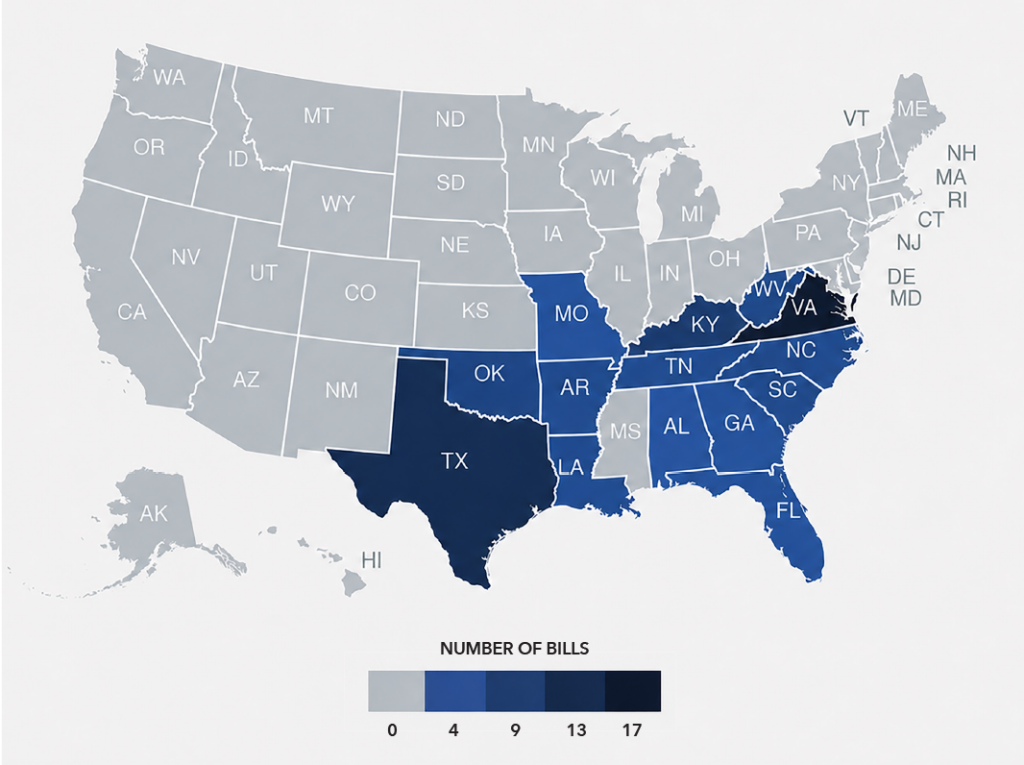
Legislative activity related to STRs has increased across Southern states in recent years (see Appendix I for selected legislation). The number of introduced and enacted measures reflects growing state attention to STR regulation and the range of policy issues associated with these rentals (see Figure 6).
Legislative proposals have expanded beyond basic questions of whether local governments may permit or prohibit STRs toward more detailed frameworks addressing state-local authority, registration and permitting, platform verification, operating and safety standards, enforcement, property rights, and the use of accessory dwelling units as short-term rentals.
Primary Policy Categories of Southern State STR Legislation, 2022-2026.93
- State Preemption and Local Regulatory Authority
- Registration, Permitting, and Enforcement
- Platform and Marketplace Regulation
- Housing and Property-Use Regulation
FIGURE 6. CSG South Short-Term Rental Legislation (2022-2026)
Source: Author’s visualization utilizing data from Quorum.94
Conclusion
The relationship between short-term rental regulation and housing affordability has become an area of policy attention across the CSG South region. STRs have expanded beyond traditional tourism destinations and are now found in urban, suburban, coastal, and rural communities, where they may contribute to tourism and local economic activity.95 At the same time, lawmakers are considering whether converting residential properties to short-term use may reduce the supply of homes available to long-term renters and prospective homeowners, particularly in markets with limited housing inventory or strong tourism demand. Research examining the STR market in Barcelona, Spain, has identified associations between STR activity and local housing-market conditions.96 However, the magnitude and direction of local effects depend on market conditions and the concentration and type of STR activity.
Southern states have adopted a range of policy structures, from comprehensive statewide frameworks to targeted statutes and broad preservation of local authority.97,98 These approaches reflect common policy questions but differing housing markets, legal structures, and tourism economies. State legislatures continue to consider housing availability and affordability alongside property rights, tourism activity, local flexibility, and statewide consistency. Within these frameworks, local governments frequently retain responsibility for zoning, occupancy, parking, and nuisance enforcement.99,100 As housing and STR markets continue to evolve, the relationship between short-term rental regulation and long-term housing availability is likely to remain an important consideration for state policymakers across the region.
Appendix I: CSG South Short-Term Rental Legislation (2022-2026)
| STATE | BILL | YEAR | FINAL DISPOSITION | SUMMARY |
| Alabama | House Bill 296 | 2026 | Second Reading in Second Chamber | Would have established the Rental Home Marketplace Guarantees Act, requiring providers of rental-home marketplace guarantees to register with the Commissioner of Insurance, maintain reimbursement insurance, disclose guarantee terms, and comply with state enforcement and civil penalty provisions. |
| Arkansas | House Bill 1445 | 2025 | Withdrawn | Would have prohibited local governments from effectively banning short-term rentals while allowing registration, limited enforcement for repeated violations, and health and safety regulations. |
| Arkansas | House Bill 1790 | 2025 | Third (Final) Reading | Would have prohibited local governments from banning or capping short-term rentals while authorizing local permitting, health and safety standards, and enforcement for ordinance violations. |
| Arkansas | House Bill 1503 | 2025 | Became Public Law | Limits municipal regulation of accessory dwelling units by requiring that at least one ADU be permitted by right on single-family residential lots and by restricting certain local development standards. |
| Arkansas | Senate Bill 197 | 2023 | Failed House | Would have prohibited local governments from effectively restricting short-term rentals while allowing permitting, limited enforcement, and classification of short-term rentals as residential land uses. |
| Florida | Committee Substitute/ Committee Substitute/ Senate Bill 48 | 2026 | Passed Senate | Would have required local governments to allow accessory dwelling units by right in single-family residential areas while limiting certain local regulatory requirements and permitting local restrictions on short-term rentals of less than one month. |
| Florida | Senate Bill 280 | 2024 | Vetoed | Would have created a more comprehensive vacation-rental framework involving local registration, advertising-platform compliance, license-number disclosures, inspections, and expanded state and local enforcement authority. |
| Florida | Senate Bill 714 | 2023 | Third Reading in Second Chamber | Would have expanded state and local regulation of vacation rentals by establishing platform listing and verification requirements, authorizing local registration programs, and strengthening state licensing and enforcement provisions. |
| Georgia | Senate Bill 570 | 2026 | Became Public Law | Requires annual human trafficking awareness training and reporting procedures for certain short-term rental property managers and lodging employees. |
| Georgia | House Bill 1121 | 2024 | Second Reading | Would have prohibited local governments from banning existing short-term rentals under certain conditions while allowing enforcement for repeated violations and permitting noncompliance. |
| Kentucky | Senate Bill 112 | 2026 | Referred to Committee | Would have established statewide standards limiting local regulation of short-term rentals while authorizing local permitting and enforcement for health and safety violations. |
| Kentucky | Senate Bill 54 | 2026 | Referred to Committee | Would have authorized local governments to regulate short-term rentals through zoning, licensing, inspections, occupancy, density, and owner-occupancy requirements. |
| Kentucky | House Bill 203 | 2026 | Referred to Committee | Would have required accessory dwelling units to be permitted by right in all residential zones while limiting local regulation and allowing planning units to prohibit or restrict their use as short-term rentals. |
| Kentucky | Senate Bill 110 | 2025 | Referred to Committee | Would have prohibited local governments from requiring conditional use permits or imposing density-based restrictions on short-term rentals. |
| Kentucky | Senate Bill 81 | 2025 | Referred to Committee | Would have authorized local governments to regulate short-term rentals through registries, permitting, zoning, and operational restrictions. |
APPENDIX I CONTINUED: CSG South Short-Term Rental Legislation (2022-2026)
| STATE | BILL | YEAR | FINAL DISPOSITION | SUMMARY |
| Kentucky | House Bill 576 | 2025 | Referred to Committee | Would have required accessory dwelling units to be permitted by right in all residential zones while limiting local regulation and allowing planning units to prohibit or restrict their use as short-term rentals. |
| Kentucky | Senate Bill 368 | 2024 | Referred to Committee | Would have required short-term rental platforms to identify listings subject to Kentucky’s residential building code and notify property owners and state officials. |
| Kentucky | Senate Bill 375 | 2024 | Referred to Committee | Would have clarified that deed restrictions or covenants do not prohibit short-term rentals unless they expressly state otherwise. |
| Kentucky | Senate Bill 234 | 2024 | Referred to Committee | Would have established a statewide framework governing owner-occupied and non-owner-occupied short-term rentals, including permitting, zoning, and local regulatory authority. |
| Louisiana | Senate Bill 225 | 2025 | Referred to Committee in the Second Chamber | Would have created a civil cause of action allowing certain parties to seek enforcement of local short-term rental laws against unlawful operators. |
| Louisiana | House Bill 469 | 2025 | Referred to Committee | Would have authorized municipalities and parishes to regulate short-term rentals through permitting, inspections, occupancy limits, and safety standards. |
| Louisiana | House Bill 518 | 2024 | Referred to Committee | Would have required short-term rental booking platforms to verify local permit information, remove unlawful listings, and subject violations to civil penalties. |
| Louisiana | House Study Request 5 | 2023 | Filed | Would have requested a legislative study of the legal liability of online booking platforms that facilitate unlawful short-term rentals. |
| Missouri | Senate Bill 1365 | 2026 | Referred to Committee | Would have required operators of short-term rental properties to complete annual human trafficking awareness training and establish reporting procedures for suspected trafficking. |
| North Carolina | Senate Bill 291 | 2025 | Referred to Senate Committee | Would have established statewide standards limiting local restrictions on short-term rentals while allowing permitting, occupancy limits, parking requirements, and health and safety enforcement. |
| North Carolina | Senate Bill 495 | 2025 | Referred to Senate Committee | Would have required local governments to allow at least one accessory dwelling unit for each qualifying single-family detached dwelling, to limit certain local zoning, parking, fee, and utility restrictions, and to protect the separate long-term rental of the primary residence and the ADU as part of an affordable-housing strategy. |
| North Carolina | Senate Bill 667 | 2023 | Referred to Senate Committee | Would have limited local restrictions on short-term rentals while authorizing permitting, occupancy limits, parking requirements, and enforcement of local ordinances. |
| North Carolina | Senate Bill 290 | 2023 | Referred to Senate Committee | Would have established safety and operational standards for short-term rentals, including occupancy limits, inspection authority, smoke and carbon monoxide detector requirements, and responsibilities for landlords and property managers. |
| Oklahoma | Senate Bill 1769 | 2026 | Referred to Committee in the Second Chamber | Would have allowed short-term rental owners to require renters to provide government-issued identification and required booking platforms to support identity verification and penalty-free cancellations for discrepancies. |
| Oklahoma | Senate Bill 1624 | 2026 | Referred to Committee | Would have required the consent of all owners before jointly owned property may be listed as a short-term rental and required platforms to verify ownership and suspend unauthorized listings. |
APPENDIX I CONTINUED: CSG South Short-Term Rental Legislation (2022-2026)
| STATE | BILL | YEAR | FINAL DISPOSITION | SUMMARY |
| Oklahoma | Senate Bill 1519 | 2026 | Reported Favorably by Committee | Would have prohibited municipalities from imposing certain restrictions on no-impact home-based businesses while preserving local authority to regulate short-term rental units. |
| Oklahoma | Senate Bill 986 | 2025 | Referred to Committee | Would have required businesses, including providers of short-term lodging, to clearly disclose all mandatory fees before a consumer completes a purchase. |
| Oklahoma | House Bill 3296 | 2024 | Referred to Committee | Would have authorized municipalities to prohibit the use of residential dwellings as short-term rentals. |
| South Carolina | Senate Bill 0442 | 2025 | Referred to Committee | Would have authorized local governments to regulate or prohibit short-term rentals through registration, permitting, insurance, local representation, and operational requirements. |
| South Carolina | House Bill 3861 | 2025 | Referred to Committee | Would have prohibited local governments from banning short-term rentals and established penalties for jurisdictions that enact prohibited restrictions. |
| South Carolina | Senate Bill 0953 | 2024 | Referred to Committee | Would have prohibited most local restrictions on short-term rentals while establishing statewide requirements for lodging marketplaces and accommodations intermediaries. |
| South Carolina | House Bill 3253 | 2023 | Referred to Committee | Would have prohibited local governments from enacting or enforcing ordinances that ban short-term rentals and established penalties for violations. |
| South Carolina | House Bill 4547 | 2022 | Referred to Committee | Would have prohibited municipalities and counties from prohibiting short-term residential rentals and established penalties for noncompliance. |
| Tennessee | Senate Bill 2131 | 2026 | Referred to Senate Committee | Would have limited local regulation of accessory dwelling units by establishing statewide standards for permitting, development, and design while allowing local governments to apply existing short-term rental regulations to ADUs. |
| Tennessee | Senate Bill 1008 | 2025 | Referred to Senate Committee | Would have authorized municipalities to establish rental-property registries for residential rental units, including short-term rentals, and require owners to provide information on property, ownership, management, unit count, and code compliance. |
| Tennessee | Senate Bill 2281 | 2024 | Referred to Senate Committee | Would have limited local governments’ ability to prohibit or substantially restrict short-term rentals while authorizing certain regulations for owner-and renter-occupied properties. |
| Texas | House Bill 2464 | 2025 | Became Public Law | Limits municipal regulation of qualifying home-based businesses but expressly preserves municipal authority to regulate the operation of short-term rental units. |
| Texas | Senate Bill 673 | 2025 | Reported Favorably by Committee | Would have limited municipal and county regulation of accessory dwelling units by establishing statewide standards for their construction, permitting, and development while preserving certain local zoning authority. |
| Texas | House Bill 5225 | 2025 | Referred to House Committee | Would have prohibited property owners’ associations from requiring approval for short-term rentals or requiring prospective tenant application materials as a condition of renting. |
| Texas | House Bill 1779 | 2025 | Referred to House Committee | Would have established statewide standards limiting local regulation of accessory dwelling units by restricting certain zoning and design requirements, streamlining permit approvals, and preserving limited local authority. |
APPENDIX I CONTINUED: CSG South Short-Term Rental Legislation (2022-2026)
| STATE | BILL | YEAR | FINAL DISPOSITION | SUMMARY |
| Texas | House Bill 878 | 2025 | Referred to House Committee | Would have limited municipal regulation of residential land use and accessory dwelling units by establishing statewide standards for zoning, permitting, and development, while authorizing certain local land-use regulations. |
| Texas | Senate Bill 840 | 2025 | Signed by the Governor | Limits municipal regulation of mixed-use and multifamily residential developments by establishing statewide zoning and development standards for qualifying projects. |
| Texas | Senate Bill 854 | 2025 | Reported Favorably by Committee | Would have limited municipal regulation of multifamily and mixed-use housing developments on religious land by establishing statewide standards for zoning, permitting, and development. |
| Texas | House Bill 2480 | 2025 | Referred to House Committee | Would have authorized municipalities and counties to regulate accessory dwelling units under a statewide framework while allowing local governments to apply existing short-term rental regulations to ADUs. |
| Texas | Senate Bill 1412 | 2023 | Failed Senate | Would have established statewide standards limiting local regulation of accessory dwelling units by restricting certain zoning and design requirements, streamlining permit approvals, and preserving limited local authority. |
| Texas | House Bill 3169 | 2023 | Second Reading | Would have limited municipal regulation of short-term rentals while authorizing inspections, emergency contacts, insurance requirements, and enforcement of health and safety standards. |
| Texas | House Bill 2665 | 2023 | Introduced in Senate | Would have established a task force to study municipal regulation of short-term rentals and develop recommendations for potential statewide legislation. |
| Texas | House Bill 2789 | 2023 | Reported Favorably by Committee | Would have established statewide standards limiting local regulation of accessory dwelling units by restricting certain zoning and development requirements, streamlining permit approvals, and allowing political subdivisions to apply existing short-term rental regulations to ADUs. |
| Virginia | Senate Bill 182 | 2026 | Referred to House Committee | Would have required short-term rental operators and certain employees to complete recurring human trafficking awareness training and incorporated the requirement into local short-term rental registry ordinances. |
| Virginia | House Bill 600 | 2026 | Failed by Committee | Would have required short-term rental operators and certain employees to complete approved human trafficking awareness training as part of local short-term rental registration requirements. |
| Virginia | Senate Bill 531 | 2026 | Signed by the Governor | Requires localities to permit qualifying accessory dwelling units in single-family residential districts, limits certain local zoning and permitting restrictions, caps the ADU permit fee at $500, and allows localities to require rental terms of at least 30 consecutive days. |
| Virginia | House Bill 1557 | 2025 | Left Unfinished | Would have established a statewide short-term rental registry and required accommodations intermediaries to remove noncompliant listings or face civil penalties. |
| Virginia | House Bill 1654 | 2025 | Left Unfinished | Would have required accommodations intermediaries to verify that short-term rental providers have completed human trafficking awareness training before listing their properties. |
| Virginia | House Bill 1688 | 2025 | Left Unfinished | Would have required accommodations intermediaries to remove unlawful short-term rental listings upon notification from a locality and established civil penalties for noncompliance. |
| Virginia | Senate Bill 985 | 2025 | Replaced With a Substituted Wholesale | Would have required accommodations intermediaries to ensure short-term rental providers complete human trafficking awareness training before listing their properties. |
| Virginia | Senate Bill 1330 | 2025 | Referred to Senate Committee | Would have established a statewide short-term rental registry and required accommodations intermediaries to remove noncompliant listings or face civil penalties. |
APPENDIX I CONTINUED: CSG South Short-Term Rental Legislation (2022-2026)
| STATE | BILL | YEAR | FINAL DISPOSITION | SUMMARY |
| Virginia | House Bill 900 | 2025 | Left Unfinished | Would have required localities to permit accessory dwelling units in single-family residential zoning districts while limiting certain zoning, parking, setback, and occupancy requirements. |
| Virginia | Senate Bill 544 | 2024 | Signed by the Governor | Prohibits localities from requiring special-use or conditional-use permits for owner-occupied primary residences used as short-term rentals. |
| Virginia | House Bill 1461 | 2024 | Signed by the Governor | Prohibits localities from banning lessees or sublessees from operating short-term rentals with the property owner’s permission, while allowing limits on the number of properties they operate. |
| Virginia | House Bill 1034 | 2024 | Left Unfinished | Would have authorized localities to enforce short-term rental zoning ordinance violations through a schedule of civil penalties instead of criminal penalties. |
| Virginia | House Bill 695 | 2024 | Left Unfinished | Would have established a statewide short-term rental registry and required accommodations intermediaries to remove noncompliant listings or face civil penalties. |
| Virginia | House Bill 2103 | 2023 | Left Unfinished | Would have authorized localities to require special exceptions or special use permits for short-term rentals to expire upon specified changes in ownership, management, or operation. |
| Virginia | Senate Bill 1391 | 2023 | Referred to Senate Committee | Would have limited local governments’ authority to impose certain restrictions on short-term rentals managed by Virginia-licensed real estate professionals. |
| Virginia | House Bill 1362 | 2022 | Referred to Senate Committee | Would have clarified that short-term rentals may operate unless expressly restricted by a locality’s zoning ordinance. |
| Virginia | Senate Bill 602 | 2022 | Left Unfinished | Would have limited certain local restrictions on short-term rentals, including neighbor approval requirements and restrictions beyond general zoning authority. |
| West Virginia | Senate Bill 659 | 2026 | Became Public Law | Requires municipalities to allow at least one accessory dwelling unit by right on qualifying residential lots and limits certain local zoning and development restrictions. |
| West Virginia | House Bill 4732 | 2026 | Referred to House Committee | Would have required municipalities to permit at least one accessory dwelling unit by right on qualifying residential lots and limited certain local zoning, design, and development restrictions. |
| West Virginia | House Bill 5065 | 2026 | Became Public Law | Establishes recordkeeping requirements for lodging marketplace facilitators, including short-term rentals, and requires geographic verification measures to ensure occupancy taxes are collected and remitted to the appropriate local governments. |
| West Virginia | House Bill 3053 | 2025 | Referred to House Committee | Would have required municipalities to permit accessory dwelling units by right on qualifying residential lots and limited certain local zoning and development restrictions to expand housing opportunities. |
| West Virginia | House Bill 5164 | 2024 | Referred to House Committee | Would have established statewide standards for fabricated expandable homes and authorized their use as accessory dwelling units while creating permitting and safety requirements. |
| West Virginia | House Concurrent Resolution 70 | 2023 | Passed House | Would have requested a legislative study to evaluate whether local regulation of short-term rental properties infringes on private property and contract rights and to assess the need for statewide legislation. |
Citations
- Legal Information Institute. “Home Rule.” Wex. Cornell Law School. Last reviewed March 2022. Accessed August 5, 2026.
- Legal Information Institute. “Dillon’s Rule.” Wex. Cornell Law School. Last reviewed July 2024. Accessed August 5, 2026.
- Legal Information Institute, Home Rule.
- Ibid.
- Witthaus, Adina. “Understanding Short-Term Rentals and Local Regulation.” Granicus. Accessed August 5, 2026.
- Ibid.
- Legal Information Institute, Dillon’s Rule.
- Ibid.
- Hamilton, Emily, Christopher Koopman, and Nicholas Zaiac. “Land Use and Homesharing Regulation: A Call for State Preemption.” Mercatus Center, February 15, 2018.
- Ibid.
- Florida Legislature, § 509.242. Public Lodging Establishments; Classifications.
- Florida Legislature. “§ 509.032. Duties.” Florida Statutes, 2025. Accessed August 5, 2026.
- Florida Legislature. “§ 509.241. Licenses Required; Exceptions; Division Online Accounts and Transactions.” Florida Statutes (2026). https://www.flsenate.gov/Laws/Statutes/2026/509.241
- Ibid.
- Florida Legislature, § 509.032. Duties.
- Florida Senate. “Senate Bill 280: Vacation Rentals.” 2024 Regular Session. Vetoed June 27, 2024.
- Tennessee General Assembly. “§ 13-7-603. Effect of Ordinance or Other Requirement That Prohibits or Regulates Use of Property as Short-Term Rental Unit.” Tennessee Code Annotated (2025).
https://law.justia.com/codes/tennessee/title-13/chapter-7/part-6/section-13-7-603/ - Tennessee General Assembly. “§ 13-7-604. Prohibition of Continued Use of Property as Short-Term Rental Unit Based on Violations; Authorization of Short-Term Rental Units Through Permitting or Application Process.” Tennessee Code Annotated (2025). https://law.justia.com/codes/tennessee/title-13/chapter-7/part-6/section-13-7-604/
- Tennessee General Assembly. “Short-Term Rental Unit Act.” Tennessee Code Annotated, §§ 13-7-601–13-7-606 (2025).
https://law.justia.com/codes/tennessee/title-13/chapter-7/part-6/ - Tennessee General Assembly. “Smoke Alarms and Carbon Monoxide Alarms in Residential Buildings.” Tennessee Code Annotated, § 68-120-112 (2025). Justia.
https://law.justia.com/codes/tennessee/title-68/safety/chapter-120/part-1/section-68-120-112/ - Tennessee General Assembly. “§ 13-7-604. Prohibition of Continued Use of Property as Short-Term Rental Unit Based on Violations; Authorization of Short-Term Rental Units Through Permitting or Application Process.” Tennessee Code Annotated (2025). https://law.justia.com/codes/tennessee/title-13/chapter-7/part-6/section-13-7-604/
- North Carolina General Assembly, Chapter 42A: Vacation Rental Act.
- Ibid.
- North Carolina General Assembly. “North Carolina General Statutes § 160D-1207: Periodic Inspections.” North Carolina General Statutes, Chapter 160D, § 160D-1207.
https://www.ncleg.gov/EnactedLegislation/Statutes/HTML/BySection/Chapter_160D/GS_160D-1207.html - South Carolina General Assembly, South Carolina Vacation Rental Act.
- Ibid.
- Ibid.
- Virginia General Assembly, § 15.2-983. Creation of Registry for Short-Term Rental of Property.
- Ibid.
- Ibid.
- Virginia General Assembly. House Bill 1557: Short-Term Rentals; Statewide Registry; Accommodations Intermediaries. 2025 Regular Session.
- Virginia General Assembly. Senate Bill 1330: Short-Term Rentals; Statewide Registry; Accommodations Intermediaries. 2025 Regular Session.
- Florida Legislature, Chapter 509: Lodging and Food Service Establishments.
- Virginia General Assembly, House Bill 1557.
- Quorum. “Short-Term Rental Legislation in the South, 2022–2026.” External spreadsheet. Accessed August 5, 2026.
- Georgia General Assembly. House Bill 1121: Local Government; Suspending or Prohibiting the Continued Use of Property as a Short-Term Rental Unit by a Property Owner under Certain Circumstances; Prohibit. 157th General Assembly, 2023–2024 Regular Session. Introduced February 1, 2024.
- Ibid.
- Arkansas General Assembly. House Bill 1445: An Act to Prohibit Certain Restrictions on the Regulation of Short-Term Rentals. 95th General Assembly, Regular Session, 2025.
- Kentucky General Assembly. Senate Bill 110: An Act Relating to Short-Term Rentals. 2025 Regular Session. Introduced
February 6, 2025. - Texas Legislature. House Bill 3169: Relating to the Regulation of Short-Term Rental Units by Municipalities and Counties. 88th Legislature, Regular Session, 2023.
- Kentucky General Assembly. Senate Bill 81: An Act Relating to Short-Term Rentals. 2025 Regular Session.
Introduced February 4, 2025. - Arkansas General Assembly, House Bill 1445.
- Arkansas General Assembly. House Bill 1790: An Act to Amend the Law Concerning the Regulation of Short-Term Rentals by a Local Government. 95th General Assembly, Regular Session, 2025. As engrossed April 3, 2025.
- Kentucky General Assembly. Senate Bill 54: An Act Relating to Short-Term Rentals. 2026 Regular Session.
Introduced January 9, 2026. - Kentucky General Assembly, Senate Bill 81.
- Kentucky General Assembly. Senate Bill 110: An Act Relating to Short-Term Rentals. 2025 Regular Session.
Introduced February 6, 2025. - Texas Legislature, House Bill 3169.
- Louisiana Legislature. House Bill 469: Provides Relative to Regulations for Short-Term Rentals. 2025 Regular Session. Prefiled March 31, 2025.
- Louisiana Legislature. House Bill 518: Provides for Civil Penalties against an Interactive Computer Service That Books Short-Term Rentals of Property That Is Not in Compliance with Local Ordinances. 2024 Regular Session. Introduced by Representative Alonzo Knox.
- Louisiana Legislature. Senate Bill 225: Provides for a Cause of Action for Operation of Short-Term Rentals. 2025 Regular Session. Introduced by Senator Royce Duplessis.
- Louisiana State Legislature, La. Rev. Stat. § 47:338.221: City of New Orleans; Short-Term Rental Occupancy Tax.
- Florida Legislature, § 509.032, Duties.
- South Carolina General Assembly, South Carolina Vacation Rental Act.
- Tennessee Department of Commerce and Insurance, Tennessee Real Estate Commission. “Vacation Lodging Service.” Accessed August 5, 2026. https://www.tn.gov/commerce/regboards/trec/license/license-how-to/vacation-lodging-service.html.
- Alabama Legislature. House Bill 296: Rental Home Marketplace Guarantees Act. 2026 Regular Session. Introduced January 20, 2026. https://alison.legislature.state.al.us/files/pdf/SearchableInstruments/2026RS/HB296-int.pdf.
- Quorum, Short-Term Rental Legislation in the South, 2022–2026.
- Alabama Legislature, House Bill 296.
- Ibid.
- San Francisco Planning Department. “FAQs on Short-Term Rentals.” Office of Short-Term Rentals. Accessed August 5, 2026.
- Alabama Legislature, House Bill 296.
- Florida Senate, Senate Bill 280: Vacation Rentals.
- Louisiana Legislature. House Bill 518: Provides for Civil Penalties against an Interactive Computer Service That Books Short-Term Rentals of Property That Is Not in Compliance with Local Ordinances. 2024 Regular Session.
- Virginia General Assembly. House Bill 1557: Short-Term Rentals; Statewide Registry; Accommodations Intermediaries. 2025 Regular Session.
- Kentucky General Assembly. Senate Bill 368: An Act Relating to Short-Term Rentals. 2024 Regular Session.
- Quorum, Short-Term Rental Legislation in the South, 2022–2026.
- Missouri General Assembly. “§ 89.020. Powers of Municipal Legislative Body.” Revised Statutes of Missouri. Effective August 28, 2019. Accessed August 5, 2026.
- Missouri House of Representatives. House Bill 1768: Modifies Provisions Relating to the Classification of Certain Residential Real Property Used for Short-Term Rentals. 103rd General Assembly, Second Regular Session, 2026.
- Missouri General Assembly, Committee on Legislative Research, Oversight Division. Fiscal Note for HCS for House Bills 1768 and 2060. L.R. No. 4108H.02C. March 10, 2026.
- Missouri General Assembly. “§ 137.016. Classification of Real Property.” Revised Statutes of Missouri. Accessed August 5, 2026.
- Missouri House of Representatives, House Bill 1768.
- West Virginia Legislature. “Article 42. Accessory Dwelling Units.” West Virginia Code, §§ 8-42-1–8-42-3.
Accessed August 5, 2026. - Ibid.
- Ibid.
- Ibid.
- Mississippi Legislature. “Title 17, Chapter 1: Zoning, Planning and Subdivision Regulation.” Mississippi Code of 1972, §§ 17-1-1–17-1-75. 2025. Accessed August 5, 2026.
- Oklahoma Legislature. “Title 11, § 43-103: Purpose of Regulations—Comprehensive Plan.” Oklahoma Statutes.
Accessed August 5, 2026. - Mississippi Legislature, Title 17, Chapter 1.
- Oklahoma Legislature, 11 O.S. § 43-103.
- Oklahoma Legislature. Senate Bill 1519: Municipal Zoning; Prohibiting a Municipal Governing Body from Adopting Certain Regulations. 60th Legislature, Second Regular Session, 2026. Introduced January 12, 2026.
- Building an ADU. “What Is an ADU: Accessory Dwelling Units Explained.” Accessed October 21, 2026.
https://www.buildinganadu.com/what-is-an-adu. - Ibid.
- U.S. Department of Housing and Urban Development, Office of Policy Development and Research. Accessory Dwelling Units: Case Study. Prepared by Sage Computing, Inc. Washington, DC: U.S. Department of Housing and Urban Development, June 2008. https://www.huduser.gov/portal/publications/adu.pdf.
- Texas House Research Organization. “Bill Analysis: C.S.S.B. 673, Relating to Municipal and County Regulation of Accessory Dwelling Units.” 89th Legislature, Regular Session, 2025.
- West Virginia Legislature. Senate Bill 659: An Act Relating to Municipal Regulation of Accessory Dwelling Units. 2026 Regular Session. Passed March 6, 2026; effective June 4, 2026.
- Florida Legislature. “§ 163.31771. Accessory Dwelling Units.” Florida Statutes, 2025. Accessed August 5, 2026.
- Arkansas General Assembly. Act 313 of 2025: An Act to Amend the Law Concerning Municipal Regulations and to Prohibit Certain Restrictions on the Regulation of Accessory Dwelling Units. Approved March 18, 2025.
- West Virginia Legislature. Enrolled Committee Substitute for Senate Bill 659: An Act Relating to Municipal Regulation of Accessory Dwelling Units. 2026 Regular Session. Passed March 6, 2026; effective June 4, 2026.
- Virginia General Assembly. “§ 15.2-2292.4. Development and Use of Accessory Dwelling Units.” Code of Virginia. Effective July 1, 2027. Accessed August 5, 2026.
- Kentucky General Assembly. House Bill 203: An Act Relating to Accessory Dwelling Units. 2026 Regular Session. Introduced January 5, 2026.
- Tennessee General Assembly. Senate Bill 2131: An Act Relative to Accessory Dwelling Units. 114th General Assembly, 2026. Introduced by Senator Ferrell Haile.
- Texas Legislature. Senate Bill 673: Relating to Regulation of Accessory Dwelling Units by Political Subdivisions. 89th Legislature, Regular Session, 2025. Senate committee report version.
- Habitat for Humanity New York City and Westchester County. “Plus One ADU.” Accessed August 5, 2026.
- Quorum, Short-Term Rental Legislation in the South, 2022–2026.
- Ibid.
- Granicus. 2024 Short-Term Rental Benchmark Report. 2024.
https://granicus.com/resource/2024-short-term-rental-benchmark-report/ - Miquel-Àngel Garcia-López, Jordi Jofre-Monseny, Rodrigo Martínez-Mazza, and Mariona Segú. “Do Short-Term Rental Platforms Affect Housing Markets? Evidence from Airbnb in Barcelona.” Journal of Urban Economics 119 (2020): 103278.
https://doi.org/10.1016/j.jue.2020.103278 - Florida Legislature, § 509.032, Duties.
- Virginia General Assembly, § 15.2-983. Creation of Registry for Short-Term Rental of Property.
- Mississippi Legislature, Title 17, Chapter 1.
- Oklahoma Legislature, 11 O.S. § 43-103.