

Issue Brief by Policy Analyst, Erin Twomey Partin
DOWNLOADHuman trafficking is recognized as a crime involving the exploitation of individuals for labor or commercial sex by way of force, fraud, or coercion. Human trafficking data is collected through various sources, including victim service providers, law enforcement, and government agencies. Still, there are data collection challenges due to the nature of the crime and data-sharing restrictions.¹
Available global estimates suggest that approximately 3.5 out of every 1,000 people experienced human trafficking in 2021.²
Through the aggregation of multiple U.S. and international databases, it is further estimated that among victims exploited in the United States, 77 percent are subjected to forced labor, while 23 percent experience commercial sex exploitation.³ These figures highlight distinctions in types of trafficking and the unique policy responses that may be necessary.
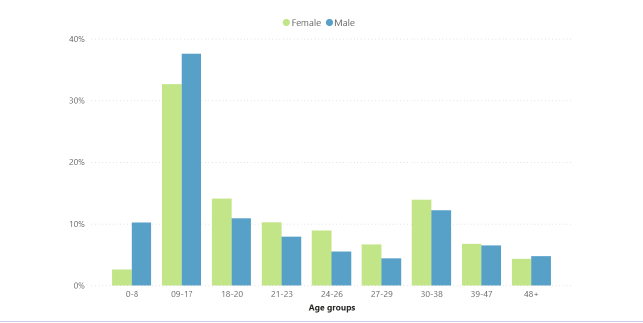
Figure 1 shows that children between the ages of nine and seventeen are particularly vulnerable. Based on available reported cases, within this age group, boys are more frequently trafficked than girls, while in adulthood, the risk is higher for women than for men.⁴
FIGURE 1. Distribution of American Victims by Age and Sex
Identified cases of human trafficking are more frequently reported in heavily populated areas and transportation hubs.⁶ This is evident in the United States, where the states with the top five highest identified cases of human trafficking as of 2023 are California, Texas, Florida, New York, and Illinois (see Figure 2).⁷ However, this does not mean human trafficking is not an issue in more rural, less populous states. For instance, in 2020, Mississippi and Nevada had the highest case rates per 100,000.⁸
As seen in Figure 3, based on 2020 census data and reported cases of human trafficking in 2023, Texas, Arkansas, Missouri, Mississippi, and Florida have the highest rates of human trafficking cases per 100,000 residents.⁹ Available studies suggest that reported human trafficking cases in rural areas more often involve labor exploitation — particularly in industries such as agriculture, forestry, and domestic work¹⁰ — while reported instances of sex trafficking occur less frequently.¹¹
It is also important to note that variations in reported cases, particularly in rural areas, may be influenced by differences in reporting capacity, training, and available resources, which can affect how trafficking is identified and documented. Limited access to specialized training can affect the ability of law enforcement agencies to consistently identify trafficking indicators.¹² Therefore, the perceived prevalence of human trafficking could be distorted from the true population rate.
FIGURE 2. Total Human Trafficking Cases Identified by State
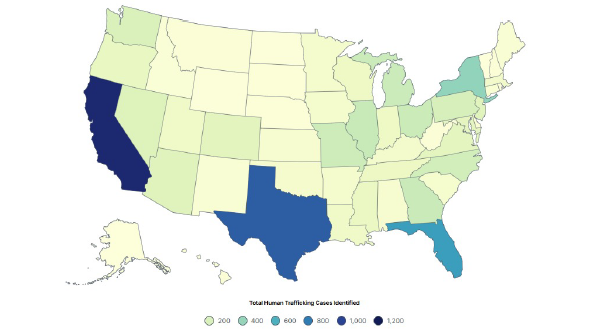
FIGURE 3. Rate of Human Trafficking Cases per 100,000

Forced Criminality
Forced criminality in human trafficking is a form of manipulation where victims are coerced through violence, isolation, and threats into engaging in criminal activities like prostitution, drug offenses, theft, and cybercrimes, allowing traffickers to profit from the victim’s actions while the victim is subjected to the consequences.¹⁶ A 2023 report from Polaris, operators of the National Human Trafficking Hotline, found that 40 percent of human trafficking victims have criminal records, and of that 40 percent, 90 percent of respondents reported that their record is related to their trafficking.¹⁷
Various factors facilitate the transition from being a victim of forced criminality to becoming entangled in the justice system. In many cases, victimization is not immediately apparent at the time of the offense, making it difficult for law enforcement, especially officers that do not have specialized training, to distinguish between a willing participant and someone acting under duress.¹⁸ Victims exist across all demographics and are sometimes unwilling to self-identify out of fear of repercussions from their trafficker or a general lack of trust in authority.¹⁹ Furthermore, some victims choose not to self-identify due to complicated feelings towards their traffickers as a result of trauma bonding, psychological dependence, and manipulation.²⁰
Resulting arrests, convictions, and sentences can create long-term practical barriers — access to employment, housing, educational opportunities, etc. — which complicate victims’ efforts to reestablish their lives after escaping a trafficking situation. Residual criminal records act as “collateral consequences” that impede access to employment, housing, education, and government benefits, which may create additional hindrance to reintegration and long-term recovery.²¹
Legal Protections
There are both federal and state-level protections in place to assist victims in navigating the justice system. However, these protections vary across jurisdictions. Because traffickers may move victims between cities, states, or other regions, the offenses victims are compelled to commit can occur in multiple jurisdictions. As a result, individuals seeking to address the consequences of forced criminality may need to navigate several record-clearance or sealing processes, creating an additional layer of complexity.
Types of Record Relief
Vacatur: sets aside a judgment; annulling a proceeding.²²
Expungement: destroy information relating to an arrest, charge, or conviction (specific definition is dependent on the jurisdiction).²³
Records Sealing: removing a record from public access while maintaining its existence.²⁴
Federal Frameworks
Federal protections are primarily under the frameworks of the Trafficking Victims Protection Act (TVPA) and the Justice for Trafficking Victims Act (JVTA). The TVPA was initially implemented in 2000 and has since been reauthorized and expanded multiple times, with the most recent update occurring in 2018.²⁵ The key tenets of the TVPA are protection, prevention, and prosecution, a framework designed to ensure a comprehensive approach to combating human trafficking and supporting victims. Some of the protective measures in place include formally identifying victims as survivors rather than criminals and providing temporary legal status²⁶ alongside a pathway to residency for victims who are not U.S. citizens through the T-Visa.²⁷
The JVTA (2015) supplements the TVPA, providing several provisions designed to assist victims through justice system processes. The JVTA offers comprehensive support, granting youth victims access to services under the Runaway and Homeless Youth Act and classifying trafficking as child abuse. Critically, Title X establishes a streamlined process for victims to have non-violent criminal records resulting from forced criminality vacated, thereby nullifying the arrest and conviction.²⁸
In 2025, Congress introduced the Trafficking Survivors Relief Act (TSRA), a bill aimed at expanding the legal mechanisms available to individuals who were compelled to commit crimes as a result of trafficking.²⁹ The proposal would create a federal affirmative defense that allows defendants to present evidence of their trafficking experience to contest criminal liability. It would also permit survivor status under the TVPA to be considered at later stages, including sentencing or post-conviction proceedings. In addition, the bill proposes allowing survivors to vacate certain non-violent federal convictions and to expunge arrests for non-violent and some specified violent offenses. Although the TSRA has not been enacted, it indicates areas where some federal lawmakers believe additional legal protections may be necessary to strengthen earlier efforts under the TVPA and JVTA.
State Relief Laws
State laws regarding the vacatur and expungement of records for human trafficking victims differ significantly. These variations include the specific types of crimes that are eligible for relief and whether the laws are designed explicitly for human trafficking victims or fall under broader record relief statutes.
Table 1 categorizes CSG South states by the availability of human trafficking-specific legal relief for victims. Relief is classified as present, absent, or partial, with partial denoting significant restrictions, such as applicability limited to crimes committed during the victim’s minority.
TABLE 1. Southern State Vacatur and Expungement for Victims of Human Trafficking
| State | Trafficking-Specific Relief Present? |
|---|---|
| Alabama (AL) | Yes (expungement) |
| Arkansas (AR) | Yes (sealing), Partial (vacatur) |
| Florida (FL) | Yes (expunction) |
| Georgia (GA) | Yes (vacatur/sealing) |
| Kentucky (KY) | Yes (expungement) |
| Louisiana (LA) | Partial (minor-focused; broader provisions exist) |
| Mississippi (MS) | Partial |
| Missouri (MO) | Partial (minor-focused) |
| North Carolina (NC) | Yes (expunction) |
| Oklahoma (OK) | No clear trafficking-specific statute (general expungement exists) |
| South Carolina (SC) | Yes (expunction) |
| Tennessee (TN) | Yes (expunction for convictions resulting from trafficking) |
| Texas (TX) | Partial |
| Virginia (VA) | Yes (expunction) |
| West Virginia (WV) | Partial (minor-focused) |
The states in the CSG South region that have trafficking-specific relief laws (AL, AR, FL, GA, KY, SC, TN, and VA) exhibit slight differences among themselves regarding the type of crime eligible for relief and the timeframe during which relief can be granted.
Below are summaries of each state’s laws.
Alabama
In Alabama, if a court finds that a crime was committed as a direct result of human trafficking, a trafficking survivor may petition for expungement. The statute does not require a separate waiting period beyond the underlying case’s completion, and there is no pardon requirement. Survivors can also have some non-violent felonies expunged, but the requirements and process for this fall under general, broader expungement rules.
Arkansas
Arkansas has specific protections for survivors of human trafficking through the state’s Comprehensive Criminal Record Sealing Act,⁴⁷ allowing them to seal offenses that were committed as a result of their trafficking experience. Many misdemeanors can be sealed as soon as 60 days after completion of the sentence, while non-violent, non-sexual felonies have more detailed eligibility requirements. Sealing in Arkansas restricts public access but does not destroy records, allowing law enforcement agencies to maintain access.
Florida
Florida’s law is a specialized, comprehensive expungement statute exclusively for human-trafficking survivors. It allows for the expungement of arrests, charges, and convictions based on competent evidence that connects the offense to trafficking. Unlike other states, there is no set waiting period beyond the requirement that the trafficking has ended, and the petition is filed with due diligence. When expungement is granted, most criminal justice agencies are required to destroy physical records.
Georgia
Through Georgia’s Survivors’ First Act (Senate Bill 435),⁵⁰ survivors can seek vacatur for convictions related to their victimization. After vacatur, they can then apply for a record restriction (similar to expungement). This removes public access but does not destroy the record. The state’s broader restriction policies allow for the restrictions of non-conviction records and up to two misdemeanor convictions once four years have passed since sentence completion, and if there are no other pending charges.⁵¹
Kentucky
Kentucky provides a trafficking-specific expungement pathway that applies to prostitution-related offenses and other nonviolent crimes. Victims can provide official documentation of trafficking, which creates a presumption in favor of relief, but they are not required to do so. A motion for expungement may be filed as soon as 60 days after final judgment (one of the quickest timelines for expungement). When expungement is granted, the case is treated as if it were dismissed with prejudice, fully restoring the individual to their pre-arrest status.
Tennessee
Tennessee has specific provisions for expunging trafficking-related criminal records, including a clearly defined process. Petitioners must have completed all terms of their sentence and wait at least one year before filing for expungement. Tennessee law excludes violent and weapons-related offenses from eligibility. Furthermore, individuals cannot have any pending charges at the time of filing. Once an expunction is granted, the record is removed from public view, and the person is legally restored to their pre-conviction status.
South Carolina
South Carolina statutes provide for victims of human trafficking to file a motion for a court to expunge convictions or adjudications of prostitution, nonviolent misdemeanors, or class F felonies if the offense in question was committed as a direct result of trafficking. Victims may use their status as an affirmative defense. If a victim was a minor at the time of the offense, they may not be prosecuted or adjudicated delinquent.
Virginia
Virginia allows victims of human trafficking to file a petition for vacatur of several nonviolent crimes, ranging from driving without a license to prostitution. The petition must include information on the victim’s status, details of the offense, and any previous petitions.
Conclusion
Human trafficking is a deeply complex and evolving crime, rooted in coercive, forceful, and fraudulent practices that strip victims of their agency. Its hidden nature poses persistent challenges for both data collection and response efforts, yet available evidence underscores its profound reach across industries, demographics, and geographic locations. Forced criminality in trafficking demonstrates that this exploitation can not only have long-lasting effects but also place the victim in legal jeopardy, as well. As a result, survivors often carry criminal records that obstruct their path to recovery and reintegration after escaping the trafficking situation.
Federal and state governments have made significant strides toward providing avenues for relief. Federal frameworks, such as the TVPA and JVTA, establish protections, while recent proposals, including the Trafficking Survivors Relief Act, highlight where policymakers have identified gaps in protections. Meanwhile, states have varying criteria and eligibility for vacatur, expungement, and sealing. The CSG South region illustrates the diversity of these laws. While some states offer comprehensive, survivor-centered relief, others provide limited or nonspecific pathways for trafficking victims. This variability results in different legal and judicial frameworks across states, which may require survivors to navigate multiple systems and different requirements and processes.
As federal and state governments continue to develop and refine legal frameworks, several approaches to record relief have emerged across jurisdictions. Some focus on simplifying the process and timeline, while others have sought to expand the types of laws available for providing specific relief for trafficking. These options reflect different interpretations of how best to address the intersection of victimization and criminal involvement. Collectively, these strategies demonstrate a growing toolkit available to support survivors as they navigate the legal system and work toward recovery.
End Notes
- “Data Collection, Analysis and Research on Trafficking in Persons | EMM2.” n.d. Emm.iom.int. https://emm.iom.int/handbooks/trafficking-persons-and-associated-forms-exploitation-and-abuse/data-collection-analysis.
- Review of Global Estimates of Modern Slavery Forced Labour and Forced Marriage. 2022. Geneva: International Labour Organization (ILO), Walk Free, and International Organization for Migration (IOM).
- Homeland Security. 2025. “Human Trafficking Quick Facts | Homeland Security.” U.S. Department of Homeland Security. May 22, 2025. https://www.dhs.gov/human-trafficking-quick-facts.
- Victims Exploited in the Americas | CTDC.” 2018. Ctdatacollaborative.org. 2018. https://www.ctdatacollaborative.org/story/victims-exploited-americas-0#_ftn1.
- “Victims Exploited in the Americas | CTDC.” 2018. Ctdatacollaborative.org. 2018. https://www.ctdatacollaborative.org/story/victims-exploited-americas-0#_ftn1.
- Ganesan, Sudharsan. 2025. “Tracking Trafficking Trends in America – National Sexual Violence Resource Center (NSVRC).” National Sexual Violence Resource Center (NSVRC). October 3, 2025. https://www.nsvrc.org/blog_post/changing-signs-trafficking-0/.
- World Population Review. 2020. “Human Trafficking Statistics by State 2020.” Worldpopulationreview.com. World Population Review. 2020. https://worldpopulationreview.com/state-rankings/human-trafficking-statistics-by-state.
- World Population Review. 2020. “Human Trafficking Statistics by State 2020.” Worldpopulationreview.com. World Population Review. 2020. https://worldpopulationreview.com/state-rankings/human-trafficking-statistics-by-state.
- World Population Review. 2020. “Human Trafficking Statistics by State 2020.” Worldpopulationreview.com. World Population Review. 2020. https://worldpopulationreview.com/state-rankings/human-trafficking-statistics-by-state.
- Review of The Typology of Modern Slavery: Defining Sex and Labor Trafficking in the United States. 2017. Polaris.
- Ganesan, Sudharsan. 2025. “Tracking Trafficking Trends in America – National Sexual Violence Resource Center (NSVRC).” National Sexual Violence Resource Center (NSVRC). October 3, 2025. https://www.nsvrc.org/blog_post/changing-signs-trafficking-0/.
- “Gaps in Reporting Human Trafficking Incidents Result in Significant Undercounting.” 2020. National Institute of Justice. 2020. https://nij.ojp.gov/topics/articles/gaps-reporting-human-trafficking-incidents-result-significant-undercounting#many-officers-unable-to-identify-human-trafficking-or-not-inclin.
- World Population Review. 2020. “Human Trafficking Statistics by State 2020.” Worldpopulationreview.com. World Population Review. 2020. https://worldpopulationreview.com/state-rankings/human-trafficking-statistics-by-state.
- World Population Review. 2020. “Human Trafficking Statistics by State 2020.” Worldpopulationreview.com. World Population Review. 2020. https://worldpopulationreview.com/state-rankings/human-trafficking-statistics-by-state.
- US Census Bureau. 2021. “2020 Population and Housing State Data.” The United States Census Bureau. August 12, 2021. https://www.census.gov/library/visualizations/interactive/2020-population-and-housing-state-data.html.
- Lateef, Rusan. 2025. “Human Trafficking and Forced Criminality.” The Exodus Road. March 25, 2025. https://theexodusroad.com/human-trafficking-and-forced-criminality/.
- Thulander, Sabrina, and Caren Benjamin. 2023. Review of In Harm’s Way: How Systems Fail Human Trafficking Survivors. Polaris.
- “Improving the Investigation and Prosecution of State and Local Human Trafficking Cases.” 2016. National Institute of Justice. 2016. https://nij.ojp.gov/topics/articles/improving-investigation-and-prosecution-state-and-local-human-trafficking-cases?utm_source=chatgpt.com.
- Rafferty, Yvonne. 2016. “Challenges to the Rapid Identification of Children Who Have Been Trafficked for Commercial Sexual Exploitation.” Child Abuse & Neglect 52 (February): 158–68. https://doi.org/10.1016/j.chiabu.2015.11.015.
- Casassa, Kaitlin, Logan Knight, and Cecilia Mengo. 2021. “Trauma Bonding Perspectives from Service Providers and Survivors of Sex Trafficking: A Scoping Review.” Trauma, Violence, & Abuse 23 (3): 152483802098554. https://doi.org/10.1177/1524838020985542.
- Rodda, Paul C. “The Human Rights of Sex Trafficking Survivors: Victim Criminal Record Relief via Discourse Diffusion.” Societies 14, no. 2 (2024): 29. https://www.mdpi.com/2075-4698/14/2/29.
- “Vacatur.” 2024. LII / Legal Information Institute. 2024. https://www.law.cornell.edu/wex/vacatur.
- “Expunge.” n.d. LII / Legal Information Institute. https://www.law.cornell.edu/wex/expunge.
- “Sealing of Records.” n.d. LII / Legal Information Institute. https://www.law.cornell.edu/wex/sealing_of_records.
- United States Department of Justice. 2023. “Human Trafficking: Key Legislation.” Justice.gov. August 23, 2023. https://www.justice.gov/humantrafficking/key-legislation.
- “3Ps: Prosecution, Protection, and Prevention – United States Department of State.” 2024. United States Department of State. December 27, 2024. https://www.state.gov/3ps-prosecution-protection-and-prevention.
- U.S. Citizenship and Immigration Services. 2021. “Victims of Human Trafficking: T Nonimmigrant Status | USCIS.” www.uscis.gov. October 20, 2021. https://www.uscis.gov/humanitarian/victims-of-human-trafficking-t-nonimmigrant-status.
- Congress.gov. 2015. “S.178 – 114th Congress (2015-2016): Justice for Victims of Trafficking Act of 2015.” Congress.gov. 2015. https://www.congress.gov/bill/114th-congress/senate-bill/178.
- R-SC-7, Russell. “H.R.1379 – 119th Congress (2025-2026): Trafficking Survivors Relief Act of 2025.” Congress.gov, 2025. https://www.congress.gov/bill/119th-congress/house-bill/1379.
- Ala. Code §15-27-1 et seq.
- AR Code §5-2-210 ; AR Code §16-90-1412
- Fla. Stat. §943.0583
- O.C.G.A. §17-10-21
- KRS §529.160
- La. Code Crim. Proc. Art. 997
- Miss. Code §99-19-71
- Mo. Ann. Stat. § 610.131
- N.C.G.S. §15A-145.9
- OK Stat § 22-18 et seq.
- SC Code § 16-3-2020F
- Tenn. Code Ann. §40-32-105
- TX CRIM P Art. 55.01
- Va. Code §19.2-327.17 et seq.
- WV Code §61-14-9 et seq.
- Ala. Code §15-27-1 et seq
- AR Code §5-2-210 ; AR Code §16-90-1412
- “AR – SB429.” 2025. BillTrack50. 2025. https://www.billtrack50.com/billdetail/1862407/50164.
- Fla. Stat. §943.0583
- O.C.G.A. §17-10-21
- “Georgia General Assembly.” 2025. Ga.gov. 2025. https://www.legis.ga.gov/legislation/57682.
- O.C.G.A. § 35-3-37
- KRS §529.160
- Tenn. Code Ann. §40-32-105
- SC Code § 22-5-910
- VA Code § 19.2-327.17